How to Reassure Family About Care Choice: A Practical Guide for UK Families

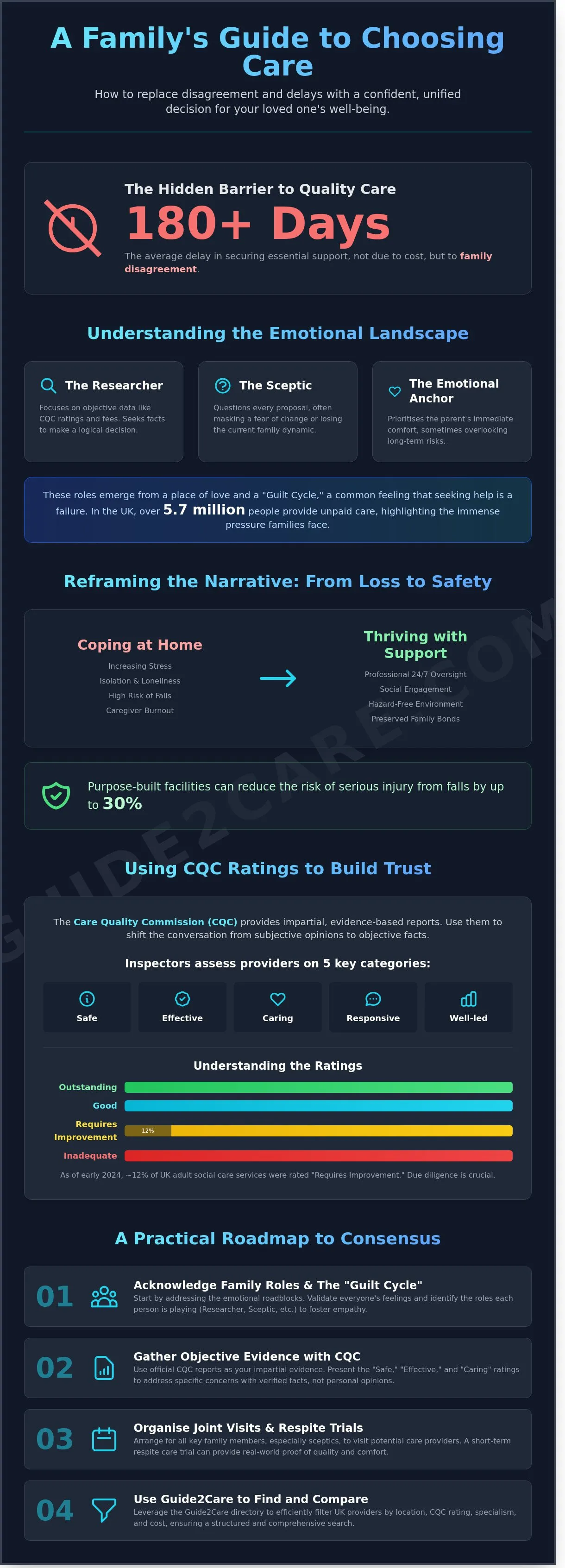
What if the primary barrier to securing high-quality support isn't the cost, but a lack of family consensus? Disagreements between siblings often stall the process, and sector data indicates these delays can postpone essential support by over 180 days. You likely feel the weight of this responsibility and the guilt that comes with suggesting professional care. Learning how to reassure family about care choice is essential to move forward and ensure your loved one receives help without causing lasting domestic friction.
This guide teaches you how to use Care Quality Commission (CQC) ratings and transparent financial data to build confidence across the family. We'll provide a practical roadmap to help you evaluate providers, resolve common tensions, and ensure everyone feels secure in the final decision. You'll find the information needed to replace uncertainty with a structured plan that prioritises safety and quality of life. Explore the steps to reach a consensus that puts your relative's wellbeing first.
Key Takeaways
- Identify specific family roles and address the "guilt cycle" to navigate emotional roadblocks during the transition to professional care.
- Utilise Care Quality Commission (CQC) ratings as impartial evidence to learn how to reassure family about care choice.
- Apply proven communication strategies to manage differing opinions between primary carers and distant relatives effectively.
- Organise joint visits and respite care trials to gather real-world evidence of quality before making a final commitment.
- Use the Guide2Care directory to filter UK providers by location, type, and specialism for a more efficient and structured search.
Understanding the Emotional Landscape of Care Decisions
Deciding on professional care often triggers a "Guilt Cycle" within British families. This cycle stems from a deep-seated sense of duty and the cultural expectation that family members should provide all necessary support themselves. Many relatives feel that moving a parent to a residential home or hiring domiciliary care is a failure of their personal responsibility. According to 2023 data from Carers UK, over 5.7 million people in the United Kingdom provide unpaid care, often at the expense of their own mental and physical health. Understanding how to reassure family about care choice starts with acknowledging that these feelings of guilt are common but often based on unrealistic expectations of what one person can manage. It's crucial to then explore the various professional support options available, understanding that different family members will approach this transition from their own emotional and practical standpoints.
Family members usually adopt specific roles during these discussions. The "researcher" focuses on objective data, such as Care Quality Commission (CQC) ratings and weekly fee structures, which often range from £800 to over £1,500 for residential care. The "sceptic" questions every proposal, usually because they fear losing the current family dynamic. Finally, the "emotional anchor" prioritises the parent's immediate comfort, sometimes overlooking the escalating risks of remaining at home without help. Recognising these roles helps in understanding the social care system and how it can be tailored to meet the specific anxieties of each relative.
Resistance to care is rarely about the quality of the provider. It's typically a mask for a fear of loss or a sense of personal inadequacy. You aren't abandoning a duty; you're organising a higher level of support. Professional care ensures that a loved one receives assistance from trained staff who manage medication, nutrition, and mobility 24 hours a day. It's a strategic decision to move from "coping" to "thriving." Learning how to reassure family about care choice involves showing that professional intervention preserves the family bond by removing the stress of full-time caregiving tasks.
The Psychology of Family Resistance
Siblings often disagree on care needs because their individual relationships with the parent vary significantly. A child who visits once a month might only see the parent on their "best" day, while the local sibling manages the daily reality of confusion or falls. Geographical distance creates a perception gap that fuels conflict. Furthermore, the "martyr complex" within a family unit can be destructive. One relative may insist they can cope alone, even when providing 50 or more hours of care per week, which leads to burnout and increases the risk of care errors.
Reframing the Narrative: From Loss to Safety
Change the focus of the conversation from "moving out" to "moving toward better support." Professional environments provide social engagement and safety features that standard homes lack. For example, purpose-built care facilities include level-access flooring and 24-hour emergency call systems that can reduce the risk of serious injury from falls by 30 percent. These features allow the parent to maintain independence in a controlled environment rather than facing isolation at home.
The "Safety First" approach focuses on securing professional clinical oversight and hazard-free living environments to preserve a loved one's independence for as long as possible.
Using Objective Benchmarks to Provide Reassurance
Data reduces emotional conflict during the decision-making process. Relying on objective benchmarks shifts the conversation from personal opinions to verified facts. The Care Quality Commission (CQC) serves as the independent regulator of health and social care in England, but this principle of seeking accredited, professional services applies to all major family health decisions. From elder care providers to specialist clinics like Scan Baby Ltd, presenting external evaluations removes the burden of being the sole decision-maker and relies on professional standards to validate your choice.
Decoding CQC Reports for the Family
CQC inspectors assess every provider based on five specific categories. These are: Safe, Effective, Caring, Responsive, and Well-led. A rating of "Good" or "Outstanding" indicates that the provider meets or exceeds national standards. If a family member expresses concern about safety, point directly to the "Safe" rating in the latest report. As of early 2024, approximately 12% of adult social care services in England were rated as "Requires Improvement." If your chosen provider has this rating, don't dismiss it. Instead, check the report date. A report from 18 months ago may not reflect recent staff changes or new management. Reviewing these details is how to reassure family about care choice by proving you've done the due diligence. You can also refer to the official NHS Choice Framework to understand the legal rights and standards patients should expect when choosing services.
Combine official reports with social proof to build a complete picture. Use third-party review platforms where a score of 9.4 out of 10 based on 45 verified reviews offers significant reassurance. Compare your chosen provider against local averages. In the South East of England, the average cost for a residential home is approximately £1,200 per week, while the North East average sits closer to £800. Demonstrating that a provider offers "Outstanding" care at a rate consistent with local averages proves both value and quality. This transparency is a vital part of how to reassure family about care choice.
Financial Clarity as a Reassurance Tool
Financial uncertainty often fuels family anxiety. Break down the costs of care into clear, manageable figures to remove this stress. Staying at home often involves hidden costs, such as property maintenance, rising energy bills, and private home help. Residential care fees usually consolidate these into a single weekly amount. Explain the difference between Local Authority funding and self-funding clearly. Currently, the capital threshold in England is £23,250. If your loved one has assets above this, they'll likely be self-funding. Providing a clear roadmap of how long funds will last prevents future shocks.
Use this checklist to ensure financial transparency when talking to providers:
- Does the weekly fee include laundry and basic toiletries?
- Is there a fixed annual percentage increase for fees?
- What is the notice period required if care needs change?
- Is a deposit or "community fee" required before moving in?
Presenting these figures alongside quality ratings creates a logical argument for your choice. Use Guide2Care’s search tool to compare local provider ratings and costs side-by-side to find the most suitable option for your family.
Navigating Family Dynamics and Differing Opinions
Family disagreements often stem from differing levels of involvement in daily care routines. The primary carer, who frequently provides more than 35 hours of unpaid support per week according to Carers UK 2023 data, usually has the most realistic view of a loved one's decline. To understand how to reassure family about care choice, you must shift the conversation from emotional preferences to objective requirements. Present your findings using Care Quality Commission (CQC) ratings and specific incident logs. If a loved one has fallen three times in the last 30 days, these statistics provide a factual basis for change that's hard to dispute.
Primary carers should avoid acting as the sole decision-maker. Instead, act as the lead researcher. Share a folder containing brochures, fee structures, and inspection reports with all siblings. By providing the same data to everyone, you reduce the feeling that you're "dictating" the outcome. This transparency is a vital step in how to reassure family about care choice while maintaining healthy relationships. It allows others to reach the same logical conclusion at their own pace.
Siblings living far away often struggle with "guilt-induced denial." They might see their parent during a "window" visit where the parent appears high-functioning for a short duration. Address this by inviting them to join a GP appointment via video call or sharing a weekly log of care needs. When they see the frequency of required interventions, such as help with medication or hygiene, the necessity of professional care becomes clearer. Stick to the facts of daily living rather than emotional appeals.
Legal frameworks provide a helpful boundary for these discussions. The Mental Capacity Act 2005 dictates that every adult has the right to make their own decisions unless it's proven they lack the capacity to do so. If your loved one still has capacity, their voice is the most important. You can refer to the NHS patient choice guidance to understand how rights and preferences should be respected within the healthcare system. Decisions must always be made in the "best interests" of the individual, not the convenience of the family.
The Family Meeting: A Structured Approach
Don't hold important discussions during emotional events like Sunday lunch. Schedule a formal meeting with a clear agenda. Start by listing the loved one's current needs based on a recent Care Act 2014 assessment. Use active listening; repeat back what a sibling says to confirm you've understood their concern. Document every agreed-upon next step in a shared email or digital document. This prevents "circular arguments" where the same issues are debated every month without progress.
Resolving Deadlocks with Professional Mediation
If the family hits a stalemate, bring in an impartial third party. A GP, social worker, or independent care consultant can provide an objective perspective that family members cannot. These professionals focus on clinical and safety requirements rather than family history. They help break emotional deadlocks by refocusing the group on the loved one's safety. Use Guide2Care resources to find local advocacy services or consultants who specialise in care transitions. An external expert often provides the "permission" family members need to let go of their guilt and accept professional support.
Practical Steps to Build Family Consensus
Building agreement requires a structured approach. Start by organising joint visits to at least three shortlisted care homes or domiciliary care agencies. Physical presence allows family members to observe daily operations directly. Schedule these visits during active hours, such as 10:00 AM or lunch service, to see staff interaction levels. When everyone sees the same environment, it reduces conflicting interpretations of care quality and safety. It's much easier to reach a decision when everyone has viewed the same facilities and met the same care managers.
When relatives need to travel for these joint visits, finding a comfortable base and reliable transport can make the process less stressful. A welcoming establishment like The Corner House Hotel can provide a place to stay, while a professional car service can simplify visiting multiple locations. This allows the family to focus on the important decisions at hand; you can find out more about how these services work, which can be helpful even as an example for finding support in your local area.
Create a shared "Care Comparison" document using a digital spreadsheet or a shared folder. This tool acts as a central repository for notes, CQC inspection reports, and fee structures. Include a column for the weekly cost; in the UK, residential care currently averages between £800 and £1,500 per week depending on the region. Documenting these facts helps the group focus on objective data rather than emotional reactions. This method is a key part of how to reassure family about care choice because it moves the discussion from opinion to evidence. Providing a clear roadmap for the decision-making process is the most effective way to manage how to reassure family about care choice when tensions are high.
Establish a formal transition period. Agree on a 28-day review cycle where the family meets to discuss the placement. During this time, set up weekly check-ins with the care manager. Use these meetings to address specific concerns about medication, social integration, or dietary needs. A structured review process ensures that no single family member feels solely responsible if the initial choice requires adjustment. This collective responsibility reduces individual guilt and promotes a unified front.
The Power of the Trial Stay
A 14-day trial stay provides real-world evidence of a home's quality. Families should monitor staff responsiveness and the resident's physical appearance during this period. Observe the "vibe" by watching how staff speak to residents in communal areas. A positive culture is evident when staff use preferred names and engage in meaningful conversation. These observations offer more reassurance than any brochure can provide; they prove that the care matches the promise.
Creating a Shared Care Checklist
Use a standardised checklist to rate each provider. Include metrics like a 1:6 staff-to-resident ratio and the variety of the 7-day social calendar. Ask to see the menu to ensure it meets nutritional standards. Rating features on a scale of 1 to 5 allows the family to calculate an objective score for each home. Shared data reduces individual responsibility for the "wrong" choice by making the final decision a collective, data-driven conclusion.
Moving Forward: Confidence Through Guide2Care
Choosing a care provider is a significant commitment that often triggers family debates. You can reduce this friction by presenting objective data. Guide2Care organises UK providers into clear categories based on their specific service types and locations. This structured approach helps you explain how to reassure family about care choice by showing them verified options rather than opinions.
Transparency builds trust. When family members see a shortlist of providers that meet specific safety and quality benchmarks, their anxiety decreases. Guide2Care acts as a central hub for this information. It provides access to Care Quality Commission (CQC) standards and funding guides, ensuring every relative understands the regulatory and financial framework behind your decision. This clarity is essential for long-term family consensus.
Leveraging the Guide2Care Directory
The directory allows you to filter results by CQC rating, which is the most reliable indicator of care quality in England. Currently, the CQC uses four ratings: Outstanding, Good, Requires Improvement, and Inadequate. Selecting a provider with a "Good" or "Outstanding" rating provides immediate peace of mind. Use the "Find Care Near Me" tool to locate facilities within a specific postcode or town. This ensures the chosen home is accessible for regular family visits, which is vital for resident wellbeing. You can Find care homes in UK that offer the exact level of support required, whether that is 24-hour nursing care or low-level residential assistance.
The search tool also distinguishes between various specialisms. If a relative has dementia, you can filter for providers with specialist units equipped for complex needs. This precision prevents the common mistake of placing a loved one in a setting that cannot meet their clinical requirements. By using these filters, you present your family with a tailored solution backed by sector-specific data rather than guesswork.
Your Next Steps for a Peaceful Transition
Transitioning into care requires a structured plan to maintain family harmony. Before you sign any care agreement, complete a final checklist. Confirm the weekly fees and understand what is included in the base price. In England, for the 2024/25 period, the upper capital limit for local authority funding remains £23,250. If your relative's assets exceed this, they will be self-funding. Clear financial planning prevents future disputes about costs and ensures everyone is on the same page.
- Review the Care Plan: Ensure it includes personal preferences and social history.
- Schedule Regular Visits: Set a rota so the family remains involved after the move.
- Monitor Progress: Use the first 28 days to assess how well the provider meets the agreed goals.
- Maintain Open Lines: Hold a brief family meeting once a month to discuss any concerns or updates.
A successful move depends on ongoing involvement. The transition isn't over once the contract is signed; it's a continuous process of monitoring and adjustment. Use our resources to stay informed about changes in care standards and funding rules. Explore our directory to find the right care for your family and take the first step toward a secure, well-managed future.
Secure Your Family's Future With Informed Care Decisions
Choosing the right support requires a balance of clear communication and objective evidence. You'll find that understanding how to reassure family about care choice becomes simpler when you rely on Care Quality Commission (CQC) ratings and structured funding guides. Use impartial data to compare the 15,000+ registered care providers across the UK. This approach removes emotional bias and focuses on the high standards of safety and effectiveness your loved ones deserve. Making decisions based on the 2024 UK care regulations ensures long-term financial stability for every family member involved.
Guide2Care provides the practical tools needed to navigate this transition efficiently. Access our comprehensive directory of UK-wide care providers and simplify complex funding rules with our easy-to-understand guides. Whether you're evaluating domiciliary care or residential homes, our impartial resources offer the clarity required for a confident choice. You don't have to manage these complex logistics alone; use our structured database to find local services that meet specific quality benchmarks.
Find the care your family needs today on Guide2Care
Start your search now to find the right support for your family's needs.
Frequently Asked Questions
How do I tell my siblings that Mum needs a care home?
Present objective evidence of her daily struggles to your siblings. Schedule a meeting to review a formal Care Needs Assessment conducted by the local council. These assessments provide a neutral, professional evaluation of safety risks and physical requirements. Focus on specific incidents, such as the 3 falls she had in the last 6 months. This data helps you understand how to reassure family about care choice by grounding the decision in health facts rather than personal opinion.
What if my family disagrees on which care home is best?
Use a comparison matrix to evaluate homes based on Care Quality Commission (CQC) ratings. The CQC inspects and rates 100% of registered care providers in England as Outstanding, Good, Requires Improvement, or Inadequate. Compare the specific scores in categories like safety and leadership. If siblings prefer different homes, visit both locations together to review their latest inspection reports. This structured approach removes emotional bias and focuses on regulated quality standards.
Is it normal to feel guilty about choosing residential care?
It's normal to feel guilt, but remember that 34% of unpaid carers in the UK report their own health has suffered due to their role. Transitioning to residential care ensures your loved one receives 24 hour professional support that a single family member can't provide. View the move as a way to return to being a son or daughter rather than a full-time medical provider. Professional care improves safety for 90% of residents with complex needs.
How can I prove to my family that a care home is safe?
Provide your family with the home's most recent CQC report, which is a legal requirement for all UK providers. Look specifically for the "Safe" category rating. Check that the home maintains a staff to resident ratio of at least 1:5 during peak hours. You can also request data on their infection control protocols and medication management systems. Showing these documents is a practical way to reassure family about care choice through transparency and verified data.
What should I do if my loved one refuses to discuss care options?
Introduce the topic gradually before a crisis occurs. If they refuse to listen, ask their GP to explain the medical necessity of increased support during a routine appointment. Statistics show that 70% of care transitions are more successful when planned at least 6 months in advance. Focus on domiciliary care or extra care housing as intermediate steps to make the transition feel less absolute and more manageable for everyone involved.
How do we handle the cost of care as a family?
Start by requesting a financial assessment from the local council. In England, if your loved one has assets below £23,250, they may qualify for some state funding. For those above this threshold, look into Immediate Needs Annuities or Deferred Payment Agreements. Clear financial planning prevents conflict. Ensure all siblings see the breakdown of the average £800 to £1,200 weekly cost for residential care in the UK to set realistic expectations for the family budget.
Can we move our loved one if the care choice doesn’t work out?
You have the right to move your loved one if the service fails to meet agreed standards. Most UK care home contracts include a 28 day notice period for termination. Review the Terms and Conditions document signed at admission to confirm specific exit clauses. If a home receives a Notice of Proposal from the CQC to cancel its registration, you should begin searching for a new provider immediately to ensure continuity of care and safety.
How often should the family meet to discuss care progress?
Hold a family meeting every 12 weeks to review the care plan. Most care homes are required to update care records every 90 days or whenever health needs change. Use these intervals to discuss any adjustments in medication, mobility, or social engagement. Consistent communication prevents misunderstandings and ensures everyone remains informed about the quality of care. Regular updates help maintain the consensus reached during the initial placement process and keep the focus on wellbeing.