Dealing with Family Disagreements About Elderly Care: A Practical UK Guide

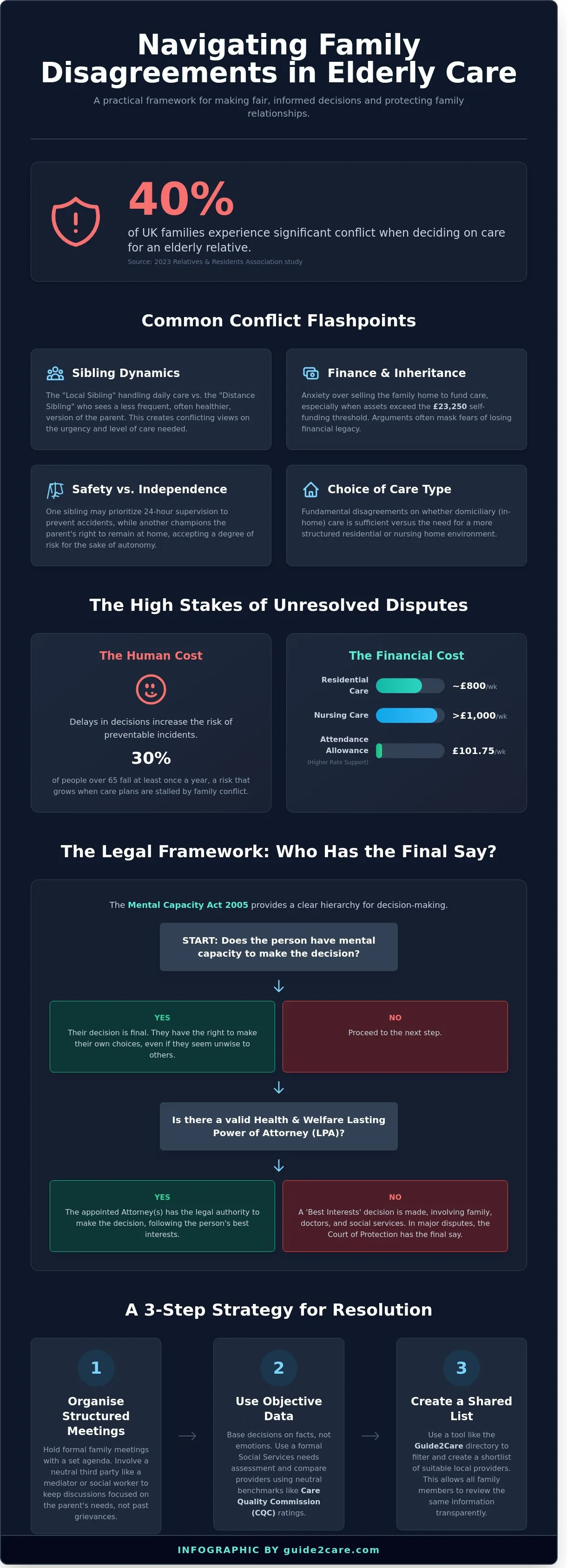
A 2023 study by the Relatives & Residents Association found that nearly 40% of UK families experience significant conflict when deciding on care for an elderly relative. Disagreements often arise from differing views on local authority funding or the choice between domiciliary care and residential homes. You likely feel that making the right choice is difficult when sibling rivalries resurface or when legal confusion creates tension. Dealing with family disagreements about elderly care requires a structured approach to ensure your loved one's needs remain the central focus.
This guide provides a practical framework to resolve these disputes while protecting family relationships. You'll learn how to navigate UK legal rights, including the specific authority granted by a Lasting Power of Attorney (LPA). We also explain how to access financial support such as the £101.75 weekly higher rate of Attendance Allowance. We provide a neutral comparison of care options and a step-by-step method for making fair, informed decisions that satisfy all parties involved.
Key Takeaways
- Understand the UK legal framework, including the Mental Capacity Act 2005 and the role of a Health and Welfare Lasting Power of Attorney (LPA).
- Learn practical strategies for dealing with family disagreements about elderly care by using structured meetings and objective Social Services assessments.
- Utilise neutral benchmarks such as Care Quality Commission (CQC) ratings to compare home care and residential providers without emotional bias.
- Identify common conflict flashpoints, from financial inheritance concerns to sibling dynamics, and find ways to mitigate their impact on care decisions.
- Organise your search using the Guide2Care directory to filter local providers and create a shared list for transparent family review.
Why Dealing with Family Disagreements About Elderly Care is So Challenging
Dealing with family disagreements about elderly care often resurfaces long-standing sibling rivalries and childhood roles. These disputes aren't just about the present; they're rooted in decades of family history. Conflict typically arises when one sibling takes on the majority of the daily workload while others remain at a distance. This creates a primary carer resentment that complicates practical decision-making. You're not just choosing a care home; you're managing years of emotional baggage.
Common flashpoints include the balance between a parent’s safety and their independence. One sibling might prioritise 24-hour supervision while another advocates for the parent’s right to stay at home, regardless of the risks. Financial concerns also dominate. The average cost of residential care in the UK currently sits at approximately £800 per week, rising to over £1,000 for nursing care. These figures often trigger anxiety regarding the sale of the family home and the eventual inheritance.
To better understand this concept, watch this helpful video:
Recognising the Root Causes of Conflict
The "Distance Sibling" versus "Local Sibling" dynamic is a frequent source of tension. A 2023 report by Carers UK found that 4.6 million people provide unpaid care, often leading to significant burnout. The local sibling sees the daily decline, such as missed meals or poor hygiene. The distance sibling might only see the parent during a pre-arranged visit where the parent "rallies" and appears healthy. This discrepancy creates conflicting urgency levels. Decisions are delayed because the family can't agree on the severity of the situation.
The immense stress and burnout associated with caregiving can sometimes lead to other health issues, including dependency on alcohol or medication as a coping mechanism. It's important for families to recognise when professional help is needed for these related problems. For those seeking support with addiction, consultation services such as Detox Rehab Clinics UK offer free, independent advice on treatment options.
This dynamic is especially challenging when the 'distance sibling' lives abroad, adding international logistics to an already stressful situation. For families navigating such cross-border complexities, it's useful to understand the resources available for expats. For example, if a sibling is based in Spain and needs to understand their legal standing, they might discover Where Can I Live as a starting point for clarifying the practicalities of living overseas.
Financial anxiety regarding the sale of a family home is another major hurdle. In the UK, if an individual has assets above £23,250, they're generally required to self-fund their care. This reality often leads to disagreements about when to start professional care services. Siblings might argue over whether to use domiciliary care or move straight to a residential setting. These arguments often mask a deeper fear of losing the family's financial legacy or the emotional anchor of the childhood home.
The Impact of Unresolved Disputes on Care Quality
Unresolved arguments have direct consequences for the elderly person’s health. Delays in decision-making increase the risk of preventable incidents. Public Health England data indicates that 30% of people over 65 fall at least once a year. If a family cannot agree on home modifications or a move to supported living, the risk of hospitalisation grows. The elderly person often feels caught in the middle. They may hide their symptoms or needs to avoid triggering further family arguments, which only worsens their condition.
A structured approach is necessary to prevent long-term family estrangement. Using a formal family mediation process can provide a neutral ground for these discussions. It's vital to keep the elderly person's wishes at the centre. If they've already documented their preferences in a Lasting Power of Attorney (LPA), use that as the definitive guide. Without a clear focus on the parent's expressed needs, family meetings often devolve into personal attacks rather than solution-based planning. Focus on facts, costs, and medical advice to keep the conversation objective.
The UK Legal Framework: Who Actually Has the Final Say?
The Mental Capacity Act 2005 (MCA) governs all care decisions in England and Wales. It provides a clear structure for making decisions on behalf of adults who lack the mental capacity to do so themselves. This legal framework is the primary tool for dealing with family disagreements about elderly care. It prioritises the individual's previous wishes and current welfare over the opinions of relatives. Without a legal document in place, family members don't have an automatic right to choose a parent’s care home or medical treatment.
When disputes arise, the local authority or NHS trust often steps in to mediate. They follow the five core principles of the MCA, starting with the presumption of capacity. Every adult has the right to make their own decisions unless it's proven otherwise. If a person cannot make a specific decision, any action taken must be the least restrictive option possible. This legal clarity helps resolve conflicts by focusing on statutory requirements rather than emotional preferences.
Understanding Lasting Power of Attorney (LPA)
A Lasting Power of Attorney (LPA) is a legal document where an individual appoints 'attorneys' to manage their affairs. There are two distinct types. A Property and Financial Affairs LPA handles bank accounts and property sales. A Health and Welfare LPA covers daily care, medical treatments, and life-sustaining decisions. The Health and Welfare LPA only becomes active once a doctor confirms the individual has lost mental capacity.
- Joint appointments: Attorneys must agree unanimously on every decision. This can lead to stalemates if siblings disagree.
- Joint and several appointments: Attorneys can make decisions together or independently. This offers more flexibility but requires high levels of trust.
- Activation: You must register the LPA with the Office of the Public Guardian (OPG), which currently takes up to 20 weeks.
If no LPA exists, families must apply to the Court of Protection for a 'deputyship'. This is a slower and more expensive route. The court charges a £408 application fee for each type of deputy. If you need to search for local providers that accept residents under local authority management, legal status will be the first thing they check.
When Capacity is in Question: The Assessment Process
Mental capacity is decision-specific. A person might have the capacity to choose their daily meals but lack the capacity to decide on complex 24 hour residential care. You can arrange a formal assessment through a GP, social worker, or a private psychiatrist. The assessor uses a two-stage test to determine if a person has an impairment of the mind and if that impairment prevents them from making a specific decision at that time.
Families cannot simply take over a parent's life because they disagree with their choices. The law protects the right to make "unwise decisions" as long as the person understands the consequences. If an assessment confirms a lack of capacity, the authorities will hold a Best Interests meeting. Attendees typically include the lead clinician, a social worker, and family members. If no family is available, an Independent Mental Capacity Advocate (IMCA) represents the individual.
Best Interests is the legal standard used by UK authorities to ensure any action taken on behalf of someone lacking capacity is the least restrictive option and aligns with their known values.
Objective Comparison: Home Care vs Residential Care in the UK
Deciding between home care and a residential facility requires a data-led approach. This helps in dealing with family disagreements about elderly care by replacing emotional arguments with factual comparisons. Use the Care Quality Commission (CQC) ratings as your primary benchmark for quality. The CQC inspects providers across five categories: safety, effectiveness, care, responsiveness, and leadership. A provider with an "Outstanding" or "Good" rating offers a factual basis for selection, moving the conversation away from personal preferences or guilt. These reports are public and provide an impartial view of how a service operates day-to-day.
Costs remain a significant factor for most UK families. In England, the upper capital threshold for local authority funding is £23,250. If your relative has assets or savings above this amount, they must self-fund their care. Residential care costs currently average between £800 and £1,200 per week, while nursing care often exceeds £1,400 depending on the region. Domiciliary care is usually billed hourly, with 2024 rates typically ranging from £20 to £35 per hour. Use a care directory to filter providers by these specific criteria. Creating a shortlist of three providers allows all family members to review the same data simultaneously, ensuring everyone starts from the same page.
Evaluating Domiciliary Care Options
Domiciliary care provides a middle ground for families split between full-time residential care and no intervention. Visiting care suits those needing help with specific tasks like medication management or meal preparation. However, dementia patients often require 24-hour live-in care to ensure their safety. Live-in care costs start at approximately £1,000 per week and can rise based on the complexity of needs. This option maintains the individual's independence in a familiar environment, which often satisfies siblings who are hesitant about care homes. When reviewing a home care agency's CQC report, focus specifically on the "Well-led" and "Safe" scores. These indicators show how reliably the agency manages its staff and scheduling. If legal decisions are pending, consult NHS guidance on power of attorney to clarify who holds the legal authority to finalise these care arrangements.
To better understand the roles and responsibilities involved in this type of care, it can be helpful to see how services are structured elsewhere. For instance, you can explore Support work models to get ideas about the range of assistance available, even though the funding systems like Australia's NDIS differ from the UK.
The Benefits of Residential and Nursing Homes
Residential homes become a necessary consideration when safety risks at home increase. Data from the Office for National Statistics indicates that falls are a leading cause of emergency hospital admissions for those over 65. Care homes provide 24-hour supervision, which significantly reduces the risks associated with wandering or medication errors. These facilities also address the hidden issue of social isolation. A 2023 Age UK report found that 1.4 million older people in the UK often feel lonely. Care homes offer communal activities and peer interaction that domiciliary care cannot easily replicate. To align family expectations and resolve lingering doubts, organise a joint tour of the facility. Ask specific questions about staff-to-resident ratios and the frequency of medical reviews. Seeing the environment firsthand often resolves lingering dealing with family disagreements about elderly care by proving the level of support available.
Practical Strategies for Resolving Care Disputes
Organise a formal Family Care Meeting to address concerns systematically. Choose a neutral venue such as a hired community room or a quiet library space. Avoid the family home to reduce emotional triggers and historical baggage. Use a printed agenda to keep the discussion on track. Focus on specific needs like mobility, medication management, and nutritional requirements. Dealing with family disagreements about elderly care often requires this structured environment to prevent conversations from devolving into old arguments.
If internal discussions reach a deadlock, hire a professional eldercare mediator. These specialists provide an impartial framework for decision-making and charge between £150 and £300 per hour in the UK. They don't take sides; they facilitate a solution that prioritises the elderly person's safety. A mediator helps neutralise "power struggles" between siblings by focusing on statutory rights and clinical realities.
Propose a 28-day trial period for any disputed care arrangement. This timeframe allows all parties to evaluate the impact of a new routine without a permanent commitment. Most UK residential homes offer these short-term stays to ensure the setting is appropriate. Use this period to gather data on the individual's well-being. It provides concrete evidence to support or refute the proposed care plan, making it easier for hesitant family members to agree to a change.
Effective Communication Techniques
Use "I" statements to express your perspective without sounding accusatory. Say "I feel overwhelmed by the daily care visits" rather than "You aren't doing your fair share." This approach reduces defensiveness and keeps the focus on the care burden. Practice active listening by repeating a sibling's concerns back to them. This validates their fears even if you disagree with their conclusion. Document every agreed action in a shared digital document or a follow-up email thread. Clear records prevent "he said, she said" disputes later and ensure everyone follows the same plan.
Utilising External Assessments
Request a statutory Needs Assessment from your local council under Section 9 of the Care Act 2014. This is a free service that provides an objective, professional view of the required support level. The resulting care plan serves as an authoritative guide for the family. It removes the guesswork from the decision-making process by identifying exactly which tasks require intervention. This external validation is highly effective when dealing with family disagreements about elderly care.
These assessments also determine financial eligibility for support. For individuals with complex, primary health needs, seek an NHS Continuing Healthcare (CHC) assessment. Data from NHS England shows that over 158,000 people received CHC funding in 2022-23. A professional "Care Needs Report" from an independent nurse or occupational therapist can also act as a tie-breaker. These experts provide a clinical perspective that siblings find harder to dispute than a family member's opinion. Use these reports to build a consensus based on facts rather than emotions.
Find the information you need to make the right choice for your family.
Find The Care You NeedMoving Forward: Finding the Right Care with Guide2Care
Dealing with family disagreements about elderly care often stems from a lack of shared facts. Guide2Care acts as a central hub to resolve these disputes through objective data. You can filter the directory by specific specialisms, such as dementia care or respite services, to ensure the shortlist meets every clinical requirement. This removes the guesswork from the decision-making process.
The directory lists over 15,000 providers across the UK. Use the location filter to find options within a specific postcode. This helps siblings who live in different cities agree on a central or logical location. Reading impartial information on funding and care types before debating prevents arguments based on outdated assumptions or emotional bias.
Simplifying the Search Process
Use the platform to find CQC-rated "Good" or "Outstanding" homes within a 10-mile radius. This feature eliminates low-quality options immediately, saving time and reducing friction between family members. If budget is the main conflict, access the funding resources on the site. In England, the upper capital threshold for local authority support is currently £23,250, and knowing these figures is essential for realistic planning. Guide2Care helps families find the care they need through transparent data and clear sector terminology.
Organising your search effectively requires a collaborative approach. Create a shared list of providers from the directory for the family to review together. Instead of sending multiple links via email, focus on a single shortlist of three to five options. This structured method keeps the conversation focused on practicalities like staff-to-resident ratios and specific facility features. Dealing with family disagreements about elderly care becomes more manageable when everyone evaluates the same set of verified facts.
Once the family agrees on a shortlist, take the next step by using the contact details provided in each listing. Arrange visits to at least three different facilities. Seeing the environment and meeting the registered manager provides clarity that a website alone cannot offer. Use these visits to ask identical questions to each provider, allowing for a direct and fair comparison of services and costs.
Final Checklist for Family Agreement
Use this 5-point checklist to ensure the chosen care plan respects the parent’s dignity and safety while satisfying the family's requirements:
- Clinical Suitability: Does the provider meet the specific medical requirements identified in the latest social services care assessment?
- Geographic Access: Is the location accessible for 100% of the primary family visitors and close to existing support networks?
- Financial Viability: Do the monthly fees align with the long-term budget, including potential annual increases or available local authority funding?
- Dignity and Privacy: Does the care plan explicitly detail how the parent's personal preferences, privacy, and daily routines are maintained?
- Quality Assurance: Are the latest CQC or Care Inspectorate reports available, and do they confirm a track record of safety and leadership?
Establish a specific review date, such as six months after the care begins, to revisit the plan. Needs evolve, and a pre-set review date ensures that the family remains proactive rather than reactive. This provides peace of mind that the decision isn't permanent if circumstances change significantly.
Once a stable care plan is in place, it's also important for the family to find ways to reconnect and create positive new memories. For some, this might mean planning a special trip together to move past the period of stress. Taking a relaxing journey, such as an India Cruise, can be a wonderful way to celebrate a loved one's comfort and reaffirm family bonds in a new, positive context.
Take Action to Secure the Right Care
Dealing with family disagreements about elderly care is manageable when you focus on facts and legal structures. Use the Mental Capacity Act 2005 to identify who holds the legal right to make decisions. Compare the practical differences between domiciliary care and residential homes using objective criteria. These steps reduce emotional tension and keep the focus on the individual's needs. Guide2Care provides the tools you need to move these conversations forward with confidence.
Access our comprehensive UK-wide directory to view current Care Quality Commission (CQC) ratings and detailed inspection reports for thousands of providers. We offer expert guides that explain care funding rules and the various types of adult social care available in Britain. Having this data at your fingertips simplifies the decision-making process for everyone involved. It's the most efficient way to resolve disputes and find a solution that works for your whole family.
Find The Care You Need on Guide2Care and start making informed decisions today. You're now equipped to choose a path that provides safety and comfort for your loved one.
Frequently Asked Questions
What do I do if my sibling has Power of Attorney but is making bad care decisions?
You should report your concerns to the Office of the Public Guardian (OPG) if you believe an attorney isn't acting in the donor's best interests. The OPG received 30,831 safeguarding referrals in 2023 to investigate such reports. Use form OPG130 to provide specific evidence of financial mismanagement or neglect. If the person is in immediate danger, contact your local council’s adult safeguarding team for an urgent intervention.
Can a parent refuse care if they've been diagnosed with dementia?
A parent can refuse care if they're deemed to have mental capacity under the Mental Capacity Act 2005. Capacity is decision-specific, meaning a person might lack capacity for finances but still choose where they live. Currently, 944,000 people in the UK live with dementia, and many retain legal capacity during the early stages. If a formal assessment proves they lack capacity for a specific decision, professionals must act in their best interests.
Who pays for elderly care in the UK if the family cannot agree on a budget?
The individual requiring care is responsible for the costs if their savings and assets exceed £23,250 in England or £50,000 in Wales. Dealing with family disagreements about elderly care budget levels doesn't change statutory funding rules. If assets are below these thresholds, the local authority provides funding based on a financial assessment. Families can choose to pay a "top-up" fee if they want a more expensive care home than the council offers.
What is a "Best Interests" meeting and who should be involved?
A Best Interests meeting is a formal gathering held under Section 4 of the Mental Capacity Act 2005 to make decisions for someone who lacks capacity. Attendees typically include the social worker, relevant medical professionals, and family members or an Independent Mental Capacity Advocate (IMCA). The group must consider the person’s past wishes and beliefs. This structured process ensures the final care plan prioritises the individual's needs over family preferences.
How can I get a social worker to help resolve a family care dispute?
Contact your local authority's adult social care department to request a formal needs assessment. Under the Care Act 2014, councils have a legal duty to assess anyone who appears to need care and support. The social worker acts as an impartial professional during this process. They focus on the individual’s eligible needs, which often helps de-escalate family tension by providing an objective, evidence-based recommendation for support.
Is mediation available for families struggling with elderly care decisions in the UK?
Specialist elder mediation is available through private providers and organisations like the College of Mediators. These sessions help families reach a consensus without involving the Court of Protection. Costs for private mediation generally range from £150 to £300 per hour. It's a faster alternative to legal action, as a 2023 report indicated that mediation resolves roughly 70% of family care disputes within two sessions.
What happens if one sibling wants a care home and the other wants home care?
The final choice depends on the individual's mental capacity and the results of a local authority needs assessment. Dealing with family disagreements about elderly care often requires looking at the practicalities of each option. In 2023, average UK residential care cost £1,100 per week, while 24-hour domiciliary care often exceeded £1,500. If the person lacks capacity, the social worker decides the most cost-effective way to meet their identified safety and health needs.