Hidden Costs of Care Homes UK: A 2026 Guide to Avoiding Fee Surprises

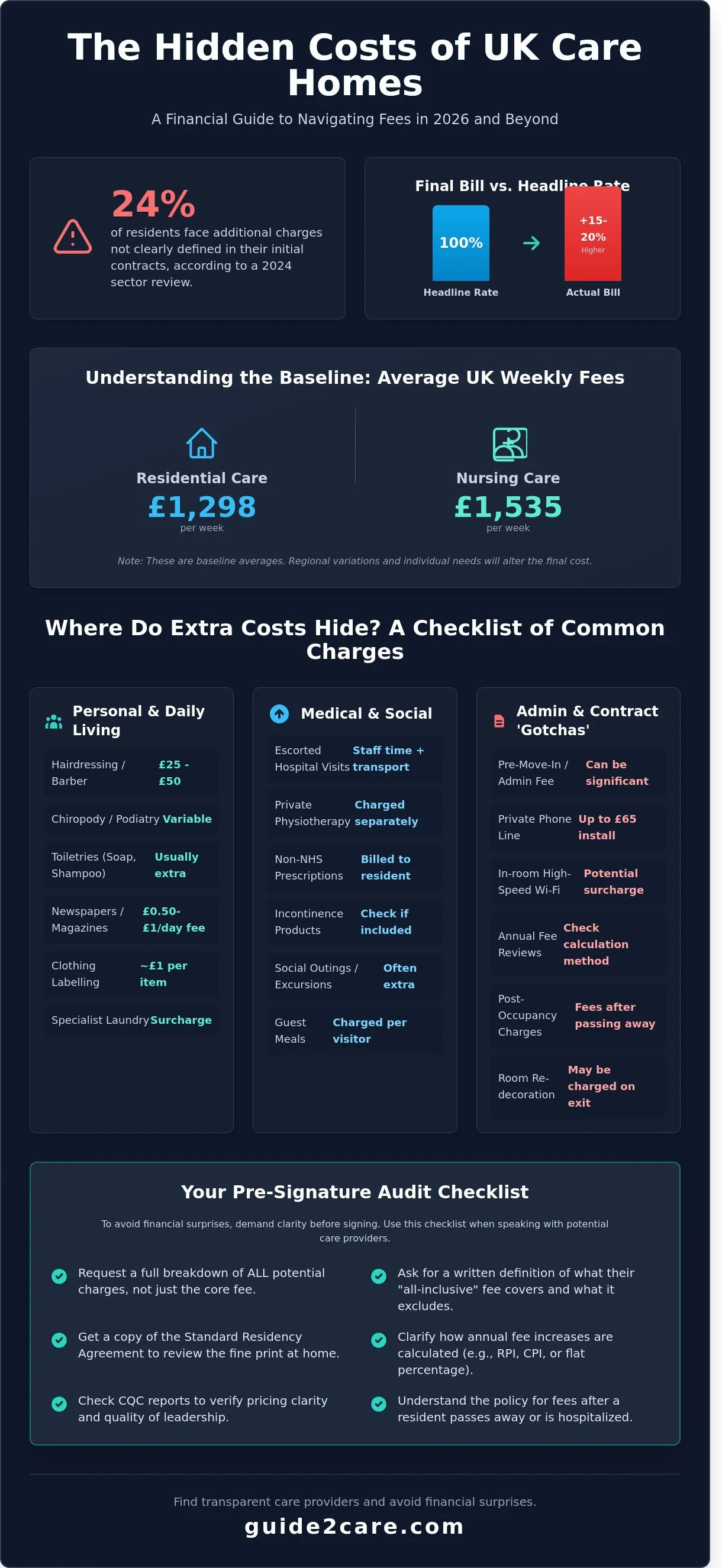
A 2024 sector review found that 24% of residents encountered additional charges not clearly defined in their initial contracts. It's frustrating to plan a long-term care budget only to find it derailed by extra charges for physiotherapy, social outings, or basic toiletries. You likely feel that a fixed weekly rate should remain predictable and transparent.
This guide identifies every potential extra charge and contractual "gotcha" to ensure your care budget remains sustainable through 2026. We'll uncover the hidden costs of care homes uk that often hide in the small print of residency agreements. By identifying these fees early, you can avoid the common top-up fee trap and manage your finances with clarity.
You'll find a comprehensive checklist of potential charges, practical tips for negotiating contracts, and a realistic framework for your 2026 financial planning. Use this information to find the care you need without financial surprises.
Key Takeaways
- Identify why headline rates often differ from the final bill due to unbundled pricing models and 2026 economic factors.
- List common non-inclusive charges for personal grooming and medical sundries to ensure your care budget remains sustainable.
- Uncover the hidden costs of care homes uk, including pre-move-in admission fees and clauses regarding payments after a resident passes.
- Audit contracts effectively by requesting a Standard Residency Agreement and checking how annual fee reviews are calculated.
- Find transparent providers using the Guide2Care directory and recent CQC reports to verify pricing clarity and leadership quality.
Understanding the Gap Between Headline Rates and the Final Bill
Identifying the hidden costs of care homes uk starts with looking past the initial quote. In the UK care sector, hidden costs refer to any charges that exceed the core residential or nursing fee. Families often focus on the headline rate when comparing providers. This figure rarely represents the total cost of occupancy. You must account for additional services that providers bill separately to maintain their profit margins.
Economic shifts in 2026 are changing how care is priced. Staff wage increases, driven by the rising National Living Wage, have forced providers to adapt. Many homes now use unbundled pricing models. This approach keeps the base rate appearing lower while charging extra for specific services. It creates a psychological trap. A home may look affordable on paper, but the final monthly bill can be 15% to 20% higher than expected. Always ask for a breakdown of every potential charge before signing a contract.
The 2026 Cost Landscape in the UK
Current data shows that average weekly fees for residential care sit at £1,298. Nursing care is more expensive, averaging £1,535 per week. These figures serve as a baseline only. Regional variations significantly affect the price of extra services. Providers in the South East often charge higher premiums for lifestyle add-ons than those in the North. Fee unbundling is the practice of separating core care from lifestyle services. This allows homes to market a competitive base price while charging for specifics like physiotherapy or social outings.
Core Fees vs. Discretionary Spending
A standard core fee typically covers your room, all meals, and 24-hour basic care. Do not assume this includes everything. Many premium 2026 care homes now use a lifestyle tier for discretionary spending. This tier covers items like hairdressing, chiropody, and even accompanied hospital visits. If a home claims to be all-inclusive, you must find a written definition of this term in the residency agreement. Without a clear list, you might find yourself paying for items you expected to be free.
- Check if incontinence products are included in the core fee.
- Verify if the home charges for transport to medical appointments.
- Ask for a price list of all personal services like laundry or newspapers.
- Confirm the cost of guest meals and visitor refreshments.
The distinction between care types also affects the final bill. If you are unsure which level of support is required, consult our Nursing Home vs Residential Care comparison guide. Understanding the hidden costs of care homes uk requires a methodical approach to reviewing the fine print. Find the care you need by demanding transparency from every provider you visit.
The 'Daily Living' Extras: Identifying Common Non-Inclusive Charges
Many residents discover that a standard weekly fee only covers the basics of room, board, and essential care. Providers categorise additional services as 'disbursements' or 'sundries' on monthly invoices. These charges accumulate quickly. Common examples include professional hairdressing, manicures, and specialised chiropody. Families frequently pay for private physiotherapy and non-NHS prescriptions. If a resident requires an escort for a hospital appointment or joins an organised external excursion, the home may charge for staff time and transport. Understanding the hidden costs of care homes uk is vital for long-term financial planning.
Personal Care and Maintenance Costs
Budgeting for personal grooming is necessary because these services are rarely inclusive. In-house hairdressing sessions are expected to cost between £25 and £50 by 2026. While high-end facilities may include toiletries, mid-range residential settings typically do not. Residents must purchase their own soap, shampoo, and dental products. Specialised laundry services for delicate items like silk or cashmere often carry a surcharge. Clothing labelling is another frequent expense. Some homes charge a flat fee or £1 per item to ensure clothes return to the correct room. Find the care you need by reviewing detailed cost breakdowns before signing a contract.
Communication and Entertainment Charges
Standard television access is usually free, but premium packages or private landline installations are not. Installation fees for a personal phone line can cost up to £65. Older buildings often have structural 'dead zones' where Wi-Fi signals are weak. Consequently, some providers charge surcharges for high-speed internet access in individual rooms. Newspaper and magazine subscriptions are another area for extra billing. Many homes add a daily delivery fee of approximately £0.50 to £1.00 on top of the publication price.
Medical and Therapy Add-ons
Supply limits often apply to medical essentials. Incontinence products are typically billed as an extra if a resident exceeds a 'standard' daily allocation. These items are often sold at a markup compared to high-street prices. Residents who prefer to remain with a GP surgery outside the home's local catchment area may face private call-out fees of over £100. NHS Continuing Healthcare (CHC) should cover these medical costs, but private settings often bill for them regardless. Identifying these hidden costs of care homes uk ensures there are no surprises in the monthly statement.
Contractual 'Gotchas': Administrative Fees and Post-Occupancy Charges
Residency agreements often contain complex clauses that significantly increase the total bill. Identifying these hidden costs of care homes uk early prevents unexpected financial strain. Most providers use standardised contracts, but the specific financial obligations vary between operators.
The Administrative and Legal Burden
Many care homes charge an 'Admission Fee' or 'Community Fee' before a resident moves in. In 2026, these non-refundable charges typically range from £1,000 to £2,500. These fees supposedly cover the cost of care assessments and room preparation. Check if the home also requires a refundable security deposit, which is often equivalent to four weeks of care. Annual fee increases are another common feature. Most contracts include 'inflation-plus' clauses, often tied to the Consumer Price Index (CPI) plus an additional 2% to 5%. This can result in a 10% total increase in costs every April. Some homes also charge a monthly management fee of £20 to £50 for maintaining a resident’s personal 'spending account' or 'comfort fund'.
End-of-Life and Departure Costs
Financial obligations do not always end when a resident leaves or passes away. Standard contracts usually require a 28-day notice period for self-funders who choose to move. You must pay the full room rate during this time, even if the bed is empty. When a resident passes away, the 'fee after death' clause takes effect. Most homes apply a three-day rule to allow families time to clear personal belongings. However, some providers charge for a full week or until the room is completely cleared and cleaned. Expect a 'deep cleaning' or 'room refurbishment' fee of £300 to £600 when vacating. Use our guide on how to find the best care homes near you to compare how different providers handle these departure terms.
Local Authority Top-up Fees
A top-up fee is required when a local authority's funding budget is lower than the home’s private rate. If a council offers £850 per week but the home charges £1,150, a £300 weekly gap exists. UK regulations generally prevent residents from paying their own top-up fees from their own capital. A third party, such as a relative or a charity, must sign a contract to cover this shortfall. These payments represent a significant portion of the hidden costs of care homes uk. These fees are risky because they often increase at a faster rate than the council's annual budget contribution. If the third party can no longer pay, the resident may be forced to move to a cheaper room or a different facility.
- Review the 'Fee After Death' clause for specific time limits.
- Ask for a written history of fee increases over the last three years.
- Confirm if admission fees are deducted from the first month's invoice.
- Check the contract for 'empty bed' discounts during hospital stays.
How to Audit a Care Home Contract Before Signing
A care home contract is a legally binding document that dictates your financial obligations for years. You must request the Standard Residency Agreement before you attend a physical tour. Reviewing this document in private allows you to spot clauses that contribute to the hidden costs of care homes uk without the pressure of a sales environment. Most providers expect a signature during the move-in process; however, you should insist on a 48-hour review period.
Pay close attention to the Fee Review clause. Most UK care homes increase their prices every April to coincide with the financial year. Check if the increase is linked to the Consumer Price Index (CPI), the Retail Price Index (RPI), or a fixed percentage. In 2023, some residents saw hikes of 10% or more. A contract that allows for "discretionary increases" is a financial risk. You should also demand a Summary of Additional Charges document. Don't sign the main agreement until you've seen a price list for services like chiropody, which often costs between £25 and £45 per session.
Guarantor clauses are another critical area for audit. These clauses often make family members personally liable for any debt if the resident's funds run out. If a contract includes this, seek legal advice or negotiate its removal. You don't want to be legally responsible for a £1,200 weekly bill if your relative's assets deplete faster than expected.
Questioning the Manager: A Script for Families
Use direct questions to pin down the manager on specifics. Ask: "Can you provide a sample invoice from last month showing all itemised extras?" This shows you exactly what current residents pay for beyond the base rate. Ask: "What specific items are excluded from the all-inclusive rate?" Many homes exclude basic toiletries or escorting residents to hospital appointments. Finally, ask: "What is the exact policy regarding fees once a room is vacated?" Following Competition and Markets Authority (CMA) guidance from 2018, fees should typically stop within three days of a resident's death.
Red Flags to Watch Out For
Avoid contracts containing vague language like "reasonable additional charges may apply." This phrasing gives the provider power to bill for anything they choose. Watch out for terms that allow the home to change fees with only 7 days' notice; standard practice requires at least 28 days. You should also verify if the fee reduces during hospital stays. Many homes continue to charge 100% of the fee for the first 14 to 21 days, even though the resident isn't consuming food or utilities. This is a major factor in the hidden costs of care homes uk that families often overlook.
Finding Transparent Care Providers with Guide2Care
Identifying transparent providers requires a structured approach. Use the Guide2Care directory to filter results by specific pricing criteria. Unlike some brokers who receive commission for referrals, this directory remains impartial. This independence helps you avoid the hidden costs of care homes uk that sometimes stem from biased recommendations. Examine the latest 2026 CQC reports for every home on your list. Focus on the 'leadership' and 'responsiveness' ratings. These sections often highlight how effectively a provider manages financial transparency and communicates fee changes to residents. A well-led home provides clear, itemised invoices and avoids unexpected surcharges.
Using Our Directory to Compare Options
Efficiency is key when comparing facilities. Use the 'Type of Care' filter to select only the services you require. This prevents you from paying for expensive nursing facilities if residential care is sufficient. Review the 'Funding' section for updated advice on the 2026 benefit thresholds. These figures determine your eligibility for state support and impact your long-term budget. Look for local providers offering 'fixed-fee' guarantees. Many homes now secure their rates for the first 12 months to provide financial certainty for families. Filtering by these criteria ensures your shortlist only contains providers who align with your financial boundaries.
Next Steps: Secure the Right Care Today
Move forward with a methodical plan. Don't rely on headline fees. Create a shortlist based on total projected costs, including potential annual increases and extra service charges. This strategy helps you identify the true hidden costs of care homes uk before you sign a contract. Organise your search by prioritising homes that offer a transparent fee structure and positive 2026 regulatory feedback.
Final Checklist: 5 things to do before paying your first care home deposit
- Request a written breakdown of all "extra" charges, such as hairdressing, chiropody, or social outings.
- Ask for the specific notice period required for fee increases and how they are calculated.
- Confirm if the home accepts local authority rates if your private funds drop below the 2026 threshold.
- Verify if the deposit is held in a protected scheme and under what specific conditions it is refundable.
- Check the 2026 CQC report for any mentions of 'leadership' concerns regarding administrative transparency.
Take Control of Your Care Planning Today
Navigating the UK care sector requires a precise approach to financial planning. You'll need to scrutinise every contract clause to avoid the hidden costs of care homes uk that often surface after admission. Recent analysis suggests that administrative fees and post-occupancy charges can add upwards of £2,500 to your total costs if they're not identified during the initial audit. Always verify which daily living extras, such as specialised therapies or social outings, are excluded from the headline rate. Auditing your agreement before signing is the most effective way to protect your capital and ensure long-term stability.
The challenges in the care sector highlight a need for greater transparency, a principle that drives success in other industries. For instance, the digital economy often thrives on clear value propositions; a retrospective on innovative business models by the eCommerce agency CDA Group shows how modern businesses build trust through clarity, a lesson the care sector could learn from.
Guide2Care simplifies this process by providing a comprehensive UK-wide directory and updated 2026 funding guidance. Our platform offers neutral and impartial advice, allowing you to compare providers based on transparency and service quality. We've organised the complex world of social care into a manageable, step-by-step resource for families across the country.
Find the Care You Need: Search Our 2026 UK Directory Now
You can find the right placement with confidence when you have the correct facts at your fingertips.
Frequently Asked Questions
What are the most common hidden costs in UK care homes?
Common hidden costs include charges for hairdressing, chiropody, toiletries, and accompanied medical appointments. A 2018 report from the Competition and Markets Authority (CMA) found these extras often add £50 to £100 per week to the base rate. Families should check contracts for "additional service" clauses to identify the hidden costs of care homes uk before signing.
Do I have to pay for a care home room after someone has died?
You usually pay for a notice period of 3 to 10 days after a resident passes away. CMA regulations prevent homes from charging for more than 10 days, or once the room is cleared and re-let. This period gives families time to collect personal belongings and allows the home to prepare the space for a new occupant.
Can a care home increase its fees without my agreement?
Care homes can increase fees annually if they provide at least 28 days’ written notice. Most contracts link these rises to the Consumer Price Index (CPI) or a fixed annual percentage, often between 5% and 8%. While you can't always block the increase, the home must justify the rise based on specific operational cost changes or inflation.
What is a 'top-up fee' and who is responsible for paying it?
A top-up fee is the gap between the local authority's funding limit and the care home's actual weekly price. A third party, such as a relative or charity, must pay this fee directly to the council or the home. Residents can't pay their own top-up fee unless they're using a 12-week property disregard or a deferred payment agreement.
Is hairdressing and chiropody usually included in care home fees?
Hairdressing and chiropody are almost never included in the standard weekly residential fee. Residents typically pay between £15 and £45 per session for these visiting professionals. It's important to ask for a price list of "lifestyle extras" to understand how these routine services impact your monthly budget.
Do I pay the full fee if my relative is in hospital?
Most care homes charge between 80% and 100% of the full fee while a resident is in hospital to keep the room available. This "bed-holding fee" covers the home's fixed costs like staff wages and building maintenance. Some contracts offer a 20% discount after the resident has been in hospital for more than 7 consecutive days.
Are there extra charges for residents with dementia?
Dementia care often costs £150 to £300 more per week than standard residential care due to higher staffing ratios. These fees cover the cost of 24-hour monitoring and staff trained in specialist techniques like the Butterfly Model or MAPA. You'll find these costs are usually higher in purpose-built dementia wings compared to general residential floors.
How can I avoid unexpected care home charges?
You can avoid surprises by requesting a written breakdown of every service covered by the core fee before admission. Study the contract for "uplift clauses" and use the CMA's 2018 guidance to challenge any vague terms. Knowing the hidden costs of care homes uk helps you plan for the 4% to 7% annual fee increases common in the sector.