Care Home Contracts: What to Look Out For (2026 UK Checklist)
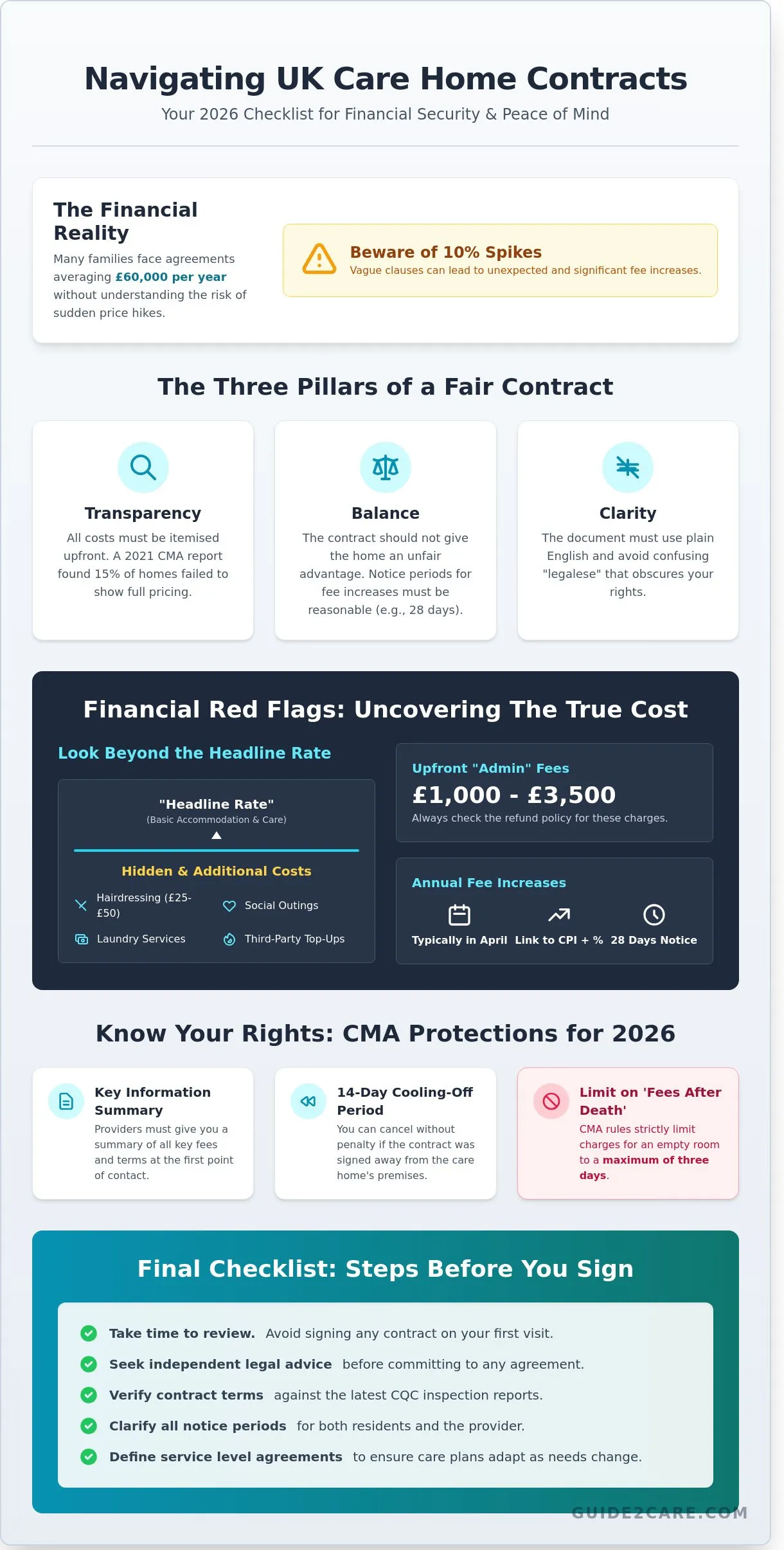
Would you sign a financial agreement worth £60,000 per year without knowing if the price could spike by 10% next month? For many UK families, this is the reality of entering a residential facility. Understanding care home contracts what to look out for is essential to avoid unexpected costs and legal pitfalls. It's common to feel pressured to sign quickly during an emotional transition. However, the small print often contains clauses that affect your long-term financial stability.
You likely feel overwhelmed by complex jargon and the fear of hidden top-up fees or guarantor responsibilities. We've designed this 2026 checklist to help you find the care you need with total transparency. This guide provides a clear list of terms to verify. It ensures you can negotiate fair notice periods and prevent unfair evictions. We'll examine fee increase structures and termination clauses to give you the confidence to secure a predictable future for your loved one.
Key Takeaways
- Identify hidden costs beyond the headline rate to ensure total weekly fees remain transparent and manageable.
- Learn about care home contracts what to look out for to protect your consumer rights under Competition and Markets Authority (CMA) regulations.
- Define service level agreements to ensure care plans are regularly reviewed and adapt as health needs change.
- Clarify notice periods for both residents and providers to avoid unexpected fees or sudden requests to leave.
- Verify contract terms against the latest CQC inspection reports at least seven days before signing any agreement.
Understanding Your Care Home Contract: The Legal Basics
A care home contract is a legally binding consumer agreement between a provider and a resident. It dictates your rights, the provider's duties, and the financial terms of your stay. Understanding care home contracts what to look out for is the first step in securing a safe placement. The UK care home system is regulated by the Care Quality Commission, but the financial terms of your residency are governed primarily by the Consumer Rights Act 2015. Find The Care You Need by reviewing every clause before committing funds.
To better understand the complexities of these legal documents, watch this helpful video regarding contract expectations:
Avoid signing any contract on the day of your first visit. Providers must give you sufficient time to seek independent legal advice. Under the Consumer Contracts Regulations 2013, you typically have a 14-day cooling-off period if the contract was signed away from the care home's business premises. This protection allows you to cancel the agreement without penalty if you change your mind. Explore Guide2Care resources to compare providers before making a final decision.
Contract variations exist depending on the level of support required. Residential contracts focus on accommodation and personal care. Nursing contracts include clinical care requirements and often involve complex fee structures. These differences are essential when evaluating care home contracts what to look out for during your search. Nursing homes may also involve NHS-funded nursing care (FNC) payments, which should be clearly deducted from your total weekly bill.
The Three Pillars of a Fair Contract
- Transparency: All costs must be itemised. A 2021 Competition and Markets Authority (CMA) report found that 15% of homes failed to show full pricing upfront. Ensure your contract lists every potential charge.
- Balance: The contract should not give the home an unfair advantage. For instance, notice periods for fee increases must be reasonable, typically 28 days.
- Clarity: The document must use plain English. Avoid "legalese" that obscures the provider's liability or your rights as a resident.
CMA Guidance and Your Rights in 2026
The CMA updated its consumer protection guidance for 2026 to enhance resident security. Providers must now provide a "Key Information" summary page at the first point of contact. This summary must include the weekly fee, deposit amounts, and any "hidden" charges like laundry or hairdressing. If a term is found "unfair" under the 2015 Act, it's not legally enforceable. Furthermore, CMA rules now strictly limit "fees after death" to a maximum of three days, preventing homes from charging families for empty rooms for extended periods.
Financial Red Flags: Fees, Increases, and Hidden Costs
Understanding care home contracts what to look out for starts with the pricing structure. The "Headline Rate" quoted in brochures is often just a starting point. It typically covers basic accommodation and standard care. It doesn't always include essential extras. You must verify if laundry, hairdressing, and social outings are part of the base price. In 2026, a single hairdressing appointment in a UK care home costs between £25 and £50. These small charges accumulate quickly. Ask for a written list of "additional service" prices before signing.
Third-party top-ups are another area of concern. These occur when a local authority pays for care but the home's private rate is higher. A family member or friend must pay the difference. The resident cannot pay this themselves from their own income or savings unless specific "12-week property disregard" rules apply. Ensure the contract defines exactly how this top-up is calculated and what happens if the payer's circumstances change.
Upfront payments are standard in the UK market. You'll likely see "community fees" or "admin charges" ranging from £1,000 to £3,500. Check the refund policy for these payments. If the resident leaves within the first 30 days, a significant portion should be returned. You can compare local care fees to see if these administrative charges align with regional averages.
Annual Fee Reviews and Inflation Clauses
Contracts must state how and when fees increase. Most homes review prices annually in April to align with the new tax year. Look for "fixed" increase formulas rather than "discretionary" ones. A fair contract links increases to the Consumer Price Index (CPI) plus a small, defined percentage. In 2026, the industry standard for notice periods regarding price hikes is 28 days. The UK Government Consumer Rights for Care Homes guidance states that terms allowing for arbitrary increases are likely unfair and unenforceable. Ensure any cap on increases is clearly documented, usually between 5% and 8% per year.
The Guarantor Trap: Who is Liable?
A financial guarantor takes on legal responsibility for the resident's fees if they can't pay. This role carries heavy risk. If the resident's private funds drop below the £23,250 threshold, the local authority should step in. However, the guarantor might still be held liable for a "top-up" to maintain the higher private room rate. Don't sign a blank-cheque agreement. Insist on a liability cap. This limits the guarantor's total exposure to a specific monetary amount or a fixed period of three to six months. Always check if the contract allows the guarantor to withdraw from the agreement with a notice period of 28 days.
Defining the Standard of Care: Service Level Agreements
Every care home contract must detail the individual Care Plan. This document is the foundation of the service provided. When reviewing care home contracts what to look out for, ensure the agreement mandates a review of this plan at least every 28 to 31 days. These reviews track health changes and ensure the level of support remains appropriate. If the resident’s needs change significantly, such as a progression in dementia, the contract should outline a clear reassessment process. Beware of vague clauses that allow the home to increase fees instantly without a formal, documented change in the Care Plan.
Staffing ratios are a critical part of the service level. While UK law doesn't set a universal fixed ratio, the Care Quality Commission (CQC) requires "safe staffing" levels. Check if the contract specifies minimum staff numbers for day and night shifts. If the wording is too broad, ask for a written addendum. You should also confirm the length of the trial period. A standard trial period is 28 days. This should include a "no-fault" exit clause, allowing either party to terminate the agreement with one week's notice if the home isn't a suitable fit.
Accommodation and Room Specification
Most care home contracts what to look out for grant a "licence to occupy" rather than a formal tenancy. This often gives the home the right to move a resident to a different room for operational reasons. Ensure the contract limits this right to essential circumstances, such as medical necessity. Clarify who is responsible for personal items. If you bring a favourite armchair, the home is usually responsible for its basic maintenance, but you may need to provide a fire safety certificate. Access to communal gardens and activity centres should be guaranteed as part of the standard weekly fee.
Health and Behaviour Management
Medical support terms vary between providers. Check if the home includes transport to GP or hospital appointments in the base price. Some providers charge an additional escort fee, often ranging from £20 to £45 per hour. The contract must also define policies on "challenging behaviour." It should outline a clear escalation process and a minimum 28-day notice period before asking a resident to leave due to behavioural changes. Finally, ensure the contract explicitly requires the home to involve family members or legal deputies in all significant care decisions and health emergencies, a process often streamlined by dedicated operational support services like Contesto that manage out-of-hours communications.
Ending the Agreement: Notice Periods and Termination Clauses
When reviewing care home contracts what to look out for, the exit terms are as vital as the entry requirements. Most standard agreements require a resident to provide 28 days' written notice to terminate the contract. If a resident moves out before this period expires, they're usually liable for the fees until the notice ends. Check if the contract includes a clause to reduce these charges if the room is re-let to a new resident within that 24-day or 28-day window. You should also verify that any pre-paid fees are refundable. Under current UK regulations, providers must return balance payments within 28 days of the contract ending.
The "Fees After Death" clause is a critical 2026 regulatory focus for the Competition and Markets Authority (CMA). Fair contracts now limit fee charges to a maximum of 3 days following a resident's death, or until the room is cleared of possessions. Contracts that demand 7 or 14 days of fees post-death are often deemed unfair and unenforceable. Ensure your agreement clearly defines these limits to avoid unexpected costs during a difficult time.
Termination by the Care Home
Care homes can't simply evict residents without valid, documented reasons. Legitimate grounds for a home to terminate an agreement include an inability to meet the resident's evolving care needs or a persistent failure to pay agreed fees. The provider must give at least 28 days' notice in writing. For emergency moves involving immediate safety risks, the contract must specify the exact protocols and the involvement of local authorities. You maintain the right to appeal any termination notice through the home's management or the local commissioning group.
Complaints and Dispute Resolution
Every provider registered with the Care Quality Commission (CQC) must maintain a clear, accessible internal complaints procedure. If an issue regarding the contract remains unresolved, you can escalate the matter to the Local Government and Social Care Ombudsman. This service is free and provides independent adjudication. Modern 2026 standards also provide strict protections against "retaliatory evictions." This ensures that a care home cannot issue a notice to leave because a resident or their family made a formal complaint about the service. To protect your rights, find the care you need by comparing providers with transparent dispute policies.
The importance of a formal management structure for upholding resident rights is a universal principle in community living. While the context is different, the role of a professional management body, such as the Shepherd HomeOwners' Association, demonstrates how structured oversight can ensure contracts are honoured and disputes are handled fairly.
Final Checklist: Steps to Take Before You Sign
Before signing any agreement, secure a hard copy of the document at least 7 days before the planned move-in date. This window allows for a thorough legal and financial review without the pressure of an immediate relocation. Use this time to cross-reference the contract terms against the most recent Care Quality Commission (CQC) inspection report. If a 2025 report highlights issues with evening staffing levels but the contract guarantees "24-hour specialist care," ask for clarification on how these standards are maintained. Understanding care home contracts what to look out for requires this level of direct comparison between marketing promises and regulatory findings.
Compare the terms you receive with other local providers to ensure they are competitive and fair. You can explore our UK-wide directory to compare providers and identify standard regional rates. Ensure every verbal promise made during a tour is documented. If a manager promises a specific premium room or a particular frequency of physiotherapy, it must appear in the final written agreement to be legally enforceable. Handshakes and verbal assurances do not hold weight if a dispute arises regarding service delivery or billing.
Questions to Ask the Care Home Manager
Direct communication is the best way to uncover hidden costs. Ask the manager for a written list of every item not covered by the weekly fee. Common exclusions often include hairdressing, chiropody, and escorted hospital visits, which can add £100 or more to monthly costs. Inquire about the average percentage fee increase over the last three years. Look for consistency; for example, increases of 5% in 2023, 7% in 2024, and 8% in 2025. Finally, clarify how the home handles the transition from private funding to local authority support. Ask if they accept the local authority rate or require a third-party top-up when assets fall below the £23,250 threshold.
Organise Your Paperwork
Verify that you have the correct Lasting Power of Attorney (LPA) documentation ready. A "Property and Finance" LPA is required to sign contracts and manage fee payments, while "Health and Welfare" covers medical decisions. Check that the home's official "Statement of Purpose" matches the contract promises to ensure the level of care matches the legal obligations. This document defines exactly what the home is registered to do. Use Guide2Care to Find The Care You Need and verify provider credentials across the UK. Finalising these details now prevents administrative delays during the move.
Finalise Your Care Agreement With Certainty
Signing a care home contract is a significant legal step that dictates your financial security and daily quality of life. Focus your review on fee increase clauses and ensure notice periods don't exceed the standard 28-day window. It's vital to cross-reference every service level agreement with the latest 2026 CQC fundamental standards to guarantee the provider meets current UK safety regulations. Understanding care home contracts what to look out for allows you to spot hidden costs before they impact your budget. Always request a written breakdown of any additional charges for services like hairdressing or chiropody to maintain full transparency. Taking these steps ensures you're entering a partnership built on clear expectations and professional accountability.
Guide2Care provides a comprehensive UK-wide directory of CQC-registered providers to streamline your search. We offer neutral, expert guidance on funding and selection, with all resources updated for 2026 regulatory standards. Our structured data helps you compare homes with precision and speed.
Find The Care You Need: Search our directory of UK care homes now
You're now ready to choose a home that offers both high-quality support and financial peace of mind.
Frequently Asked Questions
Can a care home increase fees without notice in 2026?
No, care homes cannot increase fees without notice. Under CMA regulations updated for 2026, providers must give at least 28 days' written notice of any price rise. This notice must clearly explain the justification for the increase. Most contracts link annual increases to the Consumer Price Index (CPI) plus a fixed percentage, often around 2%, to cover rising staff costs.
What is a "third-party top-up" and who pays it?
A third-party top-up is an additional payment made when the local authority’s funding rate is lower than the care home’s actual fee. A family member, friend, or charity pays this amount directly to the council or the home. The resident cannot pay this from their own resources unless they have a specific 12-week property disregard agreement in place.
Do I have to pay care home fees after a loved one has passed away?
You're usually responsible for fees for a short period after a death, typically limited to 3 days by CMA rules. Some contracts try to charge for 14 days, but you can challenge this if the room is cleared sooner. Ensure you check the "after death" clause in your care home contracts what to look out for checklist to avoid overpaying.
Is a care home contract legally binding if I haven’t signed it yet but the resident has moved in?
Yes, a contract is legally binding even if it's unsigned if the resident has moved in and started receiving care. This is known as an "implied contract" under the Consumer Rights Act 2015. By accepting the room and the care services, you're agreeing to the home’s standard terms. You still have a 14-day cooling-off period if the contract was signed away from the home’s premises.
What happens to the contract if the resident’s care needs change significantly?
If care needs change, the home must conduct a new needs assessment and provide a written notice of fee adjustments. You'll typically receive 28 days' notice before a higher rate takes effect. If the home can no longer safely provide the required level of support, they may terminate the contract with a standard notice period to allow for a move to a specialised facility.
Can a care home ask a resident to leave because of their behaviour?
A care home can ask a resident to leave if their behaviour poses a risk to themselves or others, or if the home can't meet their needs. They must provide at least 28 days' written notice. This action is regulated by the Care Quality Commission (CQC) to ensure the eviction is fair, documented, and that a safe alternative placement is found.
Are deposits refundable in UK care home contracts?
Security deposits are refundable and should be returned within 28 days of the resident leaving the home. The provider must provide an itemised list of any deductions for room damage or unpaid fees. Reservation fees are different; these are often non-refundable but should be deducted from the first month’s invoice. Knowing these financial details is vital when considering care home contracts what to look out for.
Should I get a solicitor to look at the care home contract?
You don't legally need a solicitor, but it's wise to hire one for contracts involving complex funding or property charges. A solicitor ensures terms comply with the Consumer Rights Act 2015 and identifies "unfair terms" that might cost you thousands of pounds. Professional advice is especially useful if you're signing as a guarantor for a loved one’s fees.