Can a Care Home Evict a Resident? Your Legal Rights in the UK

A care home contract doesn't guarantee a permanent place of residence. Even for vulnerable individuals, placements can end. This leads many families to ask: can a care home evict a resident uk? While providers can legally terminate a contract, they must follow strict procedural rules and statutory guidelines. Receiving a notice to leave is a distressing experience. It's natural to feel concerned about your relative's safety and the sudden pressure of finding alternative accommodation.
This guide provides the practical information required to manage this situation. You'll learn the valid legal grounds for eviction, including when a home can no longer meet a resident's complex needs. We'll explain the standard 28-day notice period and the specific regulatory requirements set by the Care Quality Commission. This overview details how to check your contract for unfair terms and provides clear steps to challenge a decision. Use these facts to understand your rights and ensure the care provider acts within the law.
Key Takeaways
- Understand the specific legal grounds for when can a care home evict a resident uk, including changes in medical needs and persistent fee arrears.
- Identify your legal status as a licensee and learn how CMA guidance protects you against unfair contract terms.
- Recognise the formal notice requirements and the mandatory 28-day period necessary for a lawful contract termination.
- Learn how to access professional advocacy services and request urgent local authority reviews to protect a resident’s placement.
Understanding Resident Rights and the Legal Reality of Eviction
Eviction in a care home context refers to the formal termination of a residential care contract by the provider. It's a serious step that requires a clear legal basis. Care homes cannot simply remove a resident without valid, documented reasons. The Care Quality Commission (CQC) monitors these providers to ensure they follow specific standards of conduct, including Regulation 19 of the Health and Social Care Act 2008. Many families ask, can a care home evict a resident uk when care needs become more complex or fees aren't paid? The answer depends on the specific terms of the residency agreement and statutory regulations.
To better understand the legalities of this process, watch this video:
Licence vs Tenancy: Your Legal Status
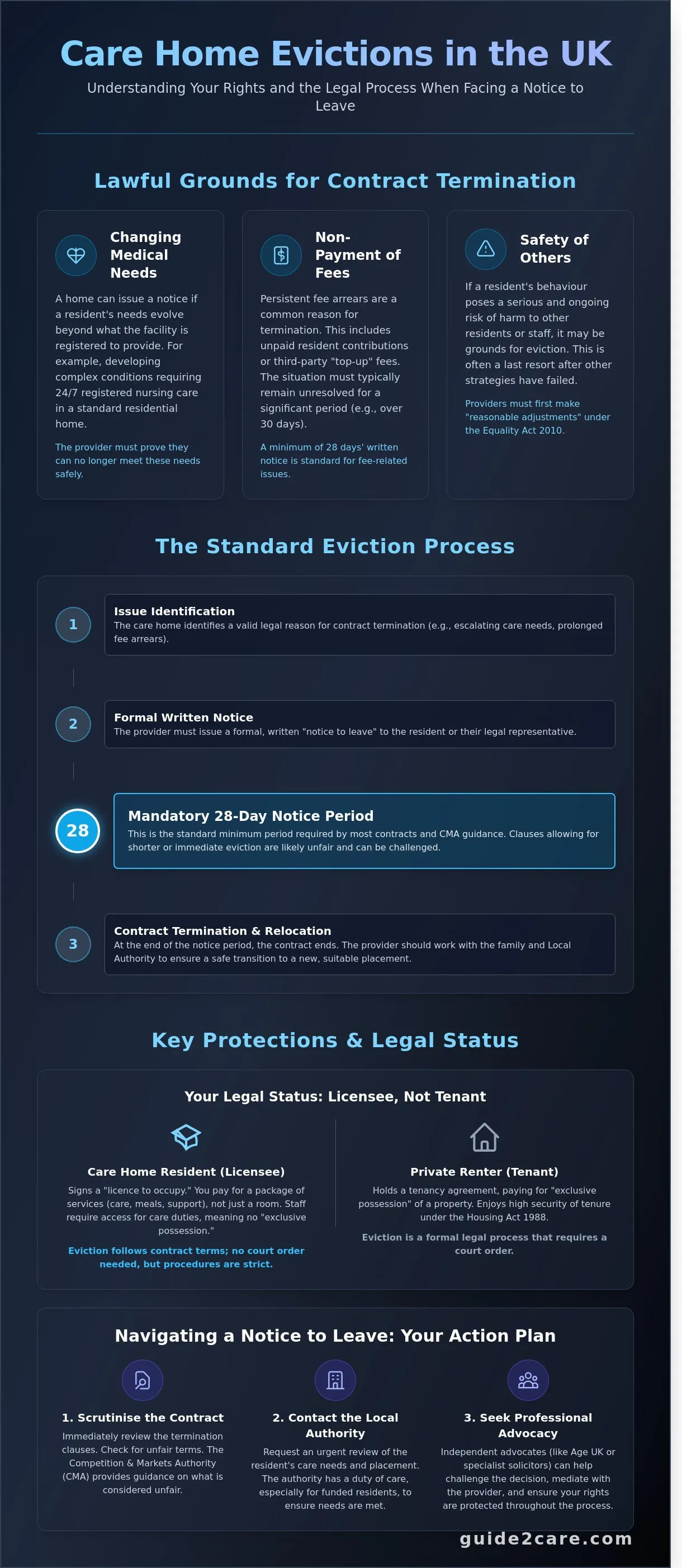
Most residents in the UK are 'licensees' rather than 'tenants'. This distinction is vital for understanding your rights. Tenants in private rentals enjoy high security of tenure under the Housing Act 1988. In contrast, care home residents usually sign a "licence to occupy." This legal status exists because the resident pays for a comprehensive service package that includes care, meals, and support, rather than just a room. Because staff must enter the room frequently to provide care, the resident rarely has "exclusive possession." This means the home doesn't need a court order to end the stay in the same way a landlord would, but they must still act reasonably and follow the contract terms.
The Role of the Care Home Contract
The written contract is the primary legal document governing a resident's stay. It defines the notice periods and the specific circumstances under which the home can end the agreement. Under the Care Act 2014, local authorities have a duty to ensure that care is managed safely and appropriately. You should review your contract for specific termination clauses. The Competition and Markets Authority (CMA) issued guidance in 2018 stating that terms allowing for immediate eviction are likely to be unfair. Most contracts require a notice period of at least 28 days. Every home must also provide a "Statement of Purpose." This document lists the specific types of care the home is registered to provide. If a resident's health deteriorates beyond what the home is registered for, they may legally require the resident to move to a more specialised facility. Understanding can a care home evict a resident uk often comes down to whether the home can still safely meet the individual's needs as stated in this document.
Lawful Grounds for Evicting a Care Home Resident in the UK
A care home is a resident's permanent residence, but it's also a service provided under a legal contract. If the terms of that contract are breached or the home can no longer fulfil its obligations, the provider has the right to terminate the agreement. Understanding the specific circumstances regarding can a care home evict a resident uk helps families protect their rights and plan for transitions.
Changes in Care and Medical Needs
Under the Care Act 2014, residents are entitled to regular re-assessments of their needs. If a resident's medical condition progresses, a standard residential home might no longer be suitable. For instance, if a person develops complex nursing needs that require 24 hour medical intervention, a residential facility without registered nurses cannot legally provide that care. The provider must prove they cannot safely meet these increased requirements before issuing a notice. They are expected to work with the Local Authority to facilitate a move to a more appropriate setting that can manage the new clinical demands.
Non-payment of Fees and Financial Disputes
Fee disputes are a common reason for contract termination. Providers typically require a minimum of 28 days' written notice for persistent arrears. This includes situations where a third party fails to pay a "top-up" fee or when a resident's personal assets fall below the £23,250 threshold and Local Authority funding is delayed. You can find detailed Age UK guidance on care homes regarding financial contracts and fee structures. While homes should show flexibility during council funding assessments, they aren't legally required to provide care without payment indefinitely. The question of can a care home evict a resident uk often arises when these financial gaps remain unresolved for more than 30 days.
Safety, Behaviour, and the Welfare of Others
Providers have a statutory duty of care to all residents and staff members. Challenging behaviour, often associated with advanced dementia or mental health conditions, may lead to eviction if it results in physical harm or persistent disruption. Under the Equality Act 2010, providers must make reasonable adjustments to manage these behaviours before considering eviction. This might include specialized staff training or altering the physical environment. If these adjustments fail to mitigate a documented risk to others, the home may terminate the contract to ensure the safety of the wider community.
Service Changes and Closures
Sometimes the reason for a notice to leave is entirely external to the resident. If a care home is closing down or changing its registration type, such as moving from elderly care to specialized learning disability support, it can terminate existing contracts. In these instances, the provider must give at least 28 days' notice and cooperate with social services to ensure a safe transition. You can search for alternative care providers to see which local homes currently have vacancies that match your specific requirements.
Consumer Rights and Human Rights Protections
Understanding whether can a care home evict a resident uk involves looking at consumer law and human rights legislation. Residents aren't just patients; they're consumers with specific legal protections. The Competition and Markets Authority (CMA) sets high standards for how care providers must treat residents during the eviction process. These rules ensure that contracts are fair and that providers don't use their position of power to bypass a resident's rights.
Contracts often contain "unfair terms" that a court can strike down. Under the Consumer Rights Act 2015, any term that creates a significant imbalance between the resident and the provider is potentially unenforceable. For example, a clause allowing the home to evict someone immediately for a minor late payment is likely unfair. You can challenge these terms if the home tries to use them as a basis for ending your stay. Shelter Legal's guidance on care home eviction provides further detail on how the Protection from Eviction Act 1977 applies to those in residential care settings.
CMA Guidance and Procedural Fairness
The CMA issued definitive guidance in 2018, with updated compliance frameworks looking toward 2026, to prevent "short-notice" evictions. These are usually considered a breach of consumer law. Most residents must receive at least 28 days' written notice before they're required to leave. This period gives the resident and their family time to find alternative accommodation and ensures a safe transition.
A home must follow strict procedures when issuing a notice. They must provide:
- A clear, written explanation of the reasons for the eviction.
- Evidence that they've tried to resolve the issue before resorting to eviction.
- Information on how to appeal the decision through a formal complaints process.
- A reasonable timeframe that reflects the resident's specific care needs.
The Human Rights Act in Care Settings
The Human Rights Act 1998 offers additional protection, particularly through Article 8, which guarantees the right to respect for private and family life. If a resident is placed in a home by a Local Authority, the home is performing a "public function." This means the home must comply with the Human Rights Act directly. For private residents, the situation is more complex, but the Care Act 2014 extended these protections to many private residents whose care is funded or arranged by a council.
Proportionality is the balance between a home’s operational needs and a resident’s fundamental rights. A home can't simply evict someone because it's the easiest option. They must prove that the eviction is a "proportionate" response to the problem. If a resident's behaviour has changed due to a medical condition, the home should adjust the care plan rather than ending the contract. When asking can a care home evict a resident uk, the answer depends on whether the provider has exhausted every other reasonable alternative first.
The Eviction Process: Notice Periods and Procedures
If you're asking "can a care home evict a resident uk", the answer is yes, but the provider must follow a strict legal sequence. A care home cannot simply ask a resident to leave overnight. They're required to issue a formal written notice that details the specific reasons for terminating the residency agreement. This document serves as the legal basis for the move and must align with the terms set out in the original placement contract.
The standard notice period is 28 days. While some contracts might specify a longer duration, such as 42 days, it's rarely shorter unless there's an immediate risk to the safety of staff or other residents. During this window, the care home has a duty to coordinate with the Local Authority. Under Section 47 of the Care Act 2014, the council must conduct a new needs assessment if a resident's care needs have changed. This ensures the transition to a new facility is managed safely and that the resident's medical requirements are fully met in their next home.
Documentation and Evidence
Request copies of all care records and incident logs as soon as you receive a notice. The home is legally required to provide a written "Reason for Notice" under CQC Regulation 19. You should keep a detailed diary of all communications with the care home manager. Document the date, time, and a summary of every meeting or phone call. This paper trail is essential for proving whether the home has met its contractual obligations. Specific evidence is vital if you believe the eviction is a "retaliatory notice" following a previous complaint.
How to Challenge or Appeal a Decision
You have the right to contest an eviction if you believe the process is unfair or the reasons are invalid. Follow these steps to protect the resident's rights:
- Trigger the internal complaints procedure: Every UK care home must have a formal, written process for handling disputes. Submit your objection in writing and request a formal review meeting.
- Escalate to the Ombudsman: If the internal response is unsatisfactory, contact the Local Government and Social Care Ombudsman (LGSCO). In 2023, the LGSCO handled thousands of complaints regarding adult social care, including unfair contract terminations.
- Notify the CQC: The Care Quality Commission doesn't settle individual contract disputes. However, they investigate "regulatory breaches". If the home fails to provide the mandatory 28-day notice, they're likely violating registration standards.
A final transition plan must be agreed upon before any move takes place. This includes transferring medication records, care plans, and personal belongings to the new provider to ensure continuity of care. Find the care you need by searching our directory for providers with transparent residency agreements and high ratings for management.
Navigating a Notice to Leave: Practical Next Steps
Receiving a notice to leave requires immediate action to protect the resident's safety and legal rights. You should first contact advocacy services such as Age UK or Independent Age. These organisations provide specific advice on whether the provider followed the correct contractual procedures. If the resident's health has declined, request an urgent review from the Local Authority social work team. Under the Care Act 2014, the council has a legal duty to ensure a resident's needs are met if a placement breaks down. This review helps determine if the current funding level or care category is still appropriate.
Involving Advocacy and Legal Services
Different types of support exist depending on the resident's circumstances. An Independent Mental Capacity Advocate (IMCA) must be appointed if the resident lacks mental capacity and has no family or friends to represent them during a change of accommodation. If you believe the provider is acting unfairly, seek a solicitor specialising in community care law. It is useful to check your home insurance policy; many UK policies include legal expenses cover that provides 24 hour advice lines or funding for contract disputes.
Using Guide2Care to Find a Suitable Alternative
Finding a new provider involves matching the home's capabilities to the resident's current medical profile. Use the Guide2Care directory to filter results by "Nursing" or "Specialist Dementia" care to find homes equipped for higher dependency levels. Check the latest Care Quality Commission (CQC) ratings directly on the platform to assess the quality of care and safety records. When you visit a new home, ask the manager for their specific eviction policy. Ask exactly what medical conditions or behaviours would trigger a notice to leave to ensure the placement is sustainable long term.
Managing the emotional impact of relocation is vital for the resident's wellbeing. Relocation stress syndrome can affect health outcomes during a forced move. To mitigate this, maintain as much of the resident's daily routine as possible and involve them in decorating their new space. Clear communication with the new staff about the resident's history and preferences helps ease the transition. Understanding how a care home can evict a resident UK allows you to manage the move professionally while prioritising the resident's dignity and comfort.
Protect Your Rights and Plan Your Next Steps
Understanding the legal framework helps you manage transitions effectively. While the answer to can a care home evict a resident uk is yes, providers must follow strict Competition and Markets Authority (CMA) 2018 regulations. These rules mandate a minimum 28-day notice period in most circumstances and require clear, documented reasons for any request to leave. Residents are also protected by the Human Rights Act 1998, ensuring that any move prioritises their safety. If a provider can't meet specific care needs under the Health and Social Care Act 2008, they're legally obligated to assist with a managed transition to a more suitable environment.
When you need to find a new placement quickly, access reliable data to make an informed choice. Our platform offers a comprehensive UK-wide directory with verified CQC ratings and direct links to the latest inspection reports. Use these independent resources for families to ensure every move is handled with clarity. Explore our database today to identify providers that meet your specific requirements and budget.
Find The Care You Need: Browse UK Care Homes
Take control of your care journey by using the right tools to secure a stable and supportive home.
Frequently Asked Questions
Can a care home evict a resident with dementia for challenging behaviour?
Yes, a care home can evict a resident if their behaviour exceeds the home's registered capability. Under the Health and Social Care Act 2008, providers must ensure they can maintain a safe environment. If a resident's needs change significantly, the home must give 28 days' notice. This ensures the resident moves to a facility with the appropriate specialist nursing or staffing levels.
What is the minimum notice period for a care home eviction in the UK?
The standard minimum notice period is 28 days for most residents. This timeframe is mandated by the Competition and Markets Authority (CMA) to protect consumer rights. When asking can a care home evict a resident uk, it's important to know that shorter notice is only legal in extreme cases involving immediate physical danger. Always check your signed residency agreement for specific termination clauses.
Can a care home ask a resident to leave if they run out of money?
Yes, a home can issue notice if fees aren't paid. If your capital drops below £23,250, you'll likely qualify for council support. Problems often arise if the council's standard rate is lower than the home's private fee. In these cases, the home might issue notice unless a third-party top-up fee is arranged to cover the price difference and keep the placement secure.
What happens if I refuse to move my relative out of the care home?
You can't be forced to move immediately, but the provider can seek legal action. If a family refuses a move after the notice period, the care home may apply to the County Court for a possession order. This legal process takes time to complete. You should contact your Local Authority's social services department immediately to mediate and help find a new, suitable care environment.
Can a care home close down and evict everyone immediately?
No, a care home cannot close and evict everyone without a planned transition. Providers usually give at least 28 days' notice for a planned closure. If the Care Quality Commission (CQC) shuts a home suddenly for safety breaches, the Local Authority must intervene. Under the Care Act 2014, the council is responsible for relocating all residents to safe accommodation, often within 24 hours.
Who can I complain to if I think a care home eviction is unfair?
First, follow the care home's formal internal complaints process. If you aren't satisfied with the outcome, escalate the matter to the Local Government and Social Care Ombudsman (LGSCO). They're an independent body that investigates unfair treatment in social care. In 2023, the LGSCO investigated hundreds of cases where residents felt their eviction from a care home was handled poorly or unfairly.
Is a care home allowed to increase fees and then evict for non-payment?
Yes, homes can increase fees if the contract allows it. The CMA requires providers to give at least 28 days' notice for any price hike. If you can't pay the new rate, the home can terminate the agreement. To understand if can a care home evict a resident uk for non-payment is legal, check if the increase follows the terms set at admission.
Does the Local Authority have to find a new home if a resident is evicted?
Yes, the Local Authority has a legal duty to help under the Care Act 2014. Councils must ensure that no resident is left without care if a home can no longer meet their needs. They'll perform a fresh assessment and provide a list of alternative providers. This duty applies even if the resident pays for their own care and has no previous council involvement.