Finding Care for Specific Conditions: A Step-by-Step UK Guide

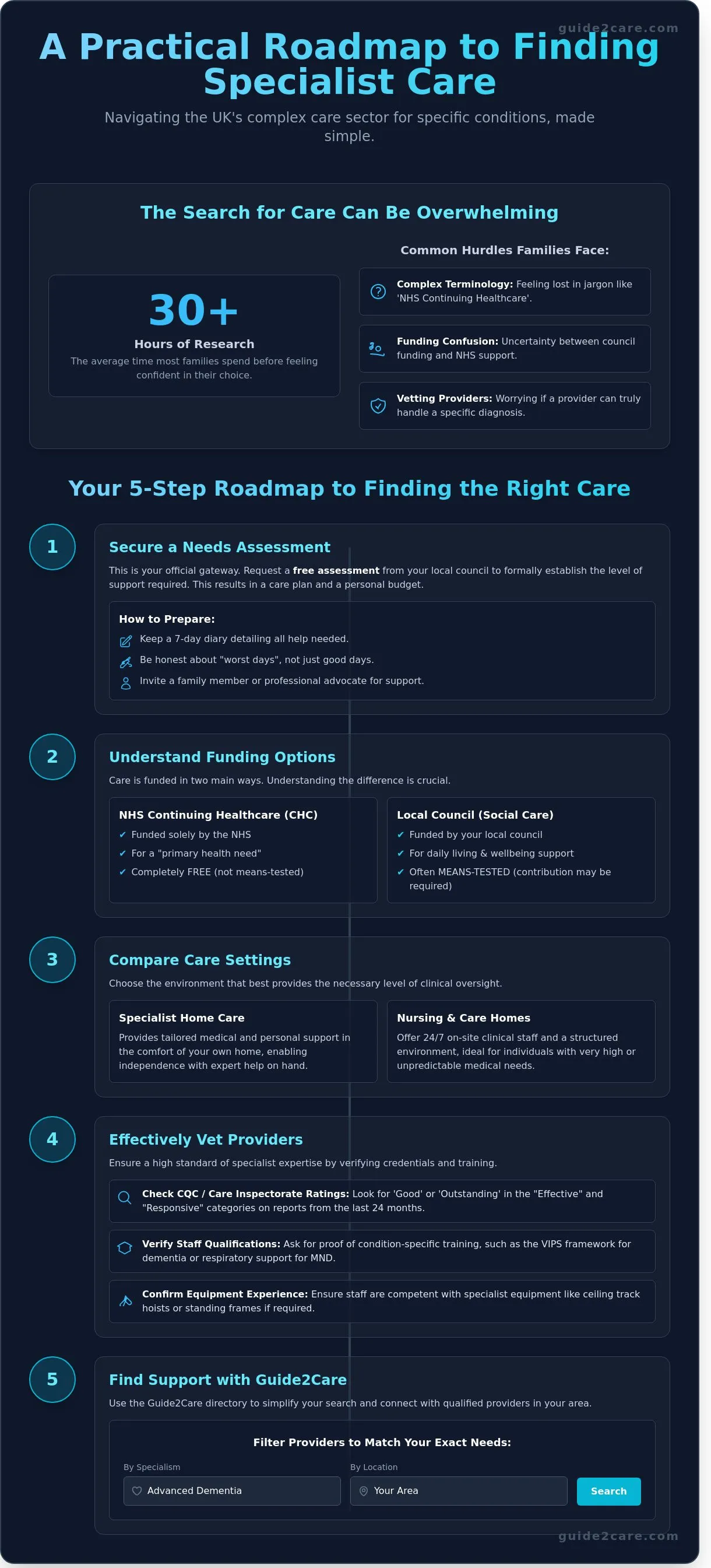
Most families spend over 30 hours researching options before they feel confident in their choice of provider. It's true that finding care for specific conditions in the UK is difficult, especially when you're faced with complex terminology and the pressure of a health crisis. You likely feel overwhelmed by the distinction between NHS Continuing Healthcare and local council funding. It's common to worry about whether a provider can actually handle a specific medical diagnosis or disability.
This article simplifies the process by giving you a direct, practical roadmap. We'll show you how to identify high-quality specialist support that fits your exact requirements. You'll gain a clear understanding of your funding options and the confidence to vet providers effectively. This guide covers everything from initial assessments to final selection. Find the care you need by following our structured approach to navigating the UK care sector and securing the right support for your situation.
Key Takeaways
- Request a free needs assessment from your local council to establish the level of support required for complex health needs.
- Discover the essential steps for finding care for specific conditions, ensuring support is tailored to specialist needs like advanced dementia or MND.
- Evaluate the differences between specialist home care and nursing homes to determine which setting provides the necessary clinical oversight.
- Learn how to verify staff qualifications and condition-specific training programmes to ensure a high standard of specialist expertise.
- Use the Guide2Care directory to filter providers by specialism and location to identify the most suitable care options in your area.
Understanding Specialist Care for Specific Conditions in the UK
Specialist care refers to support tailored for individuals with complex health needs or long-term disabilities. Standard home care often focuses on daily living tasks like washing or dressing. However, finding care for specific conditions requires a focus on clinical expertise and technical skills. Conditions like Motor Neurone Disease (MND) affect approximately 5,000 adults in the UK at any one time. These individuals require carers who understand respiratory support and communication aids. A generalist approach lacks the depth needed to manage these progressive symptoms effectively. Social care in England provides the framework for these services, but families must identify providers with the correct credentials.
To better understand how to manage complex health needs, watch this helpful video:
Condition-specific training is the foundation of high-quality specialist care. Staff must undergo rigorous modules that go beyond basic health and safety. For example, dementia care training often includes the VIPS framework, which focuses on the personhood of the individual. Without this specific knowledge, caregivers may fail to recognize the triggers for distressed behaviour. This can lead to a decline in the person's well-being and increased stress for the family. Specialist providers invest in ongoing education to ensure their teams stay updated on the latest clinical guidelines.
Why General Care Isn’t Always Enough
Generalist care can lead to poor outcomes for those with specific needs. In neurodivergent care, staff without specialist training often struggle with behaviour management. This increases the risk of sensory overload for the individual. For physical disabilities, providers must have experience with specialist equipment like ceiling track hoists or standing frames. Condition-specific knowledge ensures that care plans adapt as a condition evolves. This proactive approach reduces hospital admissions and improves long-term health metrics. Finding care for specific conditions means looking for providers who treat the diagnosis as a primary factor in the care plan.
This is particularly true for conditions like ADHD, where a formal diagnosis is the first step towards getting the right support. For families seeking a CQC-approved assessment, a specialist provider like adhd-clinic.co.uk can be an essential resource.
The Role of Regulatory Standards
The Care Quality Commission (CQC) regulates providers in England. In Scotland and Wales, the Care Inspectorate performs this role. These bodies ensure providers meet legal standards for safety and quality. The CQC evaluates services based on five key questions. Focus on the "Effective" and "Responsive" categories. These ratings indicate how well a provider meets specific clinical needs and adapts to individual preferences. Always check the latest inspection report issued within the last 24 months. Ensure the "Good" or "Outstanding" rating applies to the specific service type you require. A provider might be excellent at elderly care but lack the expertise for complex spinal injury support.
The First Step: Securing a Needs Assessment and Clinical Review
Contact your local council's social services department to request a needs assessment. This service is free for everyone in the UK, regardless of your financial situation. It serves as the official gateway for finding care for specific conditions. If the condition involves complex medical requirements, ask for a specialist clinical review. This ensures medical experts evaluate specific health needs alongside social requirements.
The council uses national eligibility criteria defined by the Care Act 2014. They assess whether you can achieve basic daily tasks and how this affects your overall wellbeing. If you meet the criteria, the council produces a formal care plan. This document details the support required and includes a personal budget allocation. This is the specific amount of money the council calculates is necessary to pay for your care services.
Preparing for Your Local Authority Assessment
Keep a detailed diary for seven days before the assessment. Record every instance where help is needed with mobility, medication, or personal care. This prevents forgetting small but vital details during the interview. Invite a family member or a professional advocate to the meeting. They provide support and ensure you cover every point. Be honest about "worst days." Don't describe a "good day" as the standard. If you do, the care plan won't be robust enough to cover times of crisis.
NHS Continuing Healthcare (CHC) vs. Social Care
NHS Continuing Healthcare (CHC) is a package of care funded solely by the NHS. It's for individuals with a "primary health need" arising from a disability, accident, or illness. Unlike standard social care, CHC is free and not means-tested. The process usually begins with a Checklist tool completed by a health professional. If you pass this stage, a Full Assessment follows. You can consult the NHS social care and support guide for detailed eligibility rules. If you don't qualify for CHC, you might still receive the NHS Nursing Care Contribution if you move into a nursing home.
Understanding these funding streams is vital for finding care for specific conditions without facing unexpected costs. Once you have your assessment results, you can search our directory of UK care providers to see which local services match your care plan requirements.
Comparing Care Settings for Complex Medical Needs
Selecting the correct environment is a vital part of finding care for specific conditions. You must balance medical safety with personal independence. The choice often depends on whether the condition is progressive, such as Parkinson's, or requires constant clinical monitoring, such as advanced respiratory failure. Each setting offers different levels of specialist intervention and social engagement.
Home Care: Maintaining Independence with Specialism
Home care, or domiciliary care, allows individuals to remain in a familiar setting. This is particularly effective for dementia patients. Staying in a known environment can reduce the speed of cognitive decline and lower anxiety levels. Specialist agencies manage this by organising consistent staff rotas. This ensures the same small team of three or four carers provides support, which is essential for building trust with patients who struggle with memory loss.
Integrating technology helps manage specific behaviours safely. You can install fall sensors, GPS trackers, or automated medication dispensers to mitigate risks. If you are at the start of this journey, ask for a referral for specialist treatment through your GP to ensure the care plan matches the clinical diagnosis. This step ensures that home carers have the right medical instructions to follow.
Nursing Homes: When Clinical Oversight is Essential
Nursing homes provide a level of clinical oversight that residential homes cannot match. You should choose a nursing home if the person needs daily medical intervention or complex medication management via injections or PEG feeding. These facilities must have a registered nurse on duty 24 hours a day. When finding care for specific conditions, check if the home has a dedicated unit, such as:
- EMI Units: Specifically designed for those who are Elderly Mentally Infirm.
- Stroke Rehabilitation: Units with on-site physiotherapists and speech therapists.
- Bariatric Suites: Equipped with specialist hoists and reinforced furniture.
Verify the Registered Manager’s professional background. A manager with a Registered General Nurse (RGN) qualification often maintains higher clinical standards. This is crucial for managing degenerative conditions where medical needs fluctuate daily.
Specialist Alternatives: Supported Living and Live-in Care
Supported living is a primary choice for adults with learning disabilities or autism. It offers a private tenancy combined with tailored on-site support. This model focuses on developing life skills while providing a safety net. For those who require 24-hour support but want to avoid a facility, live-in care is a specialist alternative. A carer resides in the property to provide one-to-one assistance. This is often the preferred route for end-of-life care or advanced Motor Neurone Disease, as it allows for total continuity of care without the disruption of a house move.
How to Vet and Select a Specialist Care Provider
Finding care for specific conditions requires a rigorous assessment of a provider's clinical and operational capabilities. Start by requesting the "Statement of Purpose". This document is a legal requirement under the Health and Social Care Act 2008. It defines the provider's aims and the specific needs they are registered to meet. If your condition is not listed as a core focus, the provider likely lacks the necessary infrastructure or specialist staff to manage complex requirements effectively.
Verify the technical qualifications of the onsite team. For mental health conditions or dementia, ensure the provider employs Registered Mental Health Nurses (RMNs) rather than only General Nurses (RGNs). Check that at least 80% of the care staff hold an NVQ Level 2 or 3 in Health and Social Care. Ask to see the organisation's condition-specific training matrix. A high-quality provider will show that 95% or more of their staff have completed recent modules in areas like PEG feeding, stoma care, or stroke rehabilitation. In addition to specialist subjects, ensure all staff have up-to-date mandatory training; you can discover JPF First Aid to see the types of regulated safety courses that form the basis of this training.
- Review Case Experience: Ask for anonymised case studies of residents with similar diagnoses.
- Check Success Metrics: Enquire about hospital readmission rates. Low rates often indicate superior condition management.
- Inspect Specialist Equipment: Ensure they have the correct ceiling track hoists or sensory equipment required for the condition.
Questions to Ask During a Site Visit or Interview
Ask specifically how the team manages challenging behaviour related to the condition. A provider using the PROACT-SCIPr-UK framework often demonstrates a commitment to positive behaviour support. Request the staff-to-resident ratio for peak times. In specialist units, a ratio of 1:3 or 1:4 is often necessary for safety. Finally, ask for three references from families who have used their services within the last 12 months to verify their claims.
Reviewing the Care Contract and Funding
Examine the fee structure for "top-up" costs. Specialist therapies, such as private physiotherapy or speech and language therapy, can cost between £60 and £120 per session if not included in the core weekly fee. Ensure the contract mandates a formal care review every 6 months. This is vital for progressive conditions where needs change quickly. Check the notice period; a standard 28-day period is typical, but shorter periods may be needed if the care level becomes insufficient. Use our directory to find the care you need today.
Finding the Right Support with Guide2Care
The process of finding care for specific conditions requires a methodical approach to ensure the provider's expertise matches the patient's medical needs. Guide2Care simplifies this search by offering a structured directory of UK care providers. Users can filter results by specific care types, such as domiciliary care, residential homes, or supported living, while narrowing the search to a specific postcode or local authority area. This targeted approach eliminates irrelevant options and focuses on local availability.
Detailed directory profiles allow you to identify providers with verified specialisms. Many facilities specialise in complex areas like palliative care, bariatric support, or neuro-rehabilitation. When searching, you should use multiple, specific terms to capture all relevant results. For example:
- Search for "Dementia care" to find specialist EMI (Elderly Mentally Infirm) units.
- Use "Nursing home" to find providers with 24-hour registered nursing staff.
- Try "Respite care" if you only require short-term support for a specific recovery period.
- Look for "Learning disability support" for younger adult care options.
Leveraging Online Resources for a Smarter Search
Guide2Care allows you to compare multiple providers side-by-side. This feature is essential for evaluating differences in CQC (Care Quality Commission) ratings or on-site facilities. You can also access guidance articles that explain complex topics like the £23,250 capital threshold for care funding in England. Use the "save" function to build a list of favourite listings. This makes it easier to share specific profiles with family members or social workers during the decision-making process.
Taking Action: From Search to Selection
Start your search today. Proactive research prevents "crisis" decisions made during a sudden hospital discharge or health decline. Data from the care sector indicates that emergency placements often result in less choice and higher costs. Once you have a shortlist, request brochures or book virtual tours from your top three providers. These initial steps provide the necessary context before you arrange formal consultations or site visits. Use the directory to begin your journey now. Find the care you need by exploring our specialist directory.
Take Control of Your Specialist Care Search
Finding care for specific conditions requires a structured, step-by-step approach. Start by securing a local authority needs assessment or a clinical review. This process identifies whether domiciliary care or a residential setting is the most appropriate option. Data from 2023 indicates that 1 in 3 UK adults will require specialist support during their lifetime. Always check Care Quality Commission (CQC) ratings to verify a provider's clinical standards. It's essential to compare providers based on their specific experience with complex medical needs.
Guide2Care simplifies the entire search process. Our comprehensive UK directory features detailed profiles for thousands of registered providers. Use our action-oriented search filters to narrow down choices by condition, location, and funding type. We offer expert guidance on NHS Continuing Healthcare (CHC) and local authority funding to help you manage costs effectively. Explore Guide2Care to access the tools needed to make an informed choice with confidence.
Frequently Asked Questions
How do I find care for a rare medical condition in the UK?
You can find care for rare conditions by contacting the NHS Rare Diseases Advisory Group or visiting one of the 17 specialist Rare Disease Centres across the UK. These centres provide expert diagnosis and coordinated management plans for complex cases. Use the NHS Find a Service tool to locate providers with specific expertise in your diagnosis. Organisations like Rare Disease UK also offer databases of specialist clinics and support networks.
What is the difference between specialist care and general residential care?
Specialist care provides clinical staff trained in specific medical needs like Parkinson's or stroke recovery, whereas general residential care focuses on daily living assistance. Specialist facilities often maintain a higher staff-to-resident ratio, sometimes 1:1 or 1:2, to manage complex symptoms. General homes provide help with washing, dressing, and meals but don't always have the equipment or training for intensive medical monitoring.
Will the council pay for specialist care if it's more expensive?
The local council pays for specialist care if a Care Needs Assessment determines that a standard home can't meet your specific requirements. Under the Care Act 2014, the council must provide a personal budget sufficient to cover the cost of the required services. If a specialist home costs £1,250 per week and no cheaper alternative can meet your assessed needs, the council is responsible for that full amount.
Can I choose my own specialist provider if I have a personal budget?
You can choose your own provider by requesting your personal budget as a Direct Payment from your local authority. This allows you to manage the funds yourself and hire specific agencies or personal assistants. When finding care for specific conditions, this flexibility ensures you select staff with the exact training required for your health status. You'll need to keep records of spending for council audits every 6 months.
How do I know if a care home is actually experienced in dementia care?
Verify dementia expertise by reviewing the latest Care Quality Commission (CQC) report and looking for "Good" or "Outstanding" ratings in the "Effective" and "Caring" categories. Ask the manager for the percentage of staff who've completed Tier 2 or Tier 3 dementia training. A dedicated dementia unit should have environmental adaptations, such as colour-coded doors and clear signage, to help residents navigate independently and safely.
What happens if my care needs change as my condition progresses?
You should request a statutory care review from your local council whenever your health status changes significantly. Providers must update your individual care plan every 12 months or sooner if your needs escalate. If your condition moves from residential to nursing level, you might become eligible for NHS Funded Nursing Care (FNC). This provides a weekly contribution of £235.88 toward your care fees in a registered nursing home.
Are there charities that help find care for specific conditions?
Charities like the MS Society, Stroke Association, and Alzheimer's Society offer specific directories and advisors to help you navigate the system. These organisations provide information that's vital for finding care for specific conditions and can connect you with local support groups. These networks also stress the importance of caregiver respite; taking even a single day for a relaxing activity, like a private trip with a service such as Timescape Tours, can help prevent burnout.
How long does it take to get a specialist care package in place?
It typically takes 4 to 12 weeks from the initial assessment to have a specialist care package in place. A standard Care Needs Assessment takes up to 6 weeks, followed by a further 2 to 4 weeks to finalise the funding and provider selection. In urgent cases, such as hospital discharge, an interim package can be arranged within 48 hours. Complex specialist needs often require 3 months to ensure staff training meets safety standards.