Parkinson’s Disease Care Homes UK: A Guide to Choosing Specialist Support
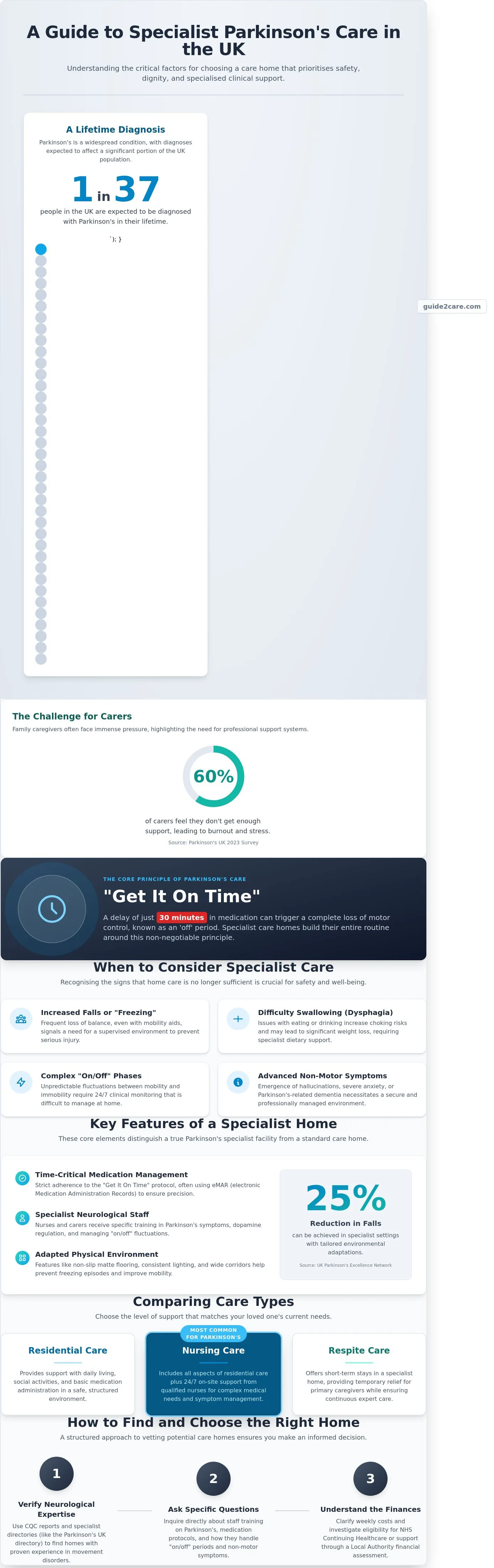
A 30-minute delay in medication can be the difference between fluid movement and a complete 'off' period for a resident. If you are searching for parkinson's disease care homes uk, you likely recognise that standard residential care often lacks the specialist training required for complex neurological conditions. With 1 in 37 people in the UK expected to receive a Parkinson's diagnosis in their lifetime, finding a provider that understands specific motor and non-motor symptoms is essential for long-term safety.
You deserve a clear path through the anxiety of medication schedules and the complexities of the UK's social care system. This guide explains how to identify high-quality specialist support and evaluate CQC reports for neurological expertise. We provide the information you need to understand NHS Continuing Healthcare eligibility and local authority funding limits. Use this framework to choose a home that prioritises both clinical safety and personal independence for your loved one.
Key Takeaways
- Recognise the signs that advancing symptoms and complex "on/off" phases require a transition from home care to professional residential support.
- Identify the essential features of parkinson's disease care homes uk, specifically the "Get It On Time" medication protocol and specialist neurological staff training.
- Compare residential, nursing, and respite care options to determine the most appropriate level of medical intervention for your loved one’s motor symptoms.
- Navigate the financial aspects of specialist care by understanding projected 2026 weekly costs and the Local Authority financial assessment process.
- Evaluate potential providers effectively by using CQC reports and specialist directories to verify safety standards and expertise in movement disorders.
When to consider Parkinson’s disease care homes in the UK
Deciding to move into a care home is a significant transition. For the 153,000 people in the UK living with Parkinson's disease, the condition's progressive nature often makes home care unsustainable. As symptoms advance, the "on/off" phases become more unpredictable. These phases involve fluctuations where medication effectiveness wears off, leading to sudden immobility or tremors. Managing these cycles requires 24-hour clinical monitoring that standard home care visits often can't provide. Family caregivers frequently face burnout. A 2023 survey by Parkinson's UK found that 60% of carers feel they don't get enough support. Specialist parkinson's disease care homes uk offer a necessary alternative to prevent safety risks during these complex stages. They provide a level of clinical oversight that ensures medication is adjusted in real-time based on the resident's physical response. To better understand the differences between home-based support and residential options, watch this helpful video:Signs that home care is no longer sufficient
Safety is the primary indicator for residential support. Frequent falls or "freezing" episodes increase the risk of fractures and hospitalisation. Medication management is also a critical factor. Levodopa must be taken at precise intervals to be effective. If doses are missed or timing is inconsistent, symptoms worsen rapidly. Additionally, the emergence of Parkinson’s-related dementia or hallucinations requires a secure, supervised environment that a private residence might lack. Find the care you need by assessing these critical indicators:- Increased frequency of falls despite using mobility aids.
- Difficulty swallowing, which increases choking risks.
- Significant weight loss due to tremors or eating difficulties.
- Heightened anxiety or depression that limits social interaction.
The benefits of a structured care environment
Specialist parkinson's disease care homes uk differ from standard elderly care through their clinical focus. They provide access to profiling beds and grab rails designed for those with motor impairments. These homes also address non-motor symptoms. For example, 40% of residents may experience significant sleep disorders or speech issues. A structured environment provides professional monitoring and social interaction to reduce isolation. Staff in these settings receive specific training to handle dopamine regulation and neuro-rehabilitation, ensuring a higher quality of life than general residential homes. Explore your options to ensure 24-hour clinical safety.Key features of specialist Parkinson’s residential and nursing care
Specialist parkinson's disease care homes uk focus on precise symptom management and maintaining resident dignity. These facilities differ from standard residential care by employing staff with specific training in neurological and movement disorders. They understand that Parkinson's is a fluctuating condition where needs change hour by hour. Effective care relies on a structured environment that supports physical safety and cognitive health.
This need for specialised assessment isn't limited to movement disorders. Families often find themselves navigating evaluations for a range of neurological or developmental conditions. For those seeking support with attention and executive function, for instance, the CQC-approved ADHD Clinic offers comprehensive assessments for both adults and children across the UK.
The "Get It On Time" philosophy is the primary clinical priority in these settings. Parkinson's UK research indicates that a delay of just 30 minutes in medication delivery can cause a total loss of motor control or "freezing" for the resident. Specialist homes implement strict protocols to ensure levodopa and other dopamine-replacement therapies are administered at exact intervals. For a detailed look at clinical symptoms, you can consult NHS information on Parkinson's.
Environment plays a significant role in resident safety. Specialist homes use non-slip, matte flooring to prevent visual triggers that cause gait freezing. Lighting is kept consistent to help those with spatial awareness issues. Statistics from the UK Parkinson's Excellence Network show that tailored environmental adaptations can reduce fall rates by up to 25% in specialist settings. Wide corridors and high-contrast signage also help residents navigate the home independently for longer.
Medication management and clinical expertise
Specialist homes use electronic medication administration records (eMAR) to track time-critical doses. Nurses are trained to recognise "on" and "off" periods, adjusting care activities to match the resident's mobility levels. Night-time care is equally essential. Since 70% of people with Parkinson's experience sleep disturbances or nocturnal akinesia, staff provide regular repositioning and monitoring throughout the night. Medication precision is the cornerstone of PD care in 2026.
Therapeutic and rehabilitative support
Access to a Multidisciplinary Team (MDT) is a standard feature of high-quality parkinson's disease care homes uk. This team includes Speech and Language Therapy (SALT) to manage dysphagia, which affects 80% of people in the later stages of the condition. Physiotherapists provide gait training and balance exercises to maintain muscle strength. Occupational therapists focus on independence, providing weighted cutlery or button hooks to assist with daily tasks. You can search for homes with on-site therapy teams to ensure these services are available daily rather than monthly.
Comparing care types: Residential, Nursing, and Respite for Parkinson’s
Determining the level of medical intervention required is the first step in your search. Parkinson’s is a progressive condition. Care requirements will change as symptoms evolve. You must identify whether your loved one needs social support or 24-hour clinical supervision. Choosing the right environment ensures safety and maintains quality of life for as long as possible.
Residential vs Nursing: Making the right choice
Residential care works best for those in the early-to-mid stages of the condition. These settings focus on personal care, such as help with dressing, bathing, and mobility. Residents benefit from structured social activities and communal dining which helps combat the isolation often associated with the disease. Find a home that understands the importance of physical activity in maintaining motor function.
Nursing care becomes essential when motor symptoms or cognitive changes require constant medical oversight. Advanced Parkinson’s often involves dysphagia, a swallowing difficulty that affects roughly 50% of people in later stages. Registered nurses are trained to manage these risks and oversee complex medication regimes. According to Parkinson's UK, precise medication timing is vital to prevent "off" periods where symptoms suddenly worsen. If your loved one uses a Duodopa pump or requires apomorphine injections, a nursing home is the only safe option.
The cost difference between these levels is significant. Residential care in the UK averages £800 per week, while nursing care often exceeds £1,200 per week due to higher staffing ratios. Care Quality Commission (CQC) inspections for nursing homes focus heavily on clinical safety and medicine management. Residential inspections look more closely at social well-being and independence. You'll need to plan for a transition between these levels as the condition progresses over several years.
Respite care as a tactical solution
Respite care offers a short-term solution for families. It gives primary carers a vital break from their daily responsibilities. Use these stays to evaluate how parkinson's disease care homes uk manage specific symptoms before making a permanent commitment. A two-week stay allows you to monitor staff responsiveness and their knowledge of Parkinson's-specific triggers.
- Evaluate staff expertise: Observe if staff understand the "on-off" phenomenon.
- Test the environment: Ensure the layout is safe for those with a high fall risk.
- Emergency support: Use respite when a sudden health crisis occurs at home.
Most providers charge a daily rate for respite, which is typically 10% to 15% higher than long-term rates. It's a practical way to ensure the home is the right fit for your family's specific needs.
Funding and costs for Parkinson’s care in the UK
Securing a place in parkinson's disease care homes uk involves significant financial planning. By 2026, the average weekly cost for specialist Parkinson’s nursing care is projected to range between £1,450 and £1,950. These figures reflect the high level of clinical oversight required for medication management and physical therapy. Costs vary significantly by region. Facilities in London and the South East often charge 25% more than those in the North of England.
Local authorities use a means-test to determine your eligibility for financial support. If your capital and savings exceed £23,250, you are usually responsible for the full cost of your care. Self-funders who own their homes may access deferred payment schemes. This legal agreement allows the local authority to pay your care fees while securing the debt against your property. You repay the total amount when the house is sold or from your estate.
Eligibility for NHS Continuing Healthcare
NHS Continuing Healthcare (CHC) is a package of care funded solely by the NHS. It’s often called the "Holy Grail" of funding because it covers 100% of care home fees. Eligibility isn't based on a Parkinson’s diagnosis alone. Instead, it depends on having a "primary health need." This means your care requirements are complex, intense, or unpredictable.
Assessors use the Decision Support Tool (DST) to evaluate 12 domains of need. You must prepare for the DST meeting with clear evidence of symptom fluctuations. Your Parkinson’s Nurse Specialist is a vital ally here. They provide the clinical data needed to prove that your needs are primarily health-related rather than social. Their input on "off" periods and swallow reflex issues can be the deciding factor in a successful application.
Local Authority support and top-up fees
If you qualify for council funding, the local authority sets a "usual cost" limit. If your preferred home costs more than this limit, a third party must pay the difference. This is known as a top-up fee. A family member or charity usually pays this. You cannot pay your own top-up fee from your own capital unless you have a deferred payment agreement in place.
The social care reforms scheduled for 2026 introduce an £86,000 cap on personal care costs. This cap limits how much you spend on the care component of your fees over your lifetime. It’s vital to understand that this cap doesn't include "hotel costs" such as food and accommodation. You should still budget for these ongoing daily living expenses even after reaching the cap.
Find the support you need by searching our directory of specialist Parkinson’s care providers.
How to find and choose the right Parkinson’s care home
Finding the right parkinson's disease care homes uk requires a methodical approach. Start your search by using the Guide2Care directory. Use the filter options to select providers offering specialist neurological care. This narrows your search to facilities equipped to handle complex motor and non-motor symptoms.
Analyse the latest Care Quality Commission (CQC) reports for every shortlisted home. Focus specifically on the "Safe" and "Well-led" sections of the report. According to CQC data from 2023, medication management is a frequent area for improvement in residential settings. Look for explicit mentions of time-critical medication protocols. Parkinson's symptoms can worsen significantly if doses are delayed by even 15 minutes. Ensure the home uses an electronic medication administration record (eMAR) system to track timing accuracy.
Prepare a checklist for your physical visit. Ask the manager these specific questions:
- What percentage of the care team has completed Level 2 or 3 Parkinson’s UK specialist training?
- How does the home manage "off" periods when medication effectiveness wears off?
- Can the home provide evidence of regular visits from a Parkinson’s Nurse Specialist or local physiotherapist?
Evaluating the environment and staff culture
Observe staff interactions during your visit. Watch how they support residents during "off" periods or episodes of "freezing." Staff should remain calm and use verbal prompts rather than physical force. Check the dining area for Parkinson’s-friendly adaptations. This includes weighted cutlery, non-slip mats, and high-contrast crockery to assist those with visual-spatial difficulties. Ask about the activity programme. Effective homes offer neurological stimulation such as rhythmic music therapy or chair-based boxing, which 2022 studies suggest can improve motor function.
Beyond therapy, live music from a resident's era can be incredibly uplifting. Award-winning tribute acts like Soul Kinda Wonderful are often booked by top-tier care homes to provide joyful, nostalgic entertainment that enhances social well-being.
Beyond therapy, live music from a resident's era can be incredibly uplifting. Award-winning tribute acts like Soul Kinda Wonderful are often booked by top-tier care homes to provide joyful, nostalgic entertainment that enhances social well-being.
Making the final decision
Compare your top three homes using a standardised scoring system. Rate each facility from 1 to 10 on staff ratios, specialist equipment, and mealtime support. Before signing a contract, check the notice period and the trial stay policy. Most UK providers offer a four-week trial period. This allows you to assess if the home's routine suits the resident's specific symptom patterns. Ensure the contract clearly states the fees for additional nursing needs as the condition progresses. Once a choice is made, organise the transition by sharing a detailed "About Me" profile with the care team, highlighting specific triggers and routines.
Secure Specialist Support for Parkinson’s Today
Selecting the right environment ensures long-term safety and effective symptom management. Statistics from Parkinson’s UK show that 1 in 37 people will be diagnosed in their lifetime, making specialist knowledge essential for precise medication timing and mobility support. You must distinguish between residential care for social needs and nursing care for complex clinical requirements. It's also vital to account for costs; the current upper capital threshold in England is £23,250, which dictates whether you'll receive local authority assistance. Finding parkinson's disease care homes uk is more efficient when you use a structured approach to filter providers by specialist expertise and regional location.
Guide2Care simplifies this search by providing a comprehensive UK-wide directory of registered providers. You can access neutral and impartial guidance to compare facilities without bias. Our platform allows you to search by specialist condition, ensuring the home you choose has the specific training required for Parkinson’s care. Find The Care You Need: Search Parkinson’s Care Homes Now. Start your search today to find a provider that offers the right level of professional support and security.
Frequently Asked Questions
How do I know if a care home is truly a Parkinson’s specialist?
A care home is a specialist if staff have completed the Parkinson's UK "Standardised Training Framework" or equivalent accredited neurological courses. You should ask to see the home's training matrix to confirm that 100% of care staff receive regular updates on neurological symptoms. Truly specialist parkinson's disease care homes uk will also have a designated Parkinson’s lead and established protocols for coordinating with local Parkinson’s Disease Nurse Specialists (PDNS).
Is Parkinson’s disease care more expensive than standard residential care?
Specialist Parkinson’s care typically costs between £200 and £500 more per week than standard residential care. While average UK residential care costs approximately £800 to £1,000 weekly, specialist neurological support often starts at £1,300. These higher fees cover increased staffing ratios and specialized equipment like profiling beds or pressure-relieving mattresses. Regional variations are significant, with London and South East England prices often exceeding £1,600 per week.
Can I get NHS funding for a Parkinson’s care home?
You can access full NHS funding through Continuing Healthcare (CHC) if your Parkinson’s symptoms are classified as a "primary health need." If you don't qualify for CHC, you may still receive NHS Funded Nursing Care (FNC), which contributes £235.88 per week directly to the care home as of April 2024. Local authorities also provide means-tested support for those with assets below £23,250 in England, though this threshold varies in Scotland and Wales.
What is the "Get It On Time" campaign in UK care homes?
The "Get It On Time" campaign is a Parkinson’s UK initiative that requires care providers to deliver medication within 15 minutes of the prescribed time. Missing a dose by even 20 minutes can lead to "freezing" or a total loss of mobility for the resident. Specialist parkinson's disease care homes uk use electronic medication administration records (eMAR) to ensure 100% compliance with these strict schedules. This campaign aims to reduce the 58% of hospital admissions caused by medication errors in care settings.
What happens if my loved one’s Parkinson’s symptoms worsen in the home?
The care home must conduct a formal care plan review within 48 hours if symptoms progress significantly. They'll contact the resident's GP or Parkinson’s Nurse to adjust medication dosages or introduce new therapies. If mobility decreases, an Occupational Therapist will visit to provide new walking aids or hoists. Most specialist homes update their risk assessments every 30 days to ensure the care level matches the resident's changing physical and cognitive needs.
How do care homes manage the "on/off" phases of Parkinson’s?
Care homes manage "on/off" phases by using detailed "Parkinson's diaries" to track exactly when medication wears off. Staff schedule physically demanding activities, such as bathing or exercise, during "on" periods when the resident has maximum mobility. During "off" phases, care plans dictate specific safety protocols to manage the increased risk of falls. This structured approach ensures that the 145,000 people living with Parkinson's in the UK maintain as much independence as possible.
Should I choose a nursing home or a residential home for Parkinson’s?
Choose a nursing home if the resident has complex needs like swallowing difficulties, frequent falls, or advanced dementia. Residential homes are only suitable for those in the early stages who require basic help with daily tasks like dressing. Approximately 60% of people with Parkinson’s eventually require nursing-level support as the condition progresses. If your loved one uses a PEG feeding tube or requires 24-hour medical monitoring, a registered nurse must be on-site at all times.
What should I look for in a CQC report for a Parkinson’s home?
Look for "Good" or "Outstanding" ratings specifically in the "Safe" and "Effective" categories of the Care Quality Commission (CQC) report. Search the document for mentions of "medication management" to ensure inspectors found no errors in dose timings or administration. A report from the last 12 to 24 months offers the most reliable data on current standards. Check the "Well-led" section to see if the manager prioritises specialist neurological training for their entire team.