Residential Care for Adults with Autism: A Comprehensive UK Guide

Securing a stable future for an autistic adult requires more than just a bed; it requires an environment that understands neurodivergent sensory needs. You likely worry about the threat of institutionalisation or the confusing nature of the UK funding system. Finding residential care for adults with autism remains a primary concern for the 700,000 autistic people currently living in the UK. It's difficult to balance the need for safety with the desire for independence, especially when local authority processes feel opaque.
You deserve clarity and a logical path forward. This guide helps you navigate specialist autism provision and compare different care models directly. We explain the functional differences between residential homes and supported living to help you make an informed choice. Learn how to access funding and build a shortlist of vetted providers. Find the care you need to ensure long-term stability and safety. Explore our structured breakdown of the UK care sector to simplify your search today.
Key Takeaways
- Identify the specific features of high-quality environments, including autism-specific communication tools like PECS and Makaton.
- Understand the fundamental differences in tenancy and support structures between residential care and supported living models.
- Learn how to navigate the UK care system, from securing a Local Authority Care Needs Assessment to reviewing CQC regulations.
- Discover how to use specialist tools to find residential care for adults with autism and effectively evaluate providers during site visits.
What is Residential Care for Adults with Autism?
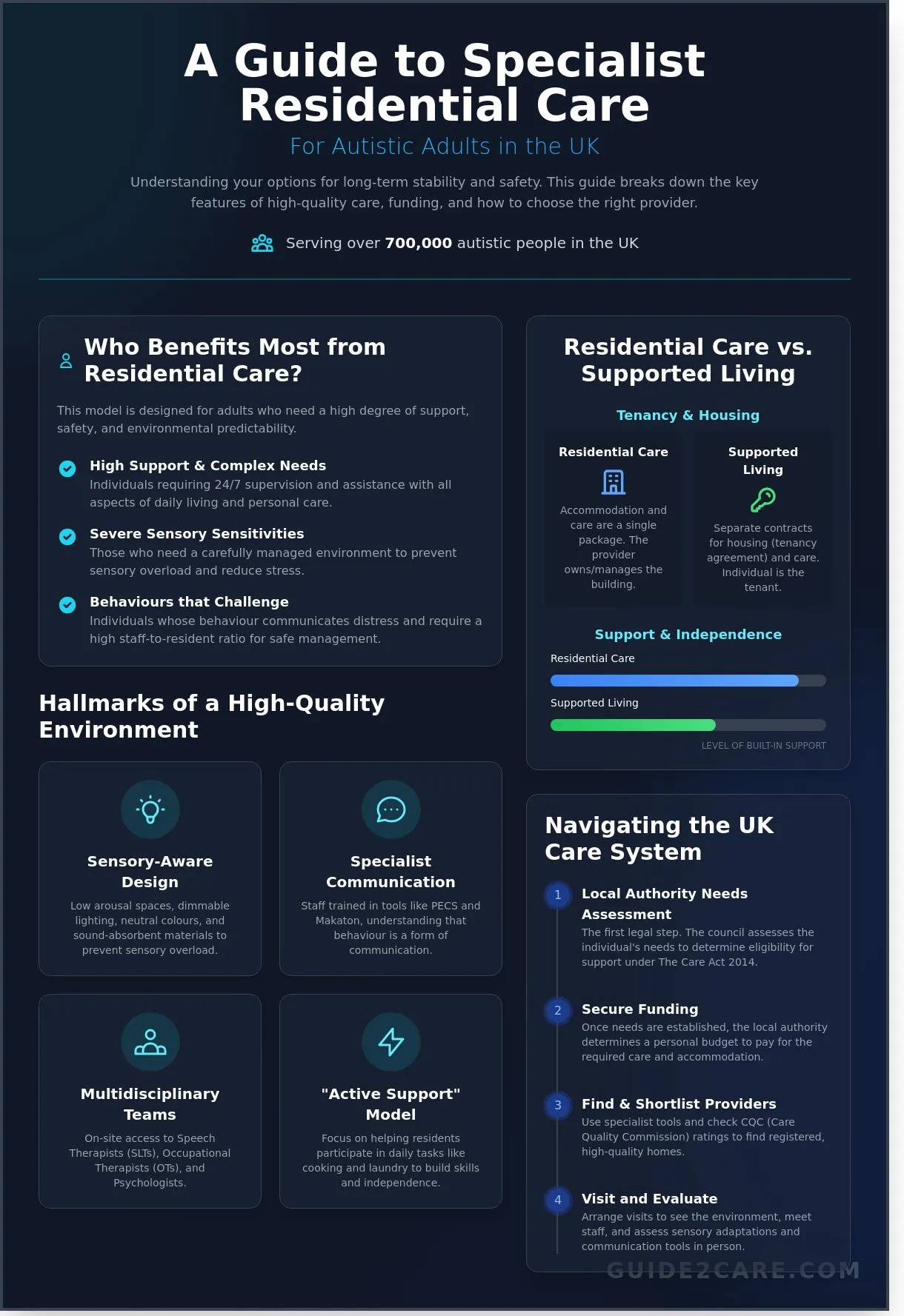
Specialist residential care for adults with autism is a registered service providing both accommodation and personal care. In the UK, the Care Quality Commission (CQC) regulates these facilities to ensure they meet specific safety and quality standards. Unlike general adult social care, which might focus on age-related frailty, autism-specific provision centers on neurodivergent needs. These environments use specific layouts to reduce sensory overload and employ staff trained in specialized communication methods. To understand the broader context of these services, it helps to define What is Residential Care? within the wider UK social care framework.
The Care Act 2014 serves as the legal foundation for these services. This legislation requires local authorities to conduct a "needs assessment" for any adult who appears to require support. The Act emphasizes "individual well-being," meaning care must support a person's dignity, physical health, and emotional resilience. For many, residential care for adults with autism is the most effective way to meet these statutory requirements because it combines housing with intensive, specialized support in one location.
The Core Purpose of Specialist Provision
Specialist homes provide 24/7 support in a structured, predictable environment. Staff use the "Active Support" model to help residents engage in daily life. This method ensures individuals don't just receive care, but actively participate in tasks like cooking or laundry to build independence. Specialist residential care is a long-term home designed for permanent residency rather than a short-term or emergency placement. It offers a consistent routine that reduces anxiety and helps residents manage their environment effectively.
Who Benefits from a Residential Setting?
This model is designed for adults with high-level support needs or complex communication requirements. It's often the right choice for individuals who require a high degree of environmental predictability to stay safe and healthy. You might consider this option when transitioning from a family home, especially if parental care is no longer viable due to the age or health of the caregivers. Residential care for adults with autism provides a sustainable, professional solution for those who cannot live independently or in less structured supported living arrangements. It's particularly beneficial for individuals who exhibit behaviors that challenge and require a high staff-to-resident ratio to manage safely.
- Adults requiring 24-hour supervision for safety.
- Individuals with severe sensory processing sensitivities.
- Those who need assistance with all aspects of personal care and daily living.
Choosing the right setting involves looking at the specific expertise of the provider. Find the care you need by checking CQC ratings and visiting potential homes to see their communication tools and sensory adaptations in person.
Key Features of High-Quality Specialist Autism Environments
High-quality residential care for adults with autism combines physical safety with proactive therapeutic support. The building's layout and the staff's approach determine the resident's quality of life. Modern facilities move away from clinical settings toward domestic, adaptable homes that promote independence while managing risks. It's essential to look for providers who view the environment as a tool for wellbeing; to explore how strategic planning and modern design trends are evolving to support specialized needs, you can check out Powerpillar Ltd.
Sensory-Aware Design and Layout
Sensory processing differences affect how people experience their surroundings. Specialist homes manage lighting, acoustics, and colour schemes to prevent sensory overload. Dimmable LED lighting and sound-absorbent materials reduce stress. Neutral colour palettes like soft greens or beiges replace high-contrast patterns that can cause visual distortion. Low arousal spaces provide quiet zones for residents who feel overwhelmed. Access to secure outdoor spaces or gardens allows for physical movement and emotional regulation, which are vital for daily stability.
Staff training is the foundation of effective care. Providers must train teams in autism-specific communication tools like PECS (Picture Exchange Communication System) and Makaton. This expertise allows staff to view "challenging behaviour" as a form of communication through behaviour. When an adult doesn't use verbal language, their actions often express unmet needs, sensory pain, or frustration. Recognising this shift helps staff respond with support rather than restriction.
Multidisciplinary teams (MDTs) ensure that clinical expertise informs daily care. These teams often include Speech and Language Therapists (SLTs), Occupational Therapists (OTs), and Psychologists. In some cases, residents may also require input from the ADHD Clinic to ensure co-occurring conditions are properly assessed and managed. SLTs develop communication frameworks tailored to the resident. OTs modify the environment to suit sensory profiles. Psychologists provide strategies for emotional regulation. This level of clinical oversight is a hallmark of specialist autism environments where complex needs are managed daily.
The role of Occupational Therapists is crucial in creating supportive environments. To explore this topic further from a provider's perspective, you can learn more about Accessible Care and their guide to occupational therapy.
Person-Centred Support Plans
Standardised care routines often fail in residential care for adults with autism. Effective support plans focus on the individual. These plans incorporate specific routines, special interests, and personal preferences. Families and the individuals themselves help create these documents. This ensures the care provided respects their history and identity. A person-centred plan might include:
- Visual schedules tailored to the individual's comprehension level.
- Specific dietary preferences and sensory requirements for mealtimes.
- Structured opportunities to engage with special interests or hobbies.
- Defined goals for developing independent living skills.
Care providers should review these plans at least every six months to ensure they remain relevant. You can find providers that specialise in these bespoke care models through our directory. Choosing a home that prioritises individual identity over institutional routine leads to better long-term outcomes for residents.
Residential Care vs. Supported Living: Which is Right?
Choosing the correct environment requires a clear understanding of how care is structured and funded in the UK. Residential care for adults with autism provides a combined package of accommodation and personal support. The Care Quality Commission (CQC) registers these settings as a single service. This model suits individuals who require constant supervision and a highly structured environment to manage complex needs.
Supported living operates on a different principle. It separates the housing element from the care provision. This means the individual has more rights as a tenant. They often have their own front door and more control over who enters their home. Financial structures also differ significantly. In residential homes, the Local Authority or NHS typically pays a single fee to the provider. The resident contributes a portion of their benefits, leaving them with a Personal Expenses Allowance of £30.15 per week. Individuals in supported living claim Housing Benefit or Universal Credit to cover rent. They keep their disability benefits to pay for food, utilities, and social activities.
- Residential Care: 24-hour onsite staff, inclusive meals, and shared communal spaces.
- Supported Living: Personalised support hours, separate tenancy agreements, and greater financial autonomy.
Assessing Support Intensity
Determining the necessary hours of care is a vital step during a Care Act assessment. Residential care for adults with autism usually guarantees a 24-hour staff presence, including waking night or sleep-in support. Supported living often involves a separate tenancy agreement, unlike residential care. You must decide if "shared care" hours are sufficient. These hours cover tasks like house maintenance or group outings. Individual 1:1 hours are reserved for specific personal care or skill-building goals.
Balancing Independence and Safety
Effective risk management empowers the individual. It shouldn't just restrict their movement. Transitioning to supported living is appropriate when a person can manage the basic responsibilities of a tenancy with help. They must show an ability to follow safety protocols within their home. Community outreach programs play a large role here. These services help individuals access local amenities and build social networks. If an individual struggles with sudden changes or requires immediate physical intervention during a crisis, a residential setting often provides a safer, more stable foundation. Use the person-centred plan to track if skills are improving enough for a future move to a less restrictive setting.
Navigating the UK Care System: Funding and Regulation
Finding the right residential care for adults with autism requires a clear understanding of regulation and financial pathways. The Care Quality Commission (CQC) acts as the independent regulator of all health and social care services in England. They monitor providers to ensure they meet the standards set by the Health and Social Care Act 2008. Every registered facility receives a rating based on five key questions: is the service safe, effective, caring, responsive, and well-led?Understanding CQC Ratings for Autism Services
An "Outstanding" rating in a specialist autism setting indicates that the provider goes beyond basic safety. These homes often implement advanced Positive Behavioural Support (PBS) frameworks and demonstrate high levels of staff retention. When you read a CQC report, look for specific mentions of "Expert by Experience" involvement. These are inspectors with lived experience of autism who provide unique insights into the quality of daily life. Red flags in "Requires Improvement" reports often include gaps in mandatory autism-specific training or poor management of sensory environments. Check the "Responsive" section of the report to see how the home adapts to individual communication needs. If a report mentions high use of agency staff, it may indicate a lack of consistency for residents who rely on routine.Funding Pathways: Local Authority vs. Private Pay
Accessing residential care for adults with autism typically starts with a Care Needs Assessment from the Local Authority. Under the Care Act 2014, councils must assess anyone who appears to have a need for care and support. In 2026, the financial thresholds determine who pays. If an individual has assets above £23,250, they are generally expected to self-fund their care. Common funding streams include:- Personal Budgets: The amount of money the council calculates is needed to cover your care.
- Direct Payments: This allows you to receive your Personal Budget as a cash payment to purchase services directly.
- NHS Continuing Healthcare (CHC): This is a package of care funded solely by the NHS for individuals with a "primary health need."
To begin your search for regulated providers, find the care you need through our comprehensive directory.
How to Find and Choose the Right Residential Provider
Selecting the correct environment for a family member is a structured process. It requires a balance between checking regulatory compliance and assessing the daily atmosphere of the home. Use a methodical approach to narrow down options from a broad list to a final choice. This ensures the selected residential care for adults with autism meets specific sensory and behavioral requirements.
Using the Guide2Care Directory Effectively
Start your search by identifying providers that hold specific expertise. Use the directory filters to select "Autism" and "Learning Disabilities" under the specialisms category. This narrows your results to facilities designed with neurodivergent needs in mind. Compare multiple providers side-by-side to evaluate their CQC ratings and capacity. Find the care you need by searching our directory of UK providers to begin building your shortlist.
Essential Questions for Your Site Visit
A site visit is the most effective way to evaluate a provider. Physical appearance is secondary to the quality of staff interaction and administrative transparency. Use this checklist to guide your conversation with the home manager:
Evaluating Home Culture
The culture of a home is defined by how much autonomy residents have. Observe the interactions between staff and residents. Staff should use the resident's preferred communication method, whether that involves PECS, Makaton, or verbal speech. Notice if the environment feels like a clinical setting or a genuine home. Look for personalized bedrooms and communal areas that accommodate different sensory profiles. A positive culture prioritizes the resident's dignity over administrative convenience.
Managing the Transition Period
A successful move into residential care for adults with autism depends on a gradual transition. Avoid abrupt moves. Most providers offer trial stays, typically lasting between 14 and 28 days. This period allows the individual to adjust to new routines while staff assess support needs. Ensure the provider creates a written move-in plan. This document should detail the phased increase of overnight stays and identify a "key worker" who will be the primary point of contact for the family during the first six months.
Take Control of Your Care Search
Choosing the right path requires a clear understanding of how the UK care system operates. You've now explored how residential care for adults with autism differs from supported living and why Care Quality Commission (CQC) ratings are vital for verifying safety standards. Success hinges on identifying providers that offer specialist sensory environments and structured routines tailored to individual needs. Navigating funding pathways under the Care Act 2014 remains a critical step in the process.
Finding a suitable provider doesn't have to be an overwhelming task. Guide2Care offers an independent and neutral database covering all adult care types across the UK. Our platform lists every CQC-registered provider, ensuring you access reliable data without any bias. By organizing complex information into a searchable format, we help you compare options and verify credentials quickly. You'll find the clarity needed to make a confident decision for your family's future.
Find the care you need today using our UK directory and start your search with confidence.
Frequently Asked Questions
What is the difference between a care home and residential care for autism?
Residential care and care homes are terms often used interchangeably within the UK care sector. A care home is the physical facility, while residential care for adults with autism describes the specific service model providing 24-hour onsite support. Both fall under Care Quality Commission (CQC) regulation. Most providers offer 5 to 10 beds in a single property to maintain a domestic feel for the residents.
How much does residential care for an autistic adult cost in the UK?
Costs vary significantly based on the level of support required. Data from LaingBuisson indicates that standard residential care averages between £800 and £1,500 per week. Specialist placements for autism often cost more because they require 1:1 or 2:1 staffing ratios. You should request a financial assessment from your Local Authority to determine your specific contribution based on the 2024 capital limits.
Can an autistic adult be forced into residential care against their will?
An adult can't be forced into residential care if they have the mental capacity to make that decision under the Mental Capacity Act 2005. If a person lacks capacity, a "Best Interests" meeting is held involving family and professionals. Deprivation of Liberty Safeguards (DoLS) must be applied for if the care setting restricts the person's freedom of movement or choice.
How do I find autism-specific residential care near me?
Use the Care Quality Commission (CQC) online directory to filter providers by location and specialism. You can also search the Guide2Care database to find residential care for adults with autism in your specific postcode. Contact your local Social Services department for a list of approved providers. Currently, there are over 4,000 registered specialist providers across the UK offering these services.
What is a "low arousal" environment in a care setting?
A low arousal environment is a physical space designed to reduce sensory overstimulation. This includes using neutral colors like beige, minimizing background noise, and removing cluttered decorations. Research by the National Autistic Society shows these adjustments reduce anxiety and prevent sensory meltdowns for 70% of residents with sensory processing sensitivities. Lighting is often dimmed to prevent visual stress for those with hypersensitivity.
Does the Local Authority have to pay for autism residential care?
The Local Authority must pay for care if the individual's assets fall below the £23,250 threshold in England. A Care Needs Assessment determines the level of funding required under the Care Act 2014. If the person has complex health needs, they might qualify for NHS Continuing Healthcare (CHC), which covers 100% of the costs. Over 50,000 people in the UK currently receive this type of health funding.
What happens to an autistic adult when their parents can no longer care for them?
Social Services take over the duty of care when a primary caregiver is no longer able to provide support. This often triggers an emergency assessment to secure a residential placement. To avoid crisis situations, 65% of families now use "Transition Planning" to move their adult children into specialist care while parents are still healthy. This ensures the individual's routine isn't disrupted by a sudden loss.
How long is the waiting list for specialist residential care?
Waiting times for specialist beds vary by region and specific care requirements. Local Authority reports suggest that a placement can take between 3 and 12 months to secure. High-dependency units have the longest wait times due to limited availability. Start the assessment process at least 18 months before you anticipate needing a move to ensure a smooth transition for the individual.