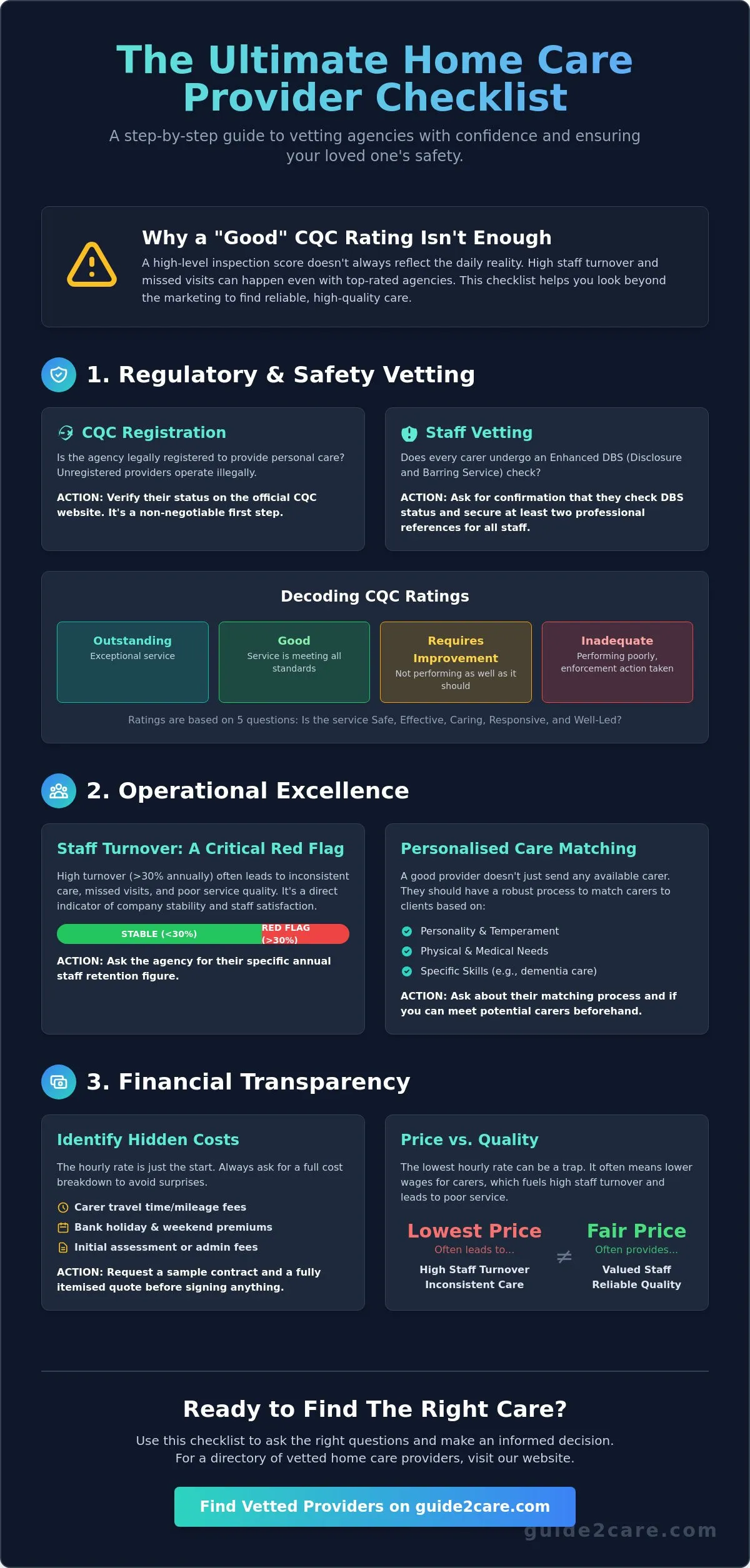
The Ultimate Home Care Provider Checklist: Choosing Domiciliary Care in 2026

Does a "Good" CQC rating actually guarantee your loved one won't face a "no-show" carer this winter? Many UK families discover that a high-level inspection score doesn't always reflect the daily reality of staff turnover or punctuality. Finding the right domiciliary care requires looking past the marketing brochures to the hard data. Use this home care provider checklist to vet agencies with precision and ensure legal compliance.
You likely feel overwhelmed by complex care contracts and the fear of hidden costs. It's difficult to compare providers when every agency uses different terminology. This guide simplifies your search by offering a comprehensive, step-by-step framework to evaluate safety and value. It's a practical tool designed to remove uncertainty from the selection process.
We'll break down the essential vetting criteria, explain how to interpret the latest 2026 regulatory standards, and provide a side-by-side comparison tool for your top choices. Explore the steps below to find the care you need with confidence.
Key Takeaways
- Verify regulatory compliance by learning how to check Care Quality Commission (CQC) ratings and registration status for any UK agency.
- Evaluate the care matching process to ensure providers align specific carers with the client’s personality and physical requirements.
- Use our comprehensive home care provider checklist to objectively compare agencies and ensure no critical safety or quality standards are overlooked.
- Identify hidden costs in care contracts, including travel time and bank holiday premiums, to understand the full financial commitment.
- Finalise your decision by applying a structured scoring system and using the Guide2Care directory to find the care you need.
Understanding Home Care: Why a Structured Selection Process is Vital
Domiciliary care refers to professional support services provided within a person's private residence. It differs from residential care, which requires moving into a care home, and live-in care, where a professional resides on-site 24/7. Understanding Domiciliary Care helps families identify the specific level of assistance required to maintain safety and comfort at home without the upheaval of relocation.
Selecting the right agency involves high emotional and financial stakes. A poor choice can lead to inconsistent support, safety risks, or rapid health decline. Most families experience significant decision fatigue because they must evaluate dozens of local agencies under pressure. Using a structured home care provider checklist eliminates guesswork and provides a clear framework for comparison. In England, the Care Quality Commission (CQC) regulates these services, providing public ratings based on whether a service is safe, effective, caring, responsive, and well-led.
To better understand this concept, watch this helpful video:
The Benefits of Personalised Care at Home
Home care allows individuals to stay in familiar surroundings, which is vital for maintaining cognitive health and emotional well-being. It's often more cost-effective than residential options. Average residential care costs in the UK frequently exceed £800 to £1,200 per week, whereas hourly domiciliary care allows families to pay only for the specific support needed. This model provides one-to-one attention that staff in busy residential homes cannot always match. You receive a dedicated professional focused entirely on your specific requirements during their visit, ensuring a higher level of personalised interaction; for those who wish to maintain their property to an equally high standard, Maintain Clean Ltd offers premium cleaning services for residential properties.
Beyond medical and personal care, keeping a clean living environment is crucial for health and safety; to find dependable help with household chores, you can check out Cleaner Connect to find reliable local cleaners in your area.
A holistic home care plan often extends to the well-being of your pets, who are essential for emotional support. If you require assistance with dog walking or mobile grooming to maintain your household's routine, hnhdog.co.uk provides professional pet care services; additionally, you can learn more about award-winning veterinary care in London to ensure your animals are supported alongside you.
Beyond pet care and cleaning, ensuring you have the right equipment for daily tasks is vital for safety; FIVESTEP 五步健 is a one-stop shopping platform for the elderly and rehabilitants that offers a wide range of products to support independent living.
Common Pitfalls in Choosing a Provider
Don't choose an agency based on the lowest price alone. Low hourly rates often indicate low staff wages, which directly leads to high staff turnover and poor service quality. Ask specifically about their annual staff retention figures; a turnover rate exceeding 30% often signals instability. Another major error is failing to verify registration. Always check the CQC website to confirm the agency is registered and read their latest inspection report. This home care provider checklist ensures you verify these credentials and contract terms before making a commitment. Avoid agencies that cannot provide clear evidence of their staff training protocols or insurance coverage.
The Regulatory Essentials: Vetting, Training, and CQC Compliance
A regulated care provider in the UK is an agency registered with the Care Quality Commission (CQC). This registration is a legal requirement for any business providing personal care, such as help with dressing, bathing, or medication. Use your home care provider checklist to confirm the agency holds a current registration. You can verify this status by searching the provider's name or postcode on the official CQC website. If an agency isn't registered, they cannot legally provide personal care services in England.
Inspectors assess every registered agency using five key questions. They ask if the service is safe, effective, caring, responsive, and well-led. Safe services protect people from abuse and avoidable harm. Well-led services have high management standards and a clear culture of improvement. Always ask a prospective agency for their latest inspection scores across these five categories.
Staff recruitment requires strict protocols to ensure safety. Every carer must undergo an Enhanced Disclosure and Barring Service (DBS) check to screen for criminal records. Agencies must also secure at least two professional references and verify the person's right to work in the UK. This Elder Law Answers checklist offers a useful framework for evaluating these operational standards during your initial interviews.
Decoding CQC Ratings for Home Care
CQC ratings range from "Outstanding" to "Inadequate." An "Outstanding" rating is awarded to only 3% to 5% of providers who demonstrate exceptional care and innovation. A "Good" rating means the agency meets all legal expectations and provides safe care. Treat "Requires Improvement" as a red flag. This rating often indicates recurring issues with record-keeping or management oversight. Always download the full report. Look at the "Summary of Findings" to see if failings occurred within the last 12 months.
Staff Training and Professional Development
Mandatory training is essential for all domiciliary staff. This includes manual handling, safeguarding adults, and medication management. If your family member has a specific condition, check for specialized certifications. Ask if staff have received dedicated training for dementia, Parkinson’s, or end-of-life care. High-quality agencies don't just train once; they provide ongoing supervision and annual appraisals. This support structure ensures carers remain competent and updated on the latest health protocols. You can find the care you need by comparing how different agencies manage their staff development. This ensures the home care provider checklist you use prioritizes long-term safety and expertise.
For families managing specific physical or developmental conditions, resources from specialized providers such as Accessible Care can offer valuable insights into targeted therapies that enhance daily living outcomes.
Operational Excellence: Evaluating Care Matching and Monitoring
Operational standards define the safety and reliability of domiciliary care. Every engagement begins with a formal Care Assessment. A senior staff member or Care Manager visits the home to identify clinical requirements, mobility risks, and personal preferences. This step is mandatory. It ensures the agency can actually meet your specific needs before any contract is signed. Use your home care provider checklist to confirm that this assessment includes a full environmental risk review of the property.
When clinical requirements are complex, families may look for specialized medical support to supplement their care plan; MyHomeDoc offers professional GP and specialist house calls that bring expert medical attention directly to the patient's door, ensuring a holistic approach to home-based health.
Effective agencies don't just assign the first available staff member. They match carers based on personality and specialized training. If a client has advanced dementia, the agency should provide a carer with a Level 2 or 3 Diploma in Health and Social Care specifically focused on cognitive decline. Technology facilitates this oversight. By 2026, most reputable UK providers use digital logging systems. These platforms allow families to see real-time updates on medication administration and daily activities via secure mobile apps. Data from 2024 indicates that agencies using digital care records reduced medication recording errors by approximately 15%.
Contingency planning is a vital part of operational success. Ask about the "Sick Carer" protocol. Reliable agencies maintain a "shadow" roster or a dedicated rapid-response team to cover short-notice absences. You should expect a replacement carer to arrive within 60 minutes for essential visits like morning routines or medication prompts.
Communication and Consistency
Consistency is the primary concern for most families. You should ask if the agency utilizes a "Care Team" model. This involves a small group of 3 or 4 regular carers who rotate shifts. This structure prevents the confusion of having a different stranger in the house every day. The Care Manager acts as your primary point of contact for all administrative queries. They're responsible for notifying you of any schedule changes. Professional agencies aim to communicate any delay of more than 15 minutes immediately via phone or app notification.
Monitoring Quality and Handling Complaints
Quality control requires active supervision. Agencies conduct "spot checks" where a supervisor visits during a scheduled call to observe the carer's performance. These happen unannounced at least once every quarter. The Care Plan itself isn't a static document. It requires a formal review every 6 months, or sooner if a health condition changes or a hospital discharge occurs.
Every UK provider must have a transparent complaints procedure. This policy should outline clear timelines. Under Care Quality Commission (CQC) standards, you can expect an initial acknowledgement of a complaint within 2 working days and a full written response within 28 days. Having this process documented ensures accountability when service levels don't meet expectations. This transparency is a key element of any home care provider checklist.
Financial Transparency: A Checklist for Costs, Contracts, and Funding
In 2026, the average cost of domiciliary care in the UK is projected at £38 per hour, though rates typically range from £34 to £42 depending on your specific region. Understanding these figures helps you build an accurate budget for long-term support. Use this home care provider checklist to identify potential expenses that aren't always listed in the base hourly rate.
Hidden costs can quickly increase your monthly bill. Check if the provider charges for these specific items:
- Travel time and mileage: Some agencies charge for the time carers spend traveling between clients, while others include it in the hourly fee.
- Bank holiday premiums: Rates often increase to 1.5x or 2x the standard fee on public holidays.
- Initial assessment fees: You might pay a one-off fee, often between £50 and £150, to establish the initial care plan.
- Administration and PPE: Verify if there are separate monthly charges for personal protective equipment or account management.
Review the care contract for notice periods and termination clauses before signing any agreement. Most UK providers require 14 to 28 days of notice to end services or change the care schedule. It's also vital to distinguish between private pay and local authority funding. If you're a self-funder, you pay the full rate directly. Local authority funding is only triggered if your capital falls below the £23,250 threshold in England, though this limit varies in Scotland and Wales.
Essential Questions for the Finance Department
Don't assume all agencies operate with the same billing structure. Ask if there's a minimum requirement of hours per week. Many providers mandate at least 5 to 10 hours of service to maintain a contract. Inquire about additional charges for complex care needs, such as stoma care or specialized dementia support. Confirm how often invoices are sent; most agencies bill fortnightly or monthly with a 14 day payment window.
Exploring Funding Options in the UK
You may be eligible for financial assistance regardless of your savings. Attendance Allowance and Personal Independence Payment (PIP) are non-means-tested benefits that provide weekly payments to help with care costs. If your needs are primarily health-based rather than social, you might qualify for NHS Continuing Healthcare (CHC). This covers the full cost of care. For those with limited assets, local authority means-testing remains the primary route for council-funded support as part of your home care provider checklist.
Find the right support for your budget and explore Guide2Care to compare local provider options.
Making Your Final Decision: Using the Guide2Care Directory
After completing your home care provider checklist for several agencies, you must synthesise your findings to make an objective choice. Use a simple scoring system from 1 to 5 for categories such as CQC ratings, staff consistency, and response times. An agency that scores highly on paper but failed to return your initial call within 24 hours may struggle with communication once care begins. Compare these scores against your specific budget and requirements to identify the top two candidates.
Trust your instincts during the assessment. Observe the interaction between the assessor and the person who needs care. If the professional speaks over the care recipient or ignores their preferences, the culture of that agency may not be truly person-centred. High-quality domiciliary care relies on mutual respect and a positive rapport. If the "gut feeling" is negative, the data points won't compensate for a lack of personal chemistry.
Prioritise local providers to ensure service reliability. Agencies based within a 5-mile radius of your home generally offer better punctuality. According to industry data, travel time is a leading cause of carer fatigue and late arrivals in the UK care sector. A local provider can respond more quickly to emergencies or last-minute schedule changes. Before signing a contract, request a 14-day trial period. Most reputable agencies allow this initial window to ensure the carer and the client are a good match before you commit to a long-term arrangement.
This commitment to client satisfaction is a core value for many top-tier providers; for example, Accessible Care emphasizes a person-centred approach in their specialized disability support to ensure the best possible match for every individual.
Find Your Care Provider on Guide2Care
The Guide2Care directory simplifies your search by categorising providers based on their specific expertise. You can use our search filters to find agencies that specialise in dementia support, live-in care, or complex medical needs. This targeted approach ensures you only spend time reviewing providers equipped to handle your specific situation.
- Compare data: View CQC ratings and service types in a standardised format to make direct comparisons easier.
- Specific filters: Search by postcode to find the most reliable local agencies near you.
- Resource access: Use our platform to find detailed information on different funding care options and eligibility criteria.
Your Next Steps
Finalising your care arrangements requires a structured approach. Follow these three steps to move from research to active support:
- Download the checklist: Print our home care provider checklist to use as a reference during your face-to-face interviews.
- Shortlist three agencies: Contact three local providers today to book an initial phone consultation.
- Check funding: Read our latest articles to understand if you're eligible for local authority support or Attendance Allowance.
Taking these steps ensures you find the care you need with confidence and clarity. Use the tools available on Guide2Care to streamline your search and secure high-quality support for your family.
Take Control of Your Home Care Search
Selecting the right domiciliary support in 2026 requires a structured method to ensure safety and financial clarity. Always verify that a provider maintains a "Good" or "Outstanding" rating from the Care Quality Commission (CQC), the independent regulator of health and social care in England. This home care provider checklist serves as your framework for evaluating staff training, care matching, and contract transparency. By focusing on these operational essentials, you eliminate ambiguity and secure a service that meets specific health requirements and budget constraints; for those looking to learn more about how these standards of non-medical support are maintained by professional agencies, viewing established care models can provide valuable context.
Guide2Care provides the tools you need to make an informed decision without the stress. Our platform features a comprehensive database of UK-wide care providers, with verified CQC registration links included for every listing. You can also access free expert resources that explain complex funding rules and care selection criteria. Use these professional insights to navigate the UK care sector with confidence and efficiency.
Find The Care You Need on the Guide2Care Directory
Start your search now to find a provider that offers the high standards of support your family deserves. As you plan for your household's future, don't forget the well-being of your animal companions; pet owners in the capital can discover London Veterinary Surgeries for independent, award-winning care.
Frequently Asked Questions
How do I know if a home care provider is reliable?
A reliable home care provider is registered with the Care Quality Commission (CQC) and maintains a "Good" or "Outstanding" rating. Look for agencies with a staff turnover rate below the 2023 industry average of 28.3%. You should also check independent review platforms to verify their consistency in service delivery and punctuality.
What is the difference between a care agency and an introductory agency?
A care agency employs and manages carers directly, taking full responsibility for their training, insurance, and scheduling. Professional agencies often use specialist HR support to maintain these standards; to see how this works in other customer-facing industries, visit Altum HR. An introductory agency acts as a middleman to match you with a self-employed carer who you then manage yourself. Introductory agencies aren't regulated by the CQC for the actual delivery of care, whereas full care agencies must meet strict regulatory standards.
Can I change my home care provider if I am not happy?
You can change your home care provider at any time by following the notice period stated in your contract. Most contracts require between 14 and 28 days of notice to terminate the agreement. Use your home care provider checklist to compare new options and ensure a smooth transition without gaps in your daily support.
How much does home care cost per hour in the UK in 2026?
Home care costs in the UK for 2026 typically range from £30 to £36 per hour depending on your location. These rates reflect the National Living Wage increases and rising operational costs for providers over the last two years. Prices in London and the South East often sit 15% higher than the national average due to increased regional overheads.
Is home care cheaper than a care home?
Home care is generally cheaper than a residential care home if you require fewer than 35 hours of support per week. The average weekly cost for a residential care home in 2024 reached £800 to £1,000, while 14 hours of domiciliary care costs approximately £420 to £500. If you need round-the-clock supervision, live-in care costs may equal or exceed residential fees.
What should I look for in a CQC report?
Check the ratings for the five key questions: is the service safe, effective, caring, responsive, and well-led? Pay close attention to the "Safe" category, as this details how the provider manages medicines and risk. A report dated within the last 24 months provides the most accurate reflection of current management and safety standards.
What happens if my carer doesn’t show up?
If a carer doesn't show up, contact the agency's emergency line immediately to request a replacement. Regulated providers must have a contingency plan to cover staff absences and emergencies. Your home care provider checklist should include a requirement for the agency to notify you within 15 minutes of a missed arrival time.
Do home care agencies provide 24-hour care?
Many home care agencies provide 24-hour care through live-in care services or waking night shifts. Live-in care involves one professional living in your home, while 24-hour domiciliary care usually uses a rotation of three carers working 8-hour shifts. This ensures constant supervision for individuals with complex needs or advanced dementia who cannot be left alone. For those seeking specialized disability support models, Accessible Care offers comprehensive services that prioritize safety and independence.