Monitoring the Quality of Home Care: A Complete Guide for Families in 2026

A Care Quality Commission (CQC) 'Good' rating is a baseline for safety, but it doesn't guarantee that a provider meets your family's personal standards every day. Consistently monitoring the quality of home care is the only way to ensure that daily support remains safe and effective. It requires active, structured oversight rather than passive trust.
You likely feel that once a domiciliary care agency is hired, the responsibility for quality lies entirely with them. It's common to worry that raising concerns makes you a nuisance or that you're missing signs of "invisible" poor practice because of complex UK regulatory jargon.
This guide empowers you with professional benchmarks and practical tools to track performance accurately. You'll learn how to interpret 2026 CQC data and communicate with providers to ensure your loved one receives the highest standard of support.
We provide a structured quality checklist and a clear framework for using feedback to build a stronger, more transparent relationship with your care agency.
Key Takeaways
- Understand how the CQC’s "Five Key Questions" provide a professional framework for assessing safety and effectiveness in domiciliary care.
- Learn to use the Personalised Care Plan as the primary tool for monitoring the quality of home care and tracking clinical outcomes.
- Discover how to leverage digital care management systems and active observation techniques to ensure consistent standards during family visits.
- Identify critical red flags across physical and administrative areas and learn the correct procedure for raising concerns with providers.
- Find out how to use independent reviews and quality ratings to compare and select the highest-rated care providers in your local area.
Defining Quality in Home Care: The UK Regulatory Framework
Domiciliary care quality is the consistent delivery of personalised support that meets both clinical and emotional needs. Monitoring the quality of home care requires a firm grasp of the UK regulatory framework. In England, the Care Quality Commission (CQC) sets these standards. Similar oversight comes from the Care Inspectorate in Scotland and Care Inspectorate Wales (CIW). These bodies ensure that Social care in England remains accountable and safe for all service users.
To better understand this concept, watch this helpful video:
The Five Key Questions Inspectors Ask
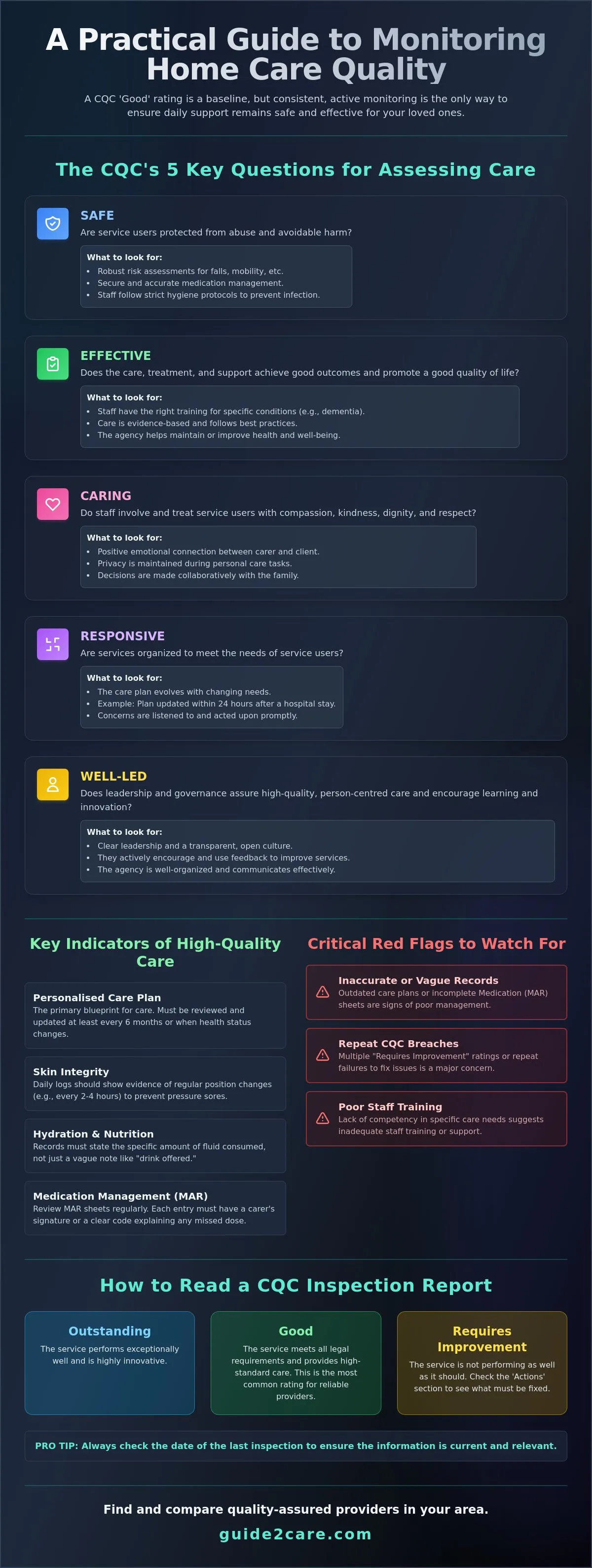
CQC inspectors use five categories to rate providers. Safe care involves robust risk assessments and secure medication management. For example, a safe agency ensures staff follow strict hygiene protocols to prevent infections. Effective care focuses on outcomes and staff competency, which is often supported by advanced degrees from UK Home Students. Inspectors check if caregivers have the right training to manage specific conditions like dementia or mobility issues. They look for evidence that staff apply their learning to daily tasks.
Caring is measured by how staff treat individuals with dignity and respect. It's about the emotional connection and privacy maintained during personal care. Responsive care means the support plan evolves. If a person's health declines after a hospital stay, a responsive provider updates the care plan within 24 hours to reflect new needs. Well-led agencies have clear leadership and a transparent culture. They encourage feedback from families to improve services constantly.
To maintain such high standards of responsiveness and leadership around the clock, many top-tier providers partner with specialist operational support teams; you can check out Contesto to learn how professional out-of-hours management helps agencies stay well-led.
How to Read a 2026 CQC Inspection Report
Start with the Summary section. This provides a snapshot of the agency's performance across all five categories. An Outstanding rating means the agency performs exceptionally well and is highly innovative. A Good rating confirms the service meets all legal requirements and provides high-standard care. Most providers fall into the Good category, which represents a reliable level of service.
Pay close attention to a Requires Improvement rating. This indicates the service isn't performing as well as it should. Check the Actions or Breaches section to see what the CQC ordered the agency to fix. In 2026, reports highlight whether an agency has successfully addressed previous failures. If a provider has multiple repeat breaches, it's a major red flag for families monitoring the quality of home care. Always verify the date of the last inspection to ensure the data is current.
Key Indicators of High-Quality Domiciliary Care
The personalised care plan serves as the primary blueprint for monitoring the quality of home care. This document details every specific need, from preferred routines to medical requirements. A high-quality provider reviews and updates this plan at least every six months or whenever a client's health status changes. If the care plan is outdated or vague, the service is likely failing to meet individual needs. Safeguarding policies provide the essential baseline for any safe service. These policies must align with the fundamental standards set by the Care Quality Commission (CQC). Check that the agency has a clear, accessible procedure for reporting and investigating concerns.
Clinical and Physical Well-being Markers
Effective monitoring requires a close look at daily records and clinical data. For clients with limited mobility, skin integrity is a critical marker. Daily logs should show evidence of regular position changes, often required every 2 to 4 hours to prevent pressure sores. Tracking hydration and nutrition is equally vital. Records must state the specific amount of fluid consumed rather than just noting that a drink was offered.
Medication management is another high-priority indicator. Review the Medication Administration Record (MAR) sheets regularly. Each entry must have a carer's signature or a specific code explaining why a dose was missed. Inaccurate MAR sheets are a significant red flag. They often suggest a lack of staff training or poor internal auditing by the agency management. To see how professional safety training and consultancy can improve these internal processes, you can visit Guardian Safety.
- Skin Integrity: Look for specific mentions of skin checks in daily notes.
- Hydration: Ensure records show a minimum daily fluid target is being met.
- Medication: Verify that MAR sheets are signed in real-time.
Social and Emotional Quality Indicators
Quality care extends beyond physical tasks. Staff consistency is one of the most reliable indicators of a healthy service. High-quality providers aim for a small, dedicated team of 2 or 3 regular carers. If a different stranger arrives for every visit, the agency likely suffers from high staff turnover, which compromises safety and comfort. Continuity allows carers to notice subtle changes in a client's mood or physical condition that a new person might miss; to understand the professional standards expected in these roles, you can explore Support work at Accessible Care.
Observe how carers interact with your family member. They should engage in meaningful conversation rather than performing tasks in silence. Empowerment is also a key marker of quality. The client should feel in control of their daily routine, including choosing their own meal times and outfits. If you are starting your search, you can find the care you need by filtering providers based on their specific specialisms and inspection ratings.
Assess whether the carer treats the home with respect. Small details, like tidying up after a meal or ensuring the client's preferred items are within reach, indicate a high level of professional pride. Hygiene is also a vital component of a safe home; for instance, families in the Suffolk area might use professional carpet cleaning Ipswich to ensure that living spaces remain allergen-free and well-maintained. These soft indicators often reveal more about the agency's culture than formal paperwork alone.
Practical Strategies for Monitoring Care Quality at Home
Effective monitoring the quality of home care requires a shift from passive oversight to active observation. Establish a partnership approach with the agency manager from the start. Treat the provider as a collaborator rather than an adversary. This transparency allows for quicker resolutions when issues arise. Use your visits to perform active observation, which involves looking for specific indicators that the care plan is being followed accurately.
A central tool in this process is the communication log. While traditional paper books still exist, most modern services now use digital equivalents. These logs should record every visit, medication dose, and meal. Consistency is vital. If entries become sporadic or vague, address this with the agency immediately to prevent a decline in standards.
Utilising Digital Care Logs and Apps
By 2026, UK home care agencies typically provide family access to platforms like Log my Care or Nourish. These secure portals deliver real-time updates directly to your smartphone. Review these notes daily to ensure they are descriptive. A high-quality note might state "client ate 75% of their chicken stew and enjoyed a short walk," whereas a poor note simply ticks a box. Use the built-in alert systems to receive instant notifications for missed visits or medication delays. This technology provides an objective data trail that makes monitoring the quality of home care more precise and less reliant on guesswork.
Conducting "Quality Visits" Without Being Intrusive
Visits should feel like social calls, but they serve a dual purpose. Check the home environment for subtle clues about care standards. Open the fridge to ensure food is within its expiry date and check that laundry isn't piling up. These small details often reflect the carer's attention to detail. If you are still researching providers, consult Age UK for advice on how to find the care you need at home and what standards to expect.
Engage your loved one with open-ended questions rather than simple "yes" or "no" queries. Ask things like "What did you and the carer do this morning?" or "How was the help with your exercises today?" Listen for inconsistencies in their routine. Observe their physical appearance and emotional state carefully. Watch for subtle shifts like increased withdrawal or uncharacteristic agitation that signal shifts in care quality. If you notice these changes, document them in the digital portal or communication book to discuss with the care manager during your next review.
Identifying Red Flags and Addressing Poor Care
Effective monitoring the quality of home care involves recognizing subtle shifts in a loved one's health or environment. Families often fear that raising concerns will lead to "retaliation" or a sudden withdrawal of service. Under Care Quality Commission (CQC) regulations, providers must have a clear policy for handling complaints without bias. You have a legal right to voice concerns. Professional agencies view feedback as a tool for improvement, not a reason to penalize the service user.
Warning Signs You Should Never Ignore
Red flags generally fall into three categories: physical, environmental, and administrative. Watch for these specific indicators during your regular checks:
- Physical signs: Unexplained bruises, skin tears, or a noticeable weight loss of more than 2kg in a single month. Poor personal hygiene or frequent "minor" falls often suggest inadequate supervision.
- Environmental signs: Carers consistently arriving more than 15 minutes late or leaving early. If a carer appears distracted by their phone or rushed during tasks, the quality of care drops.
- Administrative signs: Discrepancies between the digital or paper care log and reality. For example, a log might state a meal was prepared at 12:00 PM, but the kitchen remains untouched at 1:00 PM.
The Step-by-Step Escalation Process
If you identify issues while monitoring the quality of home care, follow this structured path to resolve them. Every UK agency must provide a formal grievance procedure document upon request.
Step 1: Informal Discussion. Speak directly with the carer or their immediate supervisor. Many issues, like timing or meal preferences, result from simple misunderstandings. State your requirements clearly and set a date to review the changes.
Step 2: Formal Written Complaint. If the issue persists, write to the Registered Manager. Use the agency's formal grievance procedure. Detail the specific dates, times, and nature of the failures. The agency must acknowledge your complaint and provide a written response within a set timeframe, usually 28 days.
Step 3: External Escalation. If the internal response is inadequate, contact the Local Government and Social Care Ombudsman. While the CQC doesn't resolve individual complaints, you should still inform them of poor standards to assist their inspection process.
Serious issues require a different approach. If you suspect neglect, financial abuse, or physical harm, this is a "Safeguarding Concern." You must report this immediately to the Local Authority Safeguarding Adults Board. They have a statutory duty under the Care Act 2014 to investigate and protect individuals at risk.
Finding and Comparing Quality-Assured Providers
Monitoring the quality of home care starts with a rigorous selection process. Families shouldn't rely on word-of-mouth alone. Instead, use a structured directory to filter providers based on objective quality ratings and regulatory compliance. This data-driven approach ensures that the agencies you shortlist have already met essential safety and effectiveness standards.
Local Authority Approved status serves as a vital secondary layer of assurance. When an agency is "approved," it means they've passed the stringent financial and quality audits required to join a council's framework. This status often indicates a higher level of stability and a commitment to meeting local government standards. Additionally, independent reviews from local families provide context that data cannot. Look for specific feedback regarding punctuality, staff consistency, and the agency's responsiveness to concerns.
Using Guide2Care to Benchmark Options
Guide2Care simplifies the initial search by providing a centralized hub for provider data. You can search for agencies by postcode and immediately filter results by "Type of Care," such as Dementia or Palliative care. This ensures you only view providers with the specific expertise your family requires.
- CQC Ratings: View Care Quality Commission ratings directly within the listings to identify "Good" or "Outstanding" providers.
- Detailed Descriptions: Identify agencies that have invested in premium listings. These often include comprehensive details on staff training, specialized equipment, and specific service protocols.
- Service Comparison: Use the directory to compare multiple agencies side-by-side, focusing on their specific service offerings and regulatory history.
Next Steps: Booking a Quality Assessment
Once you've shortlisted providers, the next step is a formal home care assessment. This meeting is your opportunity to gauge an agency's transparency. Don't hesitate to ask direct questions about their internal systems for monitoring the quality of home care. A high-quality provider will have clear, documented processes for managing feedback and incidents.
Ask these specific questions during the assessment:
- What is your current staff turnover rate for this local area?
- How do you ensure care continuity if a regular carer is unavailable?
- Can we agree on a two-week trial period before committing to a long-term contract?
Requesting a trial period is a practical way to observe the service in action. It allows you to monitor staff punctuality and the rapport between the carer and your loved one without the pressure of a permanent commitment. Use this time to verify that the agency's performance matches their directory listing and CQC rating.
For families who also require clinical oversight, you can check out MyHomeDoc to see how professional GP and specialist house calls are delivered as part of a comprehensive home health strategy.
Taking Control of Your Home Care Standards
Effective monitoring the quality of home care starts with understanding the Care Quality Commission (CQC) standards that govern the UK care sector. Families should focus on measurable indicators such as the consistency of care workers and the accuracy of daily logs. It's essential to act quickly if you spot red flags like missed appointments or unexplained changes in a loved one's well-being. By 2026, digital monitoring tools and transparent reporting have become standard requirements for high-quality domiciliary care providers.
You don't have to manage this process alone. Guide2Care provides the tools you need to compare providers based on objective data. We offer a comprehensive directory of UK-wide care providers and integrated CQC ratings to ensure your decision is based on facts. You'll also find expert guides on funding and selecting the right care level for your specific needs. Use these resources to build a safe and reliable care plan.
Find The Care You Need on Guide2Care and ensure your family receives the high standard of support they deserve.
Frequently Asked Questions
How often should I check the quality of my loved one’s home care?
You should monitor the quality of home care through informal weekly check-ins and formal monthly reviews. Weekly visits allow you to spot immediate changes in hygiene or mood. Every 30 days, review the digital care logs provided by the agency to ensure all tasks are completed. Consistent observation helps identify issues before they escalate into serious safety concerns.
What is the most important indicator of good home care?
Continuity of care is the most critical indicator of a high quality service. When the same carer visits 90% of the time, they build a deep understanding of your loved one's needs. This stability leads to better health outcomes and reduces anxiety. Look for low staff turnover rates, as high quality providers prioritise retaining experienced staff to maintain these vital relationships.
Can I install cameras (CCTV) to monitor care quality in the UK?
You can legally install cameras in a private home for monitoring purposes, but you must follow UK GDPR and privacy laws. It's essential to inform the home care agency and the individual carers about the surveillance. You should also obtain the consent of the person receiving care if they have the mental capacity to give it. Overt monitoring is generally preferred over covert methods to maintain trust.
What should I do if the CQC rating of my current provider drops?
Request a meeting with the registered manager immediately to discuss the Care Quality Commission (CQC) inspection findings. Review the "Requires Improvement" or "Inadequate" report to identify specific failings in safety or leadership. Ask for a written action plan detailing how they'll rectify these issues within a set timeframe. If the provider fails to show progress in 3 to 6 months, consider switching to a higher-rated agency.
How do I know if the carers are properly trained for specific needs like dementia?
Ask the agency to provide proof of specialist training, such as the Level 2 or 3 Diploma in Health and Social Care with a dementia pathway. It is also common for senior care staff to pursue further academic qualifications through UK Home Students to enhance their clinical and management skills. Reputable providers ensure staff complete the Care Certificate, which includes 15 minimum standards of care. Verify that the agency conducts annual refresher courses. You can also observe if the carer uses specific techniques, like the validation method, during their visits.
Who can I talk to if I am unhappy with the agency’s response to my complaint?
Escalate your complaint to the Local Government and Social Care Ombudsman (LGSCO) if the agency's internal process fails to resolve the issue. This service is free and independent. If the local council funds the care, you can also contact their social services department. While the CQC doesn't resolve individual complaints, you should still share your feedback with them to inform their future inspections.
To avoid reaching this stage, it's beneficial to choose providers that invest in professional oversight; you can learn more about Contesto to understand how operational support helps agencies address issues before they become formal complaints.
Is a higher price always a sign of better quality home care?
What happens if a home care agency is rated "Inadequate" by the CQC?
The CQC places an agency in "Special Measures" if they receive an "Inadequate" rating. This status gives the provider a maximum of six months to make significant improvements. If the agency fails to improve during this period, the CQC can cancel their registration, effectively forcing them to close. During this time, monitoring the quality of home care becomes vital to ensure the safety of your loved one.