Nursing Care Providers in Glasgow: 2026 Guide to the Best Services

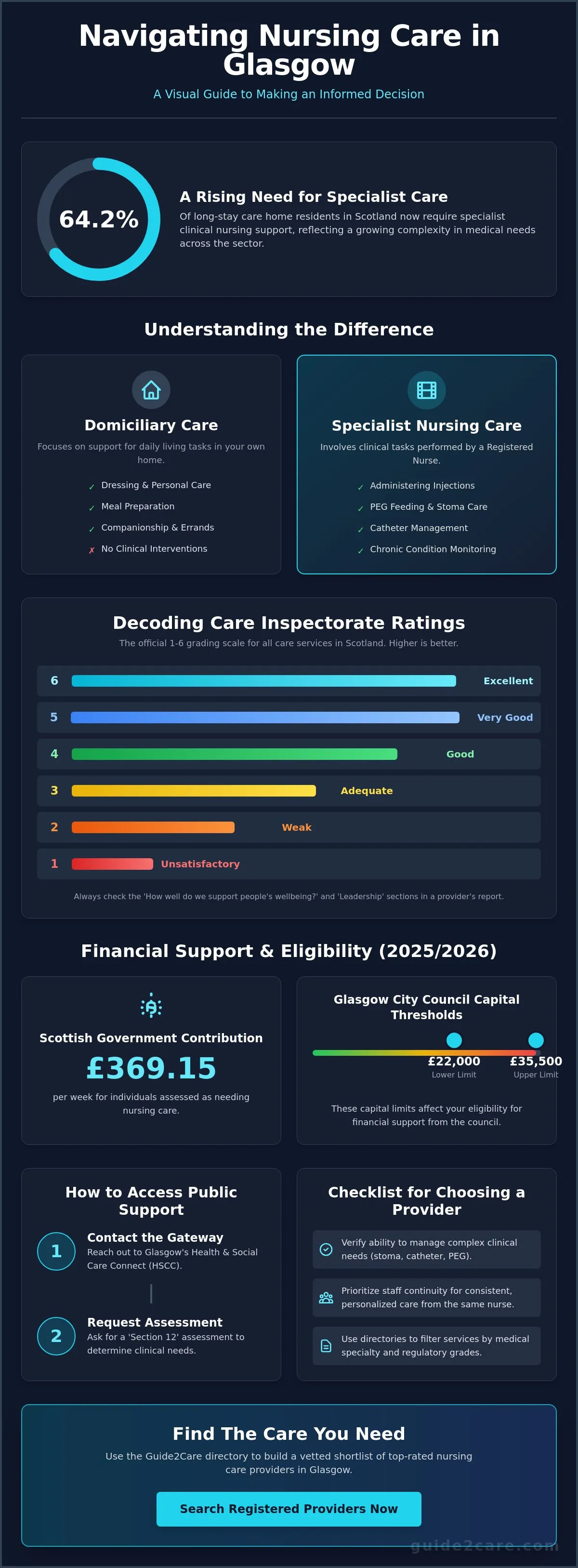
64.2% of long-stay care home residents in Scotland now require specialist nursing care. This figure represents a steady increase in clinical complexity across the sector. Identifying the right nursing care providers in Glasgow is a critical task that often begins with confusion over Care Inspectorate ratings and the specific distinction between basic domiciliary support and registered nursing.
It's natural to feel anxious about the costs of private care or the complexity of local funding. For the 2025/2026 period, the Scottish Government provides a weekly contribution of £369.15 for those assessed as needing nursing care. This guide helps you find the care you need by providing a vetted list of top-rated services and explaining how Glasgow City Council's capital thresholds, currently set between £22,000 and £35,500, affect your financial eligibility. You'll gain a clear understanding of self-directed support pathways and the practical steps to secure high-quality medical care for your loved one.
Key Takeaways
- Interpret Care Inspectorate reports using the 1-6 grading scale to evaluate the clinical performance of nursing care providers in Glasgow.
- Access public support pathways by requesting a 'Section 12' assessment through Glasgow's Health & Social Care Connect (HSCC) gateway.
- Verify a provider's ability to manage complex clinical requirements, including stoma care, catheter management, and PEG feeding.
- Prioritize staff continuity to ensure medical support is delivered by the same registered nurses for better care outcomes.
- Use the Guide2Care directory to filter services by specific medical specialties and current regulatory grades to build a vetted shortlist.
Navigating the Nursing Care Landscape in Glasgow
Nursing care in Glasgow is defined by clinical interventions delivered by registered nurses. This support takes place in private residences or specialized facilities. As of May 2026, demand for complex care in the West of Scotland has reached record levels. Data from early 2026 shows that 64.2% of long-stay residents now require clinical nursing support. This shift reflects an aging population with increasingly complex medical needs. Understanding the legislative framework of Social Care in Scotland helps families distinguish between basic assistance and regulated medical care.
To understand how Advanced Practice Nurses support care home residents in the region, watch this video from NHS Greater Glasgow and Clyde:
Specialist nursing care differs significantly from standard domiciliary care. While domiciliary care focuses on daily living tasks like dressing or meal preparation, nursing care involves technical medical tasks. These include managing PEG feeding tubes, administering injections, and monitoring chronic respiratory conditions. Proximity to major hubs like the Queen Elizabeth University Hospital (QEUH) is vital for efficient care coordination. Top nursing care providers in Glasgow often work directly with hospital discharge teams to ensure a safe transition from clinical wards to home environments.
Home Nursing vs. Residential Nursing Homes in Glasgow
Choosing between home visits and a residential facility depends on the level of clinical risk. Home nursing offers flexibility and allows patients to remain in familiar surroundings. However, Glasgow’s geography can impact response times. Agencies operating in the West End or Southside may face longer travel times during peak traffic, affecting urgent call-outs. Residential nursing homes provide 24/7 security with onsite medical staff. A cost-benefit analysis often shows that while home care feels less clinical, the infrastructure of a facility provides more immediate access to emergency equipment and round-the-clock supervision. For those who require high-level medical accessibility at home, Vitals Healthcare demonstrates how 24/7 doctor-on-call services can ensure professional care is always available at your doorstep.
Why Families are Choosing Private Nursing Agencies in 2026
Long wait times for council-allocated nursing support drive many families toward the private sector. Private nursing care providers in Glasgow often offer faster assessment turnarounds than public pathways. In 2026, consistency is a primary factor. Private agencies prioritize staff continuity, meaning the same nurse visits for every appointment. This builds trust and ensures the medical professional understands the patient's history. Most top-rated providers now adopt a holistic approach. This means they treat the medical condition while also considering the patient's nutritional needs and mental wellbeing. For pet owners in the region who can no longer manage garden upkeep, professional services like Scot Pooper Scoopers ensure that outdoor spaces remain clean and hygienic.
Understanding Care Inspectorate Ratings and Scottish Standards
The Care Inspectorate acts as the independent regulator for all social care services in Scotland. It monitors nursing care providers in Glasgow to ensure they adhere to strict safety and quality protocols. Each provider is evaluated using a standardized grading scale from 1 to 6. A grade of 1 is 'unsatisfactory', 2 is 'weak', 3 is 'adequate', 4 is 'good', 5 is 'very good', and 6 is 'excellent'. The Health and Social Care Standards provide a framework to ensure that every person receives high-quality care that is dignified, compassionate, and tailored to their specific needs.
Families can verify a provider's current registration status by using the Care Inspectorate's official online portal. This tool displays the most recent inspection dates and any active enforcement notices. If you're starting your search, you can find the care you need by filtering our database of registered providers. This allows you to view grades for specific clinical services before making contact.
How to Read a Glasgow Care Inspectorate Report
Inspection reports for nursing care providers in Glasgow offer a detailed look at clinical performance. Pay close attention to the 'How well do we support people's wellbeing?' category. This section evaluates how effectively the staff manages medical needs and emotional health. The 'Leadership' grade is also vital. It reflects how well the service is managed and whether the staff feel supported to do their jobs safely. You might notice some agencies have a 'registration reset' in their files. This usually happens after a change in corporate ownership. In these instances, look for the most recent report under the new registration number to see current performance levels. Always review the 'Requirements' list. These are legally binding changes the provider must implement within a specific timeframe.
The Impact of 2026 Staffing Standards on Quality
In 2026, new staffing standards have introduced stricter nurse-to-patient ratios for both residential and home-based nursing. These rules prevent staff from being overstretched and ensure that complex medical interventions are performed accurately. Every staff member must maintain registration with the Scottish Social Services Council (SSSC). This body ensures that workers are qualified and fit to practice. The best providers in the city often go beyond these basic requirements. They might employ specialized trainers to keep nurses updated on the latest clinical techniques for chronic condition management. To see how professional safety protocols are developed for complex care environments, you can discover Guardian Safety for specialized consultancy. As of January 30, 2026, there are 1,375 care homes registered in Scotland. The ones with the highest ratings are typically those that maintain high staff retention rates and provide ongoing education for their clinical teams.
Private Nursing Agencies vs. Glasgow City Council Support
Health & Social Care Connect (HSCC) is the primary gateway for accessing public social care in the city. To begin the process, you must request a 'Section 12' assessment. This assessment determines the specific clinical and social needs of the individual. While the council provides essential support, many families find that public resources are stretched. This often leads to a search for private nursing care providers in Glasgow to ensure immediate attention for complex medical conditions. Private agencies offer a faster alternative to council-allocated services, though they require independent funding or the use of specific benefit payments.
Means-testing remains a core part of the Scottish care system in 2026. If an individual's capital exceeds the upper limit of £35,500, they are typically responsible for their own care home fees. Those with capital below £22,000 may receive full financial support for their accommodation. However, nursing care is treated differently. In the 2025/2026 period, the Scottish Government provides a flat-rate contribution of £369.15 per week for nursing care to anyone assessed as needing it, regardless of their personal income. Private providers allow for more control over who enters the home and at what time, which is a significant advantage for those with specific clinical schedules.
Self-Directed Support (SDS) in Glasgow
Self-Directed Support (SDS) gives you choice and control over how your care budget is spent. There are four options available to Glasgow residents. Option 1, known as Direct Payments, is the most flexible. It allows you to receive your care budget directly into a dedicated bank account. You can then use these funds to hire private nursing care providers in Glasgow that meet your specific medical criteria. Option 2 involves you choosing the support while the council manages the money. Option 3 leaves all arrangements to the council, and Option 4 is a mix of these methods. For those over 65, the free nursing care contribution of £369.15 is integrated into these SDS pathways to help offset the cost of registered nurses.
Supplementing Council Care with Private Nursing
There are instances where a standard council care package doesn't cover the full scope of complex medical needs. In these cases, families often supplement public support with private nursing hours. Private agencies in the city coordinate closely with NHS Greater Glasgow and Clyde (NHSGGC) to ensure clinical safety. This is especially important during the transition from hospital discharge to home. If a patient is leaving the Queen Elizabeth University Hospital, a private nurse can be ready to provide immediate PEG feeding or wound management the moment they arrive home. This prevents the "care gaps" that sometimes occur when waiting for local authority staff to be assigned to a new case, a challenge addressed by the rapid-reponse medical models of international providers like Vitals Healthcare.
Key Criteria for Selecting Top-Rated Nursing Providers
Selecting nursing care providers in Glasgow requires a rigorous assessment of clinical capabilities. You must verify that the agency's staff are proficient in specific medical procedures such as stoma maintenance, catheter care, and PEG feeding. Don't assume every registered nurse has recent experience with every medical device. Ask for evidence of competency frameworks and recent clinical training certificates. Staff continuity is equally vital for patient safety. Frequent changes in personnel can lead to missed symptoms or errors in medication administration. A high-quality provider will offer a dedicated lead nurse to ensure clinical oversight remains consistent and personalized.
Inquire about out-of-hours support and emergency protocols. A reliable agency must have a robust plan for medical crises occurring after 5 PM or during weekends. This should include direct access to a clinical manager or a senior nurse rather than just a general call center. Local community reputation in Glasgow serves as a practical indicator of reliability. Request references from local GPs or social workers who have interacted with the agency’s staff in professional settings. If you're ready to evaluate local options, explore nursing care providers in Glasgow to compare clinical specialties and staff availability.
Specialized Nursing: Dementia and Palliative Care
Ask detailed questions about specialized training for vascular dementia or Alzheimer's. Effective care involves more than just physical safety; it requires nurses who understand the behavioral changes associated with cognitive decline. For end-of-life care, evaluate the agency's palliative pathways. They should coordinate seamlessly with local hospices or the NHSGGC palliative care team to manage pain and comfort levels effectively. True holistic care must include emotional support and practical assistance, such as using Scot Pooper Scoopers to maintain garden hygiene, ensuring a clean and dignified environment for the family during these difficult periods.
The Role of Technology in Modern Nursing Care
By May 2026, most top-tier providers use real-time digital care records to improve transparency. These systems allow families to log in and see exactly when a nurse arrived, what medications were administered, and any clinical observations recorded during the visit. Remote monitoring and telecare systems are also becoming standard in Glasgow homes. These tools can detect falls or sudden changes in vital signs, alerting the nursing team immediately. Verify that your chosen provider follows the Data Security and Protection Toolkit (DSPT) standards to ensure all patient data remains confidential and secure.
Find The Care You Need: Using Guide2Care’s Glasgow Directory
Guide2Care simplifies the process of identifying nursing care providers in Glasgow by centralizing regulatory data and clinical specialties. The search for medical support is often fragmented across multiple government portals and private websites. Our directory brings this information into a single, searchable interface. You can apply filters based on specific clinical requirements, such as stoma management or respiratory support. This ensures that the results you see are capable of handling the medical complexities discussed in previous sections.
Using filters for Care Inspectorate grades allows you to prioritize providers with 'Very Good' or 'Excellent' ratings. This structured approach removes the emotional bias often found in marketing materials. You receive impartial facts about staffing levels and inspection history. Once you've identified a suitable match, you can use our platform to contact the agency manager directly. This streamlines your initial inquiry and keeps your search organized in one place.
Step-by-Step: Comparing Providers on Guide2Care
Start by creating a shortlist of 3-4 nursing care providers in Glasgow. Evaluate these candidates based on their specific clinical specializations rather than general location alone. Premium listings on our site offer additional depth. These profiles often include detailed information on staff qualifications and internal training programs that exceed SSSC requirements. Before you make your first call, visit our funding resources. It's essential to understand the current 2025/2026 nursing care contribution of £369.15 per week and how it applies to your personal budget. This preparation prevents financial surprises during the contracting phase.
Booking Your First Assessment
Prepare for your initial meeting by gathering all relevant medical documentation. This includes current medication lists and recent hospital discharge summaries from facilities like the QEUH. During the consultation, use the Guide2Care checklist to ask about emergency protocols and staff continuity. Verify how the agency handles out-of-hours crises and whether you'll have a consistent lead nurse. Finalizing the care contract requires careful attention to the small print. Look for specific clauses regarding notice periods, clinical liability, and how the agency manages temporary staff shortages. A transparent contract is a hallmark of a high-quality provider.
Secure High-Quality Nursing Care Today
Understanding the 2025/2026 capital thresholds and the Care Inspectorate's 1-6 grading system is essential for making an informed choice. You now have the practical tools to distinguish between basic social support and specialist clinical nursing interventions. By focusing on staff continuity and verified medical expertise, you can ensure your loved one receives consistent, professional attention. Navigating these pathways requires accurate data and a clear understanding of the Self-Directed Support options available to residents across the city.
Selecting from the registered nursing care providers in glasgow doesn't have to be a complex process. Guide2Care offers a comprehensive UK-wide directory and expert guides on Scottish care funding to simplify your search. We provide neutral and impartial provider information so you can compare services based on clinical specialization and regulatory performance without marketing bias. Use our platform to build a vetted shortlist and contact agencies directly to arrange your first clinical assessment.
Find The Care You Need in Glasgow - Explore Our Directory. You're now prepared to navigate the local care system with confidence and secure the medical support your family requires.
Frequently Asked Questions
Is nursing care free in Glasgow for those over 65?
Yes, nursing care is free for individuals aged 65 and over who are assessed as needing it. For the 2025/2026 financial year, the Scottish Government provides a weekly contribution of £369.15 for personal and nursing care. This payment is made regardless of your income or capital. However, you may still be responsible for accommodation costs if your capital exceeds the upper threshold of £35,500.
What is the difference between a care home and a nursing home in Scotland?
The primary difference is the presence of registered medical staff onsite. A residential care home provides personal support and assistance with daily living tasks. A nursing home must have a registered nurse on duty 24 hours a day to manage clinical needs. In 2024, data showed that 64.2% of residents in Scottish care homes required this higher level of medical intervention due to complex health conditions.
How do I check if a Glasgow nursing agency is properly registered?
Verify registration through the Care Inspectorate’s official website. Every legitimate service in Scotland must be registered and display a unique service provider number. You can search the database to view current quality grades and read full inspection reports. These documents highlight whether the provider meets the Health and Social Care Standards. Don't use any agency that cannot provide a current registration certificate upon request.
Can I use Direct Payments to pay for a private nurse in Glasgow?
You can use Direct Payments to hire private nursing care providers in Glasgow through Option 1 of Self-Directed Support. This pathway gives you full control over your personal budget. You use the funds to pay for the specific nursing services that meet your clinical needs. You're responsible for managing the payments and ensuring the provider is registered with the Care Inspectorate to maintain safety and quality standards.
What happens if my nursing needs change after the care starts?
Your care plan is a dynamic document that should be reviewed regularly. If your medical condition worsens or stabilizes, the nursing agency or the local authority will conduct a reassessment. This ensures the level of clinical intervention remains appropriate. In Glasgow, the Health & Social Care Connect team manages these reviews for council-funded patients. Private clients can request an immediate review from their agency manager at any time.
How long is the wait for a Glasgow City Council care assessment in 2026?
Wait times for a needs assessment through Health & Social Care Connect depend on the urgency of the situation. High-priority cases, such as those involving hospital discharge from the QEUH, are often processed within 48 to 72 hours. Routine assessments for those living at home may take 4 to 6 weeks. If you require immediate support, private nursing care providers in Glasgow can often conduct their own clinical assessments within 24 hours.
Do nursing care providers in Glasgow offer 24-hour live-in care?
Many specialist agencies in Glasgow provide 24-hour live-in nursing care for patients with complex needs. This service involves a registered nurse living in the home to provide round-the-clock clinical monitoring. For 2026, the estimated cost for this level of support in Scotland ranges from £900 to £1400 per week. It offers a direct alternative to residential nursing home placement for those who prefer to stay in their own environment. For those looking for similar professional 24-hour live-in care solutions in Belgium, Zuster in Huis offers specialized home assistance to help seniors remain independent at home.
Similarly, for those seeking high-standard options in England, NeeryVille Care provides CQC-regulated live-in care services that offer a professional alternative to residential placement.
What should I do if I am unhappy with the quality of nursing care?
Follow the provider’s formal complaints procedure as the first step. Every registered service must have a written policy explaining how they handle grievances. If the provider doesn't resolve the issue, you can escalate the matter to the Care Inspectorate. They're the statutory body responsible for regulating all social care in Scotland. You can submit a complaint online or by phone to trigger an independent investigation into the care quality.