What is Assisted Living in the UK? The Complete 2026 Guide

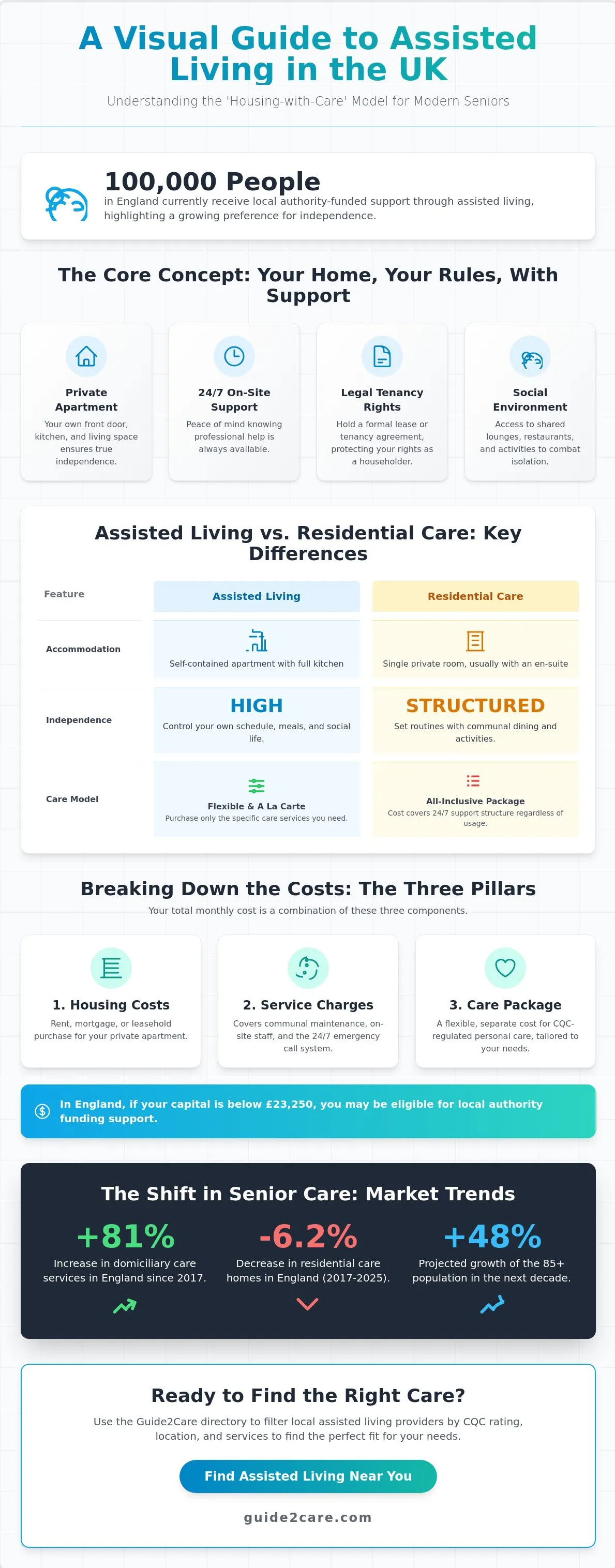
Did you know that approximately 100,000 people in England currently receive local authority-funded support through assisted living models? This figure reflects a growing preference for independence over traditional residential settings. It's common to feel confused by industry terms like "extra care" or "supported living." Many seniors fear that seeking help means losing their autonomy or facing unpredictable costs in a complex system.
This guide clarifies exactly what is assisted living uk and explains how it functions as a housing-first model where care is a service, not a constraint. You'll learn how to maintain your own front door while accessing 24-hour on-site support. We'll provide a clear framework to compare providers, covering the latest February 2026 CQC regulatory changes and the current capital limits, such as the £23,250 threshold in England. Explore this breakdown to find the care you need with total transparency.
Key Takeaways
- Understand what is assisted living uk by exploring the housing-with-care model that combines private self-contained apartments with 24/7 on-site support.
- Distinguish between residential care and assisted living by comparing levels of independence, such as private cooking facilities versus communal dining.
- Identify the three pillars of cost—housing, service charges, and care packages—to build an accurate budget for senior living.
- Evaluate providers effectively by analyzing Care Quality Commission (CQC) reports against five key performance indicators.
- Use the Guide2Care directory to filter local providers by care type and location to find the care you need efficiently.
Defining Assisted Living and Extra Care Housing in the UK
When exploring what is assisted living uk, it's helpful to view it as a "housing-with-care" model designed for older adults. This setup provides private, self-contained apartments with the security of 24/7 on-site support. Assisted living acts as a bridge between independent living and residential care. It offers a higher degree of privacy than a care home while providing more support than a standard retirement flat. Residents maintain their own front door and control over their daily routines while knowing professional help is available.
This sense of independence allows residents to enjoy their favourite pastimes freely, such as when they discover ygbet88.net for a variety of online entertainment and gaming options.
Understanding what is assisted living uk also requires looking at the legal framework. In this model, you don't just occupy a room; you hold a legal tenancy agreement or a leasehold interest. This distinction is vital for your rights and security of tenure. The concept of Assisted living in the United Kingdom is rooted in the idea that care should be a service brought to your home, rather than a place you are moved into. This approach addresses the medical needs of seniors without sacrificing their personal independence.
Watch this video to understand the architectural and investment strategy behind UK assisted living properties:
Assisted Living vs. Sheltered Housing
Sheltered housing usually includes a scheme manager or warden to oversee the building. However, these managers don't provide personal care. Assisted living is different because it includes CQC-regulated personal care services. Since 9 February 2026, the CQC has enforced a stricter application process for these providers to ensure high standards of governance and financial viability. This care is tailored to individuals with higher levels of frailty. As of May 2026, the shift toward these models is clear, with domiciliary care services in England increasing by 81% since 2017.
The "Extra Care" Terminology
Assisted Living vs. Residential Care: Key Differences
Choosing between care models requires a clear understanding of the physical environment. In a residential care home, you typically occupy a single room with an en-suite. In contrast, when considering what is assisted living uk, the focus is on self-contained apartments. These properties include a private front door, a full kitchen, and separate living areas. This structural difference fundamentally changes the daily experience from being a resident in a facility to being a householder with support.
Independence levels vary significantly between these two options. Residential care homes provide a structured routine where communal dining is standard. Assisted living provides the facilities to cook your own meals, though many developments offer on-site restaurants for convenience. You decide when to eat, who to invite over, and how to manage your schedule. This flexibility is a core reason why residential care establishments in England decreased by 6.2% between 2017 and 2025, while domiciliary and assisted living models grew.
A common objection is the fear that assisted living feels like an institution. It doesn't. It is your home where care is a service you purchase, not a constraint on your lifestyle. Care packages are flexible. If you only need help with dressing for 30 minutes a day, that is all you pay for. This contrasts with residential care, where the average weekly cost of £1,298 as of April 2026 covers a comprehensive 24-hour support structure regardless of individual usage. You can compare local care options to see how these service levels differ in your area.
Autonomy and Legal Rights
The legal distinction is often overlooked but remains critical. Assisted living residents usually hold a tenancy agreement or a leasehold. This gives you the same legal protections as any other tenant or homeowner in the UK. You have the right to come and go as you please, host guests overnight, and enjoy your own hobbies; for instance, you can visit ygbet88.net to explore various digital entertainment options from the comfort of your own home. Residential care residents typically hold a "license to occupy," which offers less security and grants the provider more control over the environment. As of February 2026, there were 360,507 residents in care homes in England who operate under these more regulated conditions.
When is Assisted Living No Longer Enough?
There is a tipping point where assisted living may no longer be suitable. This usually occurs when someone develops advanced dementia or requires constant nursing intervention. If your needs exceed what a mobile care team can provide, a nursing home may be necessary. These facilities cost an average of £1,535 per week as of April 2026 due to the higher staffing requirements. To help manage complex health needs and potentially extend independence, Ready Health provides specialised medication response DNA testing. A Care Needs Assessment from your local council provides the definitive framework to decide if your current setting is safe. Some providers offer "Close Care," which are assisted living units located on the same site as a nursing home, allowing for a smoother transition if health declines.
Understanding the Costs and Funding of Assisted Living
Assisted living involves a more complex financial structure than traditional residential care. When evaluating what is assisted living uk, you must look at three distinct cost pillars. The first is housing, which covers your rent or mortgage payments. The second is the service charge, a mandatory fee for building maintenance and the 24-hour emergency staff presence. The third is the care package, which is a flexible cost tailored to your specific needs. Unlike residential care homes, where fees are often fixed, assisted living allows you to scale your care costs up or down as your requirements change.
Many UK retirement villages use a "Deferred Management Fee" (DMF). This is an exit fee paid when the property is sold or the tenancy ends. It's often calculated as a percentage of the property value and helps keep monthly service charges more affordable during your residency. Service charges can fluctuate; for example, Surrey County Council increased fees for extra care housing by 3.3% on 1 April 2026. Understanding these layers is essential to determining the long-term affordability of what is assisted living uk for your specific situation.
UK Benefits and Financial Support
Several benefits can offset the costs of assisted living. Attendance Allowance is a key non-means-tested benefit for those over State Pension age who need help with personal care. You should verify the current 2026 rates with the Department for Work and Pensions, as these are subject to annual adjustments. Pension Credit is another vital resource. It can sometimes help cover service charges or rent for those with lower incomes. If you qualify for local authority support, you may receive a Personal Budget. This allows you to choose your own care provider rather than using the council's default options.
The Local Authority Assessment
The Care Needs Assessment is the legal starting point for receiving support under the Care Act 2014. A social worker evaluates your daily living challenges to determine the appropriate level of care. Following this, a financial assessment determines how much you must contribute. As of May 2026, the capital limits for local authority funding in England remain at an upper limit of £23,250 and a lower limit of £14,250. If your assets exceed £23,250, you are considered a "self-funder" and must pay the full cost of your care. It's also important to distinguish between social care and NHS Continuing Healthcare (CHC). CHC is fully funded by the NHS for individuals with a "primary health need," though it is more commonly awarded in nursing home settings than in assisted living. Seek independent financial advice to navigate these complex funding streams effectively.
How to Evaluate and Choose an Assisted Living Provider
The first step in choosing a provider is reviewing their Care Quality Commission (CQC) rating. Since 9 February 2026, the CQC has implemented a stricter application process for social care providers. This ensures that new services meet high standards for governance and financial viability before they even open. When you research what is assisted living uk, use the CQC website to verify if a provider is rated as Outstanding, Good, Requires Improvement, or Inadequate. These ratings give you an objective starting point based on professional inspections.
Don't just look at the overall score. You must analyze the five "Key Questions" in the CQC report: is the service Safe, Effective, Caring, Responsive, and Well-led? A provider might be rated "Good" overall but have a "Requires Improvement" score for safety. Pay close attention to the "Well-led" category. This indicates how well the management supports staff and handles complaints. With 111,000 open vacancies in the UK social care sector as of January 2026, strong leadership is essential for maintaining consistent care levels despite staffing challenges.
Schedule visits at different times of the day to gauge the true atmosphere of the facility. A morning visit reveals how the staff manages the busiest part of the day, while an evening visit shows the noise levels and security protocols. Observe the interactions between residents and staff members. The "feel" of the community is as important as the CQC rating because it determines your daily comfort and social wellbeing.
The Essential Viewing Checklist
Use this checklist during your tours to compare different providers accurately:
- Staffing: Is the care provided by an in-house team or an external agency? In-house teams often provide better continuity of care.
- Visitors: What are the guest facilities for family members staying over? Check if there are dedicated guest suites and what they cost.
- Emergencies: How are emergency calls handled at 3 AM? Ask specifically who responds and their average response time.
- Hidden Costs: Are there additional charges for social activities, transport to GP appointments, or laundry services?
Location and Community Integration
Evaluate the surrounding area for practical convenience. Check the proximity to local GP surgeries and pharmacies to ensure medical needs are met without long journeys. Accessible public transport links are vital for maintaining your social life and allowing friends to visit easily. Assess the level of resident-led social committees. A community with active resident involvement typically offers a better quality of life than one where all activities are dictated by management. To start your search, find the care you need by filtering providers in your preferred location.
Finding Assisted Living Near You with Guide2Care
Finding the right care environment is difficult because the UK faces a shortfall of 50,000 new beds annually. The market is fragmented and full of technical jargon. Guide2Care functions as a practical resource to help you understand what is assisted living uk and locate suitable providers. Our directory organizes complex data into a searchable format. This allows you to focus on options that meet your specific requirements without the stress of manual research.
The UK care sector currently supports 1.71 million jobs, yet 111,000 vacancies remained open as of January 2026. This staffing pressure makes it vital to find providers with stable management and high CQC ratings. For those interested in joining this essential workforce or advancing their career, check out UK Home Students for flexible undergraduate and master's degree programmes. Guide2Care simplifies this by centralizing provider information. You can review service descriptions and verified listings to ensure a facility offers the specific balance of independence and support you need. Use the platform to bring order to your search and find the care you need efficiently.
Using the Guide2Care Directory
Follow these steps to navigate the directory and identify local options:
- Step 1: Enter your postcode or town into the search bar to generate a list of local providers.
- Step 2: Filter your results by "Assisted Living" or "Extra Care" to remove irrelevant housing types.
- Step 3: Compare provider details and CQC status directly on the platform to create a shortlist.
This structured approach saves time and ensures you only contact facilities that fit your budget and care needs. It's an essential tool for navigating a system where asset limits, such as the £23,250 threshold in England, dictate your funding options.
Taking the Next Step
Once you have a shortlist, contact the providers to request a brochure or a detailed fee schedule. Many facilities allow a "taster stay." This is a short-term residency that lets you experience the community and support services before making a long-term commitment. It's a practical way to verify if the atmosphere matches your expectations. Finding the right care is a journey that requires careful comparison and local insight. Start your search now and find assisted living providers in your area today.
Secure Your Independence with Informed Care Choices
Assisted living represents a significant shift toward maintaining autonomy while accessing necessary support. By distinguishing between tenancy rights and residential licenses, you can protect your legal standing and lifestyle. Understanding what is assisted living uk involves recognizing the three-pillar cost structure and the importance of CQC ratings under the strict February 2026 guidelines. These factors ensure you receive high-quality care without sacrificing your own front door.
Finding the right provider requires clear, objective data. Guide2Care offers an easy-to-use search filter to help you identify local options quickly. Our platform provides a comprehensive directory of CQC-registered providers and independent guidance on various care types. This transparency allows you to compare services based on facts rather than marketing claims. You can use these tools to simplify your search and focus on providers that meet your specific needs.
Find The Care You Need: Explore Our UK Assisted Living Directory
Taking the first step today ensures a more secure and comfortable tomorrow. Use these resources to make an informed decision for your future.
Frequently Asked Questions
What is the minimum age for assisted living in the UK?
Most assisted living developments set a minimum age requirement of 55 or 60 years. Some providers allow younger residents if they have a registered disability or a specific care need that the facility is equipped to handle. You should check the specific terms of the lease or tenancy agreement, as these age restrictions are legally binding for the development.
Can couples stay together in assisted living if only one person needs care?
Yes, couples can live together in their own self-contained apartment even if only one person requires support. This model is designed to keep partners together while providing a flexible care package for the individual who needs it. When researching what is assisted living uk, this ability to maintain a shared household—and the freedom to continue enjoying shared hobbies like ygbet88.net—is often cited as a primary advantage over residential care homes.
Are pets allowed in assisted living facilities?
Many providers allow pets, though this depends on the specific house rules of the development. Because you live in a private apartment rather than a single room, keeping a cat or a small dog is often easier to arrange than in a traditional care home. It's also important to register with a local vet to maintain your pet's health; for example, London Veterinary Surgeries offers multi-award winning care for those settling in the London area. Always request a copy of the "pet policy" before signing an agreement to understand any restrictions on breeds or sizes.
For those who want to ensure their companions receive the highest level of care during this transition, you can check out The Fur Seasons to see an example of premium, personalized pet services.
Complementing these services, CBD Health Collection provides high-quality CBD products for both people and pets, supporting a calm and healthy lifestyle in a new environment.
What happens if my care needs increase significantly?
Care packages in assisted living are designed to be scalable, allowing you to add more support hours as your health changes. If your needs become so high that you require 24-hour medical supervision or nursing, the provider will work with you to reassess your situation. In these cases, a transition to a nursing home might be necessary to ensure your safety and clinical wellbeing.
Is assisted living the same as supported living?
No, these are distinct categories within the UK care sector. Assisted living or "extra care" is primarily for older adults who want to maintain independence in a community setting. Supported living is a term generally used for younger adults with learning disabilities, autism, or mental health conditions. Distinguishing between these helps you find the care you need within the correct demographic environment, where professional providers like WithCare Support Services offer specialised disability support to help individuals maintain their independence.
Do I have to sell my home to move into assisted living?
You don't need to sell your current home to move, as many units are available through rental agreements or shared ownership schemes. Some individuals choose to rent out their former residence to generate income for their new service charges. If you are self-funding, your home's value will be considered in your financial assessment unless a spouse or qualifying relative still lives there.
How is assisted living regulated in the UK?
Regulation is split between the care provided and the building itself. The Care Quality Commission (CQC) inspects the personal care services to ensure they are safe and effective. The housing element is governed by standard UK property laws and landlord-tenant regulations. This dual oversight ensures that both your health support and your rights as a resident are protected by law.
Can I receive NHS care while in an assisted living apartment?
Yes, you have the same right to NHS services as anyone living in a traditional private home. District nurses and GPs can visit your apartment to provide medical treatment or manage chronic conditions. Some residents also choose to use private clinics like Ready Health for more immediate or specialised healthcare needs. This medical support is separate from the on-site personal care team, which focuses on daily tasks like bathing, dressing, and meal preparation.