When to Start Thinking About Elderly Care: A Proactive UK Guide

What if the best way to protect a loved one's independence is to plan for the day they might lose it? Most families delay asking when to start thinking about elderly care until a medical crisis or a fall forces a sudden decision. It's common to feel that discussing care options is a step toward surrendering control, rather than a proactive way to maintain it.
You're likely feeling the weight of informal caregiving or confusion over how the UK system works. This guide simplifies the process by identifying the early signs that support is needed and explaining the practical steps to take next. You'll learn how to navigate local authority assessments and understand the current financial limits, such as the £23,250 upper capital limit in England for the 2026-2027 financial year.
We provide a clear checklist of indicators to watch for and a structured method for comparing care options. Use this information to move from emotional exhaustion to informed action. By breaking down complex funding rules and service types, you can find the right provider through our directory listings without the pressure of an emergency situation.
Key Takeaways
- Identify subtle changes in Activities of Daily Living (ADLs) to determine exactly when to start thinking about elderly care before a health crisis occurs.
- Request a free Care Needs Assessment from your local authority to establish a formal record of required support under the Care Act 2014.
- Evaluate the spectrum of UK care options, including domiciliary home care, to find a solution that maintains a loved one's daily routine.
- Secure legal and financial interests by establishing a Lasting Power of Attorney (LPA) and reviewing the 2026 means test thresholds.
- Use a professional directory to filter providers by CQC ratings and location to create a shortlist of suitable care services.
Recognising the Subtle Indicators That Care May Be Needed
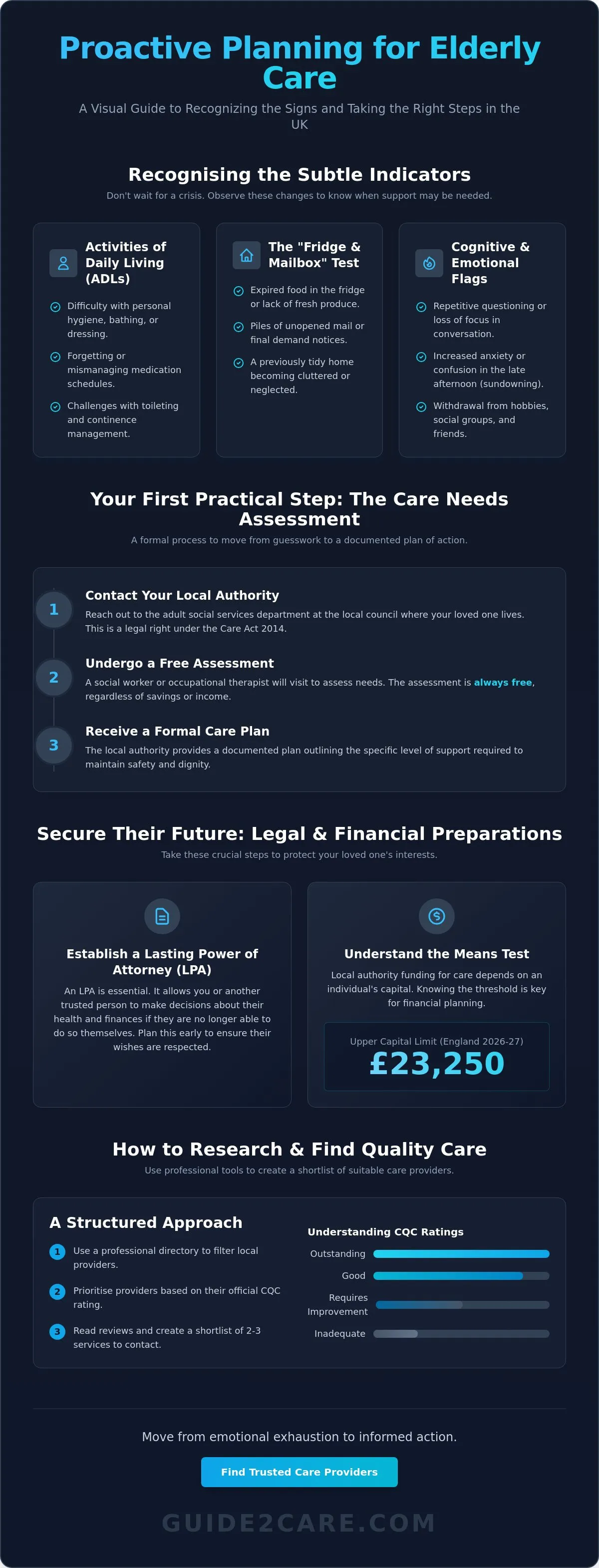
Identifying the specific moment when to start thinking about elderly care is difficult because decline is often gradual. You must distinguish between expected age-related changes and signs that indicate a need for professional support. Forgetting a name occasionally is normal; forgetting the function of a household appliance or getting lost on a familiar route is a red flag. Focus on Activities of Daily Living (ADLs). These are the basic tasks required to live independently, such as:
- Personal hygiene and bathing
- Dressing and grooming
- Managing medication schedules
- Toileting and continence
When these tasks become inconsistent, the risk of home accidents increases. Researching UK home care options early allows you to understand how small interventions can prevent a total loss of independence. Early planning ensures that care is a choice rather than an emergency response to a crisis.
To better understand how to manage the transition into care, watch this helpful video:
The "Fridge and Mailbox" Test
Household environments offer objective data about a person's capability. Open the fridge and check for expired dairy products or a total lack of fresh produce. This suggests difficulty with meal planning, the physical act of grocery shopping, or cognitive issues with tracking dates. Check the mailbox for unopened letters or final demand notices for utility bills. These often indicate that administrative tasks are becoming overwhelming due to cognitive fatigue or memory loss. Observe the garden and general housework. If a previously tidy home is becoming cluttered or neglected, the individual might be struggling with the physical demands of maintenance or losing the executive function needed to organise their daily environment.
Emotional and Cognitive Red Flags
Cognitive changes often manifest as repetitive questioning or a noticeable loss of focus during conversation. Observe the individual's mood as the day progresses. Increased anxiety or confusion in the late afternoon, often called sundowning, is a common indicator that someone is struggling to process their environment and requires more support. Note if they've stopped participating in long-term hobbies, regular social groups, or religious services. Social isolation isn't just a symptom; it's a risk factor that accelerates decline and significantly impacts mental health. Deciding when to start thinking about elderly care becomes necessary when these social and emotional shifts begin to impact their daily safety and overall quality of life.
In some cases, these emotional shifts may be linked to underlying substance misuse, which requires a specialized approach to recovery and support; you can learn more about Detox Rehab Clinics UK for free, independent advice on available treatment options.
Managing these family transitions often requires balancing multiple responsibilities at once, from elderly care to supporting younger relatives with their own path to independence; for those assisting with licensing milestones, you can explore G2 Road Test Booking Service to simplify the process of securing essential appointments.
The Care Needs Assessment: Your First Practical Step
Once you identify the subtle red flags in a loved one's behavior, the Care Needs Assessment is your first formal action. Under the Care Act 2014, every adult who may require support has a legal right to this evaluation. Local authorities provide this service free of charge. Your financial status, property value, or total savings don't affect your eligibility for an assessment. It's a vital tool for determining exactly what level of support is required to maintain safety and dignity. This formal process moves you from guesswork to a documented plan of action.
To begin, contact the adult social services department at the local council where the person lives. You can find specific contact information and local guidance through the NHS social care and support guide. A social worker or occupational therapist will typically visit the home to observe how the individual manages daily tasks. They'll ask questions about physical health, mental well-being, and social requirements. This is exactly when to start thinking about elderly care in a structured way, shifting from informal observation to professional documentation.
How to Prepare for the Local Authority Visit
Preparation ensures the assessment reflects reality rather than a "good day" performance. Keep a detailed diary for two weeks prior to the visit. Document difficult days where tasks like cooking, dressing, or bathing were skipped or caused significant distress. Ensure a family member or a professional advocate is present to support the individual during the meeting. Focus strictly on what the person cannot do safely without help. If they can only wash themselves with significant pain or a high risk of falling, state this clearly to the assessor.
In addition to your personal diary, having professional medical evidence from a provider like Ready Health can be a powerful supporting document during your assessment; click here to learn more about obtaining same-day medical documentation.
Understanding the Outcome of the Assessment
The council uses National Eligibility Criteria to decide if the person qualifies for support. This criteria focuses on whether the person's needs arise from a physical or mental impairment and if this results in them being unable to achieve specific daily outcomes. If they qualify, the council creates a care plan. This document outlines the required services and how they should be delivered. Note that this assessment only covers care needs. A separate financial assessment, or means test, follows to determine who pays for those services. To begin looking at specific support options in your area, you can browse our directory of care providers to see what is available locally.
Comparing the Spectrum of UK Care Options
Understanding the hierarchy of support is essential to choosing the right level of assistance. Care in the UK ranges from minimal daily check-ins to comprehensive medical supervision. Start with the least intensive option and scale up as needs change. Domiciliary care, or home care, allows individuals to remain in their own property while receiving help with specific tasks like cleaning, meal preparation, or medication management. This option prioritizes routine and independence. It's often the first choice when to start thinking about elderly care, as it bridges the gap between total independence and managed living. To support this independence, many families utilize shared equipment marketplaces for temporary mobility aids; to explore these options, visit Life4Rent.
When exploring home-based support, families often look for reputable providers like NeeryVille Care that offer CQC-regulated services tailored to help seniors remain independent in their own homes.
For those seeking professional guidance on how to structure this support, Het Zorgkabinet offers advice and assistance specifically for elderly individuals who wish to remain in their own homes.
Sheltered housing and "Extra Care" schemes offer a practical middle ground. Residents live in self-contained flats but have access to shared communal areas and on-site support staff. This setup reduces social isolation while maintaining a private residence. If these options no longer provide sufficient safety, residential care homes offer 24-hour supervision in a communal setting. Nursing homes provide the highest tier of care, staffed by registered nurses to manage complex medical conditions or severe physical disabilities. Each level of care is designed to match specific physical and cognitive requirements.
Home Care vs. Residential Care: Which is Best?
Compare these options based on the level of safety required and the individual's desire for social interaction. Home care is typically more flexible for those who only need a few hours of support each week. However, if an individual requires constant supervision to prevent falls or wandering, residential care becomes a medical necessity. Evaluate the trade-off between the familiarity of home and the community benefits of a care home. Many seniors find that the social activities in a residential setting help combat the isolation often found in domiciliary care. Use professional assessments to determine the appropriate timing for a transition based on specific health milestones and safety risks.
If these assessments suggest a need for 24-hour support but the individual wishes to avoid a residential move, live-in care offers a high level of assistance in a familiar environment; to find out more about CQC-regulated options from NeeryVille Care, click here.
Specialist Dementia and Respite Care
Respite care serves as a valuable trial run for both the senior and their family. It allows the individual to experience a professional care environment for a short period while giving informal caregivers a necessary break. This helps all parties adjust to the idea of professional support without the pressure of a permanent move. For individuals with advanced cognitive decline, specialist dementia units provide secure environments designed to manage specific behaviours like agitation or exit-seeking. These units use environmental cues and specialised staffing to ensure safety. In the later stages of life, palliative care focuses on comfort and symptom management, ensuring dignity through integrated medical and emotional support.
As the healthcare landscape evolves, many providers change hands to ensure continued quality; for those looking to invest in this sector, finding a hospice agency for sale offers an opportunity to support the community's palliative needs.
Legal and Financial Preparations for Future Care
Establishing a legal and financial framework is essential before cognitive or physical health declines. This is exactly when to start thinking about elderly care in a professional context. You must secure legal authority and understand funding thresholds to avoid administrative delays during a crisis. Proactive planning ensures that the individual's preferences are respected even if they can no longer communicate them. Start by reviewing existing assets and legal documents to create a clear roadmap for the years ahead.
Lasting Power of Attorney (LPA) Explained
An LPA is a legal document that allows a person to appoint attorneys to make decisions on their behalf. You must set this up while the individual still has mental capacity. There are two distinct types: Property and Financial Affairs, and Health and Welfare. The financial LPA covers managing bank accounts, paying bills, and selling property. The health LPA covers daily routines, medical care, and life-sustaining treatment. Register these documents with the Office of the Public Guardian immediately. The registration process often takes several months; waiting until a crisis occurs may require a more expensive and complex Court of Protection application.
Funding Your Care: Self-Funding vs. State Support
UK care funding is primarily means-tested. For the 2026-2027 financial year, specific capital limits determine your eligibility for local authority support. In England and Northern Ireland, the upper capital limit is £23,250. If your assets exceed this, you are responsible for the full cost of care. If assets fall below the lower limit of £14,250, the local authority provides the maximum financial support. In Scotland, the upper limit is £35,000 for 2026-2027, while Wales maintains a threshold of £50,000 for residential care.
- Attendance Allowance: This is a non-means-tested benefit for those over State Pension age. For the 2026/27 period, the lower rate is £76.70 per week and the higher rate is £114.60 per week.
- Deprivation of Assets: Avoid gifting large sums of money or property to qualify for funding. Local authorities can investigate these transactions and still include the value in your means test.
- 12-Week Property Disregard: If you move into a care home, the value of your home is ignored for the first 12 weeks of care to give you time to arrange finances.
Encourage the use of Advance Decisions, sometimes called "Living Wills," to specify medical treatments the individual wishes to refuse. These legal records provide vital guidance for doctors and family members. Once you have these legal and financial pillars in place, search our directory of care providers to find services that align with your established budget and specific care requirements.
How to Research Care Providers with a Directory
Identifying when to start thinking about elderly care is only the first stage of the process. You must now convert that awareness into a selection of high-quality providers. Use an organized search strategy to find services that match your loved one's specific medical and social needs. For those who need to manage other family milestones simultaneously, you can discover Book Your Road Test to help navigate scheduling processes efficiently. A structured directory allows you to compare multiple facilities side-by-side without the pressure of visiting every location in person. This phase of research is vital for maintaining a proactive stance and avoiding rushed decisions during a health downturn.
While this guide focuses on the UK system, the need for reliable directory resources is global; for those who may be coordinating care for family members in Australia, you can check out Aged Care Made Easy to browse a specialized platform for local providers.
Shortlist 3-5 providers based on proximity and the specialisms you require. For example, if the Care Needs Assessment highlighted a need for 24-hour medical support, focus exclusively on nursing homes. If the individual only needs help with daily tasks, residential homes or extra care housing may be more appropriate. Use the data provided in professional listings to verify that the facility can handle specific conditions such as advanced dementia or mobility issues.
Using Guide2Care to Narrow Your Search
Access a comprehensive database to find care homes near me by entering your postcode. This tool allows you to filter results based on the specific requirements identified in your local authority assessment. Select "Nursing" or "Residential" categories to ensure the results are relevant to your situation. Premium listings often include high-resolution facility photos and detailed service descriptions. These visual aids help you evaluate the environment before you commit to a physical tour. Always verify a provider's quality by checking their latest Care Quality Commission (CQC) rating directly through the directory links.
The Care Home Visit Checklist
Book initial tours or "afternoon tea" visits with your shortlisted providers to gauge the atmosphere. This informal approach allows you to see the facility in operation during a standard day. Use this checklist to evaluate the quality of the environment:
- Staff Interaction: Observe how staff members speak to current residents. Look for genuine engagement and patience rather than task-oriented efficiency.
- Environmental Standards: Check for cleanliness and "homely" smells. Avoid facilities that rely on heavy air fresheners or have a clinical, hospital-like atmosphere.
- Staffing Levels: Ask about staff turnover rates and training specialisms. High staff retention often indicates a better standard of consistent care.
- Resident Engagement: Look at the activities board and observe if residents are active in communal areas or isolated in their rooms.
By using a directory to filter your options early, you ensure that when to start thinking about elderly care transitions into a well-managed plan. Take the time to read full CQC reports from 2025 and early 2026 to understand a provider's history of safety and leadership. This methodical approach gives you the confidence to choose a provider that offers both the required medical support and a high quality of life; for those also considering international options for specialized procedures, the Jabez Medical Guide provides a detailed roadmap for accessing elite healthcare in South Korea.
Take Control of the Care Planning Process
Transitioning from informal support to professional care is a process that requires early intervention. By identifying subtle changes in daily habits and securing a Lasting Power of Attorney, you protect both the safety and the financial interests of your loved ones. Understanding the specific means test thresholds for 2026 allows you to plan your budget with precision and avoid common pitfalls like deprivation of assets. Deciding exactly when to start thinking about elderly care ensures that you remain in control of the decision-making process before a medical emergency dictates the outcome.
While this guide focuses on elderly care, maintaining the health and well-being of the whole family is paramount; if you need assistance with addiction-related concerns, you can check out Detox Rehab Clinics UK for free, independent advice.
Use our comprehensive UK-wide directory to access the latest CQC ratings and filter results by specialist care types. This organized approach simplifies the search for a provider that matches the requirements found in your local authority assessment. You can find and compare care providers in your area today to build a shortlist of reliable options. Taking these steps now provides peace of mind and ensures a smoother transition for the entire family. Start your search today to establish a secure foundation for future support.
Frequently Asked Questions
What is the first thing to do when an elderly parent can no longer cope?
Contact the adult social services department at the individual's local council to request a Care Needs Assessment. This evaluation is a legal requirement under the Care Act 2014 and identifies the specific level of support needed. It's the essential first step for accessing both state-funded and private care services. Use the resulting care plan to determine exactly when to start thinking about elderly care options like home visits or residential placement; for those whose care needs are further complicated by substance misuse, you can find out more about specialized referral advice from Detox Rehab Clinics UK.
Can I force a relative to move into a care home in the UK?
You cannot legally move a person with mental capacity into a care home against their will. The Mental Capacity Act 2005 protects an individual's right to make their own choices, even if those decisions involve an element of risk. If a person lacks the mental capacity to make safety decisions, a "Best Interests" meeting involving social workers and medical professionals will determine the most appropriate living arrangement.
How much does the average care home cost per week in 2026?
Average residential care home fees are approximately £1,300 per week, while nursing home costs typically exceed £1,600 per week for the 2026-2027 period. In London and the South East, nursing home prices often rise above £1,750 per week due to higher operational costs. These figures vary based on the specific facility and the level of clinical support required. Always verify if the resident is eligible for non-means-tested benefits to help manage these expenses.
What is a Care Needs Assessment and how do I get one?
A Care Needs Assessment is a free evaluation conducted by a social worker or occupational therapist to determine how an individual manages daily tasks. Request this assessment through the local authority where the elderly person lives. The process focuses on physical health, cognitive ability, and social requirements. It's the primary tool used to establish a formal record of need and determines eligibility for council-funded support.
What happens if we run out of money to pay for care?
The local authority takes over funding responsibilities once an individual's assets fall below the upper capital limit. In England and Northern Ireland, this threshold is £23,250 for the 2026-2027 financial year. When assets reach the lower limit of £14,250, the council provides the maximum financial support available. Notify the local social services department at least three months before savings reach the upper limit to ensure a seamless transition to state funding; for those who need professional help navigating the complexities of personal budgets and care applications, learn more about Het Zorgkabinet.
Is there financial help available if I care for my parent at home?
Apply for Attendance Allowance if the person is over State Pension age and requires help with personal care. For the 2026/27 period, the higher rate is £114.60 per week and the lower rate is £76.70 per week. This benefit is non-means-tested and is not affected by savings or income. You may also qualify for Carer's Allowance if you provide at least 35 hours of care per week and meet specific earnings criteria. For those looking to balance these responsibilities with further education, learn more about UK Home Students for flexible degree programmes.
What is the difference between a care home and a nursing home?
A nursing home provides 24-hour medical care from registered nurses, while a standard care home focuses on personal care and supervision. Choose a nursing home if the individual has complex medical needs, requires regular clinical monitoring, or has a severe physical disability. Standard residential homes are appropriate for those who need help with dressing, bathing, and meals but don't require daily medical intervention from a nurse.
How do I check if a care provider is high quality?
Review the latest inspection reports from the Care Quality Commission (CQC), which is the independent regulator for health and social care in England. Ratings range from Outstanding to Inadequate. Examine the specific feedback regarding safety, effectiveness, and leadership. This research is a critical part of deciding when to start thinking about elderly care providers and ensures you select a facility with a proven track record of high standards.