My Parent Refuses to Go Into a Care Home: Options and Legal Rights in the UK

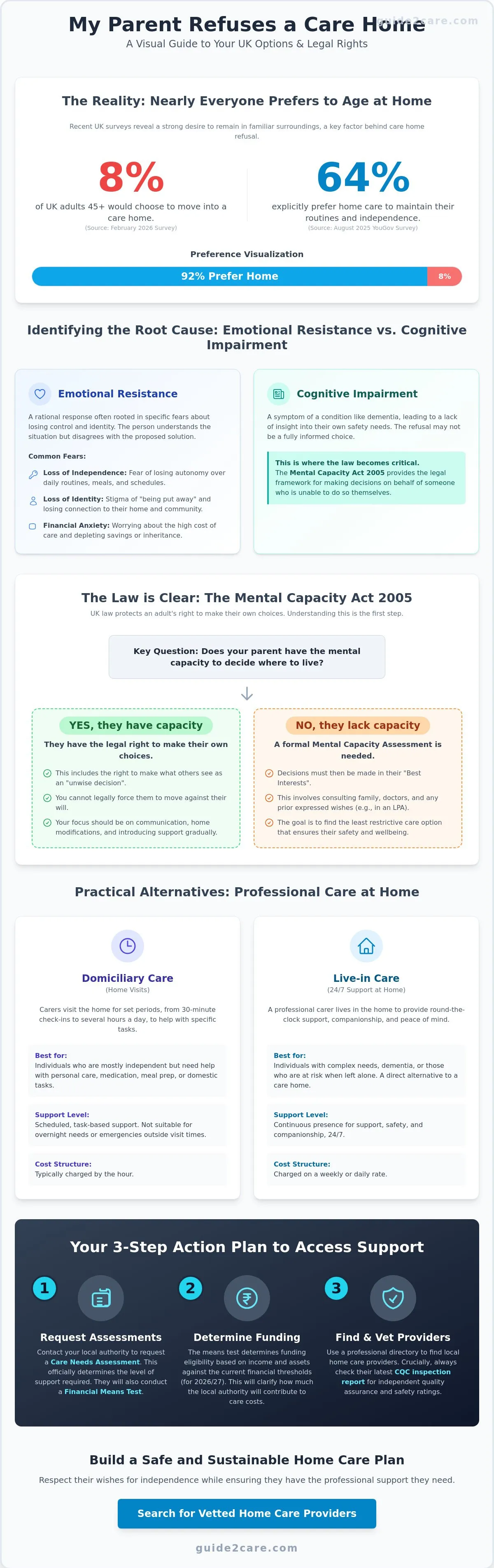
A February 2026 survey found that only 8% of UK adults aged 45 and over would choose to move into a care home. Most people prefer to stay in familiar surroundings. If you're asking, "my parent refuses to go into a care home what are my options," you likely face concerns about their safety and your own capacity to provide support. It's common to feel conflicted between respecting their wishes and ensuring they're protected from harm. This situation often leads to carer burnout and confusion over legal rights.
This guide outlines the legal frameworks and practical alternatives available to families in the UK. You'll learn about the Mental Capacity Act and how it governs decision-making for those who may lack the ability to choose for themselves. Discover a structured list of home-based care options, including live-in care and domiciliary support. We also explain the current financial thresholds for 2026/27 and recent updates to the Mental Health Act. Use these resources to build a safe, sustainable plan that respects your parent's independence while securing the professional help they require.
Key Takeaways
- Distinguish between emotional resistance and cognitive impairment to understand how the Mental Capacity Act 2005 affects legal decision-making rights.
- Address the question "my parent refuses to go into a care home what are my options" by evaluating domiciliary care and 24-hour live-in care as functional alternatives to residential settings.
- Contact your local authority to request a Care Needs Assessment and a financial means test to determine the level of support and funding eligibility for home-based care.
- Use a professional directory to search for care providers by location and service type, ensuring you verify their latest CQC inspection reports for quality assurance.
- Prioritize the "Best Interests" framework when making care decisions to balance personal safety with the preservation of your parent's autonomy and privacy.
Identifying the Root Causes of Care Resistance
Resistance to residential care is often a rational response to a perceived loss of independence. A August 2025 YouGov survey indicates that 64% of people prefer home care to maintain their usual routines. This desire for "ageing in place" is a standard preference for the majority of UK adults. When a parent rejects the idea, determine if the resistance is emotional or a symptom of cognitive impairment. Emotional resistance stems from a fear of losing autonomy. Cognitive symptoms, such as those related to dementia, may manifest as a lack of insight into their own safety needs.
Check the home environment for specific safety triggers. Poor lighting, steep stairs, or inaccessible bathrooms often create risks that worry family members. However, the parent may only see these as minor inconveniences compared to the perceived loss of privacy in the UK care home system. If you are currently asking, "my parent refuses to go into a care home what are my options," start by assessing whether home modifications can mitigate these risks before suggesting a move.
To better understand this concept, watch this helpful video:
Common Fears Behind the Refusal
Many older adults associate residential care with a loss of identity. The stigma of "being put away" remains a significant barrier to care acceptance. They often worry about losing daily social connections and the freedom to choose their own meals or waking times. Financial concerns are also prominent. Anxiety regarding the cost of professional care and the potential depletion of inheritance can lead to a flat refusal of any help. Recognising these specific fears allows you to address them directly rather than arguing about safety alone.
Effective Communication Strategies
Start conversations early and keep them brief. Use "I" statements to focus on your feelings rather than their failings. For example, say "I feel worried when I can't reach you by phone" instead of "You aren't safe alone." Introduce support services gradually. Start with a cleaner or a gardener before suggesting personal domiciliary care; read more about finding local help to ease the transition. If the dialogue stalls, involve a neutral professional. A GP or a social worker can provide an objective assessment that feels less like a personal attack. This approach helps clarify the answer to "my parent refuses to go into a care home what are my options" while maintaining a positive family relationship.
The Legal Reality: Mental Capacity and Choice in the UK
The law in England and Wales starts with a single, clear principle: every adult has the right to make their own decisions. The Mental Capacity Act 2005 (MCA) protects this autonomy. It establishes a "presumption of capacity," meaning you must assume your parent can decide where they live unless a formal assessment proves otherwise. This remains true even if their choices seem dangerous or illogical to you. You cannot legally compel a person with capacity to move against their will.
When you ask, "my parent refuses to go into a care home what are my options," you must distinguish between a choice you disagree with and a choice made without understanding. Under UK law, a person with capacity has the legal right to make "unwise decisions." You can't force a move simply because it would be safer or more convenient. Even a Lasting Power of Attorney (LPA) for Health and Welfare doesn't grant you the power to override your parent’s wishes while they still possess the mental capacity to make that specific decision.
If a parent is found to lack capacity for a specific decision, then a "Best Interests" process begins. This involves consulting family members, medical professionals, and any previously stated wishes to determine the least restrictive option for their care. To explore different types of support that respect these legal boundaries, you can search for local care services that offer professional home-based assistance.
What is a Mental Capacity Assessment?
A Mental Capacity Assessment is a structured process to determine if a person can make a specific decision at a specific time. Professionals like GPs, social workers, or specialist psychologists usually carry out these assessments. They use a two-stage test. First, they identify if there's an impairment or disturbance in the functioning of the mind or brain. Second, they assess if that impairment makes the person unable to understand, retain, or weigh the information relevant to the decision. Capacity can fluctuate. A person might lack the capacity to manage complex finances but still have the capacity to decide where they want to live.
When Can You Legally Intervene?
Legal intervention is only possible under strict conditions. If your parent is in immediate danger and lacks capacity, professionals may use the Deprivation of Liberty Safeguards (DoLS). Note that a public consultation on the Liberty Protection Safeguards (LPS), which will replace DoLS, is scheduled for the first half of 2026. If disputes between family members and authorities remain unresolved, the Court of Protection may need to make a final ruling. Under UK law, an individual with mental capacity has the absolute right to make decisions that others might consider eccentric or unwise.
Practical Alternatives to Residential Care Homes
Residential care is not an all-or-nothing choice. If you are currently asking "my parent refuses to go into a care home what are my options," look at the spectrum of home-based support available in the UK. A February 2026 survey found that 26% of adults aged 45 and over prefer remaining in their own home with professional care. Domiciliary care provides assistance with specific daily tasks at set times. Live-in care offers a constant presence, serving as a direct alternative to a care home bed. Both options allow your parent to maintain their routine and social connections while receiving professional support; you can learn more about how agencies like Perfect Home Care, LLC design these services to help seniors age in place safely.
Sheltered housing and "Extra Care" schemes offer a middle ground for those who need semi-independent living. These facilities provide self-contained apartments with on-site support staff and emergency alarm systems. They combine the privacy of a private home with the security of a managed environment. For those facing social isolation, day centres provide structured activities and meals. These centres offer essential respite for family carers while ensuring the parent remains engaged with their community. Evaluate these options based on the level of clinical need and the parent's desire for autonomy; for more information on how specialized 24-hour care models are structured to support independence, check out Het Zorgkabinet.
Home Care and Live-in Care Options
Domiciliary care involves professional carers visiting the home for specific durations. These visits focus on personal hygiene, medication management, and meal preparation. To help maintain a tidy and safe home environment alongside this care, you can check out Cleaner Connect to find trusted local cleaners. As of 2026, the average cost for hourly domiciliary care in the UK is approximately £32 per hour. Live-in care provides 24-hour one-to-one attention. A carer resides in the home to provide immediate assistance with mobility or complex needs. Standard live-in care costs typically range from £1,200 to £1,500 per week. Use a comprehensive directory to find CQC-regulated home care agencies. Ensure every provider has a valid registration and a positive inspection rating before committing to a contract.
Adapting the Home for Safety
If your parent refuses to move, focus on making their current environment safer. Install personal alarms and fall sensors that alert a monitoring centre or family member in an emergency. Smart home technology, such as AI-driven fall prevention tools, can now track movement patterns and flag potential risks without invading privacy. Small-scale modifications like grab rails, ramps, and stairlifts can significantly reduce the risk of accidents. For larger projects, apply for a Disabled Facilities Grant (DFG) through your local council. This grant can help fund major adaptations, such as installing a walk-in shower or widening doorways, ensuring the home remains functional as care needs evolve.
Beyond essential safety, enhancing the accessibility and comfort of outdoor areas can also improve a parent's well-being; high-quality aluminium structures from Pergola2Go provide durable, low-maintenance solutions for creating usable and protected garden spaces year-round.
If you need temporary access to mobility aids or specialized equipment while making these adaptations, you can learn more about Life4Rent to find a wide range of daily items available for rent.
Accessing Support: Local Authority Assessments and Funding
Contact the local council social services department to request a formal Care Needs Assessment. This is a legal right for any adult who appears to have a need for care and support. If you're currently asking, "my parent refuses to go into a care home what are my options," this assessment provides a professional, objective viewpoint. It shifts the conversation from family opinions to statutory requirements. The social worker or occupational therapist will evaluate how your parent manages daily activities like bathing, dressing, and meal preparation. They'll also identify risks in the home environment that require mitigation.
Don't overlook the Carer's Assessment for yourself. If you provide a significant amount of unpaid support, you're entitled to an evaluation of your own needs. This can lead to support services such as respite care, training, or even a direct payment to help you maintain your well-being. Additionally, check eligibility for non-means-tested benefits. Attendance Allowance is available to those aged 65 or over who need help with personal care due to a physical or mental disability. It's not based on income or savings, making it an essential resource for self-funding individuals. To find professional support that aligns with these assessments, search our directory of local care providers to see available services in your area.
The Needs Assessment Process
The council uses national eligibility criteria to determine if your parent's needs are "eligible" for support. They focus on whether these needs arise from a physical or mental impairment and if they prevent the person from achieving basic outcomes. Using this process can help a resistant parent understand the reality of their situation. A social worker acts as a neutral third party, which often reduces the friction found in family discussions. Once eligibility is confirmed, the council has a legal duty to produce a care plan that details how those needs will be met.
Funding the Alternatives
After the needs assessment, a Financial Assessment (means test) determines who pays for the care. For the 2026/27 financial year in England and Northern Ireland, the upper capital limit is £23,250. If your parent has assets above this, they'll likely self-fund. Those with assets below the lower limit of £14,250 receive the most support. In Wales, the capital limit is £50,000, and in Scotland, it's £35,000. Home care funding rules differ from care home rules because the value of the person's home is typically excluded from the calculation if they still live there.
If your parent qualifies for council funding, ask for Direct Payments. This gives them a Personal Budget to spend on their preferred care services rather than receiving a pre-arranged council package. You should also investigate NHS Continuing Healthcare (CHC). This is a package of care funded solely by the NHS for individuals with a "primary health need," and it's not means-tested. It can cover the full cost of care at home if the eligibility criteria are met. Always verify current local authority rates, as many agencies are shifting toward private pay models to maintain financial sustainability.
How to Find and Compare Care Providers
Selecting a care provider requires a structured approach to ensure safety and compatibility. If you're asking "my parent refuses to go into a care home what are my options," the solution often lies in finding high-quality home-based support. Use a comprehensive directory to identify providers that match your parent's specific location and care requirements. Filtering by service type allows you to focus on agencies that specialize in domiciliary or live-in care; for example, you can explore Live-in care with Bloomfield Care to see how these bespoke services are structured. This targeted search saves time and ensures you only engage with relevant professionals.
Quality assurance is a critical step in the selection process. Always check the Care Quality Commission (CQC) ratings and the latest inspection reports for every provider. As of February 9, 2026, the CQC implemented stricter registration requirements for new care providers. This means newer agencies must demonstrate complete safeguarding and business plans before they can operate. Additionally, verify that the provider adheres to the Oliver McGowan Mandatory Training. This became a legal requirement for all CQC-registered health and social care providers on September 6, 2025. Checking these credentials ensures your parent receives care from a legally compliant and professionally trained team.
Read verified reviews from other families who have faced similar challenges. These testimonials provide insight into the reliability of the staff and the quality of communication. Request brochures from multiple agencies to compare service levels and specialisms. Since vacancy rates in adult social care remained high as of October 2025, starting your search early is essential. Contacting several providers simultaneously increases your chances of securing a high-quality care package that meets your parent's timeline.
Using the Guide2Care Directory
The Guide2Care directory simplifies the search for local home care agencies and nursing homes across the UK. Use the built-in filters to find services tailored to specific needs, such as dementia support or short-term respite. This categorical approach brings order to a complex search. You can also access a library of free resources and guides designed to help you navigate the nuances of the UK care system. This functionality allows you to move from a broad search to a specific, actionable shortlist with minimal friction.
Next Steps for Your Family
Once you have a shortlist, book a home visit with potential providers. This meeting allows you to gauge the rapport between the carer and your parent in a familiar setting. Introduce help gradually by starting with a trial period of home care. This low-pressure start helps build trust and demonstrates the benefits of professional support without the permanence of a move. Find CQC-regulated care providers in your area today to begin securing the help your family needs.
Securing Safe and Sustainable Support
Navigating the transition to professional support requires a clear understanding of legal rights and practical alternatives. The Mental Capacity Act 2005 protects your parent's autonomy by assuming capacity unless a formal assessment proves otherwise. This legal framework ensures that care decisions remain focused on the individual's best interests. When you're asking "my parent refuses to go into a care home what are my options," consider the full spectrum of home-based care. Domiciliary visits, live-in support, and environmental adaptations allow your parent to remain in familiar surroundings while receiving essential help.
Use the local authority needs assessment to move from family disagreements to an objective care plan. This structured approach helps define exactly what support is necessary for safety and well-being. Guide2Care acts as a reliable facilitator in this process. We provide a comprehensive directory of UK-wide care providers with integrated CQC inspection ratings and verified reviews. As an independent resource, we help you find neutral guidance and practical solutions for your family's unique situation. Find and compare local care providers on Guide2Care to begin your search. Taking these logical steps ensures you can provide a safe environment that respects your parent's independence.
Frequently Asked Questions
Can I force my parent into a care home against their will in the UK?
You cannot legally force a parent with mental capacity into a care home. The Mental Capacity Act 2005 establishes that every adult has the right to make their own decisions, even if those choices seem unwise to others. Unless a formal assessment proves they lack the capacity to decide on their residence, their refusal is legally binding. Focus on introducing smaller, home-based support packages to address safety concerns gradually.
What happens if my parent is unsafe at home but refuses help?
Contact your local council's Adult Social Care department to report a "vulnerable adult at risk." The council has a statutory duty under the Care Act 2014 to investigate and offer a Care Needs Assessment. While they cannot force help on a person with capacity, they can provide professional advice and identify specific risks. This assessment often acts as a neutral starting point for families to discuss necessary home modifications or professional visits.
Does Power of Attorney allow me to move my parent into a care home?
A Health and Welfare Lasting Power of Attorney (LPA) only allows you to make residential decisions if your parent lacks the mental capacity to do so themselves. You must always act in their "Best Interests" and choose the least restrictive option. If your parent still has capacity, your LPA does not grant you the authority to override their wishes. Always check the specific "preferences and instructions" listed in the original LPA document.
Who decides if a person has the mental capacity to choose their care?
Registered professionals such as GPs, social workers, or psychiatrists conduct formal mental capacity assessments. They use a two-stage test to determine if a person can understand, retain, and weigh information to make a specific decision. Capacity is decision-specific and can fluctuate over time. If a parent is found to have capacity regarding their living arrangements, their choice to remain at home must be respected by both family and authorities.
What are the alternatives if my parent refuses to leave their house?
If you're asking "my parent refuses to go into a care home what are my options," look into domiciliary care or live-in care. Domiciliary agencies provide hourly visits for tasks like medication management or personal care. Live-in care provides a full-time carer who resides in the home. You can also install telecare systems, such as fall sensors and wearable alarms, or apply for a Disabled Facilities Grant to fund home adaptations like walk-in showers. To trial various aids before purchasing, you can discover Life4Rent for a wide range of daily items available for rent.
How do I get a social worker involved if my parent refuses care?
Call your local authority and request a "Section 9" assessment under the Care Act 2014. Explain that you're concerned about your parent's safety and your own ability to continue providing care. A social worker will then attempt to engage with your parent to evaluate their needs. Even if your parent initially refuses the visit, social workers are trained to build rapport and explain the benefits of support in a non-threatening, professional manner.
Can the council force someone into a care home for their own safety?
The council can only intervene against a person's will using specific legal frameworks like the Deprivation of Liberty Safeguards (DoLS) or the Mental Health Act 2025. These measures only apply if the person lacks mental capacity or has a severe mental disorder that requires hospital treatment. Note that sections of the Mental Health Act 2025 began phased implementation on February 18, 2026. Intervention is a last resort reserved for cases of immediate, life-threatening danger.
What is the "best interests" principle in UK care law?
The "best interests" principle is a legal framework used when a person lacks the capacity to make a specific decision. Under Section 4 of the Mental Capacity Act, decision-makers must consider the person's past and present wishes, feelings, and beliefs. They must also consult family members and healthcare professionals. The goal is to reach a decision that the individual would have likely made for themselves, choosing the option that is least restrictive to their future freedom.