Importance of a Good CQC Report for Business: A Strategic Growth Guide for 2026
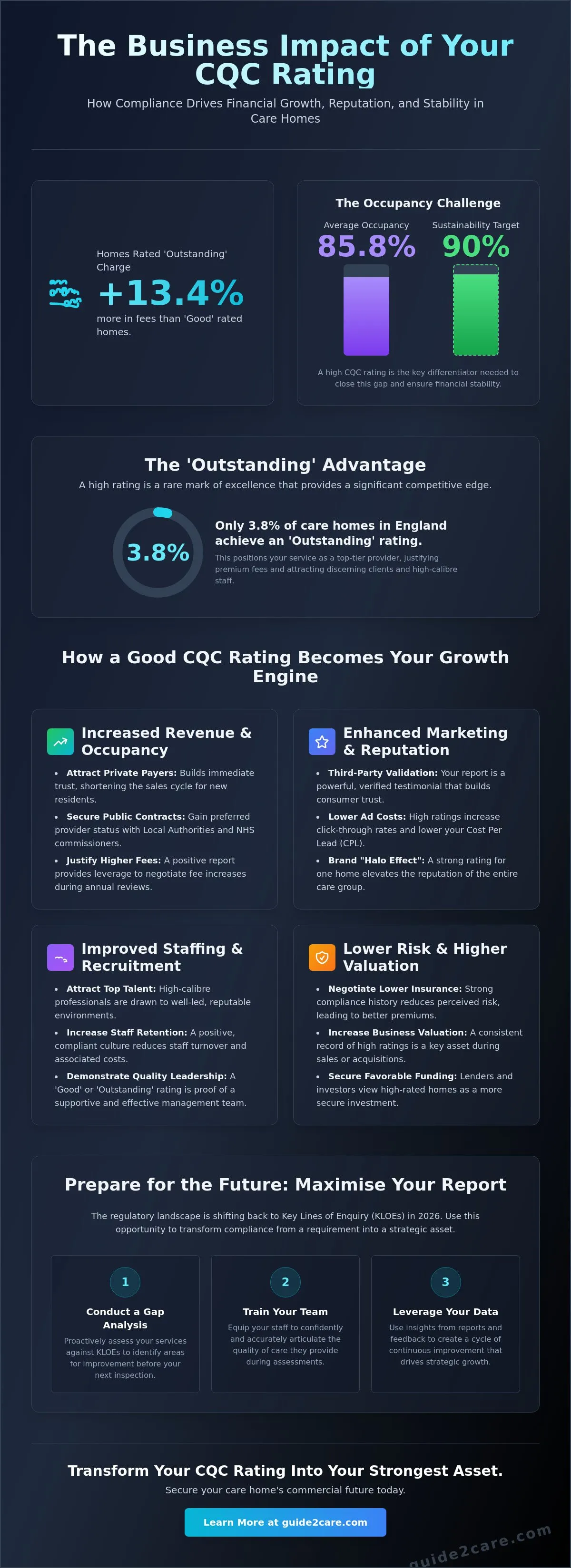
Did you know that care homes rated 'Outstanding' charge an average of 13.4% more in fees than those with a 'Good' rating? In a market where the average occupancy rate is 85.8%, reaching the 90% sustainability threshold requires a clear competitive advantage. You likely understand that the importance of a good CQC report for business goes beyond avoiding penalties. It's a vital tool for financial stability and professional reputation.
Discover how a positive CQC rating translates into higher occupancy, better staff retention, and increased business valuation. This guide explains the direct link between your inspection results and lower insurance premiums or recruitment costs. Learn how to navigate the 2026 regulatory shift back to Key Lines of Enquiry (KLOEs) to strengthen your relationships with local authorities. Use this information to transform your compliance data into a strategic growth asset. Follow these steps to improve your market position and secure your facility's commercial future.
Key Takeaways
- Link your CQC rating to revenue growth by securing preferred provider status with local authority commissioners.
- Use high ratings as verified third-party testimonials in your marketing to reduce digital advertising costs and attract more inquiries.
- Improve staff retention and attract high-calibre professionals by demonstrating a well-led environment through your inspection results.
- Understand the importance of a good CQC report for business when negotiating lower insurance premiums and increasing your overall business valuation.
- Prepare for the 2026 regulatory shift by conducting a gap analysis and training your team to articulate quality care during assessments.
The Financial Impact: How CQC Ratings Drive Occupancy and Revenue
A CQC rating is not just a badge of compliance; it is a primary driver of financial health. The Care Quality Commission (CQC) provides the benchmark for quality that lenders, insurers, and families use to assess risk and value. If your facility is rated 'Requires Improvement' or 'Inadequate', you face a financial ceiling that limits growth and suppresses fee levels. This regulatory status directly dictates your ability to generate sustainable revenue in a competitive market.
Data from 2026 confirms that homes rated 'Outstanding' charge an average of 13.4% higher fees than those rated 'Good'. With average occupancy in England sitting at 85.8% as of February 2026, reaching the 90% sustainability threshold requires a clear market differentiator. The importance of a good CQC report for business becomes evident when you realize that quality ratings are the most influential factor for both private-pay families and public sector commissioners. A positive report secures your income streams and allows for higher profit margins.
To better understand how a positive rating impacts a care provider, watch this video:
The Private Pay Market and Consumer Trust
Families use CQC reports as a primary search filter during their initial research. A 'Good' or 'Outstanding' rating builds immediate trust and significantly shortens the sales cycle for new residents. This "peace of mind" premium allows you to maintain higher margins because clients are willing to pay for verified safety and care standards. Use transparent reporting to prove your quality and reduce the time spent convincing prospective families of your service's value.
Local Authority and NHS Commissioning
Integrated Care Systems (ICS) and local authorities prioritize high-rated providers for block contracts and preferred provider status. Falling below a 'Good' rating creates a significant risk of contract termination or being excluded from new placements. A strong report provides the necessary leverage to negotiate fee increases during annual reviews. It demonstrates that your service delivers consistent value, making it difficult for commissioners to justify stagnant rates or lower-tier funding.
Building a Competitive Edge Through Quality Recognition
A positive CQC rating serves as a powerful, third-party validation of your service quality. In a market where only 3.8% of care homes achieved an 'Outstanding' rating in January 2026, high scores provide a distinct competitive advantage. You should treat your inspection report as a verified testimonial that carries more weight than any self-published review. The importance of a good CQC report for business is most visible when you use it to lower your Cost Per Lead (CPL). Highlighting an 'Outstanding' or 'Good' status in your digital advertising increases click-through rates and builds immediate trust with families.
For care groups, a strong report creates a "Halo Effect" that enhances the reputation of the entire brand. One high-performing location can signal quality across multiple sites, making it easier to enter new local markets. Use specific highlights from your report to differentiate your service from competitors who may only offer generic claims of quality care. This strategy allows you to dominate local search results and position your facility as the first choice for premium placements.
Marketing Your Rating Effectively
Integrate CQC badges across all digital and physical touchpoints. Display your rating clearly on your website, email signatures, and physical signage. Draft press releases to announce positive inspection outcomes to local media outlets. This creates a narrative of excellence that resonates with both potential clients and professional partners. Read our guide on effectively advertising your care home in 2026 to maximize your reach. You can also increase your visibility by securing directory listings for care providers to showcase your credentials to a wider audience.
Reputation Management and Crisis Prevention
A history of strong reports acts as a buffer against isolated negative reviews or minor operational issues. According to official evidence from the Care Quality Commission, regulation builds public trust and is a key factor in attracting long-term investment. Focus specifically on the "Well-led" key question to build brand equity. In early 2026, weaknesses in leadership were the primary reason for poor ratings, with every underperforming service reviewed failing the 'Well-led' category. Proving your leadership strength through a positive report establishes your Unique Selling Point (USP) to families and investors alike. Use this objective data to justify your market position and protect your business against local competition.
Solving the Staffing Crisis: The CQC Factor in Recruitment
The adult social care sector faces a severe staffing crisis, with a vacancy rate of approximately 7%. This is more than three times the wider UK job vacancy rate of 2.3%. In this environment, care professionals are highly selective about where they work. They prioritize facilities that demonstrate a commitment to safety and leadership through their regulatory standing. The importance of a good CQC report for business is clear when you consider that high-calibre staff use these reports as a primary screening tool. A 'Good' or 'Outstanding' rating signals a supportive work culture and a manageable workload.
Staff turnover in the independent social care sector reached 24.7% in the 2024/25 period. High turnover forces providers to rely on expensive agency staff, which erodes profit margins and disrupts care continuity. By achieving a positive rating, you position your business as an "Employer of Choice." This status allows you to attract permanent employees who value professional stability. While the regulator manages its own internal transitions, such as those highlighted in the Health Service Journal report on CQC's finances, the external value of their ratings for your workforce remains high. A strong report is your most effective tool for stabilizing your team.
Attracting Top Talent
Incorporate your CQC accolades directly into your job descriptions and recruitment advertisements. Highlighting an 'Outstanding' leadership rating can significantly increase your application volume. Professionals want to work under Registered Managers who have a proven track record of regulatory success. Use your report to prove that you offer a safe and well-governed environment. This transparency builds trust with candidates before the first interview even begins.
Retention and Reducing Agency Costs
A positive CQC report has a direct psychological impact on frontline staff morale. Employees feel a sense of pride when their hard work is recognized by an official body. This pride reduces burnout and absenteeism, which are major drivers of staff departure. Implement a "Quality First" culture where staff understand how their daily actions contribute to the home's overall rating. Reducing your reliance on agency staff by just 5% can save thousands of pounds annually. Focus on the 'Well-led' domain to ensure your leadership team supports staff effectively, as weaknesses here are the primary reason for poor ratings in 2026. Consistent quality leads to a stable, loyal workforce.
Risk Mitigation: Insurance, Funding, and Business Valuation
A strong regulatory profile is your most effective defense against financial volatility. The importance of a good CQC report for business extends directly to your balance sheet, affecting everything from annual overheads to your final exit price. High ratings signal operational stability to external partners. Poor ratings, however, trigger immediate financial penalties through increased risk pricing and restricted access to capital. You must treat your CQC status as a core component of your financial risk management strategy.
Professional indemnity and public liability insurers use CQC data as a primary metric for calculating premiums. Services rated 'Good' or 'Outstanding' typically access more competitive rates and a wider choice of underwriters. If your service falls into 'Requires Improvement', you'll likely face a sharp increase in premiums. In some cases, mainstream insurers may withdraw coverage entirely, forcing you into expensive high-risk pools that erode your profit margins.
Insurance and Financial Credibility
Review how your inspection data impacts your risk profile. Insurers view negative reports as evidence of systemic failure, which justifies higher costs. Secure your standing by maintaining high digital standards. Use our DSPT checklist to support your compliance efforts and prove your commitment to data security. Improving your digital evidence base makes your business more attractive to lenders who prioritize low-risk investments and stable cash flows.
Protecting Your Business Valuation
A 'Requires Improvement' rating can devalue a care business by 20% to 30% during a sale or refinancing process. Buyers and private equity firms perform deep-dive due diligence on your inspection history to identify hidden operational liabilities. Maintain a 'sale-ready' status by treating every internal audit as preparation for a potential transaction. Investing in a dedicated Quality Assurance (QA) lead provides a long-term ROI by ensuring your compliance never slips between formal inspections.
Consistent quality also builds regulatory resilience. A strong history of compliance can reduce the frequency of future inspections under the CQC's risk-based monitoring approach. This allows your management team to focus on strategic growth rather than constant crisis management. To showcase your high standards to potential partners and investors, use directory listings for care providers to highlight your regulatory achievements. This visibility reinforces your market value and protects your long-term investment.
Maximising Your Report: Next Steps for Your Business
Transitioning from compliance to strategic growth requires a proactive approach to your inspection data. Conduct a comprehensive gap analysis against the current Single Assessment Framework to identify operational weaknesses before they become regulatory risks. You must train your team to articulate quality care clearly during the inspection process. Ensure every staff member can explain how their daily actions align with safety and effectiveness standards. Understanding the importance of a good CQC report for business allows you to prioritize the right operational changes that lead to long-term commercial success.
Leverage technology to provide real-time evidence for the 'Effective' and 'Safe' domains. Digital systems for medication records, care planning, and audits offer transparent proof of quality that paper systems cannot match. These tools allow you to present data-driven evidence to inspectors, reducing the time spent on manual document reviews. Use this objective data to build a narrative of continuous improvement that satisfies the regulator's evolving expectations.
Preparing for the 2026 Inspection Model
The CQC is undergoing a significant overhaul in 2026, with a goal to publish 9,000 assessments by September. This shift moves away from periodic inspections toward continuous monitoring and remote evidence collection. Implement internal auditing processes that mirror the CQC’s Quality Statements to ensure your service is always inspection-ready. Note that the regulator plans a return to Key Lines of Enquiry (KLOEs) later in 2026, reducing 34 Quality Statements to 24 KLOEs. Maintain digital records that are easily accessible to demonstrate compliance during these remote assessments. Focus on direct observation of care, as approximately 80% of future inspection activity will center on this aspect.
Actionable Conversion Steps
Convert your regulatory success into market visibility by joining a professional directory. Review your current listing on Guide2Care to ensure your latest rating is prominent and accurate. Update all marketing collateral, including brochures and digital ads, to reflect your most recent successes. This ensures that prospective families see your verified quality at the start of their search. Book a mock inspection with an independent consultant to identify hidden risks. This exercise prepares your leadership team for the pressure of a real assessment and protects the importance of a good CQC report for business growth. Regular internal reviews ensure that your quality standards remain high between official visits.
Securing Your Competitive Position in 2026
A positive inspection outcome is a foundational business asset. It drives occupancy rates toward the 90% sustainability threshold and protects your business valuation from significant depreciation. You've seen how strong leadership ratings reduce staff turnover and lower recruitment costs in a tight labor market. Recognizing the importance of a good CQC report for business allows you to turn regulatory compliance into a clear market advantage.
Use your high ratings to build trust with families and professional partners. List your care service on Guide2Care and showcase your quality today. As the UK’s leading directory for care providers, our platform is trusted by thousands of families monthly. Take advantage of premium listing options designed specifically for high-rated providers to maximize your visibility and reach.
Start preparing for the 2026 assessment shifts now. Consistent quality ensures your business remains resilient and profitable in the long term. Take these steps to secure your facility's future.
Frequently Asked Questions
How much does a poor CQC rating actually cost a care business?
A poor rating can devalue your business by 20% to 30% during a sale or refinancing process. It also triggers higher insurance premiums and forces a reliance on expensive agency staff due to high turnover rates. These combined factors erode your profit margins and limit your ability to secure competitive business loans for growth. Maintaining high standards is essential for long-term commercial viability.
Can I still sell my care home if it has a "Requires Improvement" rating?
Yes, you can sell a home with this rating, but expect a significantly lower valuation and more intense due diligence from buyers. Investors and private equity firms often deduct the projected cost of remediation from their initial offer. A lower rating may also limit the pool of potential buyers to those specializing in turnaround projects. Aim to improve your rating before listing to maximize your exit value.
How do insurance companies use CQC reports to set premiums?
Insurers use CQC data as a primary metric to calculate your risk profile. Providers with 'Good' or 'Outstanding' ratings access more competitive premiums and a wider choice of underwriters. If your rating drops to 'Requires Improvement', you'll likely face sharp premium increases or even a total withdrawal of coverage. This forces you into high-risk insurance pools with much higher annual costs.
Does a good CQC report help with staff recruitment in 2026?
The importance of a good CQC report for business is significant in recruitment because professionals screen employers using regulatory data. A 'Good' or 'Outstanding' rating attracts high-calibre staff who want a safe and well-led work environment. This reduces your reliance on agency workers and helps stabilize your workforce. Use your rating as a key selling point in job descriptions to increase your application volume.
What is the link between CQC ratings and local authority funding?
Local authorities and Integrated Care Systems (ICS) prioritize 'Good' or 'Outstanding' providers for block contracts and preferred provider lists. A poor rating creates a high risk of contract termination or being excluded from new placements. A strong report provides the leverage you need to negotiate fee increases during annual reviews. It proves your service delivers the consistent value that commissioners require.
How can I use my "Outstanding" rating to increase my private-pay fees?
Homes rated 'Outstanding' charge an average of 13.4% higher fees than those rated 'Good'. Use this rating to justify your premium pricing to private-pay families who prioritize verified quality and safety. Highlight specific praise from the report in your digital advertising to lower your cost per lead. This objective evidence builds immediate trust and shortens the sales cycle for new residents and their families.
Is it worth appealing a CQC rating for commercial reasons?
It's often worth appealing if you have clear evidence that the rating is factually inaccurate or unfair. Because the importance of a good CQC report for business impacts your insurance costs and loan eligibility, an incorrect rating has direct financial consequences. A successful appeal can restore your market value and protect your reputation. Consult with a regulatory specialist to assess the strength of your case before proceeding.
How often should I update my marketing materials after a new CQC report?
Update your marketing materials as soon as the report is published on the CQC website. Ensure your current rating is prominent on your website homepage, email signatures, and physical signage at the facility entrance. Refresh your digital listings to capture the attention of families searching for high-quality care. Consistent and accurate branding maintains your professional reputation and ensures you don't miss out on new inquiries from prospective residents.