Finding Care in Your County: A Step-by-Step UK Guide

Starting the search for care is often a difficult and confusing process. It is common to feel overwhelmed, unsure of where to begin or what types of support are available in your local area. The task of finding the right care in your county can raise more questions than answers. You may wonder how care is regulated, where to find quality reports, and how to effectively compare different providers. This uncertainty can make it hard to feel in control of your decisions.
This guide provides a clear, step-by-step framework to remove that confusion. We will show you exactly how to navigate the UK care system at a local level, from understanding your needs to assessing providers. You will learn how to identify different care services, check official quality ratings, and build a shortlist of suitable options. Our goal is to give you the information and confidence needed to make an informed choice and find the care you need.
Understanding the Landscape of Care Services in Your County
Beginning the search for care can feel complex. A search for "care county" might mean you are looking for a specific company, but more often it is the first step in exploring all the support options available in your local area. This section provides a clear map of the care landscape, helping you understand the key organisations and the types of support you can find.
To better understand this process, watch this helpful overview:
Key Players in Local Care Provision
Three main groups are involved in providing and regulating care in your county. Understanding their roles is the first step to navigating the system.
- Local Authorities (County Councils): Your County Council is responsible for adult social care. Its primary duty is to assess the care needs of residents through a 'needs assessment'. This is the official starting point. Following an assessment, the council determines if an individual is eligible for council-funded support. The system of Social care in the United Kingdom means those who do not meet the financial criteria must pay for their own care (self-funding).
- Private Care Providers: These are the independent organisations that deliver day-to-day care. They include care home groups, independent homes, and home care agencies that you will find listed in your area.
- The Care Quality Commission (CQC): The CQC is the independent regulator of all health and social care services in England. They inspect providers and publish reports with performance ratings, which this guide will help you to understand.
Types of Care You Can Find Locally
Care services are designed to meet different levels of need. The main options available in most counties fall into these categories:
- Residential Care Homes: These provide 24-hour accommodation and personal care, including help with washing, dressing, and meals.
- Nursing Homes: Similar to residential homes, but they also have qualified nurses on-site at all times to manage specific medical conditions and nursing needs.
- Home Care (Domiciliary Care): This allows an individual to receive support in their own home. Carers visit for agreed-upon hours to help with personal care, household tasks, or companionship.
- Supported Living: This service helps people with a range of needs to live independently in their own home or in specialist housing, with support tailored to their requirements.
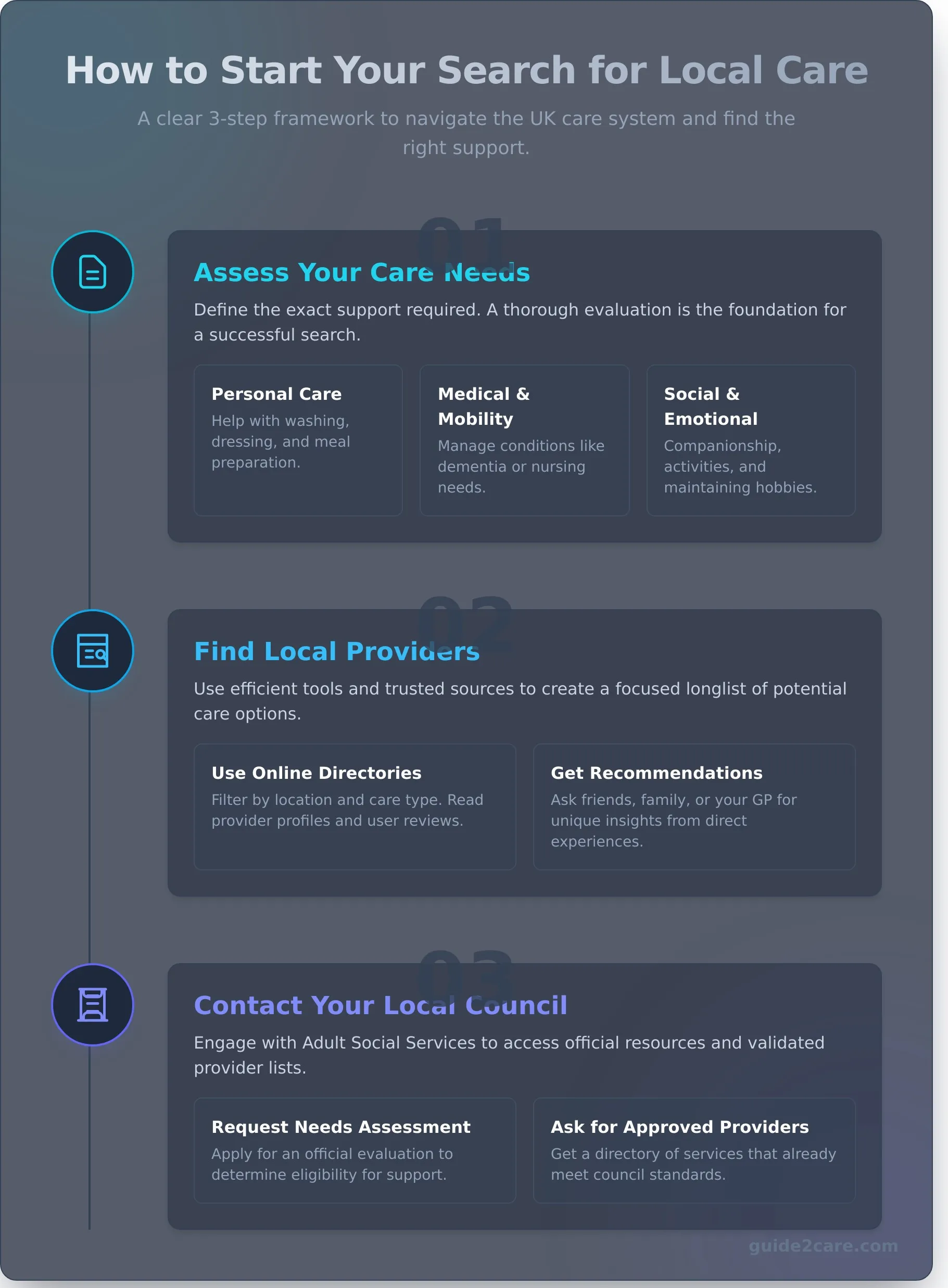
How to Start Your Search for Local Care Providers
Before you can analyse a CQC report, you first need to identify potential care providers. A structured search helps you create a focused longlist of services in your chosen care county. This process ensures you are comparing relevant options that meet your specific requirements from the very beginning.
Step 1: Assessing Your Care Needs
Start with a thorough needs assessment. This initial evaluation defines the exact type of support required and forms the basis of your search. A clear understanding of needs prevents you from wasting time on unsuitable providers. Consider the following key areas:
- Personal Care: What level of help is needed with daily tasks like washing, dressing, and meal preparation?
- Medical and Mobility: Are there specific medical conditions, such as dementia or the need for nursing care, to manage? Factor in any mobility support required.
- Social and Emotional Needs: Think about companionship, social activities, and maintaining hobbies. This is crucial for overall well-being.
Step 2: Using Online Directories Effectively
Online care directories are efficient tools for finding and filtering local options. Use the search functions to narrow down providers by location, such as a specific town or postcode, and by the type of care needed, like 'respite care' or 'live-in care'. Read the provider profiles and user reviews to get an initial impression of their services. While online resources are valuable, also consider personal recommendations from friends, family, or your GP, as their direct experiences can offer unique insights. Start your search for care in your county today.
Step 3: Contacting Your Local Council
Your local council's Adult Social Services department is another key resource. You can find their contact details by searching online for "[Your County] Council Adult Social Services". The council can conduct an official care needs assessment to determine eligibility for support. You can visit the government website to Apply for a needs assessment and understand the process. Additionally, you can ask the department for a list of their approved local providers, which gives you a directory of services that already meet council standards. Following these steps will help you build a strong longlist of potential providers in your care county, preparing you for the next stage of detailed evaluation.
Evaluating Care Quality: Using CQC Reports for County-Level Checks
To find reliable care, you must understand how quality is measured. In England, all health and social care services are regulated by the Care Quality Commission (CQC). This independent body inspects providers and publishes detailed reports, which are essential tools for a care county search. The CQC bases its inspections on five key questions:
- Safe: Are you protected from abuse and avoidable harm?
- Effective: Does your care, treatment, and support achieve good outcomes?
- Caring: Do staff involve you and treat you with compassion, kindness, dignity, and respect?
- Responsive: Are services organised to meet your needs?
- Well-led: Does the leadership of the organisation make sure it's providing high-quality care?
Each of these areas receives a rating, which contributes to an overall score for the service.
What Do CQC Ratings Mean?
The CQC uses a simple four-point rating scale to help you quickly assess a service's quality. Understanding these ratings is the first step in evaluating a provider.
- Outstanding: The service is performing exceptionally well.
- Good: The service is performing well and meeting all CQC expectations.
- Requires Improvement: The service is not performing as well as it should. The CQC has identified areas needing correction.
- Inadequate: The service is performing badly. The CQC has taken enforcement action against the provider.
A 'Good' rating is a solid benchmark and indicates a reliable service. If a provider is rated 'Requires Improvement', you should read the full report to understand the specific concerns. The issues may be administrative rather than related to direct care.
How to Search CQC Ratings by County
The CQC website makes it easy to find and compare providers in your area. Follow these steps to search for a care provider within your specific care county or town.
- 1. Go to the CQC website: Navigate to the homepage and select the type of care you are looking for (e.g., 'Care homes' or 'Care in your home').
- 2. Enter your location: Use the search bar to type in a postcode, town, or county.
- 3. Filter your results: You can refine the list by rating, service type, or specific needs. This helps you compare providers in a specific area.
- 4. Check the summary: Look at the overall rating and the date of the last inspection. A more recent report provides a more current view of the service's quality.
Key Questions to Ask Providers in Your Chosen County
A CQC report provides an essential foundation for your research. Once you have used these reports to create a shortlist of providers, the next step is direct contact. Visiting a care home or scheduling a detailed call with a home care agency is critical. This allows you to verify the report's findings and assess the service for yourself. Prepare your questions in advance to make an informed decision about the care county provider that best fits your needs.
Beyond asking questions, remember to observe. During a visit, pay attention to the cleanliness of the environment, the atmosphere, and how staff interact with the people they care for.
Questions for Care Homes
When you visit a residential or nursing home, focus on the day-to-day reality for residents. Your goal is to understand the home's culture, staffing levels, and daily routines.
- What are the staff-to-resident ratios during the day, and how do they change at night?
- Can you provide a sample weekly menu and a schedule of activities and social events?
- How do you communicate with families about a resident's health and wellbeing?
- What is your formal policy for handling complaints or concerns from residents or their families?
Questions for Home Care Agencies
For domiciliary care, questions should centre on reliability, staff suitability, and emergency procedures. Building a trusted relationship with a carer is key, so understand how the agency facilitates this.
- How do you ensure consistency of carers for a client to build a strong relationship?
- What is the procedure if a regular carer is sick or on holiday? Who is the replacement?
- Are all your carers DBS checked, and what specific training have they completed?
- How do you manage medical emergencies or a sudden change in a client's care needs?
Questions About Costs and Contracts
Before signing any agreement, you must have complete clarity on all fees. Ask for a detailed, written breakdown of costs to avoid unexpected charges. This applies to every type of care county service.
- Can you provide a full schedule of fees, including any potential extra costs (e.g., for activities, hairdressing, or specific medical supplies)?
- What is the notice period required to end the contract for any reason?
- How often are your fees reviewed, and what is the typical annual increase?
A reputable provider will welcome your questions and be transparent in their answers. To find and compare providers, explore the listings on Guide2Care.
Funding Care: Financial Support from Your County Council
Once you have used a CQC report to identify suitable care providers, the next step is to consider funding. In the UK, financial support for social care is managed at a local level. Your local authority or care county council is the first point of contact for a financial assessment to determine if you are eligible for funding.
This assessment, often called a 'means test', evaluates your ability to pay for care. The council uses national capital thresholds to decide on your contribution. For 2024/2025 in England, these are:
- Upper Capital Limit: £23,250. If your capital is over this amount, you will typically be expected to pay for your care in full. You are known as a 'self-funder'.
- Lower Capital Limit: £14,250. If your capital is below this amount, you will receive the maximum possible funding from the council, though you may still contribute from your income.
- Between the limits. If your capital falls between £14,250 and £23,250, you will receive partial funding and be expected to contribute to the cost.
Remember to also claim any non-means-tested benefits you are entitled to, such as Attendance Allowance, as this is not included in the financial assessment. If you are a self-funder, it is highly advisable to seek independent financial advice to plan for long-term care costs.
The Role of the Financial Assessment
The financial assessment is a detailed review of your income, savings, and assets. The council will look at pensions, benefits, savings accounts, investments, and property ownership. Your home is not usually included in the assessment if you need care at home. For residential care, it is typically included unless your partner or another qualifying relative still lives there. The outcome determines if you will pay for all, some, or none of your care fees.
What Happens After the Assessment?
If you are eligible for financial support, the council will calculate a 'personal budget'. This is the amount it will contribute towards your care. You can receive this budget in two main ways:
- Direct Payments: The council pays the money directly to you or a nominated person. This gives you the control to choose and arrange your own care services.
- Council-Arranged Care: The council manages your personal budget and arranges care on your behalf, paying the provider directly.
Navigating care funding can be complex, but understanding the process is the first step to securing the right support. Explore our guides on funding care for more details.
Find The Right Care in Your County
Navigating the care system can be complex, but finding the right support is achievable with a clear plan. This guide has provided the essential framework: first, understand the landscape of local services, from domiciliary care to residential homes. Second, use objective tools like CQC reports to evaluate quality and ensure safety. Finally, explore all potential funding support from your county council. This methodical approach is key to a successful care county search.
Your next step is to put this knowledge into action. Our free directory is a trusted, impartial resource designed to simplify your search. It features comprehensive listings for every county in the UK, allowing you to find and compare local options efficiently. You can filter providers by care type and CQC rating to build a shortlist that meets your specific requirements. Use our free directory to find and compare care providers in your county.
Start your search today with the information you need to make a confident choice.
Frequently Asked Questions
What is the difference between care provided by the county council and private care?
County council care is arranged by your local authority following a needs assessment and a financial assessment. The council may contribute to or cover the full cost of this care. Private care, or self-funded care, is arranged and paid for directly by the individual without financial assistance from the council. Both council-funded and private care providers in England are regulated by the Care Quality Commission (CQC) to ensure they meet fundamental standards of quality and safety.
How can I find the contact details for my local council's adult social care department?
The most direct way to find the correct contact information is by using the official GOV.UK website. Navigate to the "Find your local council" service on the site. You will be prompted to enter your postcode. This tool will then provide you with a link to your specific council's website, where you can find the contact details for the adult social care team. This ensures you are contacting the correct local authority for your area.
Are care home fees and costs different in every county?
Yes, care home fees vary significantly across different counties in the UK. Costs are influenced by local factors such as property prices, average staff wages, and the level of demand for care services in the area. For example, residential care fees are often considerably higher in London and the South East compared to counties in the North of England or Wales. Always research the average costs for your specific region when planning for care funding.
What should I do if I'm unhappy with the care provided in my county?
If you are unhappy with the standard of care in your county, your first step should be to raise the issue directly with the care provider using their official complaints procedure. If you are not satisfied with their response, you can escalate the complaint. For council-funded care, contact the Local Government and Social Care Ombudsman. For concerns about safety and quality, regardless of funding, you should report your concerns to the Care Quality Commission (CQC).
Can I find care in a different county to where I currently live?
Yes, you have the right to choose a care home in a different county. If you are self-funding, you can arrange this directly with the provider. If your local council is funding your care, they must agree to the placement. They will typically approve the move as long as the chosen home is suitable for your needs and the fees are comparable to what they would pay for a similar service in your home county.
How long does a council needs assessment typically take?
There is no fixed legal timeframe, but a council needs assessment should be carried out in a timely manner. The entire process, from first contact to receiving a finalised care plan, can often take several weeks. The exact duration for care in your county can vary depending on the complexity of your needs and the current demand on your local authority’s adult social services department. You should be kept informed of the expected timeline.