What is a Home Care Provider? A Complete UK Guide

Navigating the world of care can feel complex. You may be asking what 'home care' actually includes, how to find someone you can trust, or how the funding works. Finding the right support for yourself or a loved one is a significant decision, and the first step is to understand the role of a home care provider and the services they offer to help people live independently at home.
This complete UK guide provides the clear, practical answers you need. We will break down the different types of domiciliary care available, from companionship and personal care to more complex nursing support. You will learn how to assess your specific needs, how to find and vet a reputable provider, and what to expect regarding costs. Our purpose is to equip you with the essential information to make a confident and informed choice. Find the care you need, right here.
What is a Home Care Provider? Defining Care at Home
A home care provider is an organisation that delivers professional, regulated support to individuals within their own homes. The primary goal is to enable people to maintain their independence, safety, and comfort in a familiar environment, delaying or preventing the need to move into a residential facility. This model of support is fundamentally different from residential or nursing homes, where care is provided in a dedicated communal setting.
To better understand this concept, watch this helpful video:
In the UK, the official industry term for this service is 'domiciliary care'. It encompasses a wide range of support, from simple companionship and help with domestic tasks to complex personal and medical care. The system of Home care in the United Kingdom is structured to provide a flexible alternative to residential care, allowing for tailored support that adapts to changing needs.
The Role of a Home Care Provider
A professional home care agency manages the entire care process. This ensures quality, safety, and consistency for the client and their family. Their key responsibilities include:
- Staff Management: They recruit, vet, train, and manage a team of professional carers, ensuring they have the correct skills and qualifications.
- Personalised Care Plans: The provider assesses an individual's specific needs and creates a detailed, person-centred care plan to guide the support provided.
- Quality and Safety Assurance: They are responsible for scheduling visits, monitoring the quality of care, and adhering to regulatory standards set by bodies like the Care Quality Commission (CQC).
- Central Point of Contact: The agency serves as a single, reliable point of contact for families, handling all administrative tasks, payments, and communication.
Home Care Provider vs. Private Carer
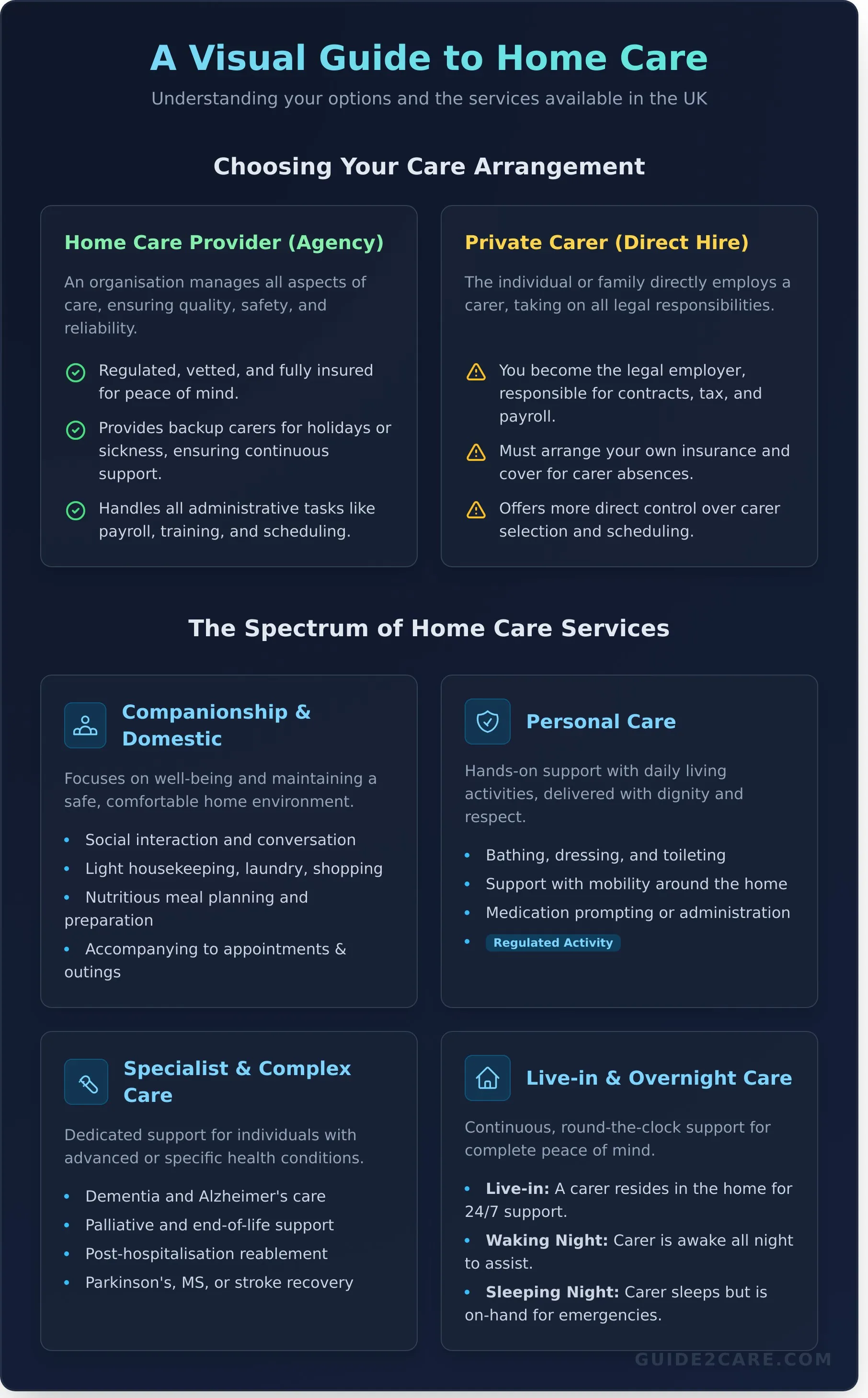
When arranging care, you can choose between an agency or employing a carer directly. A home care provider is an agency-managed service. This means they are regulated, fully insured, and can provide backup carers if the regular carer is unwell or on holiday. This offers security and reduces the administrative burden on the family.
A private carer is employed directly by the individual or their family. While this can offer more control over who provides the care and potentially more flexibility in schedules, it also means the family takes on all legal responsibilities of an employer. This includes managing contracts, payroll, tax, insurance, and arranging cover for any absences.
Types of Services Offered by Home Care Providers
A home care provider delivers a range of support services directly in a person's own home. These services are not one-size-fits-all; they are designed to be flexible, tailored to individual needs, and can be combined to create a comprehensive care plan. Support can range from a few hours of help each week to continuous 24/7 care. A key advantage is that the level of care can adapt as a person's needs evolve over time.
Understanding the full spectrum of support is essential. When choosing a home care provider, it is important to assess which services align with your current and future requirements. Services cover everything from companionship and domestic help to complex medical support for specific health conditions.
Companionship and Domestic Support
This type of care focuses on well-being and maintaining a safe, comfortable home environment. It is ideal for individuals who are generally independent but may need help with certain tasks or are experiencing loneliness. Services typically include:
- Providing social interaction and conversation.
- Assistance with light housekeeping, laundry, and shopping.
- Planning and preparing nutritious meals.
- Accompanying clients to appointments, social outings, or community events.
Personal Care (Regulated Activity)
Personal care involves hands-on support with daily living activities and is a regulated service in the UK to ensure quality and safety. Carers are trained to provide this support with dignity and respect. It often includes help with:
- Bathing, showering, dressing, and toileting.
- Support with mobility, including moving around the home and getting in or out of bed.
- Prompting or administering medication in line with the care plan.
Specialist and Complex Care
For individuals with specific or advanced health needs, specialist care is available. Carers receive dedicated training to manage complex conditions, allowing individuals to remain in the familiar comfort of their own home. This includes:
- Dementia and Alzheimer's care: Creating a safe, structured routine in a familiar setting.
- Palliative and end-of-life care: Providing comfort and support for the client and their family.
- Post-hospitalisation care (reablement): Helping individuals regain independence after a hospital stay.
- Condition-specific support: Assistance for those with Parkinson's, Multiple Sclerosis, or who are recovering from a stroke.
Live-in and Overnight Care
For those requiring round-the-clock support, live-in or overnight care provides continuous peace of mind. A carer resides in the home to offer constant assistance. There are different levels of overnight support:
- Live-in Care: A carer lives in the client's home to provide 24/7 support and companionship.
- Waking Night: The carer remains awake all night to assist as needed.
- Sleeping Night: The carer sleeps in the home but is on-hand to help in an emergency.
How to Choose the Right Home Care Provider: A Step-by-Step Guide
Choosing a home care provider is a significant decision. A structured approach simplifies the process and helps match the provider’s services with specific requirements. Whenever possible, involve the person who will be receiving care in the decision-making process. Following these steps will help you find a reliable and suitable service that meets your needs.
Step 1: Assess Your Care Needs
Before you begin your search, it is essential to define the exact level of support required. A clear assessment ensures you find a provider equipped to handle specific circumstances. This initial step prevents confusion and helps you communicate your needs effectively to potential providers.
- List all daily tasks where assistance is needed, such as meal preparation, bathing, or medication management.
- Consider the level of care: is it for companionship, personal care, or more complex medical support?
- Determine the required frequency and duration of visits, from a few hours a week to 24-hour live-in care.
- Consult with a GP or social worker for a professional needs assessment to get a comprehensive view.
Step 2: Find and Shortlist Providers
With a clear understanding of your needs, you can begin to research and identify potential providers in your area. Use trusted resources to build a shortlist of agencies that appear to be a good fit. Look for evidence of quality, reliability, and specialisms relevant to your situation. A thorough search at this stage is crucial for finding the right long-term partner.
- Use a comprehensive directory to find local providers.
- Check their Care Quality Commission (CQC) rating and read the latest inspection report for an independent quality assessment.
- Look at their website for information on their specialisms, staff training, and company values.
Start your search for trusted home care providers here.
Step 3: Ask the Right Questions
Once you have a shortlist, contact each home care provider to ask detailed questions. Their answers will give you insight into their professionalism, procedures, and how they value their clients and staff. Do not hesitate to ask for clarification or further details. This is your opportunity to gauge their suitability beyond what is written on their website.
- How do you recruit, train, and vet your carers?
- How do you create and regularly review individual care plans?
- What are your procedures for emergencies or missed carer visits?
- Can you provide anonymised references or testimonials from current clients?
Understanding Regulation and Quality Standards in the UK
In the UK, care services are regulated to ensure they meet essential standards of safety, quality, and care. Choosing a regulated provider offers protection, a guarantee of minimum standards, and access to a formal complaints process if things go wrong. While regulations vary slightly across the country, the goal is the same: to protect vulnerable people.
The main regulatory bodies for social care in the UK are:
- England: The Care Quality Commission (CQC)
- Scotland: The Care Inspectorate
- Wales: Care Inspectorate Wales (CIW)
- Northern Ireland: The Regulation and Quality Improvement Authority (RQIA)
These organisations have the power to inspect services, publish their findings, and take action against providers who fail to meet the required standards.
The Role of the Care Quality Commission (CQC)
In England, the CQC is the independent regulator of all health and social care services. Every registered care home and home care provider is regularly inspected and rated. Inspectors focus their assessment on five key questions to determine the quality of care:
- Safe: Are you protected from abuse and avoidable harm?
- Effective: Does your care, treatment and support achieve good outcomes?
- Caring: Do staff involve and treat you with compassion, kindness, dignity and respect?
- Responsive: Are services organised so that they meet your needs?
- Well-led: Does the leadership of the organisation make sure it's providing high-quality care?
The findings from these inspections are compiled into a detailed report, which is made publicly available on the CQC website.
How to Understand CQC Ratings
The CQC uses a simple four-point rating scale to help you easily compare services. A provider will be rated as:
- Outstanding: The service is performing exceptionally well.
- Good: The service is performing well and meeting expectations.
- Requires Improvement: The service is not performing as well as it should.
- Inadequate: The service is performing badly and has been placed in special measures.
A 'Good' rating is the expected standard for most services. While the overall rating is a useful starting point, it is vital to read the full report. This document provides detailed evidence behind the rating and offers a complete picture of a provider’s performance. Find providers and view their CQC ratings on Guide2Care.
Funding Your Home Care: An Overview of Your Options
The cost of care is a primary concern for many families. Understanding the available funding routes is the first step towards creating a sustainable care plan. Support depends on your specific care needs and financial circumstances. It is vital to explore every potential source of funding and to seek independent financial advice for long-term planning.
Local Authority Funding
Your local council has a duty to assess your care needs. If you meet the eligibility criteria, they will then conduct a financial assessment (a means test) to determine how much you should contribute towards the cost of your care. If you qualify for funding, you may be offered a 'Direct Payment'. This gives you the funds to arrange and pay for your own support, allowing you to choose your preferred home care provider.
NHS Funding for Health Needs
NHS funding is based entirely on health needs, not your financial situation. It is not means-tested. The main types include:
- NHS Continuing Healthcare (CHC): A full package of care for adults with a primary health need, meaning their care needs are complex, intense, or unpredictable.
- NHS-funded Nursing Care: A tax-free, non-means-tested payment towards the cost of nursing care from a registered nurse for those in a care home.
Self-funding and Other Options
Many people pay for their care privately using savings, investments, or income from pensions. Even if you self-fund, you should check your eligibility for non-means-tested benefits that can help with costs, such as Attendance Allowance. For long-term planning, specialist financial products like immediate needs annuities or equity release schemes may be considered, but you must seek regulated financial advice before proceeding.
Understanding these options is crucial. For detailed information and to find a local home care provider, explore the resources available at guide2care.com.
Your Next Steps to Finding the Right Home Care
Choosing care at home is a significant decision. This guide has shown that understanding the types of services available, from personal care to complex support, is the essential first step. It is also vital to check official quality standards and explore all available funding options to make an informed choice for yourself or a loved one.
When you are ready to find a suitable home care provider, Guide2Care simplifies the process. Use our comprehensive UK-wide directory to find and compare trusted home care providers near you. We provide verified CQC ratings and free, impartial guides to help you choose with confidence.
You are now equipped with the information needed to find the support that is right for your circumstances.
Frequently Asked Questions
What is the average hourly cost for a home care provider in the UK?
The average hourly cost for home care in the UK typically ranges from £25 to £35. Prices vary based on location, the complexity of care required, and the time of day. For example, care provided during evenings, weekends, or bank holidays often incurs a higher rate. It is essential to request a detailed price list from any provider to understand all associated costs, including potential travel or administrative fees that may apply to your care package.
What is the main difference between a home care provider and a care home?
A home care provider delivers support directly within a person's own home. This is also known as domiciliary care and can range from companionship to complex personal care. In contrast, a care home is a residential facility where individuals live full-time to receive 24-hour care and support. The primary difference is the location where care is delivered: your personal residence versus a dedicated care facility. The right choice depends on individual needs and preferences.
What qualifications should I expect a carer from a provider to have?
All carers must complete the Care Certificate, which covers fundamental skills in health and social care. A Disclosure and Barring Service (DBS) check is also mandatory to ensure they are safe to work with vulnerable people. For more complex needs, expect carers to hold formal qualifications such as a Level 2 or 3 Diploma in Health and Social Care. Providers must also ensure ongoing training for staff in specialist areas like dementia care or first aid.
How do I check if a home care provider is registered with the CQC?
The Care Quality Commission (CQC) is the independent regulator of health and social care in England. To verify a provider's registration, visit the official CQC website. Use their online directory to search for the provider by name or location. The search results will show if the provider is registered, display their latest inspection report, and provide an overall quality rating. This is a critical step in assessing the safety and quality of any service.
Can I get financial assistance from the council to pay for a home care provider?
Yes, you may be eligible for financial support from your local council. The process begins with a care needs assessment to determine the level of support you require. If you are eligible, the council will then conduct a financial assessment (a means test) to decide how much you need to contribute. If funding is approved, you may receive it as a direct payment, allowing you to choose and pay your preferred home care provider yourself.
How are care plans created and how often are they reviewed?
A care plan is created following an in-depth assessment of your needs, preferences, and personal goals. This is a collaborative process involving you, your family, and the care provider. The plan details the specific support to be delivered. Reputable providers review care plans regularly, typically every three to six months, or more frequently if there is a significant change in your health or circumstances. This ensures the care provided remains appropriate and effective.