Home Care Providers: A Complete Guide to Finding In-Home Care

Navigating the world of in-home care can feel overwhelming. You may be asking: What services are included? How does it differ from a care home? Most importantly, how do you find a trustworthy provider to ensure the safety and well-being of a loved one? This guide is designed to answer these questions and simplify your search. We provide clear, factual information on UK home care providers to help you understand all available options.
This complete guide explains the specific services offered, from companionship and personal care to more complex nursing support. You will find a practical, step-by-step process for vetting and choosing the right provider for your unique needs. Our objective is to give you the clarity and confidence to make an informed decision and find the care you need.
What Are Home Care Providers and What Do They Do?
Home care, often called domiciliary care, is professional support provided to an individual in their own home. To understand what is home care in the UK, it is best defined as a service designed to help people live safely and independently for as long as possible. This approach contrasts directly with residential care, which requires a person to move into a facility like a care home.
The key benefit of using home care providers is flexibility. Support can be tailored to specific needs, ranging from a single one-hour visit per week to comprehensive 24/7 live-in care. This allows for a personalised plan that adapts as needs change.
To better understand how to find the right support, watch this helpful video:
Common Types of Home Care Services
A carer can assist with a wide range of tasks to support daily living. Services are typically grouped into several key categories:
- Personal Care: Assistance with daily routines such as bathing, dressing, grooming, and continence care. This also includes prompting or administering medication.
- Companionship: Providing social interaction, engaging in hobbies, or accompanying the individual to appointments and social outings to combat loneliness.
- Household Tasks: Help with light housekeeping, preparing nutritious meals, doing laundry, and shopping for groceries or other essentials.
- Specialist Care: Trained support for complex conditions, including dementia, Parkinson's disease, stroke recovery, or palliative care.
Who Can Benefit from a Home Care Provider?
Home care is a suitable option for many different situations. It provides essential support for a variety of individuals, enabling them to maintain their quality of life at home. Key groups who benefit include:
- Older people who wish to remain in their familiar surroundings, a practice known as 'ageing in place'.
- Adults living with long-term disabilities who require ongoing assistance with daily activities.
- Individuals needing short-term support while recovering from surgery, an illness, or an injury.
- Family carers who require respite, giving them a necessary break from their caregiving responsibilities.
Choosing the Right Type of Care: Home Care vs. Residential Care
One of the first major decisions you will face is choosing between receiving support at home or moving into a residential care setting. Both options offer professional support, but they deliver it in fundamentally different ways. The right choice depends entirely on personal needs, finances, and desired lifestyle. Regardless of the path you choose, it is essential to check that any service is regulated by the Care Quality Commission (CQC), which ensures services meet national standards.
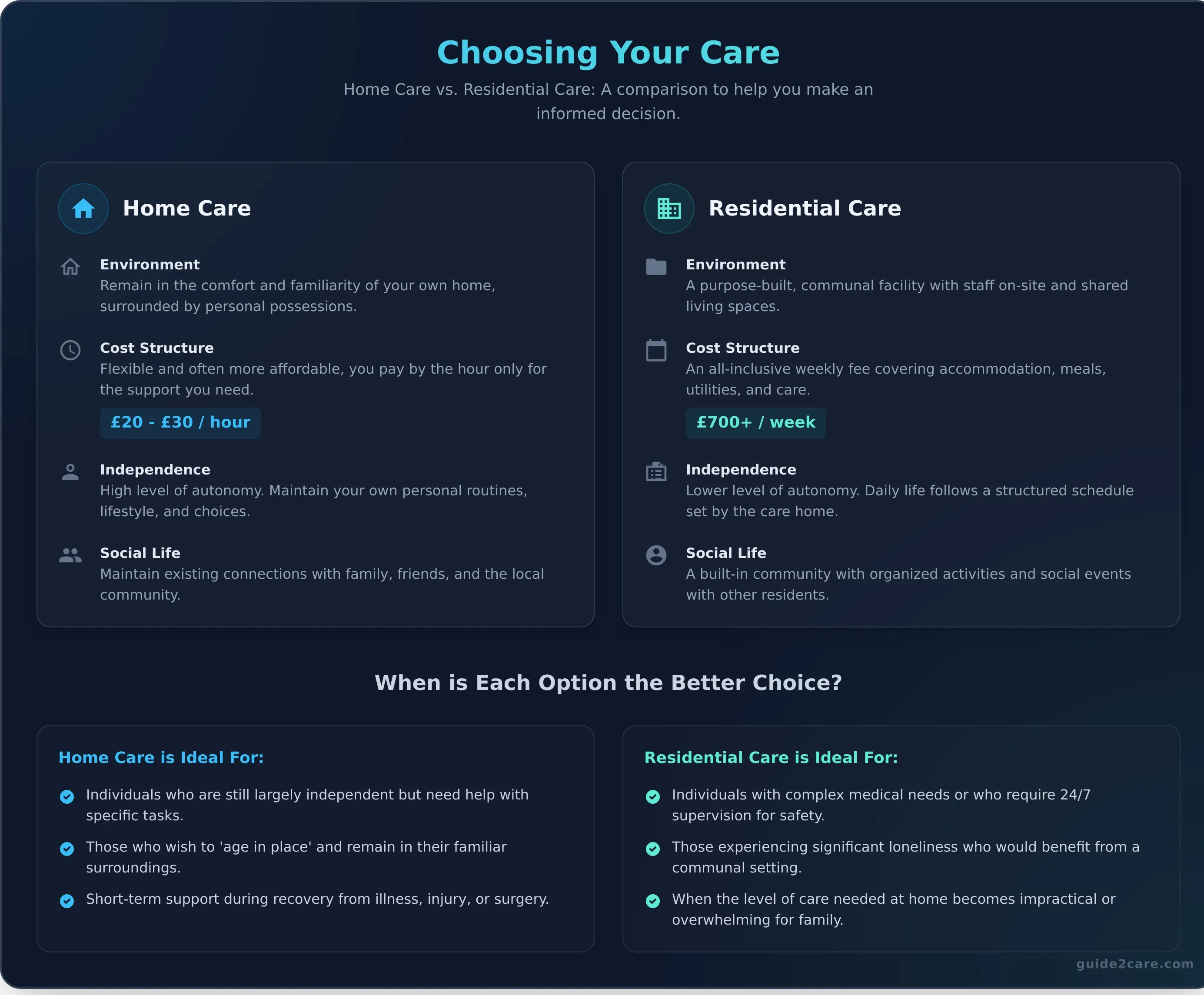
To help you compare, here is a simple breakdown of the key differences:
| Factor | Home Care | Residential Care |
|---|---|---|
| Environment | In your own familiar home | A purpose-built communal facility |
| Cost Structure | Pay by the hour (e.g., £20-£30/hour) | All-inclusive weekly fee (e.g., £700+/week) |
| Independence | High. You maintain your own routine. | Lower. Follows a structured schedule. |
| Social Life | Maintain existing social circles | Built-in community and activities |
Comparing Independence and Environment
Home care allows an individual to remain in the comfort and familiarity of their own home. This means keeping personal routines, possessions, and neighbourhood connections. Care is delivered on a one-to-one basis. In contrast, residential care offers a structured, communal environment with staff on-site 24/7. While this provides constant oversight, it requires adapting to the home's schedule and living with other residents.
Understanding the Cost Differences
The financial models for each care type are very different. With home care, you only pay for the time you need, typically charged by the hour. This makes it a flexible and often more affordable option for those who do not require constant support. Residential care charges an all-inclusive weekly or monthly fee that covers accommodation, meals, utilities, and care. Costs vary significantly based on the level of care required and the facility's location.
When is Each Option the Better Choice?
Home care is often the ideal choice for individuals who are still largely independent but require support with specific tasks like personal care, meal preparation, or medication reminders. Reputable home care providers can create flexible plans that adapt as needs change. Residential care becomes a more suitable option when a person has complex medical needs, requires 24/7 supervision for safety, or is experiencing loneliness and would benefit from a communal setting. For those needing intensive support at home, live-in care offers a hybrid solution, providing a round-the-clock presence without leaving a familiar environment.
How to Find and Select a Home Care Provider: A 4-Step Process
Choosing a home care provider can feel like a significant task. This structured, four-step process is designed to simplify your search and help you make an informed decision. Whenever possible, involve the person who will receive care in each step. Taking your time now ensures you find the right support for your needs.
Step 1: Define Your Specific Care Needs
Before you begin your search, you must first understand the exact support required. Create a detailed list to clarify your needs. Consider tasks that require support on a daily, weekly, or occasional basis.
- Daily tasks: Help with washing and dressing, meal preparation, medication reminders.
- Weekly tasks: Housekeeping, shopping, laundry, attending appointments.
- Occasional needs: Companionship, social outings, respite care.
Also, think about the times of day when help is most critical, such as in the morning or at bedtime. Consider the personality and character traits that would make a carer a good match.
Step 2: Research and Shortlist Providers
Once your needs are clear, you can start to identify potential home care providers. Use trusted sources to build a shortlist of local agencies. It is essential to check the quality and safety of any provider you consider.
In England, all care providers are regulated by the Care Quality Commission (CQC). You must check their latest inspection report and rating online. Recommendations from your GP, friends, or family can also be a valuable source of information.
Use our directory to find CQC-rated home care providers near you.
Step 3: Interview and Ask the Right Questions
Contact your shortlisted providers to ask specific questions about their service. A structured conversation will help you compare them effectively. Prepare a list of questions in advance. Key areas to cover include:
- How do you recruit, vet, and train your carers?
- What is your process if the regular carer is sick or on holiday?
- How do you create and review care plans?
- Can you provide a clear and complete breakdown of all costs and fees?
Step 4: Make Your Decision and Review the Contract
After the interviews, you can make your final choice. Before committing, ask for a copy of their contract or service agreement. Review it carefully and check for key details such as the notice period, complaints procedure, and a full schedule of fees. Ensure all agreed services are clearly documented. This final review protects both you and the provider.
Understanding Home Care Costs and Funding in the UK
The cost of care is a primary concern for most individuals and their families. Navigating the funding options in the UK can be complex, as eligibility depends on your personal financial situation and specific care needs. Understanding the main funding routes is the first step in planning for long-term care at home.
We recommend seeking independent financial advice to help you make the best decisions for your circumstances.
Average Costs of Home Care
The cost of domiciliary care is typically charged at an hourly rate. In the UK, you can expect to pay between £25 and £35 per hour. The final price is influenced by several factors:
- Location: Rates in London and the South East are generally higher than in other parts of the country.
- Level of Need: Specialist care, such as for advanced dementia or complex medical conditions, will cost more.
- Time of Day: Evenings, weekends, and bank holidays often incur higher charges.
Live-in care operates on a different cost structure, usually a weekly fee starting from £1,500, which covers 24-hour support from a dedicated carer.
Funding from Your Local Authority
You may be eligible for financial support from your local council. The process begins with a 'needs assessment' to determine the level of support you require. If you are deemed to have eligible needs, the council will then conduct a 'financial assessment' (a means test) to see if you qualify for funding.
If you are eligible for support, you may be offered Direct Payments. This is money paid directly to you, giving you the control to choose and manage your own care arrangements and select from different home care providers.
NHS Continuing Healthcare (CHC)
NHS Continuing Healthcare (CHC) is a package of care arranged and funded solely by the NHS for individuals with significant and complex health needs. Eligibility is based on having a 'primary health need' and is determined through a detailed assessment process. Unlike local authority funding, CHC is not means-tested and covers the full cost of your care. However, the eligibility criteria are very strict.
The Role of the CQC: Ensuring Quality and Safety
In England, the Care Quality Commission (CQC) is the independent regulator of all health and social care services. Its role is to monitor, inspect, and rate services to ensure they meet fundamental standards of quality and safety. This oversight is essential for protecting people who use care services.
All legitimate home care providers must be registered with the CQC to operate legally. Checking a provider's CQC registration and report is a critical step in your decision-making process. If a provider is not registered, or is reluctant to share their report, this is a major red flag and they should be avoided.
What Do CQC Ratings Mean?
The CQC inspects providers against five key standards. These questions form the basis of their assessment and are designed to reflect what matters most to people using the service:
- Safe: Are you protected from abuse and avoidable harm?
- Effective: Does your care and support achieve good outcomes and help you maintain quality of life?
- Caring: Do staff treat you with compassion, kindness, dignity, and respect?
- Responsive: Are services organised to meet your individual needs?
- Well-led: Is the service managed well to ensure it provides high-quality, person-centred care?
Following an inspection, a provider is given one of four overall ratings: Outstanding, Good, Requires Improvement, or Inadequate. When shortlisting potential home care providers, you should focus on those rated 'Good' or 'Outstanding' to ensure a high standard of care.
How to Find and Read a CQC Report
You can find all inspection reports for free on the official CQC website. Use their search tool to find a provider by its registered name or by entering your postcode to see a list of services in your area. When you find a report, read the summary section for a quick overview of the findings. It is also important to check the date of the last inspection to ensure the information is current and relevant.
This research provides an objective, impartial measure of a provider's quality. To simplify your search, all providers on Guide2Care include links to their latest CQC reports, allowing you to review quality standards alongside other essential information in one place.
Find The Right Home Care For You
Choosing in-home care is a significant decision, but it becomes a clear and manageable process when you are equipped with the right information. By understanding the difference between care types, planning for costs, and knowing how to vet providers using CQC ratings, you are empowered to make the best choice for yourself or a loved one.
Your search for professional home care providers starts here. Guide2Care offers a comprehensive UK-wide directory to simplify your search. You can check CQC ratings for every listed provider and access free resources to help you choose with confidence. Find trusted home care providers near you and take the next step towards securing the right support.
Frequently Asked Questions
How much does a home carer cost per hour in the UK?
The cost of a home carer in the UK typically ranges from £20 to £35 per hour. Prices vary based on your location, with costs often higher in London and the South East. The exact rate also depends on the level of care required, such as personal care versus more complex nursing support. Weekend and bank holiday visits usually incur a higher hourly rate. Always request a clear breakdown of costs from any potential provider.
What is the difference between home care and live-in care?
Home care, also known as domiciliary care, involves carers visiting your home at scheduled times to assist with specific tasks. These visits can range from 30 minutes to several hours a day. Live-in care provides a more comprehensive solution where a carer lives in your home to offer 24-hour support and companionship. This ensures continuous assistance is available whenever it is needed, day or night, for those with higher dependency needs.
Are home care providers regulated in the UK?
Yes, all professional home care providers are legally required to be regulated. In England, the regulator is the Care Quality Commission (CQC). Scotland has the Care Inspectorate, Wales has Care Inspectorate Wales, and Northern Ireland has the Regulation and Quality Improvement Authority (RQIA). These bodies inspect services to ensure they meet fundamental standards of quality and safety. You can check a provider's latest inspection report on the relevant regulator’s website before making a decision.
What qualifications and checks should a home carer have?
A reputable home carer should have a clean Disclosure and Barring Service (DBS) check to ensure they are safe to work with vulnerable adults. While formal qualifications can vary, many will have a Care Certificate (in England) or an SVQ/NVQ in Health and Social Care. The provider must also have verified their references, right to work in the UK, and their full employment history. Always confirm these checks have been completed by the agency.
Can I get financial help from the council to pay for home care?
You may be able to get financial assistance from your local council. To determine eligibility, the council will conduct a care needs assessment to understand your requirements. This is followed by a financial assessment, or means test, to see what you can afford to contribute. If you qualify for support, the council may arrange care for you or provide you with a personal budget via Direct Payments to choose and pay for your own care.
How quickly can a home care package be set up?
The time it takes to set up a home care package depends on the provider and the urgency of your needs. Private care agencies can often arrange an assessment and start care within 24 to 48 hours. If you are arranging care through your local council, the process is longer as it requires official needs and financial assessments. This can take several weeks to complete before a care package is put in place.
What happens if I don't get along with my assigned carer?
If you are not comfortable with your assigned carer, you should contact your care provider immediately. A good personal match is essential for a successful care arrangement. Reputable providers will have a clear process for handling this and will work with you to find a more suitable carer. Do not hesitate to raise your concerns, as your comfort and wellbeing are the highest priority. The agency will want to ensure you are happy with the service.