CQC Ratings: A Simple Guide to Understanding UK Care Quality

Choosing a care provider is one of the most important decisions you can make. The process can feel complex and overwhelming, leaving you unsure how to verify the quality of a service or worried about making the wrong choice for a loved one. Fortunately, there is an independent regulator for health and social care in England: the Care Quality Commission. Understanding the role of the cqc and its official ratings is the first step towards finding safe, effective, and compassionate care.
This simple guide provides the information you need. We explain what the CQC is, what it inspects, and why its findings matter. You will learn how to confidently interpret the four CQC ratings-from 'Outstanding' to 'Inadequate'-and see what they mean for the day-to-day reality of care. Our goal is to empower you with the knowledge to use CQC reports effectively, compare your options clearly, and select a care service with complete confidence. Find the care you need, backed by reliable information.
What is the CQC and Why is it Important for Your Care Search?
When searching for care in England, you will encounter ratings and reports from the Care Quality Commission. The Care Quality Commission (CQC) is the independent regulator of all health and adult social care services. Its primary mission is to ensure that care providers offer services that are safe, effective, compassionate, and of high quality. Essentially, the CQC sets the standard for good care and checks that services are meeting it, giving you a reliable measure of quality.
To better understand how the CQC assesses care providers, watch this helpful video on its evidence framework:
The CQC acts as an impartial benchmark, providing a clear, expert view of a service's performance. This allows you to compare different providers based on consistent, fundamental standards of quality and safety. The regulator covers a wide range of services that you may be considering, including:
- Residential care homes and nursing homes
- Home care (domiciliary) agencies
- Hospitals (both NHS and independent)
- GP and dental practices
- Mental health services
The CQC's Four Main Activities
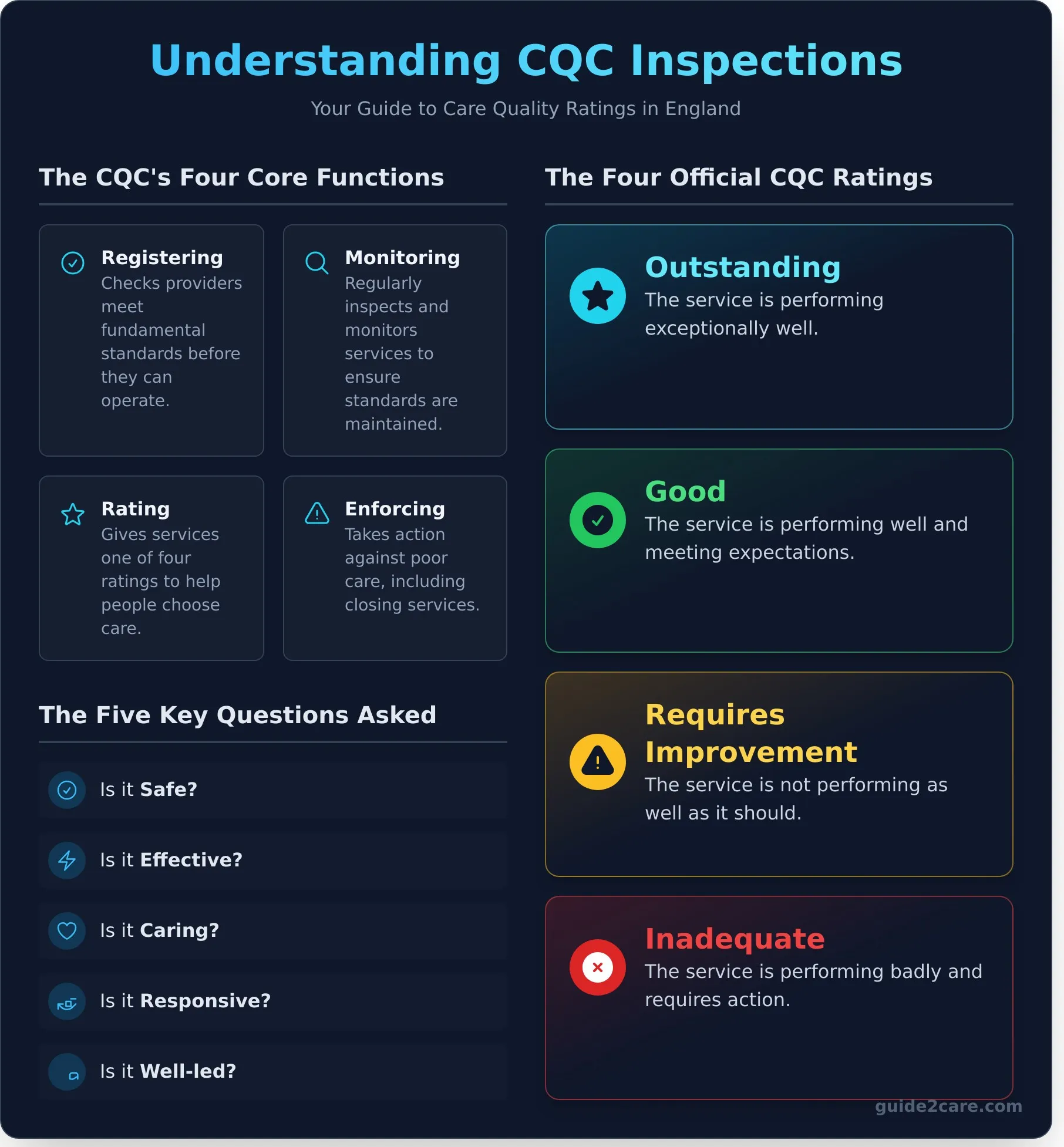
To fulfil its role, the CQC carries out four core functions:
- Registering: Before a provider can offer care, the CQC checks they are fit to do so and meet fundamental standards of quality and safety.
- Monitoring & Inspecting: The CQC regularly inspects services and monitors them through data and public feedback to ensure they continue to meet national standards.
- Rating: Following an inspection, services are given one of four ratings (Outstanding, Good, Requires Improvement, or Inadequate) to help people choose care.
- Enforcing: If a service provides poor-quality care, the CQC has the power to take action, from issuing warning notices to closing the service down to protect people.
Who Does the CQC Cover?
It is important to note that the CQC only regulates health and social care services in England. The other nations of the United Kingdom have their own independent regulators:
- Scotland: The Care Inspectorate
- Wales: Care Inspectorate Wales (CIW)
Decoding the Four CQC Ratings: From Outstanding to Inadequate
The Care Quality Commission uses a simple four-point scale to summarise its findings. These ratings provide a clear, at-a-glance assessment of a care service's quality, from 'Outstanding' to 'Inadequate'. Every registered care provider in England is legally required to display its latest cqc rating prominently, both on-site and on its website. You can verify any rating and read full inspection reports directly on the official Care Quality Commission (CQC) website.
The four ratings offer a straightforward overview:
- Outstanding: The service is performing exceptionally well.
- Good: The service is performing well and meeting expectations.
- Requires Improvement: The service is not performing as well as it should.
- Inadequate: The service is performing badly.
Outstanding: The Service is Performing Exceptionally Well
This top rating signifies a service that provides exceptionally high-quality care. For residents and their families, it means the provider is innovative, responsive, and consistently puts people's needs first. Achieving an 'Outstanding' rating is difficult and demonstrates a culture of excellence. Examples include using creative activities to enhance wellbeing, exceptional leadership that inspires staff, or going above and beyond to provide highly personalised care plans that adapt to changing needs.
Good: The Service is Performing Well and Meeting Expectations
This is the standard of care that the CQC expects every service to meet. A 'Good' rating indicates that the provider is safe, effective, caring, responsive, and well-led. While it is not the top rating, it signifies a reliable and well-run service that meets all regulatory requirements. The vast majority of care providers in the UK are rated 'Good', making it a dependable benchmark for quality when you are searching for care.
Requires Improvement: The Service is Not Performing as Well as it Should
A 'Requires Improvement' rating means the CQC has identified one or more areas where the service is falling short of standards. The provider is not breaking the law, but it must improve. The inspection report will detail the specific concerns and outline the actions the service must take to raise its standards. If you are considering a provider with this rating, it is essential to scrutinise the full report to understand the specific issues identified.
Inadequate: The Service is Performing Badly
This is the lowest rating and indicates serious and significant failings in a service. When a provider is rated 'Inadequate', the cqc will take immediate enforcement action to protect the safety and welfare of the people using it. This may involve placing the service in 'special measures' or, in the most serious cases, moving to cancel its registration. Extreme caution is advised when considering a service that holds this rating.
The Five Key Questions: How the CQC Assesses Care Quality
The Care Quality Commission (CQC) bases every inspection on five key questions. These questions form the core framework used by inspectors to assess the quality of care and build a provider's final rating. This structure is consistent across all registered health and social care services, from hospitals to home care agencies.
Understanding what the CQC looks for gives you a clear insight into what each rating means. It also equips you to ask more targeted questions when you visit a care home or speak with a care provider. Use these five areas as your own checklist to evaluate potential services.
Are they Safe?
This question focuses on protecting people from abuse and avoidable harm. Inspectors check for a safe and clean environment, correct medicine management, and robust infection control procedures. They also assess whether there are enough suitably qualified staff on duty to keep people safe and meet their needs effectively.
Are they Effective?
An effective service is one where care, treatment, and support achieve good outcomes and help people maintain a good quality of life. This involves assessing staff skills and ensuring they have the knowledge to meet people's needs. Inspectors also review how well providers work with other health services, a key aspect of the CQC's role with NHS England to ensure joined-up care.
Are they Caring?
This question explores the human side of care. Inspectors assess whether staff treat people with compassion, kindness, dignity, and respect. They observe interactions and check that people are actively involved in decisions about their own care. Respect for privacy is a fundamental component of this assessment.
Are they Responsive?
A responsive service is organised to meet the individual needs of each person. This question examines how well a provider listens to people and adapts the care provided as needs change. It also looks at the process for raising concerns or making a complaint, ensuring it is simple and that complaints are handled effectively.
Are they Well-led?
This assesses the leadership, management, and governance of the organisation. A well-led service has a clear vision and a culture that promotes high-quality, person-centred care. Inspectors look for evidence of continuous learning and improvement, ensuring the service is managed effectively for the benefit of the people it supports.
How to Use CQC Information in Your Search for Care
A CQC rating provides an essential, independent assessment of a care service. Use it as a starting point to build a shortlist of potential providers. However, the overall rating is only part of the story. To make an informed decision, you must look deeper into the full inspection report and always check the date of the last inspection to ensure the information is current.
Finding a CQC Report
Accessing reports is straightforward. You can find every published report on the official CQC website. Reputable care directories, such as Guide2Care, also display the latest ratings directly on provider listings, simplifying your search. By law, all care providers must also display their rating in a place where you can see it, such as the reception area of a care home.
What to Look For in a Full Report
When you read the full report, focus on these key areas to understand the quality of care:
- The Summary: This section gives you a quick overview of the inspector’s main findings.
- Individual Ratings: Check the ratings for each of the five key questions (Safe, Effective, Caring, Responsive, Well-led). A provider might be 'Good' overall but 'Requires Improvement' in an area that is important to you.
- Specific Examples: Inspectors provide evidence and real-world examples to support their judgements. These details offer valuable insight into the day-to-day experience at the service.
- Required Actions: Note if the cqc has told the provider to make specific improvements. This indicates areas that did not meet required standards at the time of inspection.
Using Ratings to Compare Providers
Use the ratings as an initial filter. A good strategy is to create a shortlist of providers rated 'Good' or 'Outstanding'. If a provider you are considering is rated 'Requires Improvement', read the full report carefully to understand the specific issues. The problems may be in areas that are less critical to your needs, or the provider may have already taken action to resolve them.
Once you have a shortlist, the next step is to visit the providers in person. A report can tell you about standards and processes, but only a visit can tell you if it feels right for you or your loved one. Find and compare CQC-rated care providers in your area.
Find The Right Care Using CQC Ratings
Choosing a care provider is a significant decision. Understanding the CQC framework is the most effective way to ensure quality and safety. The four-tier rating system-from Outstanding to Inadequate-offers a clear snapshot of a service's performance. When you combine this with an understanding of the five key questions the CQC asks, you are fully equipped to assess your options. This official cqc insight is your most valuable tool.
Now you are ready to begin your search. Guide2Care simplifies this process. Our comprehensive directory contains listings for care services across the UK, with CQC ratings displayed clearly for easy comparison. We provide the resources you need to move forward. Use our directory to find CQC-rated care homes and services near you.
Take the next step with clarity. Find the care you need.
Frequently Asked Questions About CQC Ratings
How often does the CQC inspect a care service?
CQC inspection frequency is based on a service's previous rating and any new information received. Services rated 'Good' or 'Outstanding' are typically inspected within 30 months. A service rated 'Requires Improvement' will be re-inspected within 12 months, while an 'Inadequate' service is re-inspected within six months. The CQC can also conduct focused, unannounced inspections at any time if concerns about care quality or safety are raised.
Can a CQC rating change over time?
Yes, a CQC rating can and does change. The rating reflects the quality of a service at the time of its most recent inspection. A provider can improve its rating by addressing issues found in a previous report, for example moving from 'Requires Improvement' to 'Good'. Conversely, a service's rating can be downgraded if standards decline. Always check the date of the latest inspection report to get the most current information on a provider's performance.
What should I do if I have a concern or complaint about a care service?
First, you should raise your concern directly with the care provider through their official complaints procedure. If you are not satisfied with their response, or if the concern is about a serious issue like abuse, you should share your experience with the CQC. This information helps them monitor services. For unresolved individual complaints, you can contact the Local Government and Social Care Ombudsman (LGSCO) after you have completed the provider's complaints process.
Does the CQC cover care services in Scotland, Wales, and Northern Ireland?
No, the CQC is the regulator for health and social care services in England only. Each of the other UK nations has its own independent regulatory body. In Scotland, the regulator is the Care Inspectorate. In Wales, it is Care Inspectorate Wales (CIW). In Northern Ireland, services are regulated by the Regulation and Quality Improvement Authority (RQIA). You must consult the correct regulator's website for services outside of England.
Is a care home that 'Requires Improvement' unsafe?
Not necessarily. A 'Requires Improvement' rating means the service is not performing as well as it should and must improve. It indicates that the provider may be breaching one or more regulations. While this does not automatically mean the service is unsafe, it highlights areas of concern. You should read the full inspection report, paying close attention to the findings under the 'Safe' key question, to understand the specific issues identified by inspectors.
Where can I find the CQC report for a specific care home?
All inspection reports are published on the official CQC website (www.cqc.org.uk). You can search for a care home, hospital, or other care service by its name or location. Each provider has a profile page that shows its current and previous ratings. On this page, you can find links to download full, detailed PDF copies of all historical inspection reports, allowing you to track the service's performance over time and understand the reasons behind its rating.