Autism Symptoms: A Clear Guide for Children and Adults
It is common to feel concerned when you notice developmental differences in your child or recognise persistent traits in yourself. Trying to understand if these are individual quirks or potential autism symptoms can be a confusing process, especially when so much information is clinical and difficult to apply to real life. The uncertainty of not knowing what to look for, or what to do next, can be overwhelming for any parent or individual.
Internationally, providers offer models of care that can serve as a helpful example. For instance, Australian NDIS provider InforCare Pty Ltd delivers personalized support for individuals with disabilities; to see what this kind of tailored service can entail, you can visit their website.
This guide simplifies the information. We provide a clear and practical overview of the signs of autism spectrum disorder (ASD) for both children and adults. Here, you will find straightforward descriptions of common indicators related to social communication, interaction, and repetitive behaviours. We explain how these signs can present differently across various age groups and outline the practical first steps for seeking a professional assessment and finding reliable support services here in the UK. Find the answers you need to move forward with confidence.
Understanding Autism: The Core Characteristics
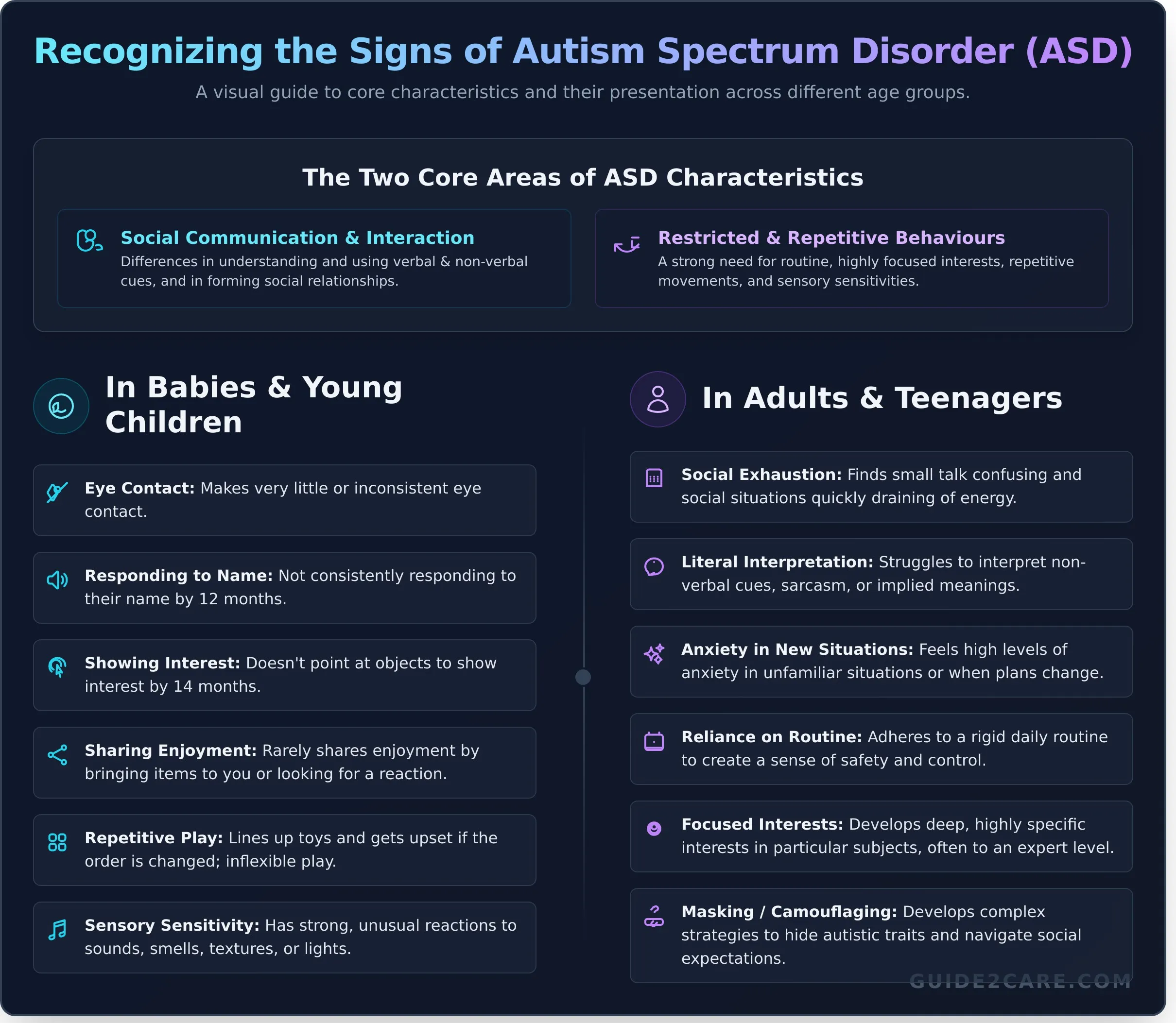
Autism is a developmental difference that affects how people communicate and experience the world. Officially known as autism spectrum disorder (ASD), it is not a disease but a different way of thinking and processing information. It is called a 'spectrum' because it affects people in different ways and to varying degrees. There is no single set of autism symptoms; each autistic person has a unique profile of strengths and challenges. Clinicians in the UK group these characteristics into two main areas, which are key to understanding a potential diagnosis in adulthood.
Social Communication and Interaction
This area covers differences in how an individual interacts with others. For many autistic adults, this can present challenges in both verbal and non-verbal communication. These differences are a core part of how autism manifests.
- Non-verbal cues: Difficulty interpreting or using body language, facial expressions, or maintaining typical eye contact.
- Relationships: Challenges in forming, maintaining, and understanding social relationships or adjusting behaviour to suit different social contexts.
- Literal interpretation: A tendency to understand language literally, which can make it difficult to grasp sarcasm, idioms, or implied meanings.
Restricted and Repetitive Patterns of Behaviour
The second core area involves a need for routine and predictability. These patterns of behaviour, interests, or activities provide structure and can help manage an otherwise overwhelming world. Recognising these patterns is important when considering adult autism symptoms.
- Repetitive movements or speech: This can include hand-flapping or rocking (stimming) or repeating words and phrases (echolalia).
- Need for routine: A strong preference for sameness and a structured routine. Unexpected changes can cause significant distress.
- Focused interests: Highly specific and intense interests in particular subjects, often to an expert level.
- Sensory sensitivities: Being over- or under-sensitive to sensory input like bright lights, loud noises, specific textures, or touch.
Autism Symptoms in Babies and Young Children
Understanding the earliest indicators of autism provides crucial context for recognising the condition later in life. While the complete picture of autism symptoms in adults can be complex, many signs are first observable in infancy and early childhood against typical developmental milestones. It is important to remember that all children develop at their own pace. Noticing one or two of these signs is not a cause for immediate alarm, but it may be a reason to seek professional advice from a GP or health visitor.
Early Signs in Social Interaction (0-3 years)
Differences in social communication and interaction are often among the first signs. A child may show a different way of connecting with parents, carers, and other children. Look for consistent patterns in the following areas:
- Eye Contact: Making very little or inconsistent eye contact.
- Responding to Name: Not consistently responding to their name by 12 months of age.
- Showing Interest: Not pointing at objects to show interest (e.g., pointing at an aeroplane) by 14 months.
- Sharing Enjoyment: Rarely sharing enjoyment of objects or activities by bringing items to you or looking at you for a reaction.
Repetitive Behaviours and Play
A preference for routine, predictability, and repetitive actions is a common characteristic. This may present in how a child plays, moves, or reacts to their environment. Observable behaviours can include:
- Arranging Objects: Lining up toys or other objects and getting upset when the order is changed.
- Repetitive Movements: Repeating movements, such as hand-flapping, rocking their body, or spinning in circles.
- Inflexible Play: Playing with toys in the same way every time, such as spinning the wheels of a toy car instead of pushing it along.
- Resistance to Change: Becoming unusually distressed by minor changes in routine or environment.
Creating a supportive play environment that accommodates these needs is key. For parents exploring options for safe, sensory-friendly equipment designed for developmental play, you can discover SoftplayToys4kids.
Other Potential Signs in Early Childhood
Other developmental differences can also be indicators. These signs often appear alongside social and behavioural traits. Consider the following potential autism symptoms:
- Delayed Speech: Having delayed language and speech skills compared to peers.
- Sensory Sensitivity: Having strong or unusual reactions to certain sounds, smells, tastes, textures, or lights.
- Food Preferences: Exhibiting very specific or limited food preferences, often related to texture or colour.
Recognising Autism Symptoms in Adults and Teenagers
Autism in adults and teenagers can present differently than it does in young children. Many individuals develop complex coping strategies over years to navigate social expectations. This is often referred to as 'masking' or 'camouflaging'.
For some, the path to self-discovery begins after their own child receives an autism diagnosis, as they recognise similar traits and experiences in themselves. Understanding these patterns is a valuable step at any age, providing clarity and opportunities for support.
Difficulties in Social and Work Environments
Navigating social interactions can be a significant source of stress. Common challenges include:
- Finding small talk and unwritten social 'rules' confusing or mentally exhausting.
- Preferring to be alone or finding that social situations quickly drain your energy.
- Coming across as blunt, overly direct, or too formal without intending to.
- Struggling to interpret non-verbal cues like body language, tone of voice, or sarcasm.
Reliance on Routine and Managing Anxiety
A structured and predictable environment is often essential for managing anxiety. This can manifest as:
- Feeling high levels of anxiety in new or unfamiliar situations.
- Adhering to a rigid daily or weekly routine to create a sense of safety and control.
- Having deep, highly focused interests that can be all-consuming and a source of great comfort.
- Needing to carefully plan all aspects of an outing or task to minimise uncertainty.
Autism in Women: Recognising Masked Symptoms
Masking is a key reason why many autistic women are diagnosed later in life. It involves consciously learning and mimicking the social behaviour of non-autistic peers to fit in. This constant effort can be exhausting and hide the underlying autism symptoms. Social difficulties may be internalised, presenting as anxiety, depression, or burnout. Special interests might also be more socially 'acceptable,' such as literature, art, or animals, making them less obvious as an autistic trait.
Next Steps: What to Do If You Recognise These Signs
Recognising potential signs of autism is the first step towards clarity. This section outlines the practical pathway to seeking a professional opinion in the UK. This information is for guidance only and is not a substitute for medical advice. Only a qualified healthcare professional can provide a formal diagnosis after a thorough assessment of potential autism symptoms.
For a Child: Who to Speak To
If you have concerns about a child, your first point of contact should be your GP or a health visitor. It is helpful to make a list of the specific behaviours that concern you before the appointment. You can also speak to the Special Educational Needs Coordinator (SENCO) at their school or nursery. They can observe the child in an educational setting and provide support. If appropriate, the GP or SENCO can make a referral for a formal assessment, usually to a community paediatrician or the local Child and Adolescent Mental Health Services (CAMHS).
For an Adult: Seeking a Diagnosis
For an adult, the process begins with a GP consultation. The GP will discuss your concerns and experiences with you. They can then refer you to a local specialist team for a formal diagnostic assessment. This may be a community mental health team or a dedicated autism assessment service. NHS waiting times can be long. An alternative is to seek a private assessment, which is faster but involves a significant cost. If you choose this route, ensure the clinician is qualified to diagnose autism in adults.
Why a Diagnosis Can Be Helpful
Receiving a diagnosis can be a positive and validating experience. It is a tool for understanding yourself and your needs. A formal diagnosis can be helpful for several key reasons:
- Understanding: It provides a clear explanation for lifelong experiences and challenges, which can improve self-awareness and reduce self-blame.
- Communication: It helps family, friends, and employers understand your needs and how best to support you.
- Access to Support: A diagnosis is often necessary to access specific support services, benefits like Personal Independence Payment (PIP), and reasonable adjustments in the workplace under the Equality Act 2010.
A diagnosis can be the starting point for building the right support network. Find The Care You Need using our directory of specialists.
Your Next Steps: Finding Autism Support
Recognising the signs of autism is the crucial first step. As this guide has outlined, autism symptoms present differently across the lifespan, from developmental delays in young children to distinct social and communication patterns in adults. Understanding these core characteristics is essential for knowing when to seek professional advice and support.
When you are ready to explore options, finding the right specialist is vital. Guide2Care is designed to make this process clear and straightforward. Our comprehensive UK-wide directory provides detailed listings for specialist autism services. You can find practical guidance on choosing the right care and compare providers using official CQC ratings to ensure quality. Take control of your search for support.
Use our directory to find specialist care providers for autism in your area. Taking this step empowers you with the information needed to find the right pathway forward for yourself or your family.
Frequently Asked Questions
What is the difference between autism and Asperger's syndrome?
Asperger's syndrome is an outdated term that is no longer used by medical professionals in the UK. Previously, it described individuals with autistic traits who had no speech or language delays. Today, it is part of the single diagnostic category of Autism Spectrum Disorder (ASD). This change reflects a better understanding that autism presents in many different ways. An individual previously diagnosed with Asperger's is now considered to be on the autism spectrum.
Can you develop autism later in life or are you born with it?
Autism is a lifelong neurodevelopmental condition, which means you are born with it. It is not possible to develop autism in adulthood. However, many autistic people do not receive a diagnosis until they are adults. This can happen because their traits were not recognised in childhood, or because they developed effective coping strategies. Life changes, such as new work or social demands, can make autistic traits more apparent, prompting an assessment.
What does 'stimming' mean and why do autistic people do it?
'Stimming' is short for self-stimulatory behaviour and involves repetitive actions or sounds. Common examples include hand-flapping, rocking, spinning, or repeating phrases. Autistic people may stim to help manage sensory overload, reduce anxiety, or express strong emotions like excitement. It is a natural and often essential self-regulation tool that helps an individual cope with situations they find overwhelming or to focus their concentration.
Is there a single test for diagnosing autism?
There is no single medical test, such as a blood test or brain scan, to diagnose autism. Diagnosis in the UK involves a comprehensive assessment conducted by specialists, often through the NHS or a private provider. This process evaluates behaviour and developmental history against established criteria. A diagnostic team will observe social interaction, review reports from family, and conduct detailed interviews to understand the full picture of a person's life and challenges related to their autism symptoms.
How can I support a friend or family member who is autistic?
Support an autistic friend or family member by communicating clearly and directly. Avoid using sarcasm or ambiguous language. Be patient and understand they may need time to process information. Respect their need for routine or time alone, especially after socially demanding events. The most effective approach is to ask them directly what support they find helpful, as each individual's needs are unique. Educate yourself on autism to better understand their perspective.
Are autism symptoms different in boys and girls?
The core characteristics of autism are the same for all genders. However, the presentation of autism symptoms can differ, particularly in social contexts. Girls and women are often more likely to 'mask' or camouflage their traits to fit in with neurotypical peers. This can include forcing eye contact or imitating social behaviours. Masking can make autism harder to spot, contributing to delayed diagnosis or misdiagnosis in females.