What is Alzheimer's Disease? Symptoms, Stages, and Care in the UK

When a parent or loved one shows signs of increasing forgetfulness, it is natural to feel concerned. You may ask if these memory issues are a normal part of ageing or the first indication of a condition like Alzheimer's disease. The distinction between Alzheimer's and other forms of dementia can be confusing, and navigating the available medical information often feels overwhelming. Knowing where to turn for help in the UK is a common challenge for many families.
This guide provides the clear, practical information you need. We explain the key symptoms to look for and break down the progression of Alzheimer's into understandable stages. You will learn the specific steps for seeking a diagnosis within the UK healthcare system. Most importantly, this article will equip you with the knowledge to explore care options, from domiciliary support to residential homes, and empower you to find the right support for your family's circumstances.
What is Alzheimer's Disease? A Plain English Explanation
Alzheimer's disease is a physical illness that affects the brain and is the most common cause of dementia in the UK. It is a progressive condition, which means symptoms develop gradually and become more severe over time, impacting memory, thinking skills, and the ability to perform daily activities. Think of the brain's communication network like a complex set of wiring; Alzheimer's causes this wiring to become faulty, disrupting the signals between brain cells. This damage is caused by a build-up of proteins that form abnormal structures called 'plaques' and 'tangles'. For a comprehensive overview of Alzheimer's and its underlying biology, this resource provides extensive detail.
The following video from the National Institute on Aging offers a clear visual explanation of the disease.
Alzheimer's vs. Dementia: What's the Difference?
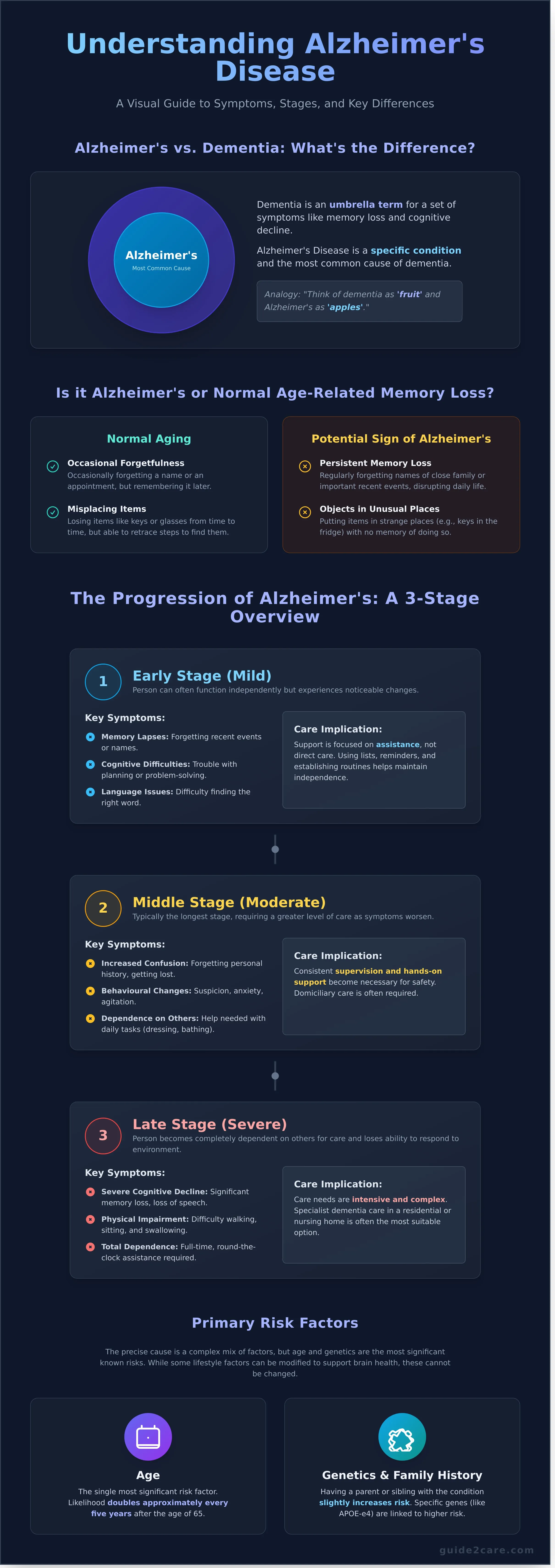
The terms dementia and Alzheimer's are often confused. Dementia is an umbrella term for a set of symptoms, including memory loss and difficulties with thinking or problem-solving. Alzheimer's disease is a specific condition and the most common cause of these symptoms. A simple analogy is to think of dementia as 'fruit' and Alzheimer's as 'apples'-one is a broad category, while the other is a specific type within it.
Is it Alzheimer's or Just Normal Age-Related Memory Loss?
Forgetting things from time to time is a normal part of ageing. The memory problems associated with Alzheimer's are more persistent and disruptive. The key difference is the pattern and severity of the memory lapses. Compare the following examples:
- Normal Ageing: Occasionally forgetting a name or an appointment but remembering it later.
- Potential Sign of Alzheimer's: Regularly forgetting the names of close family members or important recent events.
- Normal Ageing: Misplacing items like keys or glasses from time to time.
- Potential Sign of Alzheimer's: Putting objects in unusual places, such as keys in the fridge, and having no memory of how they got there.
Recognising the Symptoms: A Guide to the Stages of Alzheimer's
Alzheimer's disease affects each person differently, and the speed of progression varies. However, the symptoms can generally be grouped into three key stages: early, middle, and late. Understanding these stages helps families and carers anticipate future needs and plan for appropriate support. The NHS provides a detailed overview of the Symptoms and Stages of Alzheimer's, which serves as a valuable resource for further reading.
Early-Stage Symptoms (Mild)
In the early stage, a person can often function independently but may experience noticeable changes. These signs are sometimes mistaken for normal age-related memory loss but become more persistent.
- Memory Lapses: Forgetting recent events, conversations, or names.
- Cognitive Difficulties: Trouble with planning, organising tasks, or solving simple problems.
- Language Issues: Difficulty finding the right word during conversations.
Care Implication: At this point, support is often about assistance rather than direct care. Establishing simple routines, using lists, and providing reminders can help maintain independence.
Middle-Stage Symptoms (Moderate)
This is typically the longest stage and requires a greater level of care as symptoms become more pronounced and interfere significantly with daily life.
- Increased Confusion: Forgetting personal history, getting lost in familiar places, and losing track of time.
- Behavioural Changes: Personality shifts can occur, including suspicion, anxiety, agitation, or repetitive actions.
- Dependence on Others: Help is needed with activities of daily living (ADLs) such as dressing, bathing, and grooming.
Care Implication: Consistent supervision and hands-on support become necessary to ensure safety and well-being. Domiciliary care or other forms of regular assistance may be required.
Late-Stage Symptoms (Severe)
In the final stage of the disease, individuals lose the ability to respond to their environment, communicate, and, eventually, control movement. They become completely dependent on others for care.
- Severe Cognitive Decline: Memory loss is significant, and the ability to communicate verbally is often lost.
- Physical Impairment: Mobility becomes limited, with difficulty walking, sitting, and eventually swallowing.
- Total Dependence: Full-time, round-the-clock assistance is essential for all personal care needs.
Care Implication: Care needs are intensive. Many families find that specialist dementia care in a residential or nursing home is the most suitable option to manage complex health requirements.
Causes and Risk Factors: What We Know Today
The precise cause of Alzheimer's disease is not yet fully understood. Research indicates that it is not caused by a single factor but by a complex mix of age, genetic, lifestyle, and environmental influences that affect the brain over time. Understanding these risk factors is a key part of managing brain health.
While some factors cannot be changed, such as age and genetics, others related to lifestyle can be modified. Focusing on these areas can help reduce the overall risk of developing dementia.
Age and Genetics
Age is the most significant known risk factor. The likelihood of developing Alzheimer's disease doubles approximately every five years after the age of 65. Family history also plays a role. If a parent or sibling has the condition, your own risk increases slightly. Specific genes, like the APOE-e4 gene, are linked to a higher risk, but it is important to note that having this gene does not mean you will definitely develop the condition. For further reading, the NHS overview of Alzheimer's disease offers detailed information. Many people with a genetic predisposition never develop symptoms.
Lifestyle and Cardiovascular Health
There is a strong, established link between the health of your heart and your brain. Conditions that damage the heart and blood vessels can also increase the risk of dementia. Effectively managing these conditions is a positive step towards protecting your brain.
Key risk factors that impact both cardiovascular and brain health include:
- High blood pressure (hypertension)
- High cholesterol
- Type 2 diabetes
- Smoking
- Excessive alcohol consumption
Adopting a healthy lifestyle is beneficial. Regular physical activity, a balanced diet such as the Mediterranean diet, maintaining a healthy weight, and staying socially and mentally active are all associated with a lower risk of cognitive decline.
The Path to Diagnosis in the UK: What to Expect
Receiving a diagnosis for memory problems can feel like a complex process. However, the UK has a structured pathway designed to provide an accurate and timely assessment. Understanding these steps can help reduce uncertainty for you and your family. An early diagnosis is crucial as it unlocks access to treatments, support services, and allows for future planning.
Step 1: Visiting Your GP
Your General Practitioner (GP) is the first point of contact. During the appointment, the GP will discuss the symptoms and how they affect daily life. They may conduct a simple memory and thinking test and will review your medical history. It is also standard practice to perform physical checks and blood tests to rule out other conditions that can cause similar symptoms, such as infections, vitamin deficiencies, or thyroid problems.
Step 2: Referral to a Specialist
If the GP cannot rule out a form of dementia, they will make a referral to a specialist. This is typically an NHS memory clinic or a community mental health team. Here, you will see a healthcare professional with expertise in diagnosing dementia, such as a geriatrician (a specialist in older people's health), a neurologist, or an old age psychiatrist. This referral marks the beginning of a more detailed assessment process.
Step 3: Assessments and Tests
The specialist will conduct a series of more in-depth assessments to build a complete picture of your health. These include:
- Cognitive Tests: Detailed questionnaires and tasks, such as the Mini-Mental State Examination (MMSE) or Addenbrooke’s Cognitive Examination (ACE-III), assess memory, language, and problem-solving skills.
- Brain Scans: A CT (Computerised Tomography) or MRI (Magnetic Resonance Imaging) scan may be arranged. These scans help rule out other causes for the symptoms and can sometimes show changes to the brain consistent with Alzheimer's disease.
A diagnosis is rarely based on one single result. The specialist will make a clinical judgement after considering all the information from your appointments, tests, and scans.
An accurate diagnosis is the first step towards managing the condition and finding the right support. To understand the available care options, explore Guide2Care and find the care you need.
Planning for Care: Next Steps for UK Families
A diagnosis of Alzheimer's disease is a significant event for the entire family. Planning for future care is a practical and necessary step to ensure safety, manage symptoms, and maintain the best possible quality of life. Understanding the available options helps you make informed decisions as needs change.
Understanding Care Needs as the Disease Progresses
The level of support required will evolve with the stages of the condition. Anticipating these changes allows for smoother transitions in care.
- Early Stage: An individual may live independently with minimal support. This could include companionship, help with errands, or reminders for medication and appointments.
- Middle Stage: As cognitive and functional abilities decline, more structured support becomes essential. Professional home care can help with daily tasks like personal care, meal preparation, and ensuring a safe home environment.
- Late Stage: In the advanced stages of alzheimer's disease, individuals typically require intensive, 24-hour supervision and care. This is often provided in a specialist residential or nursing home setting.
Types of Dementia Care Available in the UK
The UK care system offers several options to meet different levels of need. The primary types include:
- Home Care (Domiciliary Care): Professional carers provide support within the person's own home. This can range from a few hours per week to full-time, live-in care, allowing for independence in a familiar setting.
- Residential Care Homes: These facilities offer 24-hour personal care, accommodation, and meals. They are suitable for individuals who need constant supervision but do not have complex medical requirements.
- Nursing Homes: For those with significant health needs, nursing homes provide 24/7 care administered by qualified nurses. They are equipped to manage complex medical conditions alongside dementia.
How to Find the Right Care Provider
Choosing a care provider is a critical decision. Prioritise providers with specific experience and training in dementia care. In the UK, always check the provider's Care Quality Commission (CQC) rating for an independent assessment of their safety and quality standards. Before committing, visit potential care homes or interview home care agencies to ensure they are the right fit.
Navigating these options can be challenging. A central directory simplifies the search for appropriate services. Use our directory to find specialist dementia care near you.
Taking the Next Step: Finding Alzheimer's Care in the UK
Understanding the progression of alzheimer's disease is the first step. A formal diagnosis provides a clear path forward, and planning for future needs is a critical part of the journey for families across the UK. This knowledge empowers you to make informed decisions at every stage.
When you are ready to explore your options, Guide2Care simplifies the process. Our platform is a comprehensive UK-wide directory of care services. Use our easy-to-use search to filter by care type and location, and access practical guidance on choosing and funding care.
Take control of your search today. Find The Care You Need: Search for dementia care homes and agencies in your area. While the path ahead may seem complex, having the right information and support makes a significant difference.
Frequently Asked Questions
What is the difference between dementia and Alzheimer's disease?
Dementia is a general term for a decline in mental ability severe enough to interfere with daily life. It describes a set of symptoms, including memory loss and impaired judgment. Alzheimer's disease is a specific condition and the most common cause of dementia. Think of dementia as the overall syndrome, while Alzheimer's is the disease that often causes the symptoms. A correct diagnosis from a GP is essential to determine the underlying cause.
At what age do the first symptoms of Alzheimer's typically appear?
The majority of individuals with Alzheimer's are aged 65 and over. This is often referred to as late-onset Alzheimer's. However, the disease can also affect people at a younger age. When symptoms develop before 65, it is known as young-onset or early-onset Alzheimer's. This form is less common and can affect people in their 40s or 50s. Early assessment by a healthcare professional is important regardless of age.
Can Alzheimer's disease be prevented or cured?
Currently, there is no known cure for Alzheimer's disease, and no single way to prevent it entirely. However, certain lifestyle choices may help reduce your risk. These include regular physical exercise, a healthy diet, and staying mentally and socially active. While these actions cannot guarantee prevention, they support overall brain health. Treatments are available to help manage symptoms and improve a person's quality of life for a time.
What is the life expectancy after an Alzheimer's diagnosis?
Life expectancy varies widely and depends on factors such as age at diagnosis and other health conditions. On average, a person may live for eight to ten years after symptoms become noticeable to others. However, the range can be from three to 20 years. A GP or specialist can offer a more personalised prognosis based on the individual's specific health profile and the progression of the disease.
Does having a parent with Alzheimer's mean I will get it too?
Having a close relative, such as a parent, with Alzheimer's slightly increases your genetic risk, but it is not a guarantee that you will develop the condition. Most cases are considered 'sporadic' and not directly inherited. A very small number of cases are caused by specific genes passed through families, known as familial Alzheimer's. If you have significant family history and are concerned, speak with your GP for guidance.
How do I talk to a loved one about my concerns with their memory?
Choose a comfortable and private moment when you are both calm. Use "I" statements to express your observations gently, for example, "I've been worried since you got lost last week." Suggest a general health check-up with their GP to rule out other treatable causes of memory problems, such as infections or vitamin deficiencies. Framing the conversation around their overall health, rather than a specific disease, can make it more approachable.