Understanding the Role of a Caldicott Guardian: A Guide for Care Providers

Managing service user data is a critical responsibility for any UK care provider. With complex information governance rules and CQC inspections to prepare for, it is easy to feel uncertain. You may be asking if your private care home needs a specific role to oversee data, or how a Caldicott Guardian differs from a Data Protection Officer (DPO). This lack of clarity can create risk for your service users and your organisation.
This practical guide provides the clear answers you need. We explain exactly what a Caldicott Guardian is, their core duties, and why their role is essential for ensuring confidentiality in any health and social care setting. By the end of this article, you will understand the 8 Caldicott Principles, know whether your organisation must appoint a guardian, and feel confident in your approach to protecting sensitive information.
What is a Caldicott Guardian? Core Role and Responsibilities
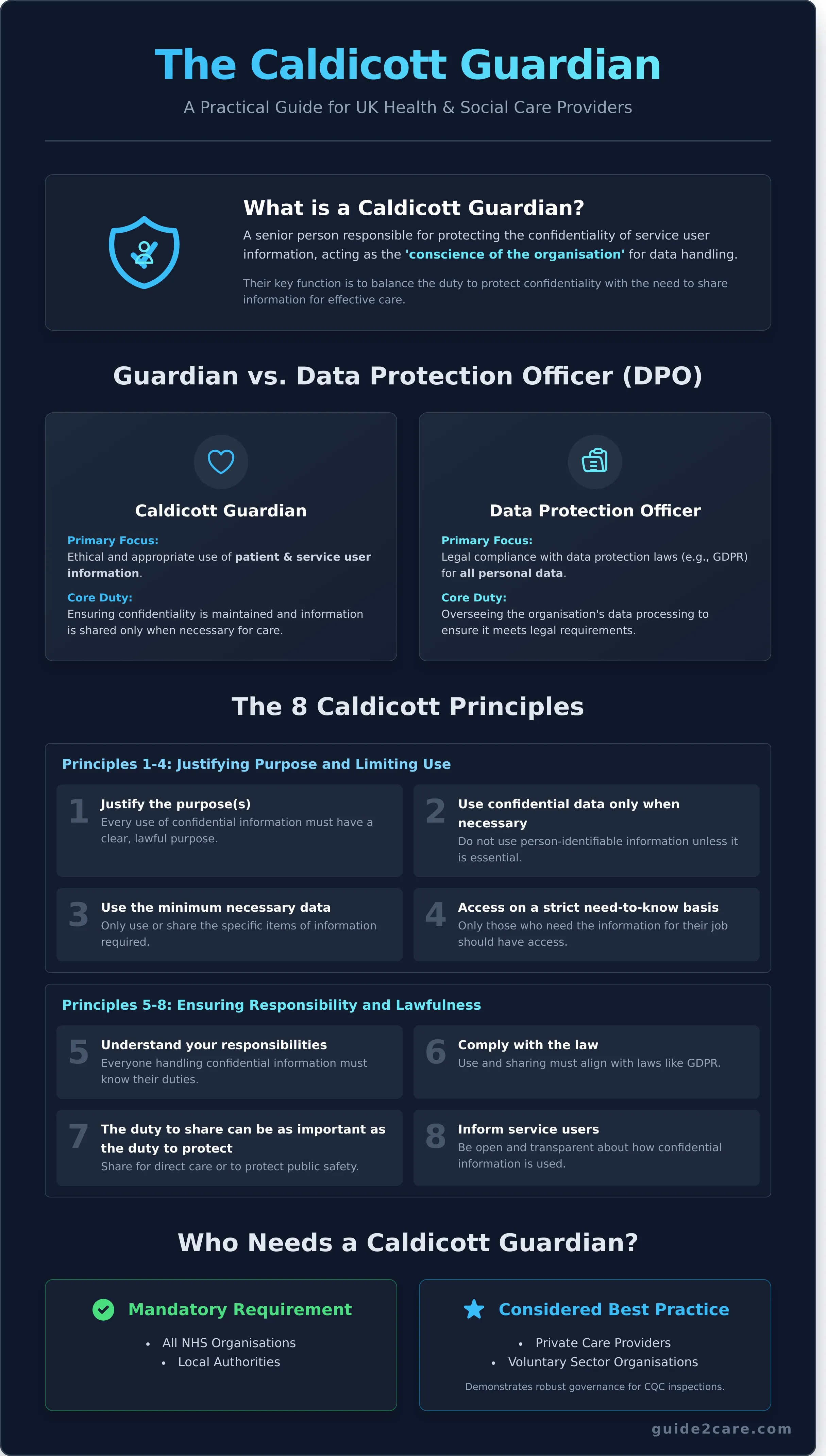
A Caldicott Guardian is a senior person within a health or social care organisation responsible for protecting the confidentiality of people’s information. They act as the 'conscience of the organisation' for data handling, ensuring that personal information is used legally, ethically, and appropriately. Their key function is to balance the duty to protect confidentiality with the need to share information for effective care.
This video provides a clear explanation of the role:
The Origins: Why Was the Role Created?
The role was established following a government review chaired by Dame Fiona Caldicott. The resulting 1997 Report on Patient-Identifiable Information set out principles to safeguard patient data within the NHS. Over time, the scope of these principles and the guardian role has expanded to cover social care and other public sector organisations that handle confidential information.
Who Needs a Caldicott Guardian?
It is a mandatory requirement for all NHS organisations and local authorities in the UK to have an appointed caldicott guardian. For other care providers, including those in the private and voluntary sectors, appointing one is considered best practice. It demonstrates robust information governance, which is a key area of assessment during Care Quality Commission (CQC) inspections.
Caldicott Guardian vs. Data Protection Officer (DPO)
While their responsibilities can overlap, these are distinct roles. The key difference lies in their primary focus. Understanding this distinction is crucial for good governance.
- Caldicott Guardian: Concentrates on the ethical and appropriate use of patient and service user information, ensuring confidentiality is maintained and information is shared only when necessary.
- Data Protection Officer (DPO): Focuses on legal compliance with data protection laws (like GDPR and the Data Protection Act 2018) for all personal data held by the organisation, not just health and care records.
The 8 Caldicott Principles Explained for Care Settings
The Caldicott Principles are the foundation of good information governance in UK health and social care. They provide a clear framework that guides all decisions about how to use and share confidential information safely and ethically. Developed to ensure data is handled correctly, these principles are upheld by the UK Caldicott Guardian Council and are the responsibility of every organisation handling patient data. A designated caldicott guardian ensures these principles are applied correctly.
Originally a set of seven, an eighth principle was added in 2020 to reinforce the importance of transparency with service users. Below, we explain each principle with practical examples relevant to a care provider.
Principles 1-4: Justifying Purpose and Limiting Use
These first four principles focus on ensuring there is a legitimate reason for using data and that its use is appropriately restricted to protect privacy.
- Principle 1: Justify the purpose(s). Every use or transfer of confidential information must have a clear and lawful purpose. Example: A care home shares a resident's Medication Administration Record (MAR) chart with their GP to ensure their prescription is accurate and safe.
- Principle 2: Use confidential data only when necessary. Do not use person-identifiable information unless it is absolutely essential for the task. Example: In a general staff meeting discussing workloads, refer to residents by room number instead of by name.
- Principle 3: Use the minimum necessary data. Only use or share the specific items of information required for the stated purpose. Example: When a resident is admitted to hospital, provide only relevant medical and care information, not their entire life history or financial details.
- Principle 4: Access should be on a strict need-to-know basis. Only those who need to see the information to do their job should have access to it. Example: Care staff can access care plans, but a resident's financial records are restricted to senior management.
Principles 5-8: Ensuring Responsibility and Lawfulness
The final four principles centre on legal compliance, professional accountability, and the rights of the individual receiving care.
- Principle 5: Understand your responsibilities. Everyone handling confidential information must understand their duties and obligations. Example: All staff must complete mandatory training on the care provider's confidentiality and data protection policies.
- Principle 6: Comply with the law. The use and sharing of information must be lawful and align with legislation like GDPR. Example: A care home must follow legal processes when responding to a subject access request for a resident's records.
- Principle 7: The duty to share information can be as important as the duty to protect confidentiality. Information should be shared for the direct care of an individual or to protect public safety. Example: If a staff member has a safeguarding concern, their duty to report it to the local authority overrides standard confidentiality rules.
- Principle 8: Inform service users about how their confidential information is used. Be open and transparent with individuals. Example: The care provider must have a clear privacy notice explaining to residents how their personal data is used and stored.
A crucial part of fulfilling Principle 8 is making sure your organisation's website clearly presents your privacy policies and commitment to data security. This digital transparency is fundamental to building trust with service users and their families. For care providers looking to improve how they communicate their high standards online, you can discover Pro-Creative, a creative agency that helps businesses build a professional and trustworthy digital presence.
Appointing and Supporting a Caldicott Guardian in Your Organisation
Implementing the Caldicott Guardian role is a critical step towards robust information governance. For health and social care providers, this means appointing a suitable individual and providing them with the necessary tools to succeed. This process does not need to be complex, even for smaller organisations with limited resources.
Finding the Right Person for the Role
The effectiveness of the role depends on the appointee's position within the organisation. The individual must be a senior person with the authority to influence strategic decisions regarding data. This is often a Registered Manager, a senior clinician, or a director. In smaller care settings, this does not require a new hire. The function can be assigned to an existing senior manager who already understands the organisation's operations and data flows.
For senior clinicians and directors taking on these significant responsibilities, managing personal financial milestones alongside a demanding career can be complex. For tailored support with home financing, you can check out Doctors Mortgages.
Essential Training and Resources
To be effective, your appointed guardian requires ongoing support and access to key resources. Ensure they are equipped with the following:
- Official Guidance: The UK Caldicott Guardian Council (UKCGC) provides 'A Manual for Caldicott Guardians', which is an essential starting point.
- Specialist Training: Enrol them in dedicated training courses on information governance, data protection law (including UK GDPR), and the specifics of the caldicott guardian role.
- Professional Networks: Encourage them to join forums and networks. These provide peer support, share best practices, and offer updates on regulatory changes.
Embedding the Caldicott Function
The guardian’s role should be integrated into your organisation's core processes. They must be consulted on any new project or system that involves the use of personal data. This includes procuring new care planning software, establishing data sharing agreements with local authorities or NHS trusts, and developing data breach incident response plans. Their early involvement ensures that data protection is a foundational part of your operations, not an afterthought. A provider with a well-supported guardian demonstrates a strong commitment to safe and secure care.
Find trusted care providers with strong governance on Guide2Care.com.
Common Scenarios: Caldicott Principles in Action
The Caldicott Principles provide a clear framework for making decisions about confidential information in health and social care. The following scenarios illustrate how these principles are applied in real-world situations. The role of the caldicott guardian is to provide expert guidance in these ethically and legally complex moments, ensuring decisions are lawful, considered, and protect the individual.
Scenario 1: A Request from Family
A resident's daughter requests access to her father's complete care records, citing concerns about his treatment. The care home manager knows the resident has dementia and his capacity to consent is unclear. The guardian advises that the first step is a formal capacity assessment, as required by the Mental Capacity Act 2005. They guide the manager on how to proceed: if the resident has capacity, his consent is needed. If he lacks capacity, information can only be shared if it is in his best interests and a legal basis exists, such as a valid Lasting Power of Attorney. This approach ensures Principle 6 (Comply with the law) is followed precisely.
Scenario 2: A Safeguarding Alert
A carer raises a safeguarding alert, suspecting a service user is being neglected. The care provider must decide whether to share this sensitive, confidential information with external bodies. The Caldicott Guardian would immediately highlight Principle 7 (The duty to share information can be as important as the duty to protect confidentiality). In cases of potential harm, the legal duty to safeguard a vulnerable person overrides standard confidentiality rules. The guardian confirms the correct action is to report the concerns to the local authority's safeguarding team without delay.
Scenario 3: Sharing Data for Research
A university contacts a care provider asking for anonymised data about resident falls to support a public health study. The provider must balance supporting valuable research with protecting privacy. The guardian guides them through the principles. They confirm the purpose is justified (Principle 1) and that anonymised data is appropriate (Principle 2). They also advise that only the minimum data required for the study should be extracted (Principle 3), ensuring no extraneous personal details are shared. This allows important research to proceed ethically and securely.
The Caldicott Guardian: Your Key to Information Governance
In summary, the role of the caldicott guardian is not merely a procedural requirement; it is the conscience of your organisation's data handling practices. This position is central to building trust with service users by ensuring their sensitive information is always protected. Mastering the eight Caldicott Principles and understanding their practical application are the foundational steps for any care provider dedicated to upholding the highest standards of confidentiality and ethical conduct.
Navigating these responsibilities requires reliable information and support. Guide2Care provides a comprehensive UK-wide care directory and essential resources to support informed care decisions. As a platform trusted by both care seekers and providers, we are committed to helping you maintain compliance and excellence. Explore information and guidance resources on Guide2Care.com to find the tools and knowledge your team needs.
By embedding the principles of information governance into your daily operations, you create a safer and more transparent care environment for all.
Frequently Asked Questions About the Caldicott Guardian Role
What is the difference between a Caldicott Guardian and a Senior Information Risk Officer (SIRO)?
A Caldicott Guardian focuses specifically on the ethical and appropriate use of patient and service user identifiable information. Their role is to be the 'conscience' of the organisation. In contrast, a Senior Information Risk Officer (SIRO) has a broader responsibility for managing all information risks across the organisation, including corporate, financial, and personal data. The SIRO is typically a board-level executive who owns the overall information risk policy and strategy.
Are private care homes legally required to have a Caldicott Guardian?
While not a direct statutory requirement for all private care homes, it is considered essential best practice. Organisations that have access to NHS patient data and systems are required to meet the standards of the Data Security and Protection Toolkit (DSPT). A key part of this is appointing a Caldicott Guardian to oversee the use of patient data. Therefore, any care home providing NHS-funded care must have this role in place to ensure compliance.
How do the Caldicott Principles align with the requirements of GDPR?
The Caldicott Principles and the UK General Data Protection Regulation (GDPR) are complementary frameworks. GDPR provides the legal basis for processing all personal data, while the Caldicott Principles offer specific guidance on handling confidential patient information within health and social care. Adhering to the Caldicott Principles helps organisations demonstrate compliance with GDPR's key requirements, such as lawfulness, fairness, and data minimisation, in a care context.
Can a Caldicott Guardian be held personally liable for a data breach?
Generally, the organisation, as the data controller, holds the primary legal liability for a data breach, not the individual. The Information Commissioner's Office (ICO) would typically take action against the organisation itself. However, an individual could face personal liability or professional sanction in cases of gross negligence, a deliberate breach of their duties, or if they have committed a criminal offence under the Data Protection Act 2018.
Where can I find official training and resources for a new Caldicott Guardian?
Official training and resources are available from several key UK bodies. NHS England provides an online e-learning module which serves as a good introduction for the role. The UK Caldicott Guardian Council (UKCGC) offers comprehensive guidance, manuals, and a knowledge base on its website. It is also recommended to join the council's network for peer support and updates. These resources provide the foundational knowledge needed for the role.
What is the UK Caldicott Guardian Council (UKCGC) and what does it do?
The UK Caldicott Guardian Council (UKCGC) is the national body that provides support and guidance to Caldicott Guardians across the UK. It is responsible for maintaining a register of guardians and developing clear guidance on the role's responsibilities. The council acts as a central point of contact, offering advice, sharing best practices, and ensuring a consistent approach to the application of the Caldicott Principles in health and social care organisations.
How often should Caldicott Guardian training be refreshed for staff?
Best practice, in line with the NHS Data Security and Protection Toolkit (DSPT), dictates that all staff should receive data security and confidentiality training annually. This includes awareness of the Caldicott Principles. This ensures knowledge remains current and that staff are regularly reminded of their responsibilities. For the designated guardian, continuous professional development is expected, including attending relevant forums and updates as they arise.