Your Complete Guide to Finding Caregiver Jobs in the UK

Starting a career in the UK care sector can be a rewarding path, but it often begins with questions. If you are searching for caregiver jobs, you might be unsure about the qualifications required, the differences between various roles, or how to identify a trustworthy employer. Navigating the application process can also feel complex, leaving many potential candidates feeling uncertain about where to begin.
This complete guide is designed to provide clear, practical answers. We will help you understand the UK care job market and the types of caregiver roles available, from domiciliary care to residential support. You will learn about the qualifications and experience you need to get started and find practical steps for identifying reputable care providers. Prepare to move forward with confidence as we outline everything you need to know to find a stable, fulfilling caregiver job in the UK.
Understanding the Role: What Does a Caregiver Do?
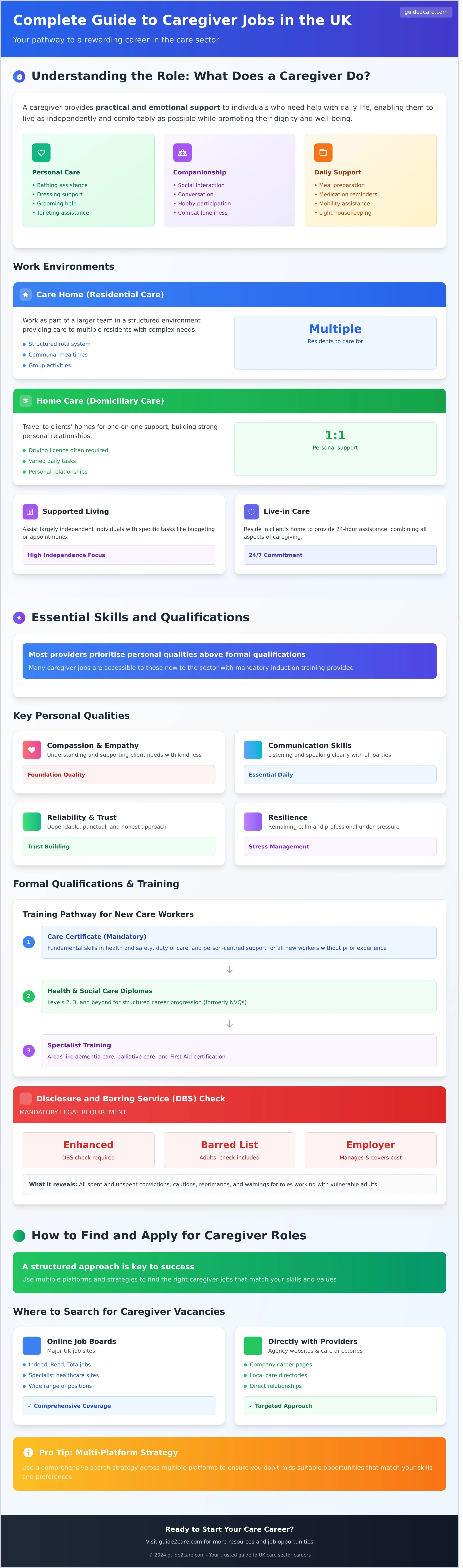
A caregiver, often called a care assistant in the UK, provides practical and emotional support to individuals who need help with daily life. The core of the role is to enable people to live as independently and comfortably as possible, always promoting their dignity and well-being. This work is a fundamental part of the system of Social care in the United Kingdom, encompassing a wide range of responsibilities tailored to individual needs.
Watch this video to learn more about securing a care role in the UK:
Primary duties vary depending on the setting but typically fall into three main categories:
- Personal Care: Assisting with tasks such as bathing, dressing, grooming, and toileting in a respectful manner.
- Companionship: Providing social interaction, engaging in conversation, and participating in hobbies to combat loneliness.
- Daily Support: Helping with practical needs like meal preparation, medication reminders, mobility, and light housekeeping.
The environment where care is delivered significantly impacts a caregiver's daily tasks and routine. Understanding these differences is key when looking for caregiver jobs caregiver jobs that suit your skills and preferences.
Working in a Care Home (Residential Care)
In a residential or nursing home, you work as part of a larger team in a structured environment. Care is provided to multiple residents, often with complex needs. Daily duties are typically organised around a rota and include assisting with communal mealtimes, supporting mobility around the home, and helping residents participate in group activities. The focus is on collaborative, consistent care for the entire community.
Working in Home Care (Domiciliary Care)
Domiciliary care involves travelling to clients' private homes to provide one-on-one support. This role allows for building strong, personal relationships with individuals. Tasks are highly varied and can include medication reminders, preparing meals, shopping, or accompanying clients to appointments. This autonomy requires excellent time management, and many roles require a driving licence for travel between visits.
Other Settings: Supported Living and Live-in Care
Supported living services assist individuals who are largely independent but need help with specific tasks like budgeting or attending appointments. In contrast, live-in care offers the most intensive support, where a caregiver resides in the client’s home to provide 24-hour assistance. This role combines all aspects of caregiving into a unique lifestyle, requiring a deep commitment to the client's well-being.
Essential Skills and Qualifications for Caregiver Jobs
When considering a role in home care, many people ask if they need previous experience or specific qualifications. While formal training is important, most providers prioritise personal qualities above all else. The right character traits are the foundation of excellent care. Most agencies provide mandatory induction training, making many caregiver jobs caregiver jobs accessible to those new to the sector.
Key Personal Qualities Every Great Caregiver Needs
Effective care is built on a specific set of personal attributes. Providers look for candidates who can demonstrate the following core qualities:
- Compassion, empathy, and patience: The ability to understand and support a client's needs with kindness and respect.
- Communication skills: Listening carefully to clients and speaking clearly to them, their families, and other healthcare professionals.
- Reliability and trustworthiness: Being dependable, punctual, and honest is essential for building trust with vulnerable clients.
- Resilience: The ability to remain calm and professional in challenging or stressful situations.
Formal Qualifications and Training
Upon starting, all new care workers in England without prior experience must complete the Care Certificate. This covers fundamental skills in health and safety, duty of care, and person-centred support. For those seeking to advance, Health and Social Care Diplomas (formerly NVQs) at Levels 2, 3, and beyond offer structured career progression. Many employers also provide specialist training in areas like dementia or palliative care. You can find more details in the National Careers Service guide to care worker jobs. Practical certifications, such as First Aid, are often included in induction training.
The Disclosure and Barring Service (DBS) Check
A background check is a mandatory legal requirement for all individuals working in regulated activities with vulnerable adults. In the UK, this is the Disclosure and Barring Service (DBS) check. For roles in home care, an Enhanced DBS check with a check of the adults' barred list is required. This check reveals any spent and unspent convictions, cautions, reprimands, and warnings. The process is managed by the employer, who will also typically cover the cost.
How to Find and Apply for Caregiver Roles
A structured approach will help you find and secure a role in the care sector. This guide provides the necessary steps to locate vacancies, create a strong application, and succeed at interview. A focused search is key to finding the right caregiver jobs caregiver jobs that match your skills and values.
Where to Search for Caregiver Vacancies
Begin your search across multiple platforms to see the full range of available positions. A comprehensive strategy ensures you do not miss suitable opportunities.
- Online Job Boards: Check major UK sites like Indeed, Reed, and Totaljobs. Also, look for specialist websites that focus exclusively on healthcare and social care roles.
- Directly with Providers: Many home care agencies list vacancies on their own websites. Use a care directory to find providers in your local area and check their careers pages.
- Local Resources: Your local Jobcentre Plus and community newspapers often list care worker positions.
- Recruitment Agencies: Register with agencies that specialise in the healthcare sector for access to roles that may not be advertised elsewhere.
Crafting Your Caregiver CV and Cover Letter
Your CV is your first opportunity to make a positive impression. It must be professional, clear, and tailored to the care industry. Highlight transferable skills from previous employment, such as customer service from retail or time management from hospitality. Emphasise essential soft skills like compassion, patience, reliability, and strong communication.
Keep your CV concise and easy to read, ideally no longer than two pages. Always write a unique cover letter for each application. Address it to the specific hiring manager and explain why you are interested in working for that particular provider.
Preparing for the Caregiver Interview
Preparation is essential for a successful interview. Be ready to answer common questions such as, 'Why do you want to be a caregiver?' and 'What qualities do you have that make you suitable for this role?' Recruiters will assess your suitability based on the core competencies of the role. Review the National Careers Service guide to care worker roles to understand the key skills employers value.
Expect scenario-based questions, for example, 'What would you do if a client refused to take their medication?' Use these to demonstrate your problem-solving skills and calm judgement. Prepare your own questions to ask the employer about training, team structure, or company culture. Dress professionally and ensure you arrive on time, whether the interview is in person or virtual.
Choosing the Right Employer: How to Research Care Providers
Finding the right employer is as important as finding the right role. A provider that values its staff creates a positive work environment, which directly translates to higher quality care for clients. Conducting proactive research before you apply helps you secure a long-term, satisfying position. This step is crucial for anyone looking for fulfilling caregiver jobs caregiver jobs and a supportive workplace.
Check the Care Quality Commission (CQC) Ratings
The Care Quality Commission (CQC) is the independent regulator of health and social care in England. Its inspection reports offer an impartial assessment of a provider's quality and safety. The CQC inspects providers against five key questions:
- Safe: Are you protected from abuse and avoidable harm?
- Effective: Does your care, treatment and support achieve good outcomes?
- Caring: Do staff involve and treat you with compassion, kindness, dignity and respect?
- Responsive: Are services organised to meet your needs?
- Well-led: Does the leadership of the organisation make sure it's providing high-quality care?
Each provider receives a rating of 'Outstanding', 'Good', 'Requires Improvement', or 'Inadequate'. A 'Good' or 'Outstanding' rating indicates a high-performing employer committed to quality.
Use Directories and Read Reviews
Online directories provide a clear snapshot of care services available in your local area. Look for detailed provider profiles that list the types of care offered and the company's ethos. Most importantly, read reviews from service users and their families. These firsthand accounts offer valuable insight into a provider's day-to-day operations and reputation. You can find and research local care providers on Guide2Care.
Key Questions to Ask a Potential Employer
An interview is a two-way process. Use the opportunity to assess whether the employer is a good fit for you. Prepare direct questions to clarify their culture and expectations:
- What ongoing training, development, and support systems do you provide for staff?
- What are your staff-to-resident ratios or policies on travel time between clients?
- Can you describe the company's core values and mission?
- What are the clear expectations for shift patterns, pay rates, and benefits?
Career Progression and Development in the Care Sector
A common misconception is that care work is a 'dead-end job'. This is incorrect. The social care sector offers structured career pathways with significant opportunities for professional growth. For individuals with dedication and a desire to learn, a role that starts with providing essential support can evolve into a leadership position or a highly specialised career. The best caregiver jobs caregiver jobs providers invest heavily in staff training, making this a key factor to assess.
A career in care provides immense personal fulfilment by making a tangible difference in people's lives. This sense of purpose, combined with clear professional development, creates a uniquely rewarding long-term vocation.
Advancing Your Role
The journey often begins as a Care Assistant. With experience and further training, you can advance to a Senior Care Assistant or Team Leader. This senior role involves greater responsibility, such as:
- Mentoring and supervising new members of the care team.
- Conducting client assessments and developing individual care plans.
- Administering medication and liaising with healthcare professionals.
From there, the path can lead to a Deputy Manager and ultimately a Registered Manager role, where you are responsible for the entire service and its compliance with Care Quality Commission (CQC) regulations.
Opportunities for Specialisation
Alongside the management track, there are extensive opportunities to become a specialist. This allows you to develop deep expertise in a specific area of care, providing highly skilled support to clients with complex needs. Many carers choose to specialise in:
- Dementia Care: Gaining qualifications to support individuals living with Alzheimer's and other forms of dementia.
- Palliative Care: Providing compassionate end-of-life support for clients and their families.
- Complex Conditions: Focusing on care for individuals with specific conditions like Parkinson’s disease, stroke, or motor neurone disease.
- Other Roles: Moving into related positions like Activities Coordinator or a specialist in nutrition and hydration.
A provider's commitment to staff development is a strong indicator of their overall quality. Explore providers on Guide2Care to find an organisation that supports your career aspirations.
Your Next Steps to a Rewarding Care Career
You now understand the essentials of a caregiver role, from the required skills to the significant opportunities for career development. Finding the right employer is the most critical step in your search for fulfilling caregiver jobs caregiver jobs. A supportive workplace that aligns with your values is the foundation for a long and successful career in the care sector.
The best way to begin is with effective research. Start your search by researching reputable care providers on the Guide2Care directory. Our comprehensive list of UK care providers gives you access to crucial CQC ratings and reports. Use this information to find providers that match your professional values and career ambitions.
Take the first step towards a meaningful and rewarding career today.
Frequently Asked Questions About Caregiver Jobs
What is the average salary for a caregiver in the UK?
The average hourly pay for a caregiver in the UK typically ranges from £11.00 to £13.00, but this can be higher in London and the South East. On an annual basis, a full-time caregiver's salary is often between £22,000 and £26,000. Pay rates are influenced by the employer, the caregiver's experience, specific qualifications, and the complexity of care required. Live-in care roles may offer a different pay structure, often calculated on a weekly rate.
Do I need my own car to be a caregiver?
This depends on the type of care role. For domiciliary care, where you travel to multiple clients' homes, a driving licence and access to a vehicle are often essential. Employers usually pay a mileage allowance to cover travel costs. However, for live-in care positions or roles within a single residential facility, a car is not typically a requirement. Always check the specific job description for transportation needs before you apply to a role.
What are the typical working hours and shift patterns?
Working hours for caregiver jobs are highly varied to meet the round-the-clock needs of clients. Shift patterns can include early mornings, afternoons, evenings, overnight stays, and weekends. Many roles offer part-time or flexible hours, which can suit different lifestyles. Live-in care involves living with the client for set periods, such as one week on and one week off. The specific rota will be determined by the care provider and the client’s care plan.
Is being a caregiver an emotionally demanding job?
Being a caregiver is an emotionally rewarding but also demanding role. You build strong professional relationships with clients and may support them through difficult health challenges. The work requires a high degree of empathy, patience, and emotional resilience. While challenging, many caregivers find immense satisfaction in making a positive difference. Reputable employers will provide support systems, such as supervision and team meetings, to help you manage the emotional aspects of the job.
How long does the DBS background check take?
An Enhanced Disclosure and Barring Service (DBS) check is a legal requirement for working in care. The processing time can vary, but most checks are completed within 2 to 4 weeks. Some applications can be faster, while others may take longer if additional information is required by the police. Your employer will initiate and manage the application process. You cannot start working unsupervised with vulnerable adults until the DBS certificate has been received and cleared.
Can I get a caregiver job with no formal qualifications?
Yes, you can secure many entry-level caregiver jobs without formal qualifications. Employers often prioritise personal qualities such as kindness, patience, reliability, and a compassionate nature. Most care providers offer comprehensive induction training, which includes completing the Care Certificate. This is the recognised standard for the sector. While qualifications like Diplomas in Health and Social Care are beneficial for career progression, they are not usually essential to start.
While your employer will provide essential liability cover, many caregivers look into personal insurance like income protection as they build their long-term career. Understanding your options is a key part of professional financial planning. For those exploring what's available, you can discover AllCover Insurance Brokers for examples of comprehensive solutions, even though they are based in Australia.
Do I need any special insurance as a caregiver?