What Is the Difference Between a Nursing Home and a Residential Home?
Choosing the right care for a loved one is one of the most important decisions you can make. The process can feel complex, filled with industry terms that are not always clear. A primary point of confusion for many is understanding what is the difference between a nursing home and a residential home. Getting this distinction right is crucial, as it directly impacts the level of medical support available and can prevent the need for another move in the future if health needs change.
This guide is here to provide clarity. We will break down the key functions of each type of home in simple terms. You will learn about the differences in staffing, the specific care services offered, and how costs typically vary between the two. By the end, you will have a clear understanding of which option best suits your or your loved one's current and potential future needs, empowering you to take the next step with confidence.
Key Takeaways
- The primary answer to what is the difference between a nursing home and a residential home is the level of medical care; one provides 24/7 on-site nursing, and the other does not.
- Discover how residential homes are structured to provide personal care and social support for individuals who do not require constant nursing supervision.
- Identify when a nursing home is the necessary choice by understanding the specific medical conditions and complex care needs they are equipped to manage.
- Use our practical framework to assess care needs accurately, helping you confidently match an individual to the correct type of UK care home.
At a Glance: Residential Home vs. Nursing Home Explained
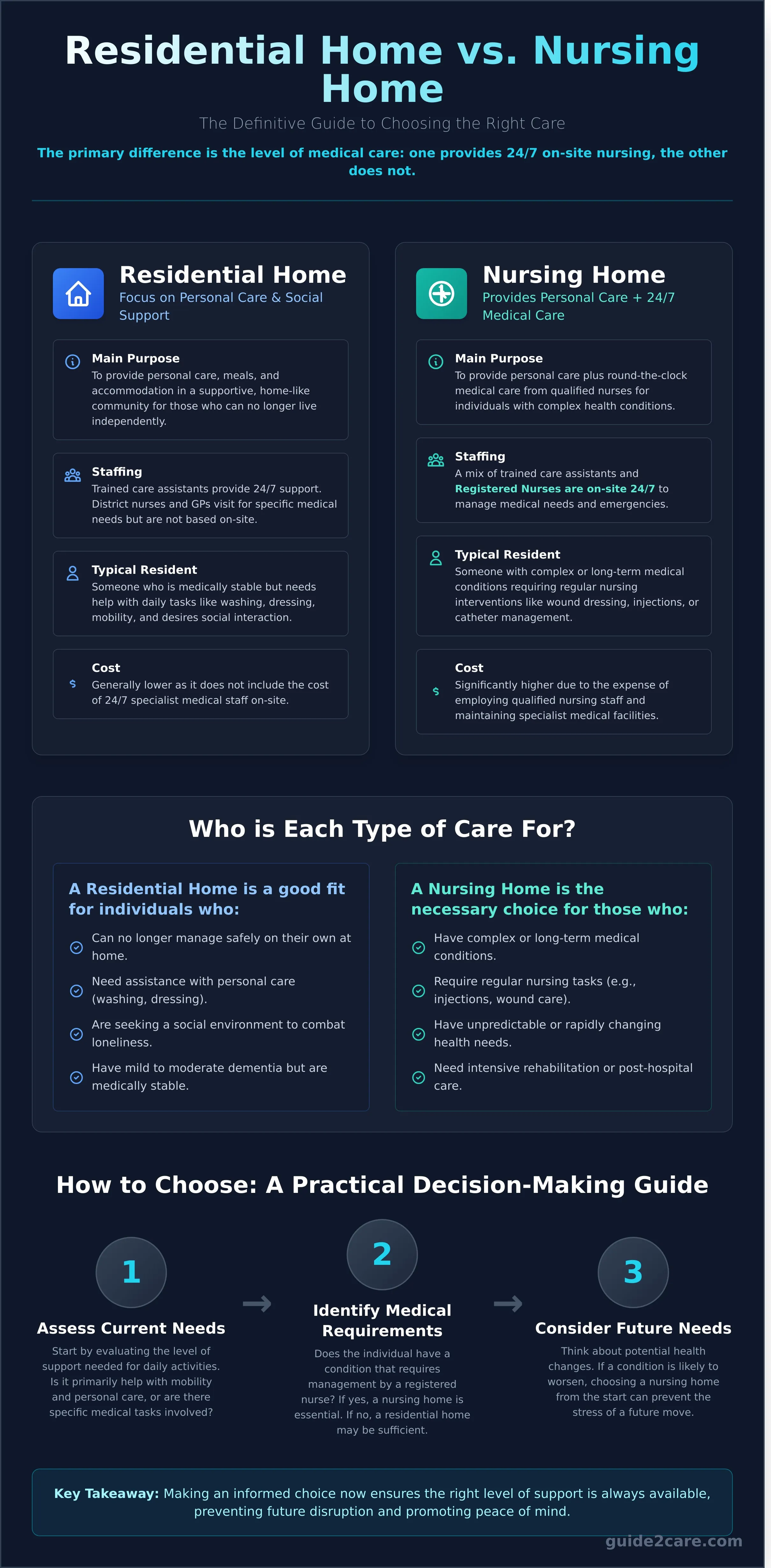
The main difference between a nursing home and a residential home is the level of medical care provided. A nursing home has qualified nurses on-site 24 hours a day to deliver medical treatment. A residential home provides personal care and support but does not have a 24/7 nursing team.
Both options fall under the umbrella term 'care home', but understanding this distinction is the first step in finding the right support. Knowing what is the difference between a nursing home and a residential home ensures you can match a person's specific needs to the correct environment.
To better understand this concept, watch this helpful video:
The Core Difference: Personal Care vs. Medical Care
Residential homes focus on providing personal care. This includes support with daily activities such as washing, dressing, eating, and mobility. The goal is to create a safe and supportive home-like environment. To understand in more detail what is residential care, it is useful to see it as support for those who cannot live independently but do not require constant nursing.
A nursing home offers the same personal care but adds round-the-clock medical care from a clinical team. This means registered nurses are always available to manage complex health conditions, administer injections, dress wounds, or handle other specific medical requirements.
Quick Comparison Table
Use this table as a simple guide to the key differences.
| Feature | Residential Home | Nursing Home |
|---|---|---|
| Main Purpose | To provide personal care, meals, and accommodation in a supportive community. | To provide personal care plus 24/7 medical care from qualified nurses. |
| Staffing | Trained care assistants. District nurses may visit for specific medical tasks. | Trained care assistants and registered nurses are on-site 24/7. |
| Typical Resident | Someone who needs help with daily living but is medically stable. | Someone with complex or long-term medical conditions requiring regular nursing. |
| Cost | Generally lower, as it does not include 24/7 specialist medical staff. | Higher due to the cost of qualified nursing staff and medical facilities. |
A Deeper Look at Residential Care Homes
A residential care home provides personal care and accommodation in a supportive, community-focused environment. The primary goal is to assist residents with daily living while promoting social well-being and independence. This model is fundamentally built around support rather than intensive medical treatment, which is key to understanding what is the difference between a nursing home and a residential home.
Who Are Residential Homes For?
Residential homes are designed for individuals who find it difficult to live independently but do not require 24-hour nursing care. They are an ideal choice for older adults seeking security, companionship, and support with personal tasks. This setting is suitable for individuals who:
- Can no longer manage safely on their own at home.
- Need assistance with personal care like washing, dressing, and mobility.
- Are looking for a structured social environment to combat loneliness.
- May have mild to moderate dementia; many homes offer specialist dementia care units.
Services and Staffing in a Residential Home
The crucial staffing distinction in a residential home is the absence of on-site registered nurses. Care is delivered by a team of trained care assistants who provide comprehensive personal support but are not qualified to administer complex medical treatments. For those researching care options, it can be useful to review external resources comparing assisted living and nursing homes, as the 'assisted living' model in other countries often aligns with the UK's residential care approach.
Health needs are managed through close collaboration with external NHS services. Staff will arrange and facilitate visits from community health professionals, including:
- General Practitioners (GPs) for routine check-ups and medical advice.
- District nurses for wound care, injections, and other clinical tasks.
- Physiotherapists and occupational therapists as required.
The focus remains on maintaining a resident's independence wherever possible. Typical services include meal preparation, medication reminders, housekeeping, laundry, and organising social activities. The environment is not equipped for residents with severe, unstable, or complex medical conditions that require constant monitoring by a qualified nurse.
Understanding Nursing Homes and Their Medical Capabilities
A nursing home provides 24-hour personal and nursing care for individuals with specific medical needs. The primary answer to what is the difference between a nursing home and a residential home is the provision of constant, on-site medical supervision. By law, a UK nursing home must have a qualified, registered nurse on duty at all times.
While they offer all the same personal care services as a residential home-such as help with washing, dressing, and meals-nursing homes are equipped to manage more complex health conditions. They use specialised equipment like profiling beds, hoists, and mobility aids to support residents with significant physical needs.
Who Needs a Nursing Home?
A nursing home is designed for individuals whose needs exceed the scope of personal care. This typically includes people who require regular medical assessment and intervention. Consider a nursing home for:
- Individuals with complex, long-term medical conditions.
- Those recovering from surgery or a significant medical event, such as a stroke.
- People requiring specialised procedures like peg feeding or complex wound care.
- Residents with physical disabilities who need frequent assistance from medically trained staff.
Specialised Medical Care and Staffing
The clinical team is led by Registered General Nurses (RGNs) or Registered Mental Nurses (RMNs). These professionals are responsible for developing and managing detailed clinical care plans for each resident. Their medical tasks include:
- Administering medication, including intravenous (IV) drugs.
- Managing and changing catheters.
- Monitoring vital signs and assessing health changes.
- Providing palliative and end-of-life care.
This level of staffing ensures that complex health needs are met safely and effectively within the home, reducing the need for hospital admissions. To find a provider that meets these specific requirements, you can explore listings on Guide2Care.
How to Choose: A Practical Decision-Making Guide
Choosing between a nursing and residential home means matching a person’s specific care needs to the right services. This guide provides a practical framework to help you make an informed decision. Understanding what is the difference between a nursing home and a residential home is the first step, but planning for both current and future requirements is essential for long-term stability and peace of mind.
Start with a Care Needs Assessment
A Care Needs Assessment is a free evaluation arranged by your local council's adult social services department. Its purpose is to officially determine the level of support an individual requires, whether it is personal care or more complex nursing care. This assessment is the critical first step in defining care needs and is also necessary to find out if you are eligible for local authority funding towards care costs. Contact your council directly to arrange an assessment.
Consider Current and Future Health Needs
Evaluate the stability of the person’s health. If they have a progressive condition, such as advanced dementia, Parkinson’s disease, or multiple sclerosis, their needs will likely increase over time. In these situations, choosing a nursing home from the outset can prevent a disruptive and stressful move later. Discuss their long-term prognosis with their GP to get a clear medical perspective on the level of care that will be required in the future.
The Advantage of a Dual-Registered Home
A dual-registered home is a facility registered to provide both residential and nursing care under one roof. The primary benefit is continuity. A resident can move in needing only personal care and later transition to receive nursing care if their health changes, all within the same familiar environment. This ‘ageing in place’ model offers significant peace of mind, removing the future burden of searching for a new home during a health crisis.
Comparing Costs: What to Expect
Nursing homes are more expensive than residential homes due to the cost of employing registered nurses 24/7. The price difference can be significant, often costing £150-£300 more per week. For those assessed as needing nursing care, the NHS may contribute towards the cost through a payment called NHS-funded Nursing Care (FNC) in England. This is paid directly to the care home to cover the nursing element of the fees. Use our directory to find and compare local care home fees.
Find the Right Care Home for Your Needs
Choosing the right care environment begins with understanding a key distinction. A residential home is ideal for those who need support with personal care and daily living, such as meals and mobility, in a social setting. In contrast, a nursing home provides this same support with the crucial addition of 24-hour medical care administered by qualified nurses on-site. Understanding what is the difference between a nursing home and a residential home is the essential first step to matching the right level of care to an individual's specific and evolving health requirements.
With this knowledge, you are ready to find the right solution. Guide2Care provides the tools and free, impartial information to help you make an informed decision. Explore our comprehensive listings across the UK and use our practical filters to narrow your search by care type, location, and the latest CQC rating. The right support is out there. Find the care you need. Search our directory of UK nursing and residential homes.
Frequently Asked Questions
Can a person move from a residential home to a nursing home?
Yes, it is common for a person to move from a residential home to a nursing home if their care needs increase. This transition usually follows a new care needs assessment that identifies a requirement for 24-hour support from a qualified nurse. Some homes are dual-registered to provide both types of care, which can allow a resident to remain in the same location even as their needs change, avoiding the stress of another move.
Do all care homes in the UK provide dementia care?
No, not all UK care homes are equipped to provide specialist dementia care. While many homes can support residents with early-stage dementia, advanced care requires specially trained staff, secure facilities, and tailored activities. It is vital to check a home's registration and specialisms with the Care Quality Commission (CQC) or on a care directory to confirm they can meet the specific needs associated with dementia before making a choice.
What is the role of the CQC in regulating nursing and residential homes?
The Care Quality Commission (CQC) is the independent regulator of health and social care in England. Its primary role is to ensure care homes provide people with safe, effective, compassionate, and high-quality care. The CQC inspects services and publishes its findings, including a performance rating from 'Outstanding' to 'Inadequate'. You should always review a home's CQC report to get an impartial view of its standards and practices before making a decision.
Similarly, how a care home presents itself to the public through its website and brochures often reflects its professionalism and commitment to transparency. Families rely on this information to make informed choices, so clear and professional communication is key. For those interested in the type of agencies that help care homes create these materials, you can learn more about Pro-Creative, which specialises in web design and print for various sectors.
The CQC's focus on safety includes rigorous standards for hygiene, a crucial factor in resident well-being. To meet these requirements, many care facilities partner with specialist commercial cleaning providers. For those interested in what this entails, services like That's Cleaning show the professional level of cleaning needed in such sensitive environments.
Social well-being is another crucial factor in quality of care, and activity coordinators often draw inspiration from various sources to create engaging programs. For instance, well-curated city guides can serve as a model for developing accessible and enjoyable local activities for residents. To see an example of a guide focused on curated experiences, you can learn more.
Who pays for the nursing care part of the fees in a nursing home?
In a nursing home, the nursing care component of the fees is paid for by the NHS. This is known as NHS-funded Nursing Care (FNC) and is a standard, non-means-tested weekly payment made directly to the care home. It covers the specific services provided by a registered nurse, such as administering complex medication or wound care. This is separate from the fees for accommodation, food, and personal care, which the resident must fund themselves.
How can I tell if a care home is residential, nursing, or dual-registered?
The most reliable way to check a home’s status is to view its latest report on the CQC website or its listing on a care directory. These resources will clearly state what type of care the home is registered to provide. Understanding what is the difference between a nursing home and a residential home is crucial; only a nursing home will be registered to provide 'Accommodation for persons who require nursing care' and have qualified nurses on-site 24/7.
Do you need a doctor's referral to get into a nursing home?
A formal doctor’s referral is not always required for admission into a nursing home. However, entry is dependent on a comprehensive care needs assessment completed by a qualified professional, like a social worker or NHS nurse. This assessment must conclude that the individual has complex health needs requiring the 24-hour supervision of a registered nurse. This process is often initiated following a hospital stay or a significant deterioration in health.