Care Homes in London: A Complete Guide to Finding Care

The search for suitable care homes in London presents unique challenges. With 32 boroughs to navigate, concerns over high costs, and complex quality reports, the process can feel overwhelming. You need to find a place that not only provides excellent care but is also accessible for family visits, adding another layer to your decision-making.
This complete guide simplifies the task. We provide a structured approach to finding and choosing the right care home for your loved one. Inside, you will find clear information on the types of residential and nursing care available, a practical breakdown of average costs across different London boroughs, and direct guidance on how to interpret CQC inspection reports. Our goal is to give you the essential facts needed to compare your options effectively.
Follow our step-by-step process to build a shortlist of high-quality homes to visit. Gain the clarity and confidence required to make a well-informed decision. Find the care you need.
Key Takeaways
- Understand how to select the right London borough based on transport, community, and budget before starting your search.
- Get a clear overview of the typical costs for care homes in london, including average weekly fees and potential extra charges.
- Learn to use official CQC reports and a practical checklist to assess the true quality of a care home beyond its brochure.
- Follow a step-by-step process that guides you from initial research and shortlisting to making a final, confident decision.
Understanding the London Care Home Landscape
Finding the right care homes in London presents a unique set of challenges and opportunities. The capital's market is vast and diverse, offering a wide spectrum of options across 32 boroughs and hundreds of providers. This scale means more choice but also significant variations in cost, specialisms, and availability. Understanding the broader UK care home landscape provides a useful foundation, but London operates with a distinct level of complexity due to its property values and population density.
To better understand this market, watch this helpful overview video:
Types of Care Available in London
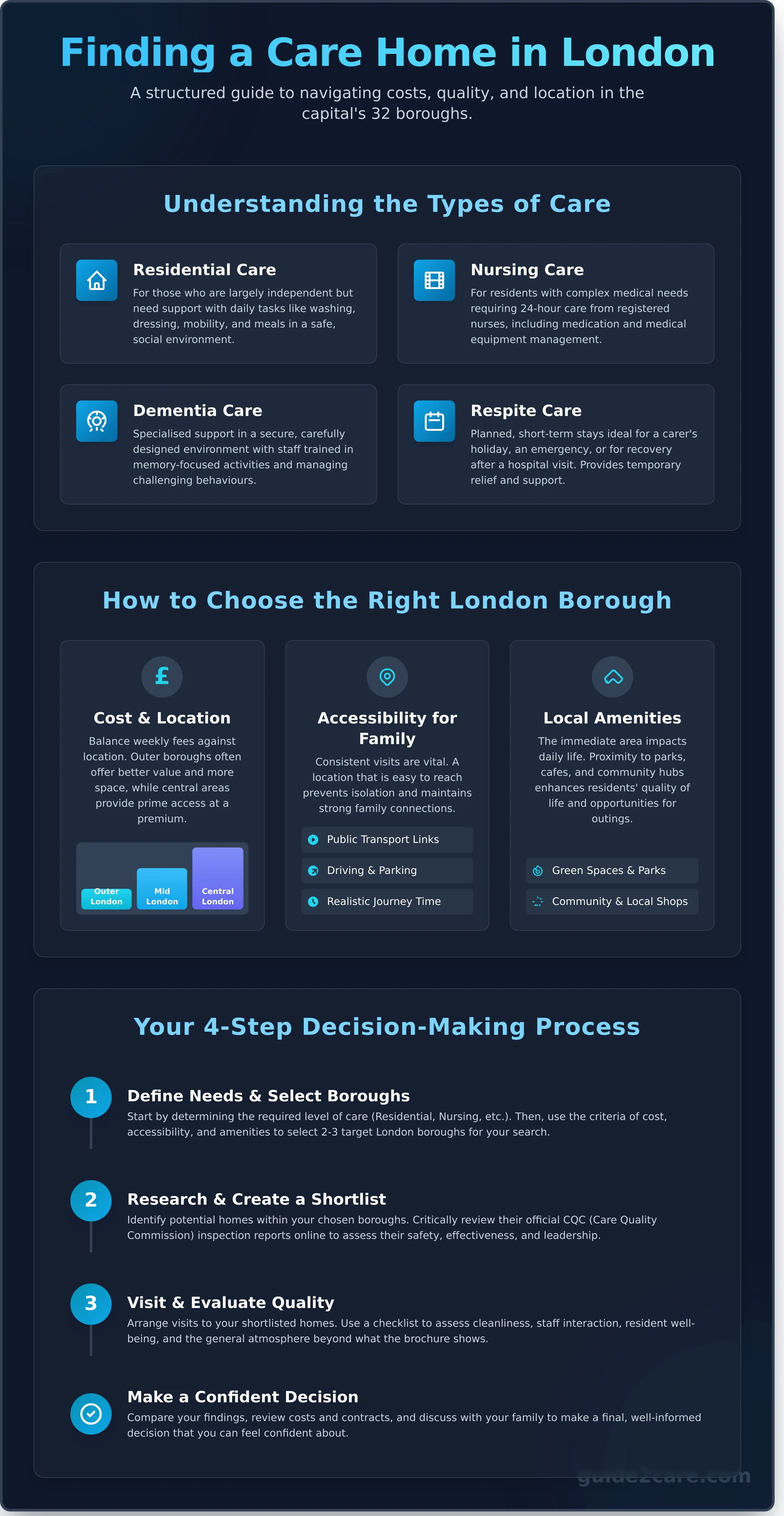
Care homes provide different levels of support. It is essential to match the type of care to the individual's needs. The main types you will find are:
- Residential Care: Suited for individuals who are largely independent but need support with daily tasks like washing, dressing, mobility, and meal preparation. It provides a safe, social environment.
- Nursing Care: For residents with complex medical needs, chronic illnesses, or disabilities that require 24-hour care from registered nurses. This includes administering medication and managing medical equipment.
- Dementia Care: Offers specialised support in a secure and carefully designed environment for individuals living with dementia. Staff are trained to manage challenging behaviours and provide memory-focused activities.
- Respite Care: Provides a planned, short-term stay in a care home. This is an ideal solution for a carer's holiday, an emergency situation, or for an individual recovering after a hospital visit.
Key Considerations for the London Market
When searching for care homes, several London-specific factors are critical. All providers in England are regulated by the Care Quality Commission (CQC), which inspects and rates services. You should always check the latest CQC report for any home you consider. Beyond regulation, focus on these practical points:
- Cost Variation: Fees differ significantly across the capital. Homes in central boroughs like Westminster or Kensington and Chelsea often have higher weekly costs than those in outer boroughs like Bexley or Havering. Clarify exactly what the quoted fee includes.
- Accessibility and Location: A home's location is vital for maintaining family connections and quality of life. Evaluate its proximity to family, local amenities, and green spaces. Check public transport links (Tube, bus routes) and parking availability for visitors.
- Availability of Specialist Services: While London has many specialist providers, their distribution is uneven. If you require care for specific conditions (e.g., Parkinson's) or culturally specific services, your search may be focused on particular areas of the city.
How to Choose the Right London Borough for Care
Before you compare individual providers, you must first select the right London borough. This decision is a critical first step that influences cost, convenience for visitors, and a resident's overall quality of life. Use this guide to create a framework for your family, helping you prioritise needs and find a location that is suitable for the long term.
Balancing Cost and Location
The cost of care homes in london varies significantly from one borough to another. A care home in a central, prime location like Kensington and Chelsea will have substantially higher weekly fees than one in an outer borough such as Croydon or Havering. You must consider the trade-off. Central locations offer excellent transport links but often come at a premium with less outdoor space. Outer London can provide better value, larger grounds, and a quieter, more residential environment.
Accessibility for Family and Friends
Consistent visits from family and friends are vital for a resident's happiness and well-being. A location that is difficult for loved ones to reach can lead to isolation over time. Before creating a shortlist, assess the practicalities of travel for your key visitors.
This period of transition can be emotionally taxing for family members as well. If you are navigating the complexities and stress of this decision, seeking professional support can be incredibly helpful. For those in the London area, services such as Jonathan Cullen Therapy offer counselling to help families manage this significant life event.
- Public Transport: Check how close the home is to a convenient Tube, Overground, or bus route.
- Driving and Parking: If visitors will drive, confirm the availability of on-site or unrestricted street parking.
- Journey Time: Factor in the realistic travel time for those who will visit most frequently.
Proximity to Amenities and Green Spaces
The immediate local area directly impacts daily life. A home situated near a park provides valuable opportunities for gentle walks and fresh air, which supports both physical and mental health. As you explore options, the official NHS guide to choosing a care home can help you evaluate all aspects of a home's suitability. Consider access to local amenities like shops, cafes, or a library, as these allow for simple and enjoyable outings. Above all, the local area should feel safe, welcoming, and pleasant.
Evaluating London Care Homes: A Quality Checklist
A brochure presents an ideal version of a care home. To understand the reality, you must look deeper. A thorough evaluation combines official reports with your own direct observations from a visit or virtual tour. This checklist helps you assess the true quality of care homes in London and make an informed decision.
How to Use CQC Ratings Effectively
The Care Quality Commission (CQC) is the independent regulator of health and social care in England. Every care home receives a rating based on five key questions: is it Safe, Effective, Caring, Responsive, and Well-led? Use their reports as your starting point. Look beyond the overall 'Outstanding' or 'Good' rating to read the detailed findings. Note any trends from previous inspections and identify specific areas that either excel or require improvement. For more official guidance, the NHS guide to choosing a care home provides a useful overview.
Assessing Staffing and Specialist Care
The quality of staff is central to the quality of care. During your visit or call, ask direct questions about the team. Observe how staff members speak to and assist current residents-their interactions should be respectful, patient, and kind. Key questions to ask include:
- What are the staff-to-resident ratios during the day, evening, and at night?
- What is the staff turnover rate?
- What specific training do staff have for complex needs, such as dementia or nursing care?
- How are residents' care plans developed and reviewed?
Inspecting Facilities and Daily Life
The physical environment and daily structure significantly impact a resident's well-being. Pay attention to the details. Check for cleanliness in private rooms and communal areas, and note any signs of poor maintenance. A vibrant and well-managed home will have a clear structure for daily life. Be sure to:
- Review the weekly activities schedule. Is there a good variety of engaging options?
- Examine the meal menus. Do they offer choice and cater to dietary requirements?
- Assess the outdoor space. Is it safe, accessible, and pleasant for residents to use?
A well-tended garden significantly enhances residents' quality of life, and it's a key indicator of a well-managed home. Many providers work with professional landscapers to create safe and therapeutic outdoor areas. To get an idea of the high standards you should look for in a care home's garden, you can learn more about Agents Green.
A systematic approach ensures you gather the necessary information to compare different providers. Search for CQC-rated care homes in London today.
Navigating the Cost of Care Homes in London
Understanding the financial commitment is a critical step in choosing a care home. Costs can be substantial, particularly in the capital, but a clear understanding of fees and funding can make the process more manageable. This section breaks down the typical expenses associated with care homes in london and outlines the main avenues for financial support.
Average Weekly Fees in London
The cost of care varies significantly based on the level of support required. In London, you can expect to find average weekly fees in the following ranges:
- Residential Care: Typically between £1,200 and £1,600 per week.
- Nursing Care: Often ranges from £1,500 to over £2,000 per week, reflecting the inclusion of specialist medical support from registered nurses.
Prices differ between London boroughs, with homes in central areas often costing more. The quality of facilities and the specific care package will also influence the final fee. If the local authority contributes to funding but your chosen home costs more than their set rate, a relative may need to pay a 'third-party top-up fee' to cover the difference.
Understanding What's Included
Standard care home fees are usually inclusive of core living costs. However, it is vital to confirm what is covered before signing a contract. Always request a clear, itemised breakdown of fees.
Typically Included:
- Fully furnished accommodation
- All meals, snacks, and drinks
- Utility bills (heating, electricity)
- Basic laundry services
- In-house activities and entertainment
Common Additional Costs:
- Hairdressing and chiropody
- Newspapers or magazines
- Private phone lines and internet
- Escorted trips or appointments
It's also worth asking how the home facilitates access to specialist medical services, such as dental care, which is vital for residents' overall health. For complex procedures in the London area, you can check out Bespoke Dental Fulham.
Overview of Funding Options
Several routes are available to help fund care. The most suitable option depends on your financial circumstances and healthcare needs. The main pathways include Local Authority funding, which is determined by a financial assessment (means test) of your capital and income. If your assets fall below a certain threshold, the council may contribute towards your fees.
For individuals with a primary health need, NHS Continuing Healthcare (CHC) may provide full funding. Eligibility is based on a complex health assessment, not on your financial situation. For those who are self-funding, seeking independent financial advice is strongly recommended to ensure you can make informed decisions about your assets. Explore all the options available to find the right support for your circumstances.
Your Step-by-Step Process for Finding a Home
Finding the right care can feel complex. This structured process breaks the task into clear, manageable stages, guiding you from initial research to a final, informed decision. Follow these steps to navigate your search for care homes in London with confidence and clarity.
Step 1: Create a Longlist with an Online Directory
The most efficient way to begin is with a comprehensive online directory. Use the Guide2Care search tool to filter options based on your specific requirements. This allows you to build a list of potential homes without leaving yours.
- Search by location: Pinpoint homes in your preferred London borough, from Barnet to Bromley.
- Filter by care type: Select residential, nursing, dementia, or other specialist care.
- Check CQC ratings: Instantly see the official Care Quality Commission rating for each provider.
Save or bookmark the profiles that meet your criteria. Read reviews from other families and browse the photo galleries to get a clear first impression of the environment and facilities on offer.
Step 2: Shortlist and Make Initial Contact
Review your longlist and narrow it down to your top three to five homes. A focused list allows for a more detailed and effective comparison. Once you have your shortlist, make direct contact with each home. Call the manager to confirm they have current availability and to ask any immediate questions about their fees or admissions process. Request a copy of their brochure and a sample weekly menu to review in your own time.
Step 3: Arrange Visits and Ask Key Questions
You must visit your shortlisted care homes in London in person. An online profile provides essential facts, but nothing replaces a direct visit for assessing the atmosphere. If possible, arrange to see the home at different times of the day to observe the daily routine and staff interactions.
Prepare a checklist of key questions to ask the manager and staff. Observe the cleanliness of the home, the quality of the facilities, and how residents are engaged. Trust your instincts-a welcoming, safe, and positive environment is crucial for wellbeing.
For families travelling to the capital to visit multiple locations, this can be a demanding task. Combining these essential trips with a private driver tour London can make the process more manageable and less stressful, allowing you to focus on the important decision at hand.
Ready to begin? Start your search for care homes in London here.
Your Next Step to Finding Care in London
Choosing a care home is a significant process, but it can be managed with the right information. As we have covered, understanding the differences between London boroughs, using a quality checklist for evaluation, and planning for the costs are crucial first steps. This structured approach removes uncertainty and empowers you to focus on finding a safe and suitable environment for your loved one.
The best way to apply this knowledge is to start exploring your options. Our directory is the practical tool designed to help you find and compare care homes in london efficiently. We provide comprehensive, impartial listings across every borough, giving you a complete overview of the market. You can filter your search by CQC rating, specific care types like dementia or nursing care, and available facilities to quickly create a shortlist.
Use our free directory to find and compare care homes in London today. Take the next confident step in your search.
Frequently Asked Questions
How much does a care home in London typically cost per week?
The cost of a care home in London varies significantly based on location and the level of care required. Residential care typically ranges from £1,000 to £1,600 per week. Nursing care, which includes specialised medical support from qualified nurses, is more expensive, often costing between £1,200 and £2,000 per week. Always request a full fee breakdown from the provider to understand all potential costs before making a decision.
What is the difference between a residential home and a nursing home?
A residential home provides accommodation, meals, and personal care, which includes help with daily tasks like washing, dressing, and mobility. A nursing home offers all the services of a residential home but also has qualified nurses on-site 24 hours a day. This allows them to provide medical care for more complex health conditions, such as administering injections or managing chronic illnesses. The choice depends entirely on the individual's medical needs.
How can I check the official quality rating of a care home in London?
The Care Quality Commission (CQC) is the independent regulator for health and social care in England. Every care home is inspected and rated as Outstanding, Good, Requires Improvement, or Inadequate. You can find the latest inspection report for any care home by searching for its name on the official CQC website. This provides a detailed and impartial assessment of its safety, effectiveness, and quality of care.
Which London boroughs are the most affordable for care homes?
Generally, care homes in outer London boroughs are more affordable than those in central areas. Boroughs such as Bexley, Havering, Croydon, and Sutton often have lower average weekly fees. In contrast, costs in boroughs like Kensington and Chelsea, Westminster, and the City of London are typically much higher. Use online directories to filter and compare prices across different London postcodes to find options within your budget.
What should I look for when I visit a care home for the first time?
During your visit, observe the overall atmosphere. Check if the home is clean, safe, and well-maintained. Notice how staff interact with residents-do they seem respectful and caring? Ask to see the menu and the schedule of activities to ensure they meet the needs and preferences of your loved one. Speak with the manager, staff, and if possible, current residents to get a comprehensive view of life at the home.
Can we use local authority funding to pay for a care home in London?
Yes, you may be eligible for local authority funding. Eligibility is determined by a care needs assessment and a financial assessment (a means test). In England, if your capital is below the upper threshold of £23,250, the council may contribute towards the cost of your care home in London. You should contact the adult social services department of your local council to arrange these assessments and confirm your eligibility for support.
How do I find care homes that offer specialised dementia care in London?
Use a dedicated care directory and apply a filter for "dementia care" to narrow your results. When you contact or visit specific care homes in London, ask about their approach to dementia support, staff training, and the security of the environment. Look for homes that offer activities designed for cognitive engagement and sensory stimulation. The home's CQC report may also contain specific details about the quality of its dementia care services.