Supported Living Providers in Scotland: A Complete Guide

Understanding the different types of care available in Scotland can be a significant challenge. Terms like 'supported living' are often used, but what do they actually mean? If you are feeling unsure about how this model differs from a residential care home, or how to begin your search for quality supported living providers in Scotland, you are not alone. These are common concerns for families seeking the right balance of independence and professional support for a loved one.
This complete guide is designed to remove that confusion and empower your search. We provide clear, direct answers to your most pressing questions. We will define the supported living model, explain how it is regulated in Scotland, and outline the key differences from other care options. Our goal is to equip you with the knowledge to make an informed and confident decision.
You will learn how to find and evaluate potential providers, what to look for during a visit, and how to navigate the funding process. Use this guide as your practical roadmap to finding the right support. Find the care you need, simplified.
Key Takeaways
- Understand the core model of supported living, where your housing and support are arranged separately to maximise choice and independence.
- Learn a clear process to define your specific needs before you begin to research and compare supported living providers in scotland.
- Discover the different types of providers available across the country, from national charities to local organisations, and why availability varies.
- Navigate the funding system by learning how costs are divided between housing (tenancy) and your individual support package.
What is Supported Living in Scotland? A Clear Definition
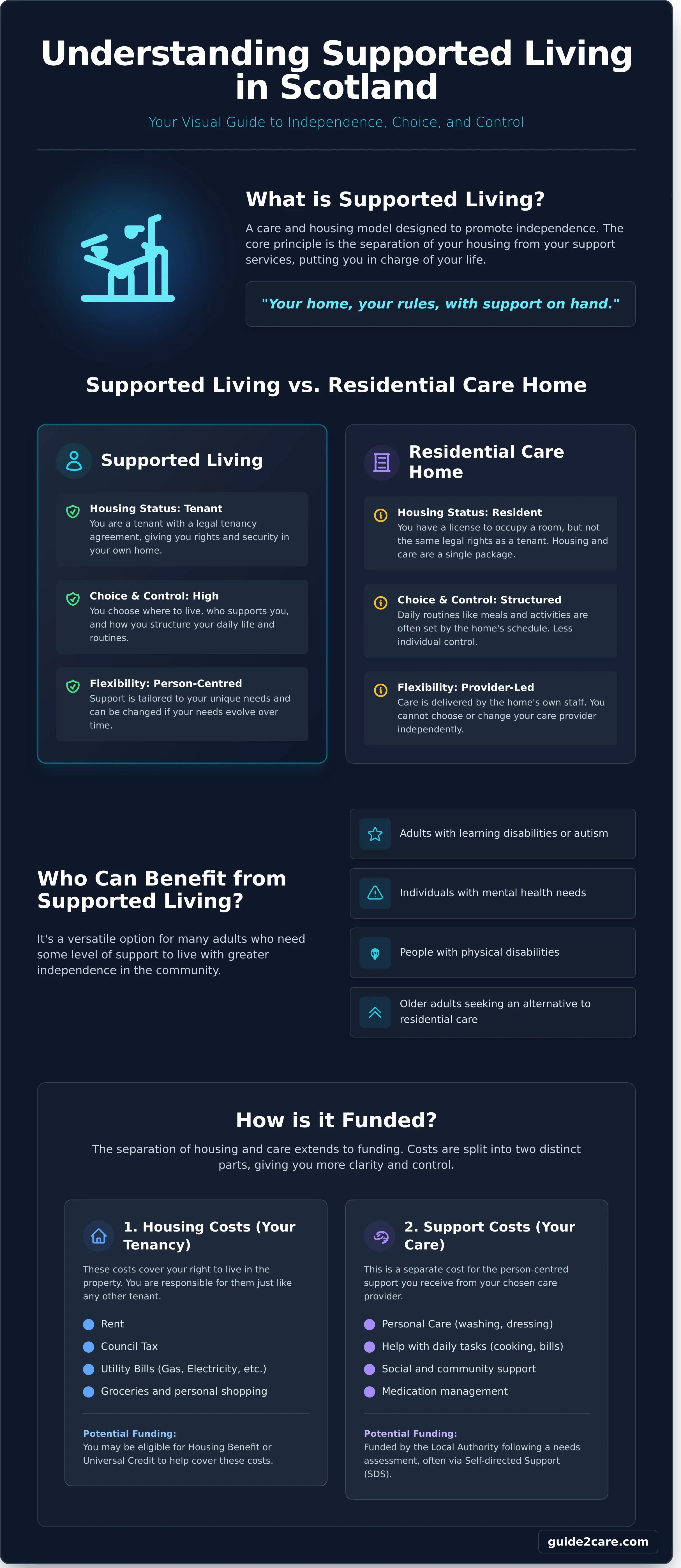
Supported living is a care and housing model designed to promote independence, choice, and control. The core principle is the separation of your housing from your support services. This means you have your own tenancy agreement and live in your own home, while a separate care provider delivers tailored support based on your specific needs. It puts you in charge of your life.
The model is best summarised as: your home, your rules, with support on hand. To understand the foundational concept, you can explore the full definition of supported living, but the key takeaway is empowerment. You choose where to live, who supports you, and how you spend your days, just like anyone else.
This video from Community Integrated Care showcases a supported living service in Kirkcudbright, offering a practical look at the model in action:
The support you receive is flexible and person-centred. Supported living providers in Scotland can offer help with a wide range of areas, including:
- Personal Care: Assistance with washing, dressing, and managing medication.
- Daily Tasks: Help with cooking, cleaning, shopping, and managing bills.
- Social and Community Life: Support to attend clubs, pursue hobbies, or access education and employment.
To achieve these goals, many individuals benefit from specialised services like adult occupational therapy. For instance, providers like Accessible Care focus on developing practical skills for independent living, demonstrating the kind of targeted support that can be integrated into a care plan.
Who is Supported Living For?
Supported living is a versatile option suitable for many adults who need some level of support to live independently in the community. This includes:
- Adults with learning disabilities or autism.
- Individuals with mental health needs.
- People with physical disabilities.
- Older adults who want to remain in their own home as an alternative to residential care.
For individuals dealing with specific challenges like addiction, which often falls under mental health needs, finding the right therapeutic support is also crucial. While local providers handle daily living assistance, specialist services can be accessed from experts across the country. For example, you can learn more about Harley Street Addiction Specialist and the types of hypnotherapy and coaching they offer for a range of addictions.
Similarly, for those needing guidance on navigating the broader landscape of addiction treatment, including detox and rehabilitation centres, professional referral services can provide independent advice. To explore these options further, you can find out more.
Supported Living vs. Residential Care Homes
The main difference lies in tenancy rights and personal control. In a residential care home, your accommodation and care are delivered as a single package by one organisation. With supported living, you hold a tenancy for your home, and your care is arranged separately. This separation gives you significantly more control over your daily life.
This table outlines the key distinctions:
| Feature | Supported Living | Residential Care Home |
|---|---|---|
| Housing Status | You are a tenant with a legal tenancy agreement. | You are a resident with a license to occupy a room. |
| Choice of Home | You choose where you live, often on your own or with housemates. | You choose a care home, not a specific house or flat. |
| Support Provider | You can choose and change your support provider. | Care is provided by the home's own staff. |
| Daily Control | High level of control over daily routines and lifestyle. | Routines are often structured by the home's schedule. |
How to Choose the Right Supported Living Provider in Scotland
Selecting the right provider requires a clear, methodical approach. Your search for suitable supported living providers in Scotland begins with a detailed assessment of the individual’s specific support needs, including personal care, social goals, and health requirements. Once these are defined, research providers within your desired local authority area. To better understand The Landscape of Providers Across Scotland, use official resources and local directories. The goal is to create a shortlist of three to five providers for a more detailed review.
Essential Evaluation Criteria
When you assess potential providers, focus on key indicators of quality and suitability. A robust evaluation will help you compare services effectively. Consider the following criteria:
- Specialisms: Does the provider have proven experience with specific needs, such as learning disabilities, autism, or complex physical health conditions?
- Staffing: Ask about staff qualifications, ongoing training programmes, and staff turnover rates. A low turnover rate often indicates a stable and positive working environment.
- Person-Centred Planning: How do they develop and review care plans? Ensure the individual and their family are central to this process.
- Concerns and Complaints: Review their official complaints procedure. A clear and accessible process is a sign of a transparent and accountable organisation.
The Importance of Care Inspectorate Ratings
All care services in Scotland are regulated by the Care Inspectorate. This independent body inspects and grades services to ensure they meet national standards. They use a 6-point grading scale from 1 (Unsatisfactory) to 6 (Excellent). You can find all inspection reports on the Care Inspectorate website. When reading a report, pay close attention to the grades and comments in the "How well do we support people's wellbeing?" and "How good is our leadership?" sections for insight into the quality of care.
Visiting and Asking the Right Questions
An in-person visit is a critical step. It provides a direct sense of the environment, culture, and staff interaction. Arrange visits with your shortlisted providers and go prepared with a list of questions to ensure you cover all important aspects of their service.
- How do you support individuals to engage with the local community and pursue hobbies?
- Can we speak with current service users or their families about their experiences?
- What is the process for regular communication between staff, the individual, and their family?
- How are support plans reviewed and adapted as an individual's needs change over time?
The Landscape of Providers Across Scotland
When searching for supported living providers in scotland, you will encounter a diverse range of organisations. These fall into three main categories: large national charities, smaller local organisations, and private companies. Each offers a distinct approach to care and support. It is important to note that availability and the type of support can vary significantly depending on your location, from bustling city centres to remote island communities. Many providers work in close partnership with specific housing associations to deliver integrated housing and care packages. Understanding the full scope of Supported Living Services is the first step. The most effective way to navigate this market is to use a comprehensive directory to filter options by location and specific support needs.
Providers in the Central Belt (Glasgow & Edinburgh)
As Scotland's most populated region, the Central Belt has the highest concentration and widest variety of supported living providers. The urban environment allows for diverse models, from individual flats with scheduled visiting support to modern, clustered apartment complexes with 24/7 on-site staff. This density provides greater choice for individuals seeking to live independently with easy access to amenities, transport, and employment. Well-known providers active in this region include:
- The Mungo Foundation: A Glasgow-based charity offering services for a wide range of needs.
- Blackwood: Specialises in accessible housing and technology-enabled care across Scotland, with a strong presence in Edinburgh and Glasgow.
Services in the North East (Aberdeen & Dundee)
In cities like Aberdeen and Dundee, and across Aberdeenshire and Tayside, you will find a robust mix of established local charities and larger national organisations. Providers such as VSA in Aberdeen and Cornerstone deliver specialised support tailored to local community needs. In these areas, which combine urban centres with surrounding rural towns, reliable transport links are a crucial consideration. Good access enables individuals to participate fully in work, education, and social activities, a key factor when choosing a provider.
Options in the Highlands, Islands, and Rural Areas
Finding suitable support in Scotland's vast rural and remote areas presents unique challenges. The choice of local providers may be more limited, and services are often structured differently to overcome geographical distance. Organisations like Carr Gomm and Key Community Supports specialise in delivering peripatetic (visiting) or flexible support to individuals in their own homes, even in isolated communities. This model is vital for ensuring people can remain independent in the areas they know and love, maintaining strong local connections.
Use our directory to find providers in your specific Scottish postcode.
Navigating Funding for Supported Living in Scotland
Understanding how supported living is funded is a critical step in your search. In Scotland, funding is separated into two distinct parts: your housing costs and your support costs. This separation is key to how the model offers independence.
Housing costs, such as rent and service charges, are typically paid for through Housing Benefit or Universal Credit, or with personal funds. The cost of your care and support is handled separately and is determined by your local council following an assessment. The primary framework for managing this is Self-Directed Support (SDS), designed to give you choice and control over how your support is delivered by supported living providers in Scotland.
Understanding Self-Directed Support (SDS)
Self-Directed Support (SDS) is the Scottish Government's approach to social care. It allows you to choose how your support is managed. After an assessment, you will be allocated a personal budget and can select one of four options:
- Option 1: Direct Payment. The council pays the budget directly to you, and you arrange and pay for your own support.
- Option 2: You Choose, Council Arranges. You choose the support you need, and the council manages the payments and arrangements on your behalf.
- Option 3: Council Manages All Support. The council's social work department chooses and arranges all support for you.
- Option 4: A Mix of Options. You can combine the options above to suit different aspects of your support plan.
The Role of the Local Authority Assessment
To access public funding, you must have a needs assessment from your local council's social work department. This is a conversation to determine your eligibility and the level of support required to meet your needs and desired outcomes. The assessment results in a personal budget, which is the amount the council will contribute towards your support costs. To prepare, consider your daily routine, the challenges you face, and what support would help you live more independently.
Private Funding and Other Financial Considerations
It is also possible to pay for your support privately, known as self-funding. This gives you complete control over choosing from available supported living providers in Scotland without a local authority assessment. You may also be entitled to disability-related benefits like Personal Independence Payment (PIP) or Disability Living Allowance (DLA), which can help with costs. These are not means-tested. For complex financial situations, it is highly recommended to seek independent financial advice. While we don't offer financial advice, our guides can help you prepare.
Find The Right Supported Living Provider in Scotland
Navigating the path to the right support is a significant step towards greater independence and wellbeing. This guide has equipped you with the core knowledge you need: a clear understanding of what supported living is, practical criteria for choosing a provider, and a map of the funding landscape in Scotland. These are the foundational elements for making a confident and informed decision.
Your next action is to explore the specific supported living providers in scotland that meet your requirements. Guide2Care is your practical tool for this search. We offer comprehensive, impartial listings covering every local authority in Scotland. Our platform is free to use, allowing you to filter providers by location, the type of support offered, and specialist services to create a tailored shortlist.
Take control of your search and find the care you need. Find and compare supported living providers across Scotland today.
Frequently Asked Questions
What is the main difference between supported living and assisted living in the UK?
The primary difference lies in the separation of housing and care. In supported living, you hold a tenancy agreement for your home and choose a separate provider for your care. This provides greater control and tenancy rights. Assisted living, often called extra care housing, typically bundles accommodation, care, and support services into a single package from one provider, which can limit your choice.
Who is eligible for a social care needs assessment in Scotland?
Any person in Scotland who appears to require care and support is eligible to receive a free social care needs assessment. Eligibility is determined by your needs, not your financial situation. To begin the process for yourself or another person, you must contact your local council's social work department. The assessment establishes the type and level of support required to meet your needs.
How much does supported living in Scotland typically cost?
The total cost is broken down into three areas: housing, household bills, and care. Rent and some service charges are often covered by Housing Benefit or the housing element of Universal Credit if you are eligible. Your care and support costs are determined by a financial assessment from the local council. You may be required to contribute towards your care based on your income and savings.
Can I choose my own support workers in a supported living arrangement?
Yes, choice and control are central to the model used by supported living providers in Scotland. You can select the care agency that best meets your needs. If you receive a Direct Payment as part of your Self-directed Support (SDS) budget, you have even greater control. This allows you to directly employ your own personal assistants, giving you full say over who supports you.
What are my rights as a tenant in a supported living property?
In a supported living property, you are a tenant with a formal tenancy agreement, such as a Scottish Private Residential Tenancy. This gives you legal rights, including the right to decide who enters your home and protection from eviction without due process. Your landlord is a separate entity from your care provider, ensuring your housing rights are protected just like any other private tenant.
How long does it take to arrange a supported living package?
The timeframe varies from a few weeks to several months, depending on individual circumstances. The process includes a social care needs assessment, securing a funding agreement from the local authority, and finding a suitable property. Identifying the right accommodation is often the longest part of the process. An experienced provider can help coordinate these steps to arrange a package efficiently.