Average Cost of Residential Care UK: A 2026 Projection

Planning for future care costs is a significant source of anxiety for families across the UK. The complex funding system and the fear of depleting savings make it difficult to prepare with confidence. Finding a reliable figure for the average cost of residential care uk 2026 is the essential first step. This guide is designed to remove that uncertainty. We provide a clear, data-driven projection to give you a solid foundation for your financial planning.
Here, we will break down the key factors that influence the final price, from regional variations to the specific level of care required. You will gain a clear understanding of what contributes to the overall cost, how to navigate the funding options available, and what steps you can take now to prepare your finances. Our aim is to equip you with the information needed to create a realistic budget and make informed decisions with confidence.
Key Takeaways
- Get our data-driven projection for the average cost of residential care uk 2026 to understand the weekly and monthly figures you can expect.
- Learn why your final care costs can vary significantly from the national average based on your location and specific care requirements.
- Understand the key differences between self-funding and council support, including the specific capital savings thresholds for each UK country.
- Discover actionable financial planning strategies to prepare for future care fees and reduce long-term financial stress.
Projected Residential Care Costs in the UK for 2026
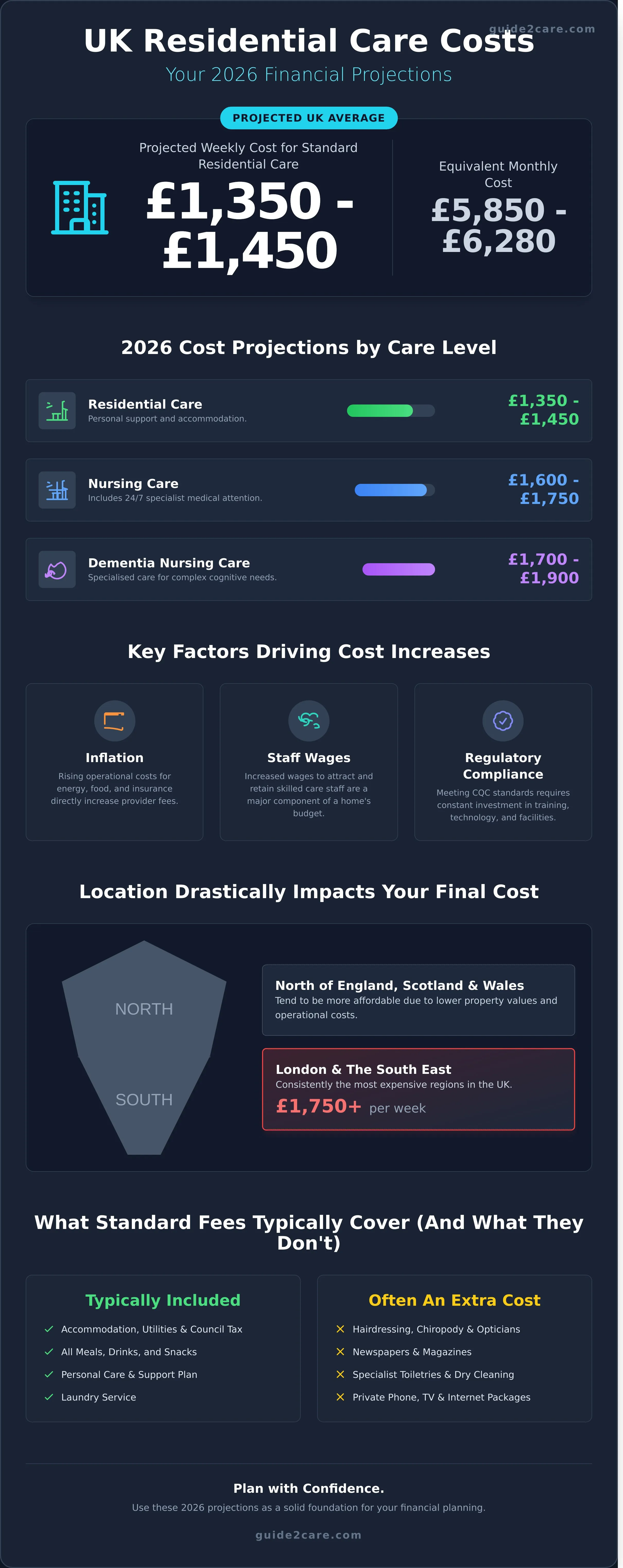
Planning for future care requires a clear understanding of potential expenses. Based on current market analysis and economic forecasts, the average cost of residential care in the UK is projected to rise significantly by 2026. We anticipate the weekly fee for a standard residential care home to be between £1,350 and £1,450. This equates to a monthly cost of approximately £5,850 to £6,280.
To better understand current pricing, which informs these future projections, watch this helpful video overview:
UK Average Cost Projections for 2026
The average cost of residential care uk 2026 will vary based on the level of support required. Costs differ significantly between standard residential care, which provides personal support, and nursing care, which includes specialist medical attention. The table below outlines the projected weekly figures for different types of care.
| Type of Care | Projected Average Weekly Cost (2026) |
|---|---|
| Residential Care | £1,350 - £1,450 |
| Nursing Care | £1,600 - £1,750 |
| Dementia Nursing Care | £1,700 - £1,900 |
Understanding Cost Trends: Why Fees Are Rising
Several key economic factors are driving the increase in care home fees towards 2026. Understanding these pressures helps explain why planning is essential.
- Inflation: Rising operational costs, including energy, food, and insurance, directly impact the fees charged by providers.
- Staff Wages: The care sector faces significant recruitment and retention challenges. Increased wages, driven by the National Living Wage and market competition, are a major component of a care home's budget.
- HR Strategy: To manage these complex staffing pressures, care home operators often turn to specialist consultancies. Firms like Pioneer HR provide the strategic support needed to handle recruitment, retention, and compliance, which are essential for running a sustainable care business.
- Regulatory Compliance: Meeting the standards set by bodies like the Care Quality Commission (CQC) requires ongoing investment in training, technology, and facilities, adding to overall costs.
Residential vs. Nursing Care: A 2026 Cost Comparison
Nursing care is consistently more expensive than residential care due to the specialist skills and resources required. A nursing home must have registered nurses on-site 24/7 to administer medication, manage complex health conditions, and operate medical equipment. This structural requirement is a core part of the Overview of UK Residential Care system. By 2026, weekly nursing care fees are projected to reach £1,600 to £1,750. A formal needs assessment from your local authority is crucial to determine the appropriate level of care, ensuring you only pay for the support you require.
How Location and Care Needs Drastically Impact Your Final Costs
While a national average provides a useful benchmark, it is only a starting point. The final price you pay for residential care is determined by two primary factors: where the home is located and the specific level of care required. Understanding these variables is essential when calculating the true average cost of residential care uk 2026 for your circumstances.
Regional Cost Breakdown: North vs. South Projections for 2026
A significant cost disparity exists across the UK, largely driven by regional differences in property values and staff wages. Homes in London and the South East are consistently the most expensive, while those in the North of England, Scotland, and Wales tend to be more affordable.
| Region | Projected Average Weekly Cost (2026) |
|---|---|
| London | £1,750+ |
| South East England | £1,650 |
| Scotland | £1,350 |
| Wales | £1,100 |
| North West England | £1,050 |
Note: These are projected estimates for standard residential care and can vary significantly between individual homes.
The Added Cost of Specialist Dementia and Palliative Care
The complexity of a resident's needs directly influences the cost. Individuals requiring specialist dementia, nursing, or palliative care will face higher fees. This is due to the need for higher staff-to-resident ratios, specially trained personnel, and often, more secure or adapted environments. A formal needs assessment, as outlined in the NHS guide to care home funding, will determine the exact level of support required. Expect specialist care to add approximately 15-25% to the standard residential fee.
The Role of Care Home Quality and Facilities
The quality of the care home itself is a key price factor. Homes rated 'Outstanding' by the Care Quality Commission (CQC) often command a premium. Likewise, the facilities on offer can increase costs significantly. Features such as private en-suite rooms, luxury dining options, beautifully maintained grounds, and extensive activity programmes all contribute to a higher weekly fee. It is important to balance the desired environment with your budget to find the right fit.
What's Included in Standard Care Home Fees (And What's Not)
To budget accurately for care, you must understand what the advertised weekly fee includes. The headline price covers a core package of services, but many costs are considered optional extras. A clear understanding of these distinctions is essential for long-term financial planning and helps clarify the true average cost of residential care uk 2026.
Standard Inclusions in Your Weekly Fee
Your weekly fee typically bundles together all essential living costs. This standard package ensures a resident's fundamental needs for accommodation, nutrition, and basic care are met. Always confirm the specifics with the home, but expect the following to be included:
- Accommodation & Utilities: A private, furnished room, including all heating, lighting, water, and council tax.
- Food & Drink: Three daily meals (breakfast, lunch, and dinner), plus snacks and drinks like tea, coffee, and juice.
- Housekeeping Services: Regular room cleaning and a standard in-house laundry service for personal clothing and bedding.
- Personal Care & Activities: Support with daily tasks like washing, dressing, and mobility, plus access to a programme of organised social activities within the home.
Common Extra Costs to Budget For
Beyond the standard fee, residents often pay for optional or specialised services. These extras allow for a more personalised lifestyle but must be factored into your budget to avoid surprises.
- Professional Services: Appointments with hairdressers, chiropodists, opticians, or private physiotherapists who visit the home.
- Personal Items: Daily or weekly newspapers, magazines, and specific premium-brand toiletries.
- In-Room Technology: Installation and use of a private phone line, dedicated Wi-Fi, or premium satellite TV packages.
- External Trips: Escorted trips for shopping, social outings, or non-emergency transport to and from hospital or GP appointments.
Reading the Fine Print: Checking Your Contract for Hidden Fees
The care home contract is a legally binding document that details all costs. Review it carefully before signing to understand your financial obligations fully. Look for specific clauses on fee increases, which can significantly impact the long-term average cost of residential care uk 2026. Pay close attention to:
- Annual Fee Increases: The contract must state when and by how much fees will rise each year. This is often linked to inflation, but the basis for any increase should be clear. Data from the Official UK Adult Social Care Finance Report highlights the financial pressures that influence these annual adjustments.
- Changes in Care Needs: Clarify how the fee will be adjusted if a resident’s health changes and they require more intensive nursing or dementia care in the future.
- Unlisted Services: If a service you require is not explicitly listed as included, assume it costs extra and request a full price list.
Funding Your Care: Self-Funding vs. Council Support in 2026
Understanding how to pay for residential care is a critical step in your planning. In the UK, there are two primary routes: funding the care yourself (self-funding) or receiving financial assistance from your local authority (council). Your eligibility for council support depends entirely on the outcome of a financial assessment, also known as a means test.
The Capital Thresholds Explained (England, Scotland, Wales, NI)
Your savings and assets, known as capital, determine if the council will help pay for your care. Each UK country has its own capital thresholds. These figures are for 2024/25 and are expected to be updated by 2026.
- Above the Upper Limit: You are considered a 'self-funder' and must pay for your care in full.
- Between the Limits: You will contribute to your care costs from your capital and income. The council pays the rest.
- Below the Lower Limit: Your capital is not included in the assessment, but you will still contribute from most of your income.
Current Upper/Lower Thresholds:
- England: £23,250 / £14,250
- Scotland: £32,750 / £20,250
- Wales: £50,000 (a single capital limit)
- Northern Ireland: £23,250 / £14,250
How Local Authority Funding Works
If your capital is below the upper threshold, the council will conduct a full financial assessment of your savings, investments, property, and income. If you are eligible for support, the council sets a 'personal budget'. This is the amount they will contribute towards your care, based on their standard rate. Should you choose a care home that costs more than this rate, a third party, such as a family member, can pay the difference through a 'top-up fee'. Understanding this process is vital when considering the average cost of residential care uk 2026.
Important Benefits and NHS Funding to Explore
Even if you are a self-funder, you may be eligible for financial support that is not means-tested. It is essential to check your eligibility for these streams, as they can significantly reduce the overall cost of care.
- Attendance Allowance: A tax-free benefit for people over State Pension age who need help with personal care due to illness or disability.
- NHS Continuing Healthcare (CHC): If your primary need for care is health-based, the NHS may cover the full cost of your residential care. This is based on a detailed assessment and is not dependent on your finances.
- NHS-funded Nursing Contribution (FNC): A weekly payment made directly to the care home for residents assessed as needing care from a registered nurse.
To understand these options in more detail, explore the funding resources on Guide2Care.
Strategic Planning for 2026 Care Costs
Understanding the data is the first step; the next is to create a clear, actionable plan. Proactive planning helps you manage costs, reduce future stress, and ensure the best possible care outcome. By preparing now, you can face the projected average cost of residential care uk 2026 with confidence and control. Follow these three essential steps to begin the process.
Step 1: Get a Free Care Needs Assessment
Your first official action is to arrange a care needs assessment through your local council. This assessment is free of charge and is not means-tested. Its purpose is to formally determine the specific level and type of care an individual requires. The outcome provides an official foundation for your care plan, whether it is funded by the local authority or paid for privately.
Step 2: Seek Independent Financial Advice
If you expect to self-fund your care, consulting a specialist financial advisor is a critical step. We recommend seeking an advisor accredited by the Society of Later Life Advisers (SOLLA). They provide expert guidance on the most effective ways to fund long-term care, including options such as:
- Care fee annuities
- Equity release schemes
- Investment management
This professional advice ensures your funds are structured to last as long as they are needed, providing peace of mind as you plan for the future average cost of residential care uk 2026.
For a broader perspective on funding later-life care, it's interesting to look at different national models. In the US, for instance, seniors often rely on specific health insurance programs. A specialized brokerage like The Modern Medicare Agency helps individuals navigate these complex systems, showcasing a different approach to managing healthcare expenses in retirement.
Different professions can also benefit from tailored financial guidance. For medical professionals, for example, specialist brokers like Doctors Mortgages can provide expert advice on managing property assets and mortgages, which is often a key component of long-term care funding strategies.
As part of this strategic planning, some also look into alternative retirement options, such as moving abroad where care and living costs can be substantially lower. For those curious about this path, you can explore Digital Guides that detail the process and benefits of retiring in destinations like Thailand.
Similarly, managing the logistics of a major downsize or handling an estate with international connections can be complex. Understanding the processes behind moving goods and personal effects is a key part of this planning. For those who need to navigate these logistical challenges, you can learn more about the intricacies of freight and shipping.
Step 3: Research and Compare Care Homes Early
Making a decision about residential care during a moment of crisis often leads to limited choices and immense pressure. Begin your research well in advance of any urgent need. Create a shortlist of potential homes in your preferred location, comparing their Care Quality Commission (CQC) ratings, facilities, and fee structures. A structured approach allows for a more considered and suitable choice.
A comprehensive directory simplifies this task. Find and compare local care homes using the Guide2Care directory.
Planning for 2026: Key Takeaways and Your Next Steps
Understanding the financial landscape of future care is the first step toward making a sound decision. As this guide has outlined, the average cost of residential care uk 2026 is set to increase, but this figure is heavily influenced by two key factors: geographical location and the specific level of care needed. Proactive planning, which includes a clear understanding of what standard fees cover and a thorough review of your funding options, is essential for navigating these costs effectively.
Armed with this knowledge, your next step is to explore specific options. Use the Guide2Care directory to find and compare care homes in your area. Our platform offers comprehensive UK-wide listings and a wealth of free, impartial information and guides. You can use our simple tools to filter by care type and location to create a tailored shortlist.
Finding the right care can feel complex, but with the right resources, you can approach the process with clarity and confidence.
Frequently Asked Questions
How much are care home fees expected to rise by 2026?
Care home fees typically rise annually, often above general inflation due to increasing staff wages and operational costs. Projections suggest a potential increase of 5-8% per year. By 2026, this could add a significant amount to the weekly cost. Understanding the average cost of residential care uk 2026 requires factoring in these consistent yearly increases. Always check a home's fee history and contract terms regarding future price rises before making a decision.
Will I definitely have to sell my family home to pay for care?
You do not automatically have to sell your home to pay for care. The value of your property is disregarded in the council's financial assessment if your spouse, partner, or a qualifying relative continues to live there. If you move into care permanently and no one eligible remains in the home, its value will likely be included. A deferred payment agreement may be an option to delay selling the property until a later date.
What is the difference in cost between residential care and live-in care?
Residential care provides accommodation and personal care in a dedicated facility, with average costs from £800 to £1,500 per week. Live-in care involves a professional carer living in your own home, providing one-to-one support. Live-in care costs typically start from £1,200 to £1,800 per week. For a couple, live-in care can be more cost-effective than two places in a residential home, which would be charged individually.
Can the council force me to move into a specific care home?
A council cannot force you into a specific care home. However, if the council is contributing to your fees, they must offer you at least one suitable option that accepts their funding rate. You have the right to choose a more expensive home, but the council will not pay more than their standard rate. The difference in cost, known as a top-up fee, must be paid by a third party, such as a family member.
What is a 'top-up fee' and who is responsible for paying it?
A 'top-up fee' is the difference between the amount the local council agrees to pay for your care and the actual fee charged by your chosen care home. This payment is required when you select a home that costs more than the council's standard rate. The person needing care cannot pay this fee from their own capital below the upper savings threshold. It must be paid by a third party, for example, a relative, friend, or charity.
How often do care homes increase their fees?
Most care homes review and increase their fees annually to cover rising costs like staff wages, food, and utilities. Your contract should clearly state how and when fees will be reviewed. The provider must give you reasonable advance notice in writing, typically at least 28 days, before any increase takes effect. It is essential to read the terms and conditions of your contract carefully to understand the policy on fee increases.