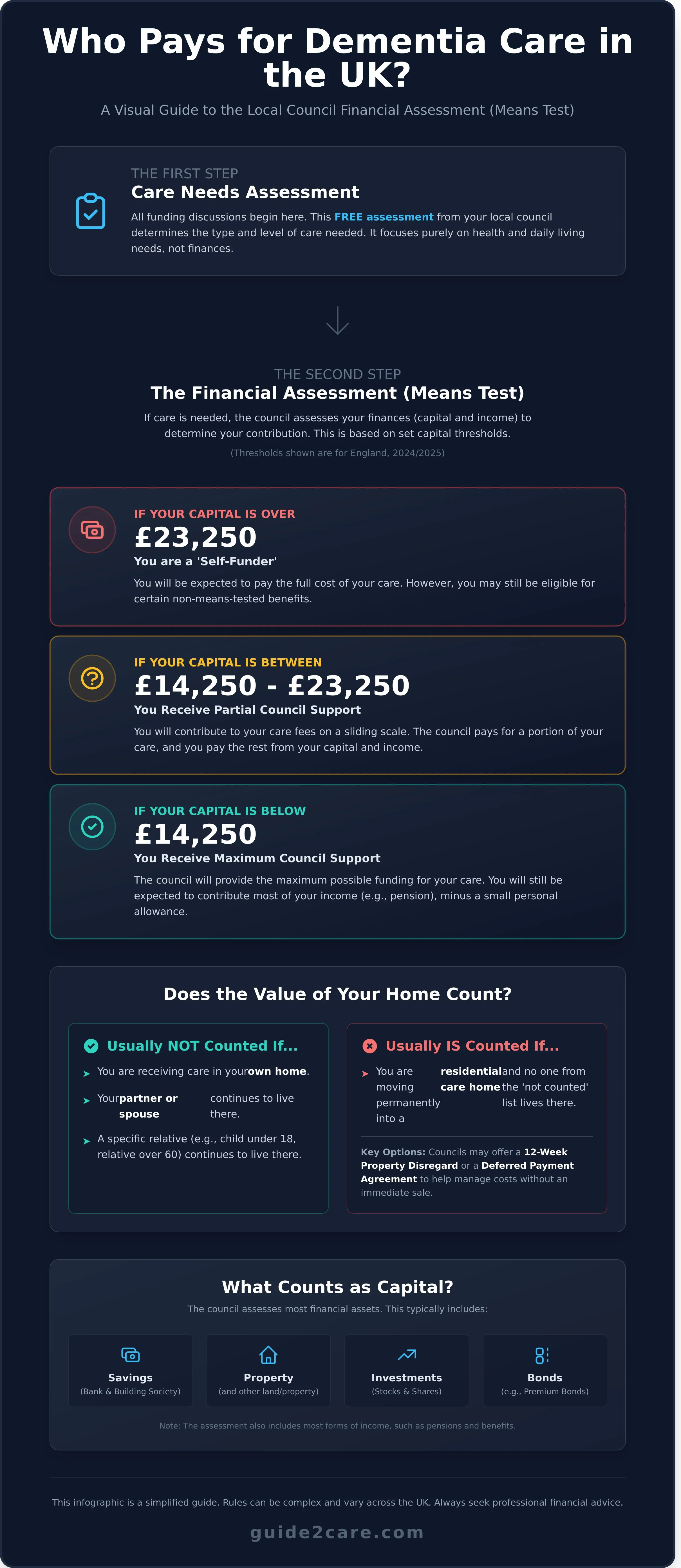
Who Pays for Dementia Care in the UK? A Complete Funding Guide

Arranging care for a loved one with dementia is a significant challenge, made more complex by the financial questions that follow. The system can seem confusing, and the question of who pays for dementia care UK often leads to worries about depleting savings or even selling the family home. It is easy to feel overwhelmed when you do not know where to turn for clear, reliable information.
This guide provides the answers you need. We break down the entire funding process into manageable steps. You will learn the crucial differences between NHS funding and local council support, what to expect from a needs and financial assessment, and how to apply for the help you are entitled to. We clarify when a home is considered in a means test and explore all potential funding sources, including state benefits, to give you a complete financial picture. Find the clarity you need to make informed decisions.
Key Takeaways
- Understand that all funding support begins with a free Care Needs Assessment from your local council.
- Learn the critical difference between means-tested council funding and non-means-tested NHS funding for dementia care.
- Discover how capital thresholds determine who pays for dementia care uk, defining whether you receive council support or are classed as a 'self-funder'.
- Identify key benefits and allowances you may be entitled to, even if you are not eligible for other types of funding.
The First Step: The Care Needs Assessment
Determining who pays for dementia care UK always begins with a formal assessment of need. Before any funding is discussed, the first step is to arrange a Care Needs Assessment through your local council. This process is completely free of charge. Its purpose is to officially document the specific help a person with dementia requires to live safely and maintain their quality of life, focusing entirely on care needs, not finances.
Understanding the potential costs is a key part of the journey. This video provides a helpful overview of dementia care costs in the UK.
What is a Care Needs Assessment?
A Care Needs Assessment is a professional evaluation of the daily challenges a person faces due to their dementia. A social worker or occupational therapist will speak with the individual and their family to build a complete picture of their situation. This collaborative approach is central to effective Dementia caregiving, ensuring all perspectives are considered. The assessment will typically cover:
- Personal Care: Help with washing, dressing, and eating.
- Mobility: Difficulties moving around the home safely.
- Household Tasks: Managing cooking, cleaning, and shopping.
- Safety: Risks such as falls, leaving the cooker on, or wandering.
- Social Needs: Maintaining relationships and accessing community activities.
To address safety concerns like wandering, families often look into technological aids. GPS trackers can be a particularly useful tool for providing peace of mind, with options for both personal use and vehicles. For instance, Letstrack offers various personal tracking devices, while UK-based installers like safeandsoundmobile.co.uk specialize in vehicle security solutions.
The outcome of this process is a formal 'care and support plan'. This document details the exact type and level of support the council has agreed the person needs.
While the funding and provider systems are different, it can be useful to see what specialized support looks like. For an example from Australia's disability care sector, you can check out Accessible Care.
How to Arrange an Assessment
To arrange a free assessment, you must contact the adult social services department of the relevant local council. You can find their contact details on the GOV.UK website. The request can be made by the person with dementia, a family member or carer, or a healthcare professional like a GP.
To prepare, it is useful to make notes beforehand. List all the daily tasks the person finds difficult and any concerns you have about their safety or wellbeing. This ensures you cover all important points during the assessment. This resulting care and support plan is the crucial document that forms the basis for the next step: the Financial Assessment.
The Financial Assessment (Means Test): Will the Council Pay?
If a needs assessment determines that a person requires paid support, the local council will then conduct a financial assessment, often called a means test. This process calculates how much the individual can afford to contribute towards the cost of their dementia care. The assessment examines two key areas: capital and income. The rules and thresholds for this test are a critical part of understanding who pays for dementia care uk.
Understanding the Capital Thresholds
Your local council uses capital thresholds to decide the level of funding you are eligible for. These limits vary across the UK. For 2024/2025 in England, the thresholds are:
- Upper Capital Limit: £23,250. If your capital is above this amount, you will be expected to pay for your care in full. This is known as being a 'self-funder'.
- Lower Capital Limit: £14,250. If your capital is below this amount, you will receive the maximum possible funding support from the council, though you will still contribute most of your income.
If your capital falls between these two figures, you will be expected to contribute to your care fees on a sliding scale.
Does the Value of Your Home Count?
For many, the value of their home is their largest asset. The property's value is generally included in the means test for residential care, but not for care at home. However, the home will not be counted if your partner, spouse, or a specific relative (such as a child under 18 or a relative over 60) will continue to live there. If you move into a care home, the council also offers a '12-week property disregard'. This gives you time to decide whether to sell the property without the value being included in your assessment. You may also be able to arrange a Deferred Payment Agreement, which is a loan from the council to cover care costs, repaid later from the sale of the home.
What Counts as Income and Capital?
The council assesses most of your financial assets. It is important to understand what is included. The rules, as detailed in official guides on NHS funding for dementia care, are specific.
Capital includes:
- Savings in bank or building society accounts
- Stocks, shares, and investments
- Any property or land you own (including overseas)
Income includes:
- State and private pensions
- Annuities and other regular payments
- Most welfare benefits, such as Attendance Allowance
Some benefits, like the mobility component of Personal Independence Payment (PIP), are disregarded and not counted as income.
NHS Funding for Dementia Care: When the Health Service Pays
In certain situations, the NHS has a responsibility to pay for an individual's care. This is a crucial point for anyone asking who pays for dementia care UK-wide. NHS funding is entirely separate from local council social care support and is not means-tested. Eligibility is based solely on a person's health and care needs, not their financial situation.
This type of funding is provided when an individual's primary need for care is a health need. There are two main types of NHS funding available for people with dementia.
Understanding the full extent of an individual's health profile, including risks for conditions like stroke or heart disease, can be crucial in these assessments. For those looking to get a clearer picture of underlying health markers through preventive screenings, click here to learn more about available options.
NHS Continuing Healthcare (CHC)
NHS Continuing Healthcare (CHC) is a package of care arranged and funded solely by the NHS. It is for adults with long-term, complex health needs who are assessed as having a 'primary health need'. In the context of dementia, this means the individual's care needs are driven by their health condition, involving factors like intensity, complexity, or unpredictability that go beyond what a local authority would typically provide. If eligible, CHC covers 100% of care costs, including care home fees or care at home.
NHS-Funded Nursing Care (FNC)
NHS-Funded Nursing Care (FNC) is a weekly payment from the NHS to help cover the costs of nursing care from a registered nurse. It is only available to people living in a care home that provides nursing care. Unlike CHC, FNC is a contribution, not a full payment of fees. The NHS pays a flat rate directly to the care home. For 2024/2025 in England, the standard rate is £235.82 per week. Rates may differ in other UK nations.
How to Get Assessed for NHS Funding
Accessing NHS funding requires a formal assessment process. It is the key step in determining whether the NHS will contribute to or fully cover care costs.
- The CHC Checklist: This is a simple screening tool used by a nurse, doctor, or social worker to see if a full assessment is required.
- The Full Assessment: If the checklist suggests you may be eligible, a multidisciplinary team (MDT) will carry out a full assessment using a framework called the 'Decision Support Tool' (DST).
During the assessment, it is vital to provide detailed evidence of the individual's health needs. This includes medical records, care plans, and daily diaries that demonstrate the complexity and intensity of their condition. A thorough and accurate picture is essential for the assessment team to make the right decision.
Self-Funding: Paying for Care When You Are Over the Threshold
If your capital, such as savings and property, is above the upper threshold (£23,250 in England), you are classified as a 'self-funder'. This means you are responsible for arranging and paying for your dementia care in full. Understanding this is a key part of the answer to who pays for dementia care UK for thousands of families.
Even as a self-funder, you retain important rights. You are still entitled to a free care needs assessment from your local council to identify the level of support required. The council can also provide information and help you arrange care services, ensuring you find suitable options.
Common Ways to Pay for Care
Self-funders use a combination of income and capital to meet care costs. Common sources include:
- Regular Income: This includes the State Pension, private or workplace pensions, and any disability benefits you are entitled to, such as Attendance Allowance.
- Savings and Investments: Funds from ISAs, premium bonds, shares, and other investments can be used to pay for care fees.
- Immediate Needs Annuity: This is a specialist financial product bought with a lump sum. It guarantees a regular income for life to help cover care costs, providing peace of mind.
This process of evaluating assets often leads families to conduct a broader review of their financial planning. Ensuring that long-term provisions like life insurance are in place can provide peace of mind for the future. For those exploring these options, independent resources like LifeInsure.com offer a starting point for understanding policies without needing to submit personal information.
Options Involving Your Property
For many homeowners, the value of their property is a significant asset. There are regulated financial products designed to help fund long-term care.
An Equity Release scheme allows you to access some of the tax-free cash tied up in your home. The loan and interest are typically repaid from the sale of your property later on. A Deferred Payment Agreement (DPA) is a loan from your local council, which they secure against your home. The council pays a portion of your care home fees, and the loan is repaid when the house is sold. It is vital to seek independent financial advice before committing to any of these options.
What Happens if Your Savings Run Out?
You will not be left without care if your capital is depleted. Once your savings and assets fall below the upper funding threshold, you can apply to your local council for financial support. The council will then conduct a financial assessment and, if you are eligible, will begin to pay towards your care.
It is important to note that the council will pay its standard rate for care. This may be less than you were paying as a self-funder. This could mean moving to a more affordable care home that accepts the council rate or arranging for a third party, such as a family member, to pay a 'top-up fee' to cover the shortfall.
Explore your care options and find detailed funding information at guide2care.com.
Additional Financial Help: Benefits and Allowances
When considering who pays for dementia care UK, it is essential to look beyond council funding. Several state benefits and allowances can provide extra financial support, and many are available regardless of your income or savings. These tax-free payments are made directly to the individual with dementia to help cover the additional costs associated with their condition or to contribute towards care fees.
These benefits are often under-claimed. It is vital to check eligibility for all available support to ensure you are receiving the help you are entitled to.
Attendance Allowance
Attendance Allowance is for individuals over State Pension age who need help with personal care or supervision because of an illness or disability, including dementia. It is not means-tested and is paid at two different weekly rates depending on the level of support required:
- Lower Rate: Awarded if you need frequent help or constant supervision during the day, or supervision at night.
- Higher Rate: Awarded if you need help or supervision throughout both the day and night.
Personal Independence Payment (PIP)
For those under State Pension age, the equivalent benefit is the Personal Independence Payment (PIP). Like Attendance Allowance, PIP is not means-tested and is designed to help with the extra costs of a long-term health condition. It has two components:
- A daily living component for assistance with everyday tasks.
- A mobility component for help with getting around.
When a person receiving PIP reaches State Pension age, they will typically be invited to claim Attendance Allowance instead.
Council Tax Reductions
Your household may be eligible for a significant reduction in your Council Tax bill. A person who is medically certified as being 'severely mentally impaired' (SMI), which includes many people with dementia, is disregarded for Council Tax purposes. To qualify, they must also be receiving a specific benefit, such as Attendance Allowance or PIP.
This can lead to a 25% discount if they live with one other adult, or a 100% exemption if they live alone. To apply, you must contact your local council. Furthermore, if one partner moves permanently into a care home, the partner remaining at home can apply for a 25% single person discount.
Navigating the benefits system can be complex. Find clear guidance and explore your options on Guide2Care to ensure you find the care you need.
Your Next Steps: From Funding to Finding Care
Navigating the financial landscape of dementia care is a significant challenge. The crucial question of who pays for dementia care uk ultimately depends on a person's specific health needs and financial situation. The process begins with a Care Needs Assessment, which then leads to a financial means test. This determines whether the local council or NHS will contribute, or if you will be self-funding. Remember that various benefits and allowances may also be available to provide extra support, regardless of your savings.
With a clear view of the financial route ahead, the next step is to locate the right support. Once you understand your funding options, find local dementia care providers on Guide2Care. Our comprehensive, UK-wide directory is built to help you make an informed decision. Explore and compare CQC-rated care homes and services with the information you need at your fingertips. Taking this practical step puts you in control of finding the right care solution.
Frequently Asked Questions
Do you have to sell your home to pay for dementia care in the UK?
Not always. The value of your home is disregarded in the financial assessment if your partner, a relative over 60, or a disabled relative still lives there. For care in a residential home, the property's value is also ignored for the first 12 weeks of care. If you receive care at home (domiciliary care), the value of your main home is never included in the means test, which is a key factor in determining who pays for dementia care UK.
What happens if a self-funder runs out of money while in a care home?
If your capital drops below the upper threshold (£23,250 in England), you should contact your local authority for a needs and financial assessment. The council will then determine its contribution towards your fees. You will not be made homeless. However, if the council's funding rate is lower than your care home's fees, you may need a third-party top-up fee or have to discuss moving to a more affordable home that meets your needs.
Can the council force someone with dementia to move into a care home?
A council cannot force someone into a care home if they have the mental capacity to decide where they live. If an individual lacks capacity, any decision must be made in their 'best interests' under the Mental Capacity Act. This involves social workers, medical professionals, and family. A move to residential care is only considered if it is the least restrictive option required to meet their care and safety needs and keep them from harm.
How are finances assessed for a couple if one partner needs care?
The financial assessment focuses only on the assets and income of the person needing care. This includes their personal savings and 50% of any jointly held savings. The income and savings of the partner remaining at home are not included. The value of a jointly owned property is completely disregarded if the other partner continues to live in it, ensuring they are not forced to sell the home to fund their partner's care.
Is dementia care funding different in Scotland, Wales, or Northern Ireland?
Yes, the rules for dementia care funding vary significantly across the devolved nations. In Scotland, personal and nursing care is free for those assessed as needing it. Wales has a single, more generous capital limit for residential care funding. Northern Ireland operates its own distinct set of capital thresholds and charging policies. Always check the specific regulations for the country where the care is being provided to understand how funding works; similarly, foreigners moving to other regions like the Schengen Area need to secure specific health coverage, often available through providers like Insurance VISA.
What are 'top-up fees' for care homes and who pays them?
A top-up fee is an additional payment to cover the difference between the local authority's standard funding rate and the fees of a more expensive care home. This fee cannot be paid by the resident from their own capital if their assets are below the upper threshold (£23,250 in England). It must be paid by a third party, such as a family member or a charity, who must sign an agreement confirming they can sustainably meet the cost.