Local Authority Funding for Care Homes: A Simple Step-by-Step Guide

Navigating the process for council-funded care can seem overwhelming. The system is often filled with complex jargon, and financial worries, such as having to sell a family home, are common. This guide is designed to provide clarity. Here, you will find local authority funding for care homes explained in simple, direct terms. It provides the essential information you need to understand the system and make informed decisions for your relative.
Yes, help is available for completing the financial assessment forms. Your local council's social services department can provide guidance, and for independent support, you can contact organisations such as Age UK or Citizens Advice. For managing personal finances more broadly during such a complex time, using a comparison platform like RatesChaser can also be beneficial for finding competitive rates on various products.
This step-by-step guide breaks down the entire journey. We cover the initial needs assessment, the crucial financial assessment (means test), and the current capital limits in England, Scotland, Wales, and Northern Ireland. By the end, you will have a clear checklist of actions, understand how property is treated, and feel more confident in securing the financial support available. Find the information you need to move forward.
Key Takeaways
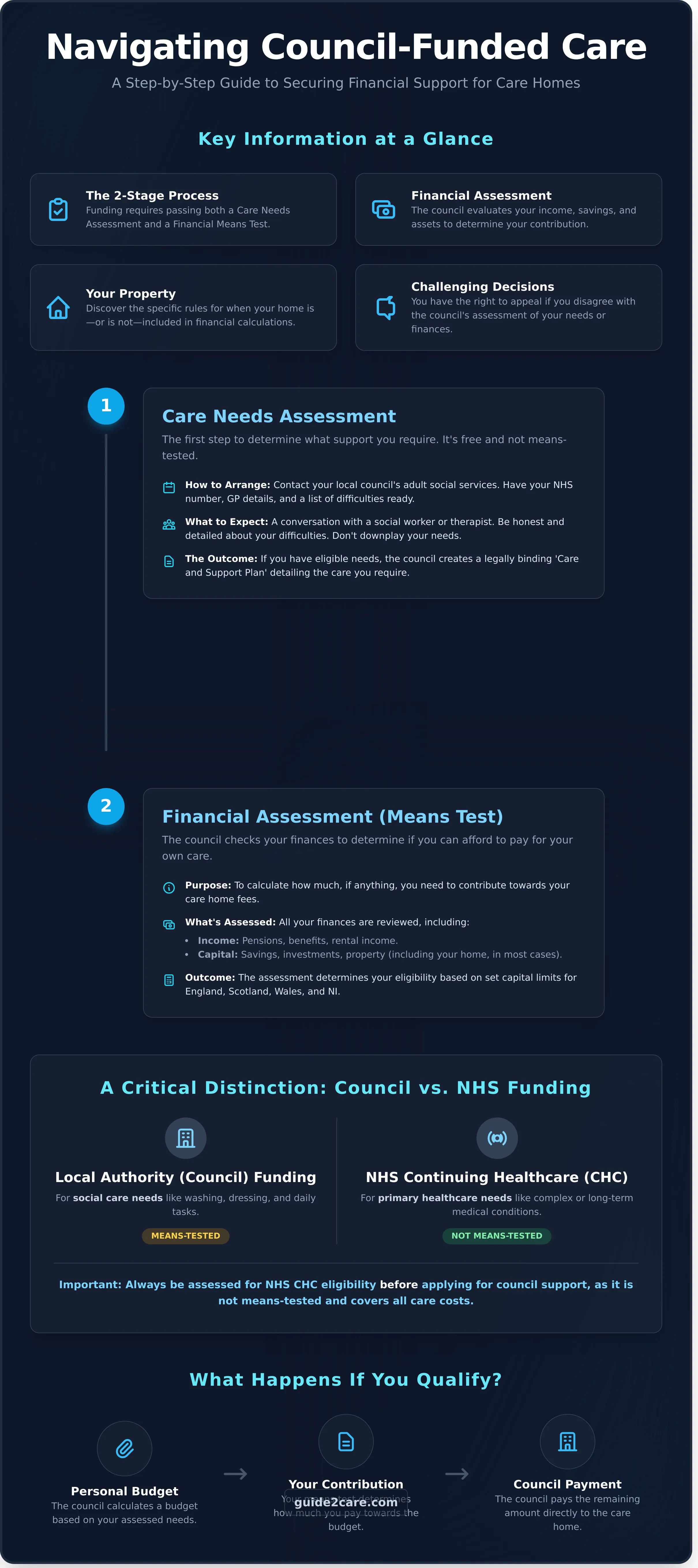
- Understand the two-stage process for council funding, starting with a Care Needs Assessment to establish your support requirements.
- With local authority funding for care homes explained, you can learn how the council assesses your capital and income in a financial 'means test'.
- Discover the specific rules regarding your property and when it is, or is not, included in the council's financial calculations.
- Learn the steps to take if you disagree with the council's decision about your eligibility for funding or the level of support offered.
What Is Local Authority Funding and Who Can Get It?
Local authority funding is financial support provided by your local council to help cover the costs of care. If you need to move into a care home but cannot afford the fees, your council may be able to help pay for some or all of the costs. This support is a key component of the system of Social care in England and is governed by the Care Act 2014.
To have local authority funding for care homes explained simply, eligibility depends on two main criteria: your care needs and your financial situation. You must be assessed as having eligible care needs and your income and capital must fall below specific financial thresholds. This is different from NHS Continuing Healthcare, which is full funding for primary health needs and is not means-tested.
This video provides a clear overview of how the funding works:
The Two Main Eligibility Tests
To qualify for council funding, you must pass two separate assessments. You will only be offered financial support if you meet the criteria for both.
- Care Needs Assessment: Your local council will first assess your care needs to determine what level of support is required. They must conclude that your needs are significant enough to warrant care in a residential setting.
- Financial Means Test: The council will then evaluate your finances, including your income, savings, and assets (capital), to see if you can afford to pay for your own care. There are set capital limits, which change annually.
Local Authority vs. NHS Funding: A Key Distinction
It is important to understand the difference between council funding and NHS funding. Local authority funding is for social care needs, such as help with washing, dressing, and day-to-day tasks. In contrast, NHS Continuing Healthcare (CHC) is for primary healthcare needs, such as managing a complex or long-term medical condition.
Because NHS funding is not means-tested and covers all care costs, you should always be assessed for CHC eligibility before you apply for council support.
Step 1: The Care Needs Assessment - Proving You Need Support
The first official step to securing council support is the Care Needs Assessment. This is a free assessment conducted by your local authority to determine your specific care requirements. It is not a test of your finances; its sole purpose is to establish what help you need to live safely and independently. This applies whether you need support in your own home or are considering moving into a care home. Anyone can request one, regardless of their income or savings, making it the essential starting point for anyone seeking support.
How to Arrange a Care Needs Assessment
To begin, contact the adult social services department of your local council. You can usually do this by phone or by completing an online form on the council's website. You can request this for yourself, or a family member or GP can do it on your behalf with your permission. To make the process efficient, have key information ready:
- Your NHS number
- Your GP's name and surgery address
- A list of any current health conditions or medications
- A summary of the daily tasks you find difficult
What to Expect During the Assessment
The assessment is a structured conversation, typically with a social worker or an occupational therapist. They will ask about your ability to manage daily living activities, such as washing, dressing, cooking, and mobility. They will also consider your physical, mental, and emotional wellbeing. Be as honest and detailed as possible. It is vital not to downplay your difficulties, as this assessment determines the level of support you could receive. You can have a friend or family member with you for support during the conversation.
Understanding the Outcome: Your Care and Support Plan
If the assessment shows you have eligible needs under the Care Act 2014, the council will create a legally binding 'Care and Support Plan'. This document outlines the specific type and amount of care required to meet those needs. This plan is crucial, as it forms the basis for the next stage. The council uses it to calculate a personal budget before conducting a financial assessment (means test) to determine your contribution. This is a critical document in the process of getting local authority funding for care homes explained and approved.
Step 2: The Financial Assessment (Means Test) - How Your Finances Are Checked
Once the council agrees you need care, they conduct a financial assessment, often called a 'means test'. This process determines if you need to contribute towards the cost of your care home and by how much. For many families, this is the most complex stage, and understanding it is central to having local authority funding for care homes explained correctly. The assessment looks at both your capital (e.g., savings, property) and your income (e.g., pensions). While the rules are set nationally, your local council is responsible for managing the assessment. For a detailed breakdown, you can review Age UK's guide to paying for a care home.
Understanding the Capital Limits (England 2024/25)
In England, your eligibility for financial support depends on where your total capital falls in relation to set thresholds. These figures are for the 2024/25 financial year.
| Your Capital Level | Funding Outcome |
|---|---|
| Over £23,250 | You are considered a 'self-funder' and will pay for your care in full. |
| Between £14,250 and £23,250 | You will receive partial council funding but must contribute from your capital and income. This contribution is calculated on a sliding scale. |
| Under £14,250 | You will receive the maximum possible funding from the council. Your contribution will be calculated from your income only. |
If your capital is between the thresholds, you will contribute £1 per week for every £250 of capital you have over the lower limit of £14,250. This is known as 'tariff income'.
What Counts as Capital and Income?
The council assesses both your capital and income. It is important to know what is included:
- Capital: This includes money in bank and building society accounts, stocks and shares, and any property or land you own (including your main home, in certain circumstances).
- Income: This covers your state pension, private or occupational pensions, and most benefits, such as Attendance Allowance or Pension Credit.
Your main home is not included in the capital assessment if your partner, a relative over 60, or a disabled relative continues to live there.
Deliberate Deprivation of Assets: What You Must Avoid
You must not intentionally reduce your assets to avoid paying for care and qualify for funding. This is called 'deliberate deprivation of assets'. The council will check your financial history for unusual activity. Examples include:
- Giving away large sums of money as gifts.
- Selling a property for significantly less than its market value.
- Spending extravagantly on non-essential items like expensive holidays or cars.
To ensure a property is sold at the correct market value and avoid any accusations of deliberate deprivation, getting a formal valuation is essential. To see how RICS-regulated surveys establish an accurate figure for the financial assessment, you can visit South Surveyors.
If the council decides you have deliberately deprived yourself of assets, they can include the value of those assets in your financial assessment as if you still owned them.
What Happens If You Qualify? Budgets, Payments, and Choosing a Home
Once the local authority confirms you are eligible for funding, the process moves to establishing how your care will be paid for. The council will determine a 'personal budget' based on your care needs assessment. This figure represents the weekly amount the council will contribute towards the cost of your care. Importantly, you still retain control and choice over where you live, even with council support.
Your Personal Budget and Direct Payments
Your personal budget is the total sum the council allocates to meet your assessed needs. This funding can be managed in two primary ways:
- Council-Arranged Care: This is the most common route for residential care. The council pays the care home directly from your personal budget. You will contribute any assessed amount from your own income.
- Direct Payments: The council pays the personal budget directly into a dedicated bank account for you (or a nominated person). You are then responsible for arranging and paying the care home yourself. This option provides more control but also more administrative responsibility.
Understanding Care Home 'Top-Up Fees'
You may prefer a care home where the weekly fees are higher than your personal budget. In this situation, the difference must be paid by a third party, such as a family member or charity. This is known as a 'top-up fee' or 'third-party contribution'. The resident cannot pay this from their own capital if their savings are below the upper threshold. Understanding this arrangement is a key part of having local authority funding for care homes explained properly. The council must always offer you at least one suitable care home option that is fully covered by your personal budget.
Choosing a Care Home with Council Funding
Receiving council support does not remove your right to choose. You can choose any care home in any part of the UK, provided it meets three key conditions:
- It is suitable for your assessed care needs.
- It does not cost more than your personal budget allows, or a formal third-party top-up fee agreement is in place to cover the shortfall.
- The home is willing to accept the council's funding terms and conditions.
The stability and ownership of a care home can also be a factor in your decision. The market for these facilities is a specialized area of real estate. For instance, in the US, firms like the Assisted Living Real Estate Group focus exclusively on these transactions, ensuring continuity of care when ownership changes.
To begin your search and identify suitable options in your area, you can search for care homes that accept local authority funding on our directory.
Key Scenarios: Selling the Home and Challenging Decisions
When navigating council support, two issues often cause the most stress: the potential sale of a family home and what to do if you disagree with a decision. Understanding your rights is a key part of having local authority funding for care homes explained properly. This section provides clear, practical steps for these common scenarios.
Do I Have to Sell My Home to Pay for Care?
You may not need to sell your home immediately, or at all. The council provides certain protections to give you time and options.
- 12-Week Property Disregard: For the first 12 weeks of permanent residential care, the council must ignore the value of your property in the financial assessment. This provides a breathing space to decide on the best course of action, such as selling the property or arranging a Deferred Payment Agreement.
- Deferred Payment Agreement (DPA): This scheme allows you to delay paying care home fees. The council pays the fees on your behalf and secures the amount as a loan against your property. The debt is then repaid when the property is sold, often after the resident has passed away. You must meet certain eligibility criteria to access this scheme.
- Automatic Exemptions: Your property will not be included in the financial assessment at all if it is still occupied by your spouse, partner, or a specific qualifying relative (such as a relative over 60 or one who is incapacitated).
How to Appeal a Council's Decision
If you disagree with the council's decision regarding your care, you have the right to challenge it. This could relate to the outcome of your needs assessment, the details of your financial assessment, or the suitability of the proposed care plan.
The process involves two main steps:
- Make a Formal Complaint: The first step is to use the council’s official complaints procedure. Submit your complaint in writing, clearly stating which decision you are appealing and providing evidence to support your position. The council must then investigate and provide a formal response.
- Contact the Ombudsman: If you are not satisfied with the council's final response, you can escalate your case to the Local Government and Social Care Ombudsman (LGSCO). The LGSCO is an independent body that investigates complaints about councils in England. They can review your case and recommend a resolution if they find the council acted incorrectly.
For more resources on navigating the care system, explore Guide2Care to find the information you need.
Navigating any complex process, whether for local care or international travel, is easier with the right tools. For instance, those planning travel in West Africa can discover Casa Ferry to simplify booking ferry tickets in Senegal.
Your Next Steps for Care Home Funding
Securing council support for care follows a clear, structured process. It always begins with a care needs assessment to officially confirm your requirement for support. Only then does the council conduct a financial assessment, or means test, to determine your eligibility for funding. With these core steps of local authority funding for care homes explained, you are now equipped to navigate the system effectively.
The next practical step is to identify care homes that accept local authority rates and meet your specific needs. Guide2Care is designed to make this process efficient. Our comprehensive UK-wide directory provides the clear, impartial information you need to compare providers. Use our straightforward tools to filter your search by funding type, required level of care, and location, ensuring you find a suitable match for your budget and personal circumstances.
Start your search today. Find care homes in your area that meet your needs and budget. Arming yourself with the right information allows you to move forward with confidence.
Frequently Asked Questions
How long does the entire funding application process take?
The timeframe for a funding application varies between local authorities. Typically, the process can take several weeks to a few months. It involves two key stages: a care needs assessment to determine your care requirements, followed by a financial assessment to evaluate your eligibility for support. Contact your local council's adult social services department directly for their specific timelines. Proactive communication can help ensure the process runs smoothly.
What is the difference between local authority funding in England, Scotland, and Wales?
The main differences relate to capital limits and personal care contributions. In England, the upper capital limit is £23,250. Wales has a single capital limit of £50,000, while Scotland has an upper limit of £32,750. A key distinction is that Scotland offers Free Personal and Nursing Care to eligible adults. Our guide on local authority funding for care homes explained in detail covers these regional variations to help you understand the rules where you live.
Does council funding cover nursing care costs in a care home?
Council funding typically covers the costs of accommodation and personal care, such as help with washing and dressing. It does not usually cover costs for nursing care provided by a registered nurse. This specific element is often funded separately by the NHS. In England and Wales, this is called NHS-funded Nursing Care (FNC). In Scotland, it is included as part of the Free Personal and Nursing Care package for eligible individuals.
Can the council force me to move to a different care home?
A council cannot force you to move if your chosen care home meets your assessed needs and a funding agreement is possible. The council must offer you at least one suitable option that accepts their standard rate. If your preferred home costs more than this rate, you can stay if a third party, such as a family member, agrees to pay the difference in a 'top-up fee'. The council must ensure the arrangement is sustainable.
What happens if my savings run out while I am self-funding?
If your savings are likely to fall below the upper capital limit (£23,250 in England), you must contact your local council well in advance. Do not wait until the money has run out. The council will then conduct a needs and financial assessment to determine if you are eligible for funding. This ensures a smooth transition from self-funding to council support without any disruption to your care arrangements.
Can I get help with filling out the financial assessment forms?
This principle of seeking expert guidance applies to other complex administrative undertakings as well. For instance, entrepreneurs looking to navigate the regulations of setting up a business in a new jurisdiction, such as the UAE, can explore Company Formation Services to ensure a smooth process.