NHS Continuing Healthcare Eligibility Criteria: A Complete 2026 Guide

Navigating the NHS care funding system is a complex task. The process is filled with specific terminology, from Integrated Care Boards (ICBs) to Decision Support Tools (DSTs), which can create confusion and anxiety. Understanding the official NHS continuing healthcare eligibility criteria is the most critical step toward securing the funding a loved one may be entitled to. This can often feel like the biggest barrier, leaving many unsure if a person's condition even qualifies for consideration.
This complete 2026 guide is designed to provide clarity. We will walk you through each stage of the assessment process in plain English. You will learn the key differences between a health need and a social care need, how to prepare the right evidence to build a strong case, and what your options are if an application is unsuccessful. Use this guide to prepare for the process and find the information you need to move forward with confidence.
Key Takeaways
- Understand the core NHS continuing healthcare eligibility criteria, which are based on proving a 'primary health need' across 12 care domains.
- Get a clear, step-by-step guide to the CHC assessment process, from the initial checklist to the final decision.
- Discover practical tips on how to prepare for the assessment and advocate effectively for yourself or a loved one.
- Identify your options for funding care if you do not meet the high threshold for full CHC funding.
What is NHS Continuing Healthcare? The Core Principles
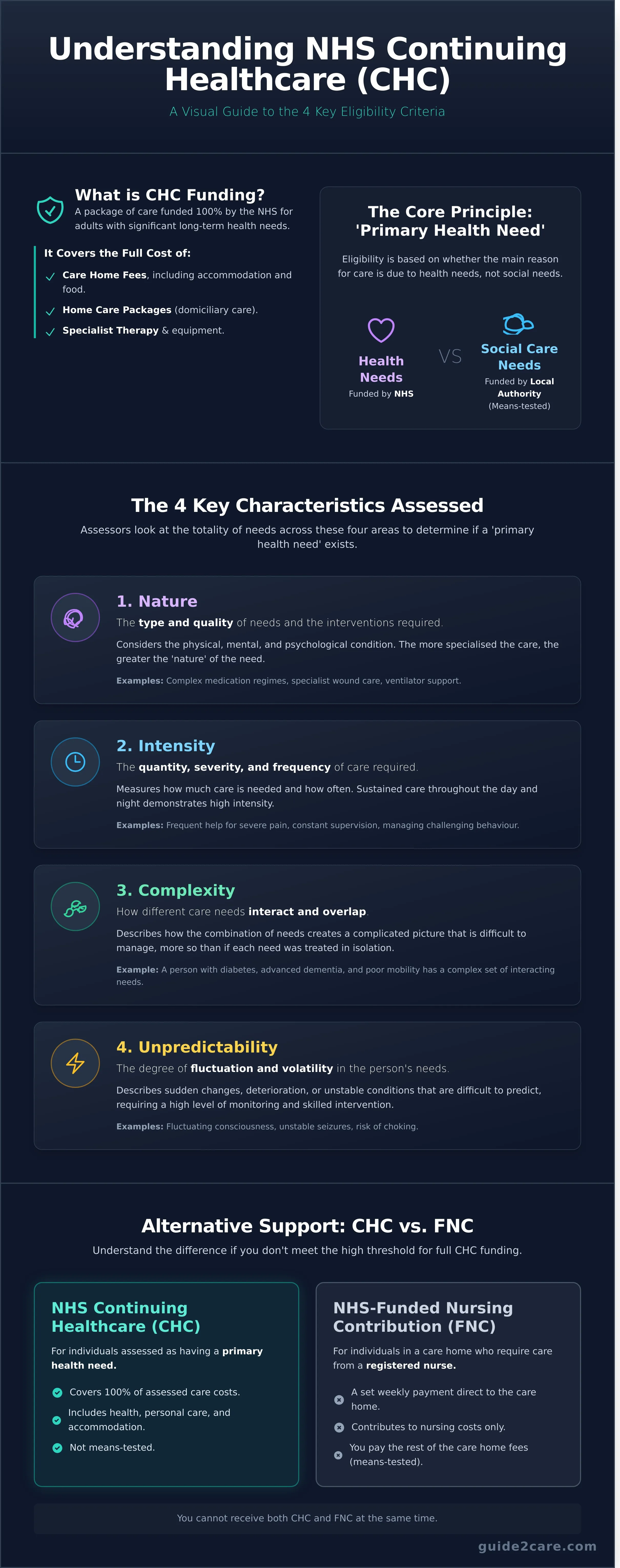
NHS Continuing Healthcare (CHC) is a package of ongoing care arranged and funded solely by the National Health Service (NHS) for adults with significant long-term health needs. It is often called "fully funded NHS care" because it covers the full cost of an individual's health and personal care. Understanding these core principles is the first step in navigating the NHS continuing healthcare eligibility criteria.
To better understand this concept, watch this helpful video:
The central principle of CHC is the concept of a 'primary health need'. This means the main reason you require care is due to your health needs, rather than social care needs. This distinction is crucial because healthcare needs are the responsibility of the NHS, while social care needs (such as help with personal care or domestic tasks) are funded by the local authority and are means-tested. For a detailed background, you can explore What is NHS Continuing Healthcare? to understand its history and legal framework.
If an assessment determines you have a primary health need, the NHS will fund all of your assessed health and social care. A successful CHC award covers 100% of these costs, which can include:
- Full care home fees, including accommodation and food.
- Care packages to support you in your own home (domiciliary care).
- Specialist therapy and equipment required to manage your needs.
Crucially, eligibility is based on your assessed needs, not on a specific disease or diagnosis. Having a condition like dementia, a stroke, or Parkinson's disease does not automatically make you eligible for CHC funding.
Who is CHC for?
CHC is for adults aged 18 and over with long-term, complex, and intense or unpredictable health needs. Eligibility is determined solely through a detailed assessment process, not by an individual's financial situation. Children and young people under 18 may receive a similar package of support called 'Continuing Care', which operates under a separate framework.
CHC vs. NHS-funded Nursing Contribution (FNC)
Do not confuse CHC with NHS-funded Nursing Contribution (FNC). FNC is a set weekly payment from the NHS directly to a care home to support the costs of care provided by a registered nurse. It is for individuals who require nursing care but do not meet the full NHS continuing healthcare eligibility criteria. An individual cannot receive both CHC and FNC at the same time.
The 4 Key Eligibility Criteria Explained in Detail
To qualify for CHC funding, an individual must be assessed as having a 'primary health need'. This is not determined by a particular diagnosis but by the overall picture of their care requirements. Assessors use the NHS continuing healthcare eligibility criteria to evaluate this need across 12 'care domains', focusing on four key characteristics. It is vital to understand that assessors look at the totality of needs and how these characteristics interact.
Nature: The Type of Needs
'Nature' describes the quality and type of the individual's needs and the interventions required to meet them. It considers the person's physical, mental, and psychological condition. Practical examples include the need for complex medication regimes administered by a clinician, specialist wound care for pressure sores, or breathing support from a ventilator. The more specialised the care required, the greater the 'nature' of the need.
Intensity: The Amount and Frequency of Care
'Intensity' relates to the quantity, severity, and continuity of care required. It measures how much care is needed and how often. A person may have intense needs if they require frequent interventions to manage severe pain or challenging behaviour. Sustained care required throughout the day and night to prevent a condition from deteriorating also demonstrates a high level of intensity.
Complexity: The Interaction of Needs
'Complexity' refers to how different care needs interact with each other to create a complicated overall picture. This can make the needs difficult to manage. For example, a person with diabetes, advanced dementia, and poor mobility has a complex set of needs. The combination of these conditions makes their care far more difficult than managing each issue in isolation. The official NHS website provides further guidance on how the four key eligibility characteristics are explained and applied during an assessment.
Unpredictability: The Volatility of Needs
'Unpredictability' describes sudden changes or fluctuations in a person's condition that are difficult to predict. This creates challenges in managing care, as it requires constant monitoring and a rapid, skilled response to prevent crises. Examples include a high risk of choking, frequent falls due to an unstable medical condition, or a volatile condition that could deteriorate quickly without immediate clinical intervention.
The CHC Assessment Process: A Step-by-Step Walkthrough
Navigating the journey to secure NHS Continuing Healthcare funding involves a structured, multi-stage process. Your local Integrated Care Board (ICB) is responsible for managing this process, but the assessment itself is carried out by healthcare professionals. The entire framework is detailed in the official government guidance on The CHC Assessment Process. Throughout each stage, your involvement, and that of your family or advocate, is vital to ensure a complete picture of your needs is presented. Timelines can vary, but the standard process typically takes around three months from referral to decision.
Stage 1: The Initial Checklist
The first step is a screening tool called the CHC Checklist. It is not an assessment of eligibility but determines if you require a full assessment. A nurse, social worker, or other qualified health or social care professional can complete this tool. It reviews 11 care domains to gain a high-level view of your needs. A positive Checklist indicates you should proceed to the next stage; a negative result means you do not currently qualify for a full assessment.
Stage 2: The Full Assessment & Decision Support Tool (DST)
If the Checklist is positive, a full assessment is arranged. This is conducted by a multidisciplinary team (MDT) comprising at least two professionals from different disciplines, such as a nurse and a social worker. The MDT uses the Decision Support Tool (DST) to build a comprehensive picture of your needs across 12 domains, including behaviour, cognition, and mobility. Each domain is assigned a level of need: 'Priority', 'Severe', 'High', 'Moderate', 'Low' or 'No Needs'. The MDT then makes a recommendation to the ICB on whether the NHS continuing healthcare eligibility criteria have been met based on the nature, intensity, complexity, and unpredictability of your overall needs.
The Fast-Track Pathway
A separate, quicker process exists for individuals with a rapidly deteriorating condition who may be entering a terminal phase. The Fast-Track Pathway Tool is used in these specific circumstances to ensure care is arranged urgently. This pathway bypasses the Checklist and DST stages. A clinician must complete the tool, stating that the person has a primary health need arising from their condition. The ICB must then accept this and arrange a care package promptly.
How to Prepare for the Assessment and Advocate Effectively
Thorough preparation is essential for the NHS Continuing Healthcare (CHC) assessment. A well-prepared case ensures the multidisciplinary team has a complete and accurate understanding of the individual's care needs. This section provides practical steps to help you present a clear picture and advocate effectively during the process.
Start by keeping a detailed diary for one or two weeks before the assessment. Note all care interventions, daily challenges, and the level of support required. This provides a real-time record that is more powerful than memory alone.
Gathering Your Evidence
Collect all relevant documents to build a comprehensive file. This evidence will support your descriptions of care needs and help demonstrate how they meet the NHS continuing healthcare eligibility criteria. Ensure you have:
- Current care plans from social services or a private care provider.
- Hospital discharge summaries and GP medical records.
- Reports from specialists like occupational therapists, speech therapists, or dietitians.
- A timeline of significant health events, hospital admissions, and changes in condition.
For each of the main care domains, note specific, recent examples that show the nature, intensity, complexity, and unpredictability of the needs.
Your Role During the Assessment
You have the right to be an active participant in the assessment meeting. You can also have a family member, friend, or a professional advocate present for support. During the meeting, be clear and direct. Describe the reality of daily care, including difficult or challenging days, not just the good ones. Use the evidence and diary you have prepared to illustrate your points. Do not understate the level of skill or intervention required to manage the person's needs.
After the Decision: Understanding the Outcome
Once the assessment is complete, the Integrated Care Board (ICB) will send a written decision. There are two possible outcomes.
If the decision is 'eligible', the ICB is responsible for funding all assessed health and social care needs. They will work with you to create a personalised care and support plan. If the decision is 'ineligible', the ICB must provide a clear, written rationale explaining why the person's needs did not meet the threshold for CHC funding. If you disagree with the outcome, you have the right to appeal. You can find detailed information on the appeals process on the official NHS website.
What if You Are Not Eligible? Understanding Your Options
Many people find they do not meet the high threshold for full NHS funding. The NHS continuing healthcare eligibility criteria are intentionally strict, focusing only on those with a primary health need. If you are found ineligible, it is not the end of the road. Other routes for funding and support are available to ensure you get the care you need.
Understanding these alternatives is the next practical step in your care journey. The two main pathways are support from your local authority or funding the care yourself.
Local Authority Support
If you are not eligible for CHC, your local authority (council) has a duty to assess your care needs. This process involves two stages:
- A needs assessment: This determines what type of care and support you require to live safely and maintain your quality of life.
- A financial assessment: Also known as a means test, this calculates how much you will need to contribute towards the cost of your care. In England, if you have capital over £23,250, you will likely be expected to fund your own care.
To begin, find and contact the adult social services department at your local council.
Self-funding Your Care
A 'self-funder' is someone who pays for their care from their own private funds, such as savings, investments, or income. This is typically because their assets are above the local authority's financial threshold. If you are in this position, it is essential to seek independent financial advice from a specialist in long-term care planning. They can help you make your funds last and explore options like care annuities. Even as a self-funder, you can still ask your council to arrange care services for you.
For homeowners, releasing equity from a property is a common way to cover these costs. This can involve complex financial decisions, and it's often beneficial to seek advice tailored to your profession. For instance, medical professionals can get specialised help from Doctors Mortgages when navigating complex options like releasing equity.
Alongside planning for care costs, taking proactive steps to manage underlying health conditions becomes a key priority. For individuals where weight is a contributing factor to health concerns, exploring options for medical weight loss UK can be a significant part of a long-term health strategy.
Similarly, comprehensive end-of-life planning often involves making arrangements for funeral services to ease the burden on family. Understanding the options available can provide peace of mind during a difficult time. As an example of how providers can offer personalised services, you can learn more about Funera.
This kind of long-term planning isn't limited to the UK. For families with members living or planning to move abroad, securing the right health coverage is a similar challenge. For instance, navigating the requirements for foreigners in Poland and the Schengen area requires specialist insurance; to learn more about this process, you can visit Insurance VISA.
This forward-thinking approach to healthcare applies at all stages of life, including the very beginning. For expectant parents, accessing specialized services is a key part of their planning. For example, clinics like Scan Baby Ltd provide essential diagnostic and reassurance scans throughout pregnancy, highlighting another area where families navigate specific health services.
Finding the Right Care Provider
Once you have a clear understanding of your funding situation, the next step is to find a suitable care provider. Whether you need a residential home or domiciliary care, always choose a provider regulated by the Care Quality Commission (CQC). CQC registration ensures the service meets national standards for safety and quality. A comprehensive directory can help you search for and compare regulated providers in your area, simplifying the process.
Use our directory to find trusted care homes and home care agencies near you.
Navigating Your Next Steps in Care Funding
Understanding the assessment process is the first step toward securing the right support. Success hinges on demonstrating a 'primary health need' through diligent preparation and effective advocacy. Remember, even if you do not meet the strict NHS continuing healthcare eligibility criteria, other funding routes and support systems are available to explore.
Whatever the outcome, finding a suitable care provider is the next crucial stage. Guide2Care simplifies this process with a comprehensive UK-wide directory of care providers. We provide clear guidance to help you make informed decisions and allow you to search for CQC-rated services in your area. Take control of your care search today.
Start your search: Find the care you need on Guide2Care.
Frequently Asked Questions
Does a diagnosis of dementia or Alzheimer's automatically qualify for NHS Continuing Healthcare?
No, a specific diagnosis like dementia does not automatically qualify an individual for CHC funding. Eligibility is determined by a person's overall care needs, not their condition. The assessment focuses on whether the individual has a 'primary health need'. This is evaluated against the complex NHS continuing healthcare eligibility criteria, which look at the nature, intensity, complexity, and unpredictability of the needs arising from the condition.
Can I be charged for care while I am waiting for a CHC assessment decision?
Yes, you may have to pay for care while awaiting a CHC decision. Until eligibility is confirmed, the existing funding arrangement remains in place. This means the individual self-funds or the local authority provides funding following a financial assessment. If CHC funding is approved, it should be backdated to the 29th day after the ICB received the initial Checklist, and any fees paid from that point should be reimbursed.
How often is eligibility for NHS Continuing Healthcare reviewed?
NHS Continuing Healthcare eligibility is subject to regular reviews to ensure the individual's needs still meet the criteria for a primary health need. The first review typically takes place within three months of the initial eligibility decision. After that, reviews are conducted at least annually. A review may also be triggered if there is a significant change in the person's health or care needs at any time.
Can I pay a top-up fee if I am receiving NHS Continuing Healthcare?
No, you cannot pay top-up fees for care funded by NHS Continuing Healthcare. If an individual is eligible for CHC, the NHS is responsible for funding the full cost of their assessed health and associated social care needs, including accommodation costs. Top-up fees are a feature of local authority funding and do not apply when the NHS is paying for the entirety of your care package.
What is the difference between CHC and Section 117 aftercare under the Mental Health Act?
CHC is for individuals with a 'primary health need' of any kind, based on the complexity of their overall care requirements. In contrast, Section 117 aftercare is a specific legal duty to provide free health and social care for people who have been detained under certain sections of the Mental Health Act. Section 117 funding is not means-tested and covers needs arising from the person's mental disorder to reduce the risk of readmission.
Can I appeal a decision if I am found ineligible for CHC?
Yes, you have the right to appeal an ineligibility decision. The first step is to request a local review with your Integrated Care Board (ICB). If you remain dissatisfied with the outcome, you can escalate your appeal to NHS England for an Independent Review Panel (IRP). The IRP will examine the process and the application of the national framework to ensure a fair decision was made based on the evidence.