Attendance Allowance for Care Home Residents: A Complete UK Guide

Are you concerned about how a move into a care home will affect your benefits? It is a common worry, and the rules surrounding attendance allowance for care home residents can be difficult to navigate. Many people fear losing this essential payment and struggle to find a clear, straightforward answer about their eligibility, leaving them uncertain about how to budget for their future care costs.
The answer to whether you can continue to claim depends almost entirely on a single factor: how your care home fees are being paid. If you are funding your own care, the rules are different than if your local authority is contributing. Understanding this distinction is the key to knowing exactly where you stand with the Department for Work and Pensions (DWP).
This complete UK guide removes the guesswork. Here, you will find a definitive explanation of when you can and cannot receive Attendance Allowance in a care home. We will clarify the rules for your specific situation, show you how to report your change in circumstances, and give you the confidence to plan your finances accurately.
Key Takeaways
- Your eligibility for Attendance Allowance is determined by who pays for your care - you or your local authority.
- Confirm if you can continue receiving the benefit if you are fully self-funding your care home fees.
- Moving into a care home is a key change in circumstances that you must report to the DWP to correctly manage your claim for attendance allowance for care home residents.
- Learn how this non-means-tested payment can be used for personal items and services that improve your quality of life.
What is Attendance Allowance? A Brief Overview
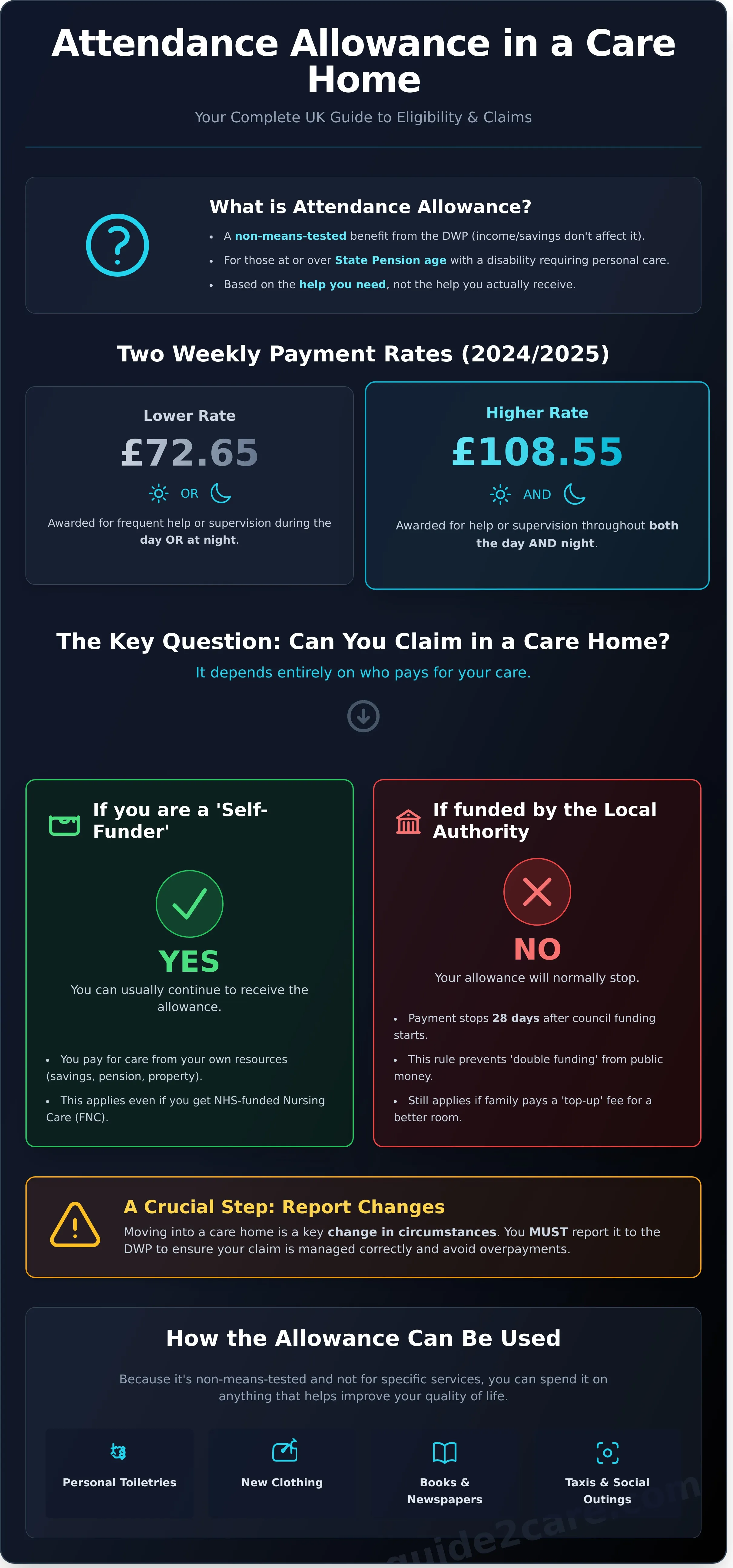
Attendance Allowance is a non-means-tested benefit provided by the Department for Work and Pensions. It is designed to help with the extra costs faced by individuals over State Pension age who have a physical or mental disability severe enough to require personal care or supervision. Because it is non-means-tested, your savings or income will not affect your eligibility.
Crucially, this benefit is based on the help you need, not the help you actually receive, and you do not need to have a carer to make a claim. The allowance is intended for personal care needs, not for mobility issues. Understanding the rules around Attendance Allowance is the first step in making a successful claim.
To better understand how these state benefits work, watch this helpful video:
Who is Generally Eligible?
To make a new claim for Attendance Allowance, you must meet several key criteria. While eligibility for attendance allowance for care home residents can depend on how your care is funded, a topic covered in the next section, the basic personal requirements are consistent.
- You must be at or over the State Pension age.
- You must have a physical disability, a mental disability (such as a learning difficulty or dementia), or both.
- Your care needs must have been present for at least six months before you can receive payment.
- You must meet certain UK residency and immigration status rules.
Understanding the Two Payment Rates
Attendance Allowance is paid at two different weekly rates, and the amount you receive depends entirely on the level of care and supervision you need. These rates are typically updated each April. For the 2024/2025 financial year, the rates are:
- Lower Rate - £72.65 per week: Awarded if you need frequent help or constant supervision during the day, or supervision at night.
- Higher Rate - £108.55 per week: Awarded if you need help or supervision throughout both the day and night.
In this context, 'supervision' means having someone on hand to ensure your safety, for example, to prevent falls or wandering. The assessment for attendance allowance for care home residents will focus on whether your needs meet the criteria for the day, the night, or both.
The Key Rule: Can You Claim Attendance Allowance in a Care Home?
Whether you can claim Attendance Allowance while living in a care home depends entirely on who pays your fees. This is the single most important factor that determines your eligibility. The core principle is to prevent 'double funding'-where public funds from two different sources pay for the same care needs.
Understanding your funding situation is the first step. Your eligibility for attendance allowance for care home residents falls into one of two main scenarios: you are either a 'self-funder' or your care is funded by the local authority.
If You are a 'Self-Funder' (Paying Your Own Fees)
If you pay for your care home fees yourself, you can usually continue to receive Attendance Allowance. A self-funder is someone who pays for their care from their own resources, such as savings, a private pension, or income from the sale of a property. This remains true even if you receive some funding from the NHS, such as NHS-funded Nursing Care (FNC). The allowance is intended to help you with the extra disability-related costs you face.
If Your Care is Funded by the Local Authority (Council)
Your Attendance Allowance will normally stop if your care home fees are paid for, in part or in full, by your local authority (council). The payment usually stops 28 days after the council funding begins. This rule exists because the financial support from the council is considered to already cover the cost of your personal care. This is a key part of the official government eligibility rules designed to avoid paying for the same need twice from the public purse.
What if You Have a Mix of Funding?
In situations with mixed funding, the rule still applies. For example, if the council pays for your basic care fees but a family member pays a 'top-up' fee for a better room, your Attendance Allowance will still stop. The determining factor is the council's contribution to your core care costs. Similarly, if you start as a self-funder and your savings run out, your Attendance Allowance will stop 28 days after the council takes over the funding of your place.
| Funding Source | Attendance Allowance Eligibility |
|---|---|
| Self-Funded (Using your own savings, pension, assets) |
Yes - You can usually claim or continue receiving it. |
| Local Authority Funded (Council pays for some or all of your fees) |
No - Payments will stop 28 days after funding starts. |
How to Apply for or Manage Your Claim from a Care Home
The process for applying for Attendance Allowance is the same whether you live in your own home or a care home. However, you must report moving into a care home if you already receive the benefit. This is a significant 'change in circumstances' that affects your eligibility.
Failing to report this change promptly can lead to an overpayment of benefits. If this happens, the Department for Work and Pensions (DWP) will require you to pay the money back. It is essential to keep the DWP informed to avoid future complications.
Making a New Claim While in a Care Home
To start a new claim, you must complete the Attendance Allowance (AA1) claim form. You can get the form by calling the Attendance Allowance helpline or downloading it from the GOV.UK website.
When filling out the form, focus on the help and supervision you need, not just your medical conditions. Describe how your illness or disability affects you with daily tasks, both during the day and at night. Be specific about the support you require.
You can ask for help to complete the form. This could be a family member, a key worker at your care home, or a specialist advisor from a charity like Age UK or Citizens Advice. Including supporting evidence, such as a copy of your care plan or a letter from your GP, can strengthen your application for attendance allowance for care home residents.
Reporting a Move into a Care Home (Existing Claims)
If you already receive Attendance Allowance, you must contact the Disability Service Centre to report that you have moved into a care home. This should be done as soon as possible.
You will need to provide them with:
- The date you moved into the care home.
- The name and address of the care home.
- Details of how your care is being funded.
The DWP will use this information to assess whether your payments can continue. According to the official Attendance Allowance eligibility rules, your payments will usually stop if a local authority pays for your care. However, if you are self-funding your care, you should remain eligible. After you report the change, always keep a record of the date you called and the name of the person you spoke to.
Navigating Special Circumstances and Common Questions
The rules for claiming Attendance Allowance in a care home are not always straightforward. Many situations fall outside the simple categories of 'self-funded' or 'council-funded'. Understanding how different circumstances affect your payments is essential to avoid confusion and potential demands for overpayment from the Department for Work and Pensions (DWP).
This section addresses the most common 'what if' scenarios to provide clarity on your entitlement.
Attendance Allowance During Respite Care
Respite care is a short, temporary stay in a care home, often to give a regular carer a break. If you are in a care home for respite, it is considered a temporary stay, and your Attendance Allowance should not be affected. The DWP generally defines a temporary stay as one lasting less than 28 days. If the stay becomes permanent, you must inform the DWP immediately as your eligibility may change depending on how the permanent care is funded.
What About Hospital Stays?
If you are admitted to hospital from your care home, your Attendance Allowance will stop after you have been in hospital for 28 days. These 28 days can be a single period or linked periods. The count resets only if you are discharged from hospital for 28 days or more before being readmitted. It is a legal requirement to inform the DWP about:
- Your admission to hospital
- Your discharge from hospital
Failure to report these changes can result in an overpayment that you will be required to pay back.
The Impact of NHS Continuing Healthcare (CHC) and FNC
NHS funding is a critical factor for anyone assessing their eligibility for attendance allowance for care home residents. The type of NHS funding you receive makes a significant difference.
- NHS Continuing Healthcare (CHC): If your care home placement is fully funded by the NHS through CHC, your Attendance Allowance will stop. This is because CHC covers all your health and social care needs, including the costs of accommodation.
- NHS-Funded Nursing Care (FNC): If you only receive FNC, you can continue to claim Attendance Allowance. FNC is a smaller, specific contribution from the NHS paid directly to the care home to cover nursing tasks performed by a registered nurse. It does not count as full NHS funding for your care.
For more detailed information on different funding options, explore the resources available at guide2care.com.
How Attendance Allowance Can Be Used in a Care Home
Once a claim is approved, the money is paid directly to the claimant, not to the care home. Attendance Allowance is a non-means-tested benefit, which means it is not affected by savings or other income. The funds can be spent on anything that helps the recipient maintain their quality of life and independence.
This financial support can make a significant difference to a resident's daily life, providing them with personal choice and control over their own comfort and well-being. How the money is used is entirely up to the individual.
Practical Examples for Enhancing Daily Life
The flexibility of Attendance Allowance means it can cover costs that are not included in standard care home fees. This empowers residents to purchase items and services that enhance their personal comfort and social life. Common uses include:
- Personal Treatments: Paying for services such as a hairdresser, a private chiropodist, or therapeutic massages.
- Personal Items: Buying higher-quality toiletries, favourite snacks, new clothes, or books and magazines.
- In-Room Comforts: Covering the cost of a private phone line, a personal TV subscription service, or a newspaper delivery.
- Social Activities: Funding transport for family visits, paying for taxis to social outings, or covering the cost of hobbies and activities.
Does the Care Home Need to Know About It?
You are not legally required to declare Attendance Allowance to the care home. This benefit is specifically disregarded as income when a local authority conducts a financial assessment to determine how much you should contribute towards your care home fees.
This protection ensures that attendance allowance for care home residents provides genuine extra financial support. It grants the resident a degree of financial independence and the freedom to make personal choices about their own spending. This autonomy is a vital part of maintaining dignity and control. Find a care home that respects your independence.
Navigating Attendance Allowance and Finding Your Care Home
Understanding your eligibility for Attendance Allowance is a critical step in planning for care. The key rule to remember is that you can typically continue receiving this benefit if you are fully self-funding your care home fees. This tax-free payment can then be used for extra personal support, enhancing comfort and quality of life. Knowing the rules for attendance allowance for care home residents ensures you access all the financial support to which you are entitled.
Once you have clarity on funding, the next step is finding the right care setting. Guide2Care simplifies this process with our comprehensive UK-wide directory and clear, expert guides. We are here to help you make informed decisions. Use our directory to find care homes in your area and take the next step with confidence. Find the care you need, simplified.
Frequently Asked Questions
What happens to my Attendance Allowance if I pay for my care home from my pension?
How you fund your care home does not directly affect your claim. The rules for receiving attendance allowance for care home residents depend on who pays the fees. If you are self-funding, even by using your pension, you can continue to receive the benefit. Eligibility is primarily affected by whether your local authority contributes. If the local authority pays towards your fees, your Attendance Allowance will usually stop after 28 days.
Can I still get Attendance Allowance if a charity helps pay my care home fees?
Yes, you can usually continue to receive Attendance Allowance if a charity contributes to your care home fees. The key factor is whether a local authority is paying towards your costs. If your care is funded by yourself, your family, or a charity without any local authority input, your eligibility for Attendance Allowance should not be affected. Always confirm the specific funding arrangement to be certain of your entitlement.
How is Attendance Allowance different from Personal Independence Payment (PIP)?
Attendance Allowance and Personal Independence Payment (PIP) both help with extra costs from a long-term health condition. The main difference is age. Attendance Allowance is for individuals who have reached State Pension age. PIP is for people aged 16 up to State Pension age. PIP also has two parts for daily living and mobility, whereas Attendance Allowance is based only on the help you need with personal care or supervision.
Do I have to pay back Attendance Allowance if my circumstances change?
You do not have to pay back Attendance Allowance unless you have been overpaid. An overpayment can happen if you do not report a change in circumstances that affects your eligibility. For example, this includes moving into a care home where the local authority pays your fees. You must report any changes to the Disability and Carers Service immediately to prevent an overpayment.
At what age does Attendance Allowance stop?
Attendance Allowance does not have an upper age limit. Once awarded, you can continue to receive it for the rest of your life, provided you still meet the eligibility criteria. Your condition and care needs must still qualify you for the benefit. The Department for Work and Pensions (DWP) may review your award from time to time to ensure your circumstances have not changed, but the payment does not stop at a specific age.
Can my carer still claim Carer's Allowance if I move into a care home?
Your carer’s eligibility for Carer's Allowance may be affected if you move into a care home. Carer's Allowance depends on the person being cared for receiving a qualifying benefit, like Attendance Allowance. If your Attendance Allowance stops because the local authority is funding your care, your carer will no longer be able to claim Carer's Allowance for you. They must report this change in circumstances to the Carer's Allowance Unit.
How long does it take for an Attendance Allowance claim to be processed?
The time it takes to process a new Attendance Allowance claim can vary. You should typically expect a decision within 8 to 12 weeks from when the Department for Work and Pensions (DWP) receives your form. This is an estimate and processing times can change. If your claim is successful, payments will be backdated to the date you first made the claim, ensuring you do not lose out due to the processing period.