The Essential Checklist: 85+ Questions to Ask a Care Home Manager

Choosing a care home is a significant responsibility. The process can feel overwhelming, and without a clear plan, it is easy to miss crucial details. To make an informed choice for a loved one, you need the right information. Having a structured list of questions to ask a care home manager is the most effective tool to use during your visit. It ensures you cover all critical areas, from daily care routines to the specifics of the contract, giving you the clarity needed to proceed with confidence.
This essential checklist provides that structure. We have compiled over 85 questions, organised into logical categories including Staffing & Training, Health & Medical Care, Daily Life & Activities, and Costs & Contracts. This comprehensive guide is designed to help you systematically evaluate each home, compare your options objectively, and understand all financial obligations upfront. Use this resource to prepare for your meetings and find the safe, caring, and suitable environment you are looking for.
Key Takeaways
- Prepare for your visit by researching the home's official CQC report and recent family reviews online.
- Use our targeted questions to ask a care home manager about staffing levels, qualifications, and turnover to gauge the quality of daily care.
- Clarify all potential costs by requesting a detailed breakdown of weekly or monthly fees to prevent financial surprises.
- Look beyond basic care by asking about the daily schedule, resident activities, and social life to understand the home's community.
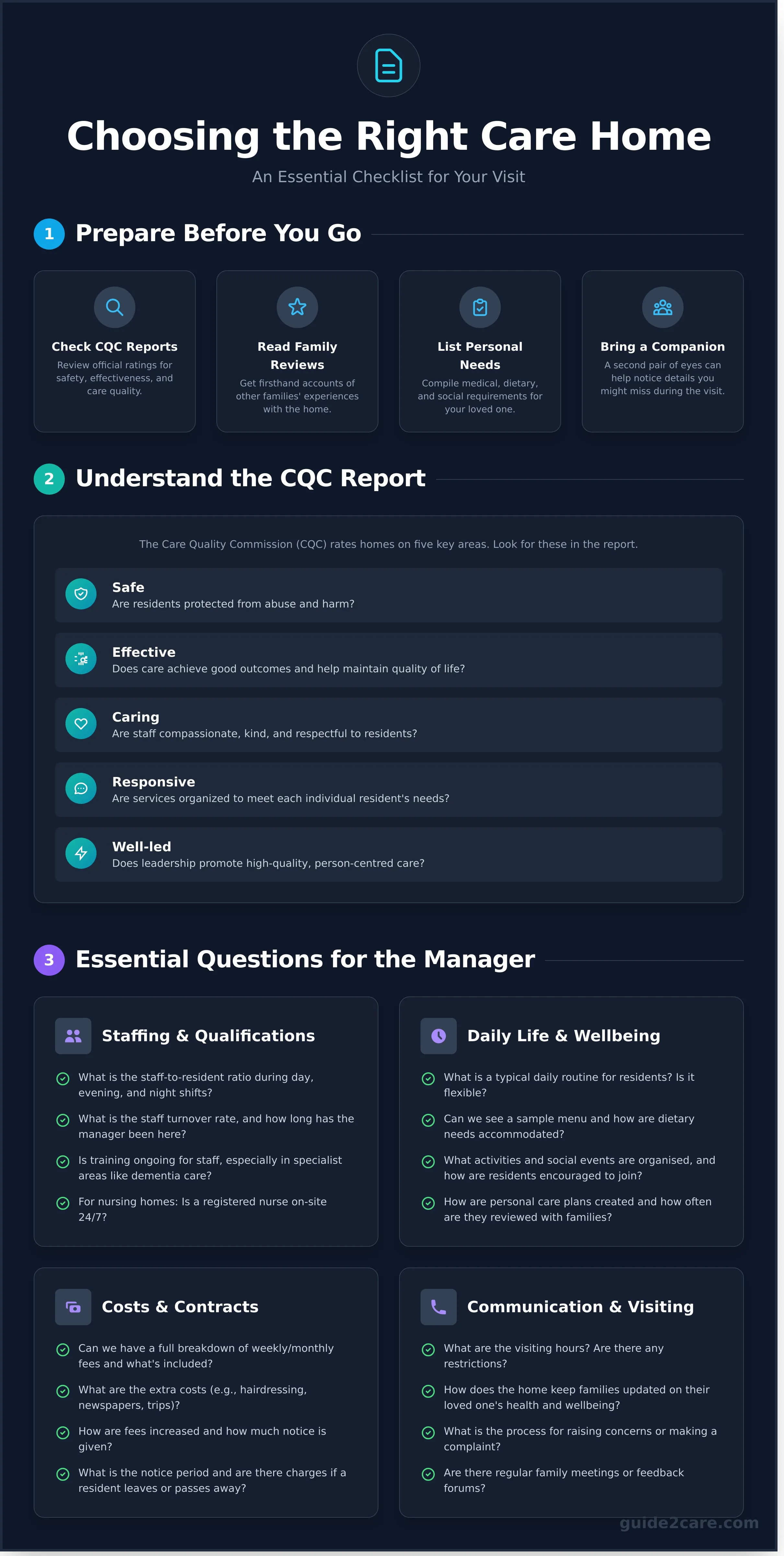
Preparing for Your Visit: What to Do Before You Meet the Manager
A successful care home visit starts before you walk through the door. Proper preparation ensures you use your time effectively and helps you formulate the right questions to ask a care home manager. This groundwork provides the context you need to make an informed decision for your loved one.
To understand the manager's role and the types of questions they face, watch this helpful video:
Before your meeting, read online reviews and testimonials from other families to get a sense of their experiences. Compile a detailed list of your loved one's specific needs, including medical history, dietary requirements, and personal preferences. Plan your visit for a busy period, such as lunchtime, to observe the home's atmosphere and staff interactions. Finally, ask a trusted friend or family member to join you. A second pair of eyes can notice details you might miss.
Understanding the CQC Report
In England, the Care Quality Commission (CQC) is the independent regulator of all health and social care services. Every care home receives a rating based on five key areas. You can find the latest report for any home on the CQC website.
- Safe: Are residents protected from abuse and harm?
- Effective: Is the care, treatment, and support achieving good outcomes?
- Caring: Do staff treat residents with compassion, kindness, and respect?
- Responsive: Are services organised to meet residents' needs?
- Well-led: Does the leadership promote high-quality, person-centred care?
Note any areas rated as 'Requires Improvement' or 'Inadequate'. These are important topics to raise when you create your list of questions to ask a care home manager.
Setting Your Priorities
Create a checklist of priorities, separating them into 'must-haves' and 'nice-to-haves'. This helps clarify what is non-negotiable. Consider practical factors like location, budget, and the specific type of care required. For example, you may need to decide between residential care and nursing care. If you are new to these terms, understanding what is a nursing home? provides essential context for the higher level of medical support they offer. Involve your loved one in this process as much as possible to ensure their preferences are central to the decision.
Core Questions About Staffing and Day-to-Day Care
The quality of a care home is ultimately defined by its staff. These are the individuals who provide the daily support, companionship, and medical attention your loved one requires. Posing direct questions about the team provides crucial insight into the stability and expertise of the care environment. This line of questioning is a critical step in the overall process of learning how to choose a nursing home. During your tour, observe how staff and residents interact; this often reveals more than words can.
Staffing Levels and Qualifications
A stable, qualified, and sufficient team is fundamental to consistent, high-quality care. Low staff turnover is often a key indicator of a positive working environment, which directly translates to better resident experiences. Use these questions to understand the skill level and availability of the team who will be providing care.
- What is the staff-to-resident ratio during the day, evening, and at night?
- What qualifications and training do care staff hold (e.g., NVQs in Health and Social Care)? Is training ongoing?
- What is the staff turnover rate? High turnover can disrupt continuity of care.
- How long has the current manager been in post?
- For nursing homes: Is a registered nurse on-site 24 hours a day, seven days a week?
Personalised Care Plans
Effective care is not one-size-fits-all. It must be tailored to the individual's specific needs, personal history, and daily preferences. A detailed and regularly reviewed care plan demonstrates that the home is committed to person-centred care. These are vital questions to ask a care home manager to clarify how they deliver this individualised support.
- How do you create a new resident's care plan upon admission? Who is involved?
- How often are care plans reviewed, and how are residents and their families involved in updates?
- Could we see an anonymised example of a care plan to understand its level of detail?
- How do you accommodate personal preferences for daily routines, such as waking times or meal choices?
Handling Specific Health Needs
If your loved one has a specific or complex health condition, it is vital to confirm the home has the relevant experience and established procedures. Whether it's dementia, Parkinson's, or post-operative recovery, you must be confident in the team's ability to manage particular requirements and respond to changes.
This extends to managing common underlying health factors, such as weight, which can impact conditions like diabetes and mobility. While care homes provide dietary support, for those needing a structured medical approach, programs from services like foundry can provide a useful framework for discussion with the care team.
This includes asking about their approach to musculoskeletal health, as mobility and pain management are key to a resident's quality of life. A proactive home will have plans for physiotherapy and specialist support, sometimes working with external providers like GB Clinic to ensure residents receive expert MSK care.
Many families facing these health challenges find purpose in fundraising for related charities. For those looking for an adventurous way to contribute, you can discover UK Skydiving, as sponsored jumps are a popular way to raise awareness and funds for causes like dementia or cancer research.
- What specific experience does your team have with conditions like [insert condition, e.g., dementia, Parkinson's, stroke recovery]?
- How do you manage challenging behaviours or a sudden deterioration in a resident's condition?
- What is the procedure for arranging GP visits, and can a resident retain their own GP if they are local?
Daily Life, Activities, and Resident Wellbeing
A good care home provides more than just clinical support; it fosters a community. The quality of daily life is a critical factor in a resident's happiness and health. These questions move beyond the basics of care to explore the factors that contribute to a fulfilling and enjoyable life. Use these essential questions to ask a care home manager to build a complete picture of resident wellbeing.
Activities and Social Life
A varied and engaging activities programme prevents isolation and promotes mental and physical stimulation. It should cater to a wide range of interests and mobility levels. Look for a mix of group activities and individual pursuits. One-to-one time is particularly important for residents who may be reluctant to join groups or have specific cognitive needs.
- Can we see a recent weekly activities schedule?
- How are residents encouraged to participate? Are one-to-one activities available?
- Are there organised trips or outings? How often do these take place?
- How does the home celebrate birthdays, holidays, and other special occasions?
Food and Mealtimes
Mealtimes are often a key social part of the day. The quality, choice, and flexibility of the dining service significantly impact a resident's daily experience. If possible, arrange your visit during a mealtime to observe the dining room atmosphere and see the food quality. Flexibility is key, as a rigid schedule may not suit everyone.
- Where is the food prepared? Can we see a sample menu?
- How do you cater for special dietary needs, such as diabetic, vegetarian, or cultural requirements?
- Do residents have a choice of when and where to eat, for example, in their room?
- Are snacks and drinks readily available between meals?
Living Environment and Facilities
A resident's room is their personal space, and making it feel like home is vital for settling in. Understanding the rules around personalisation and the available facilities is crucial for comfort, dignity, and safety. These are important questions to ask a care home manager to clarify what is and is not permitted.
- What personal items and furniture can residents bring?
- Are all rooms en-suite? What adaptations, like walk-in showers or grab rails, are standard?
- Is there safe and easy access to an outdoor space or a secure garden?
- What additional services are available (e.g., hairdressing, chiropody, newspapers) and what are the associated costs?
- What are the home's policies on smoking and vaping? It's a key consideration for some residents, and if you need to source products online, you can check out Vape Center for a wide range of options.
Contracts, Fees, and Financial Matters
Understanding the full financial commitment is vital to avoid unexpected costs. The financial agreement is a significant part of choosing a care home, so clarity is essential. This section covers the key financial questions to ask a care home manager before you agree to a placement.
The significant costs involved in care highlight the financial scale of the healthcare industry. Many care providers are growing businesses that require substantial capital to expand and improve their facilities. For companies in this sector or others looking for growth capital, it's possible to feature my company for pre-IPO investment and access new funding opportunities.
Understanding the Fee Structure
A transparent fee structure prevents future disputes. You need a clear, itemised breakdown of all potential costs. Do not hesitate to ask for everything in writing.
- What is the exact weekly or monthly fee for the proposed room and required level of care?
- Please provide a list of all services not included in this fee. Common extras include hairdressing, private chiropody, newspapers, and some social outings.
- How and when are fees paid? Is it monthly in advance by direct debit?
- Under what circumstances do fees increase? Ask about the annual review process and how much notice is provided, which is typically at least 28 days.
Contracts and Notice Periods
The contract is a legally binding document. Always take time to review it thoroughly with family or a legal advisor before signing. A reputable home will provide a copy for you to take away and review without pressure.
- What is the notice period required if the resident decides to leave the care home?
- Is a deposit or an upfront administration fee required? If so, what are the terms for its return?
- What is the process if a resident's funding situation changes, for example, from self-funding to Local Authority funding?
Funding and Support
Navigating care funding in the UK can be complex. The care home manager should be able to explain which funding types they accept and how they work within their home. These are critical questions to ask a care home manager if you are not fully self-funding.
- Do you accept residents funded by the Local Authority?
- If so, is a 'top-up' fee required from a third party to meet the difference between the council's rate and the home's private rate?
- Do you have experience with residents receiving NHS Continuing Healthcare (CHC) funding?
For more detailed information on funding your care, explore the resources available at guide2care.com.
Communication, Visiting, and Feedback
Clear and consistent communication is the foundation of trust between a care home and a resident's family. A transparent home will have established procedures for keeping you informed, managing visits, and handling feedback. When you are considering a home, these are some of the most important questions to ask a care home manager, as the answers reveal how they value their relationship with residents and their families. An open and professional approach to these topics is a strong indicator of a well-run facility.
Family Communication
Establish how the home will maintain contact with you. Knowing who to speak with for routine updates and how major events are communicated provides essential peace of mind. Ask for specific details on their communication protocols.
- Who is our main point of contact for day-to-day queries, such as a named key worker or senior carer?
- How, and how quickly, will you inform us of any incidents, accidents, or significant changes in health?
- Are there regular care plan reviews or family meetings, and how often do they take place?
Visiting Policies
A home's visiting policy directly impacts your ability to stay connected with your loved one. Policies should balance resident safety and comfort with the importance of family contact. This extends to physical security measures, such as preventing unauthorized entry or 'tailgating', a risk that security awareness platforms like AwareGO help organizations address. A flexible yet secure approach that accommodates family life is often a positive sign.
- Are there set visiting times, or do you operate an open-door policy?
- Can family and friends join a resident for meals? If so, is there a charge (e.g., £5-£10)?
- Are children and well-behaved pets welcome to visit?
- What are the procedures for visiting during an outbreak of an infectious illness, like influenza or norovirus?
Complaints and Feedback Process
Every care provider regulated by the Care Quality Commission (CQC) must have a formal complaints procedure. A well-managed home will not only have this but will also actively encourage feedback as a tool for improvement. Do not hesitate to ask about how they handle concerns.
- What is the official procedure for raising a concern or making a formal complaint?
- Could we see a copy of your anonymised complaints log to understand how issues are resolved?
- How do you proactively gather feedback from residents and their families (e.g., surveys, suggestion boxes)?
A manager who answers these questions openly and provides clear, documented policies demonstrates a commitment to partnership and transparency. This diligence is a crucial part of ensuring you find the right care environment for your loved one. To compare providers and find the care you need, explore the resources at guide2care.com.
Making an Informed Choice: Your Next Steps
Choosing a care home is a significant decision. This checklist has equipped you with the essential information needed to evaluate a home's suitability, covering everything from day-to-day staffing and resident wellbeing to financial contracts and communication policies. Having a structured list of questions to ask a care home manager ensures you can conduct a thorough and objective assessment during your visit, leaving no important detail overlooked.
Now you are prepared, the next step is to locate suitable homes. Use our free directory to find and compare care homes near you. Our comprehensive UK-wide directory provides trusted information and guidance. You can filter your search by care type, location, and official CQC rating to create a targeted shortlist.
This methodical approach will help you find the right care with confidence. Find the care you need today.
This process of planning for a loved one's care often brings up other important considerations for the future. For guidance on other sensitive arrangements, like understanding funeral etiquette, you can check out Funera for helpful resources.
Frequently Asked Questions
What are the biggest red flags to look for during a care home visit?
Look for strong, unpleasant odours, poor cleanliness in communal areas, and residents who appear bored, distressed, or unkempt. A high staff turnover or staff who seem stressed and rushed can also be a warning sign. Observe interactions between staff and residents; they should be respectful and kind. A lack of visible activities or engagement is another key red flag. Trust your instincts; if the atmosphere feels unwelcoming or chaotic, it warrants further investigation.
How can I verify the information the care home manager tells me?
Always verify information independently. The most reliable source is the care home's latest Care Quality Commission (CQC) inspection report, available on the CQC website. Speak directly with current residents and their families during your visit to get their firsthand experiences. You can also check online reviews on independent platforms. Cross-referencing these sources provides a balanced view and confirms the accuracy of the manager's statements.
Should I visit a care home more than once before making a decision?
Yes, multiple visits are highly recommended. A single visit provides only a snapshot. Visiting at different times, such as during a mealtime and then on a weekend, gives a more complete picture of daily life, staffing levels, and resident activities. This approach allows you to observe different routines and staff interactions, ensuring the home consistently meets a high standard. It also provides more opportunities to ask follow-up questions and confirm your initial impressions.
What is the difference between a residential care home and a nursing home?
The primary difference is the level of medical care provided. A residential care home offers personal care and support, such as help with washing, dressing, and taking medication. A nursing home provides the same support but also has qualified nurses on-site 24 hours a day to deliver medical care. This makes nursing homes suitable for individuals with complex medical conditions, significant physical disabilities, or long-term illnesses requiring regular nursing intervention.
How important is the CQC rating when choosing a care home?
The CQC rating is a critical indicator of a care home's quality and safety. The Care Quality Commission is the independent regulator for health and social care in England. Its ratings-Outstanding, Good, Requires Improvement, or Inadequate-are based on thorough inspections. While a 'Good' or 'Outstanding' rating is a strong benchmark, you should also read the full inspection report. This document offers detailed insights that complement your own visit and observations.
What should I do if a manager seems evasive or won't answer my questions?
Evasiveness from a care home manager is a significant red flag. A transparent manager should be willing and able to answer all reasonable questions about care, staffing, and policies. If a manager avoids direct answers or seems defensive, it may indicate underlying issues. Your list of questions to ask a care home manager is a tool to assess transparency. A refusal to engage is a clear warning sign to consider other options.
Is it better to visit announced or unannounced?
Both types of visits have benefits. An initial, announced visit ensures the manager is available to answer your questions and provide a full tour. However, a follow-up, unannounced visit can provide a more authentic glimpse into the home's daily operations and atmosphere when they are not expecting visitors. If a home discourages unannounced visits, this can be a red flag. A combination of both is the ideal approach for a comprehensive assessment.