Understanding CQC Ratings for Care Homes: A Simple Guide

Choosing a care home is a significant task. Faced with official reports and industry jargon, the process can feel overwhelming. The Care Quality Commission (CQC) report, in particular, can seem complex, yet it is one of the most powerful tools you have. A solid grasp of this document is essential, and understanding CQC ratings for care homes provides the clarity needed to assess the quality and safety of a provider, cutting through marketing promises to reveal the facts.
This simple guide is designed to make that process straightforward. We will decode the CQC’s four official rating levels: Outstanding, Good, Requires Improvement, and Inadequate. We also explain the five key questions every inspector asks, covering everything from safety to leadership. By the end, you will have the knowledge to read any CQC report with confidence, create an informed shortlist, and feel empowered to choose a safe, high-quality home for your family member.
Key Takeaways
- Learn what the CQC is and why its ratings are the official measure of a care home's safety and quality in England.
- Go beyond the overall score; see how a home performs against the five key inspection questions for a more detailed view.
- A clear understanding CQC ratings for care homes is the most effective way to build a shortlist of potential providers.
- Discover how to use the full inspection report to ask the right questions, especially for homes rated 'Requires Improvement'.
What is the CQC and Why Do Its Ratings Matter?
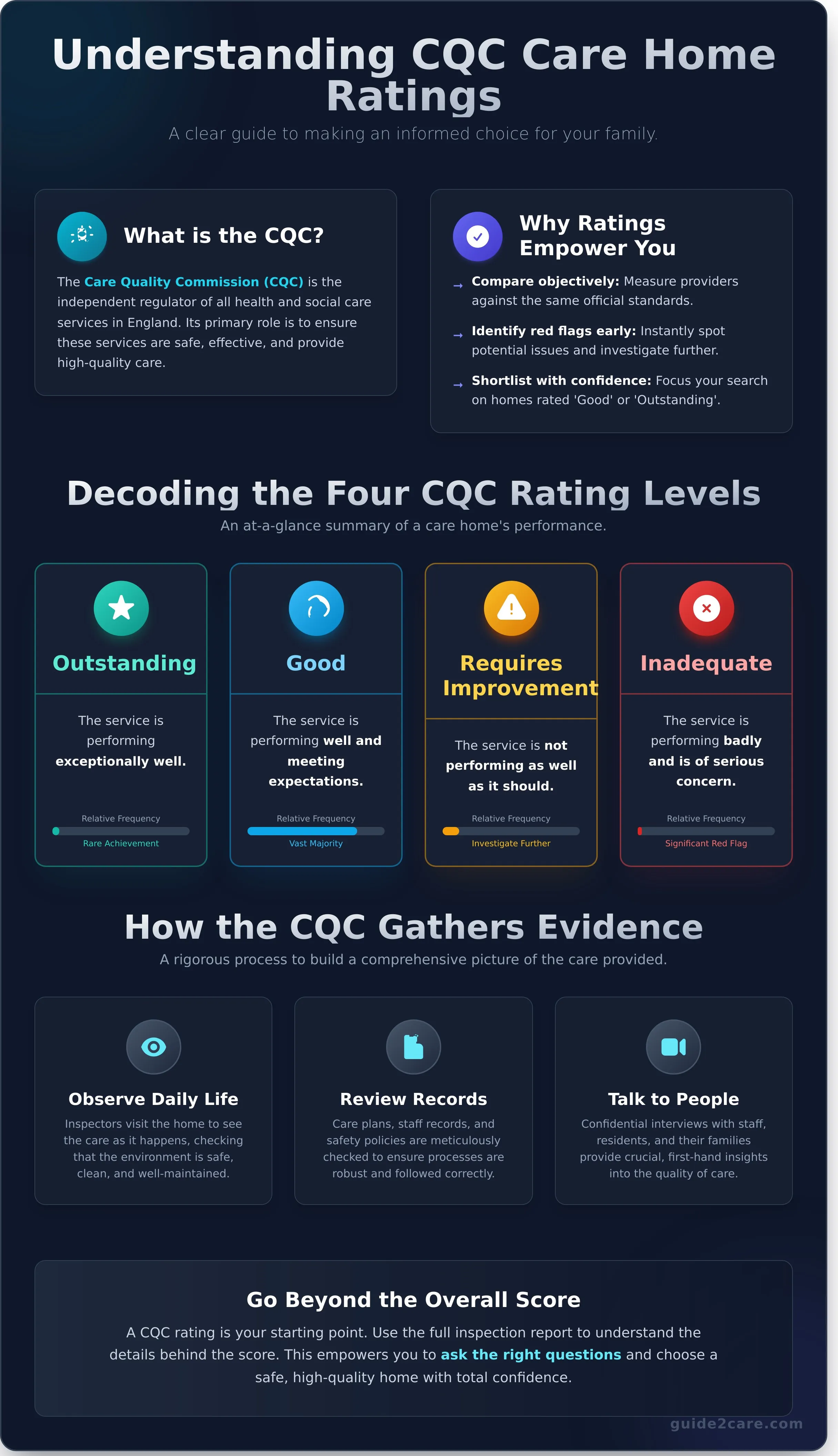
When searching for a care home in England, your most important resource is the Care Quality Commission (CQC). The CQC is the independent regulator of all health and social care services. Its primary role is to ensure these services are safe, effective, and provide high-quality care. For a detailed overview of the organisation, you can learn more about what the Care Quality Commission (CQC) is and its history.
A CQC rating is an impartial, expert assessment of a care home's performance. It is not an opinion or a customer review; it is the result of a rigorous inspection process. For this reason, understanding CQC ratings for care homes is the crucial first step in your research, providing an objective foundation for your decision.
To see how the CQC's standards are applied in practice, watch this short video:
The Purpose of CQC Inspections
The CQC gathers evidence through detailed inspections. Inspectors visit the care home to observe daily life, review records, and check that the environment is safe and clean. They conduct interviews with staff, residents, and family members to build a comprehensive picture of the care provided. While inspections are carried out regularly, they can also be triggered by specific concerns raised by the public or staff members, ensuring continuous oversight.
How CQC Ratings Empower Your Choice
CQC ratings simplify the process of finding a quality care home. They provide a clear, at-a-glance summary of a home’s performance, helping you to:
- Compare homes objectively: Ratings allow you to measure different providers against the same official standards.
- Identify red flags early: A rating of 'Requires Improvement' or 'Inadequate' signals potential issues that you should investigate further before arranging a visit.
- Shortlist with confidence: Focusing your search on homes rated 'Good' or 'Outstanding' helps you direct your time and energy toward the best options.
Decoding the Four CQC Rating Levels
The Care Quality Commission (CQC) uses a straightforward four-point scale to rate care homes. This system is designed to give you a clear, at-a-glance summary of a service's quality. A rating is awarded following a comprehensive inspection where inspectors assess the provider against key standards of care. Effective understanding CQC ratings for care homes begins with knowing these four levels.
It is important to know that a care home receives one overall rating, as well as separate ratings for each of the five key areas of service we will explore in the next section. This allows you to see both the big picture and the specific areas where a home excels or needs to improve.
The four possible overall ratings are:
- Outstanding: The service is performing exceptionally well.
- Good: The service is performing well and meeting CQC expectations.
- Requires Improvement: The service is not performing as well as it should.
- Inadequate: The service is performing badly.
Outstanding & Good
An 'Outstanding' rating is a rare and significant achievement. It means the care provider delivers an exceptional standard of care that is tailored to individual needs and consistently achieves positive outcomes for residents. Only a small percentage of services in the UK receive this top rating.
A 'Good' rating indicates that the service is meeting all legal standards and CQC expectations. The vast majority of care homes in the UK are rated 'Good'. This shows they are providing safe, effective, and well-led care, making them a reliable choice for your consideration.
Requires Improvement & Inadequate
If a service is rated as 'Requires Improvement', it means the CQC has identified one or more concerns during its inspection. The provider is not performing as well as it should and has breached at least one regulation. The CQC will require a clear action plan for improvement and will conduct a follow-up inspection to ensure changes are made. The NHS provides further context on how to use CQC ratings like this to inform your search.
An 'Inadequate' rating is the most serious and is a significant cause for concern. It signifies that the service is performing badly and people are not receiving safe or appropriate care. When a service is rated 'Inadequate', the CQC will take immediate enforcement action to protect residents. This may involve placing the service in special measures or, in serious cases, beginning the process to cancel the provider's registration.
The Five Key Questions: What the CQC Actually Inspects
The overall rating is a useful summary, but a key part of understanding CQC ratings for care homes is to look at the detail behind it. The Care Quality Commission (CQC) bases its overall score on a home's performance against five key questions. Examining the individual rating for each question provides a much deeper insight into a provider's service.
A care home may be rated 'Good' overall but have a 'Requires Improvement' rating in a specific area that matters most to you. This detailed breakdown helps you identify a home's specific strengths and weaknesses, allowing you to make a more informed decision.
Safe and Effective
These two questions assess the fundamental quality and safety of the care provided. They check that the service is reliable and delivers positive health outcomes for residents.
- Safe: Are residents protected from abuse and avoidable harm? Inspectors review staffing levels, medicine management, cleanliness, and infection control procedures.
- Effective: Does the care and treatment achieve good outcomes and help residents maintain a good quality of life? This looks at staff training, nutrition and hydration, and how residents' health needs are assessed and met.
The focus on cleanliness and infection control is crucial, and it's an area where many care homes rely on professional support to meet rigorous CQC standards. As an example of a dedicated commercial service, That's Cleaning helps facilities meet these high benchmarks.
Caring and Responsive
This pair of questions focuses on the residents' experience and whether the service is person-centred. It evaluates the human element of the care provided.
- Caring: Do staff treat residents with compassion, kindness, dignity, and respect? This is assessed by observing interactions and checking if residents are involved in decisions about their own care.
- Responsive: Are services organised to meet each person's individual needs? This examines the provision of social activities, flexibility of visiting policies, and how effectively the home listens to and acts on complaints.
Well-led
This question assesses the leadership, management, and governance of the care home. A well-run service is more likely to provide high-quality care across all areas. Inspectors check if the management team fosters a positive and open culture, supports its staff, and has a clear vision for continuous improvement. A poor 'Well-led' rating can be a significant warning sign, as it often indicates wider problems within the service that could impact resident safety and well-being.
The importance of a 'Well-led' service is a universal principle that extends beyond healthcare. Understanding the human-centred stories behind policy and leadership is crucial in any sector. For those interested in this kind of journalism on a global scale, you can discover Gulf–ASEAN Exchange.
How to Use CQC Ratings in Your Care Home Search
Information is only useful when you can act on it. This section provides a practical, step-by-step process to use CQC data to build an informed shortlist of care homes. Effective use of this data is central to understanding CQC ratings for care homes and finding the right provider.
Step 1: Find the Ratings
Start your search using the Guide2Care directory. Every care home listing prominently displays its overall CQC rating, giving you an immediate quality indicator. For a more detailed view, each listing includes a direct link to the latest full inspection report on the official CQC website. This allows you to access the primary source of information quickly and easily.
Step 2: Create a Shortlist
To begin, filter your search results to show only care homes rated 'Good' or 'Outstanding' in your chosen area. This simple action creates a baseline of quality-checked options, saving you time by removing services that do not meet the CQC's required standards. This is the most efficient way to build a strong initial list of potential homes to investigate further.
Find 'Good' and 'Outstanding' care homes near you now.
Step 3: Compare the Key Questions
Once you have a shortlist, it's time to look deeper than the overall score. Compare the ratings for the five key questions (Safe, Effective, Caring, Responsive, and Well-led) for each home. Your loved one's needs should guide this comparison. For example:
- Does one home have an 'Outstanding' rating for Caring but is only 'Good' for Safe?
- Is another home exceptionally Well-led, suggesting strong management and stability?
This level of detail helps you match a home’s specific strengths to your most important priorities. A complete understanding of CQC ratings for care homes involves assessing these individual components, not just the final grade. This ensures you choose a home that truly excels in the areas that matter most to you and your family.
Looking Beyond the Rating: What to Do with the Information
A CQC rating is a vital tool for assessing a care home, but it is a snapshot in time. To make a fully informed decision, you must look beyond the single-word rating and into the details of the inspection report. A deeper understanding of CQC ratings for care homes comes from analysing the context behind the headline grade.
This section explains how to use the full CQC report to build a complete picture of a service, helping you move from a black-and-white judgement to a more nuanced choice.
Interpreting a 'Requires Improvement' Rating
This rating does not automatically mean a home is unsafe or of a poor standard. The context is crucial. Read the full report summary to understand why the rating was given. Consider the following:
- The Area of Concern: Was the issue related to a critical area like resident safety, or was it an administrative problem such as incomplete paperwork? The latter can sometimes indicate issues with internal data systems, and for any organization, it's a reminder to explore Microsoft Access Application repair and maintenance to keep processes efficient.
- The Action Plan: The report will detail what the CQC has instructed the home to do. A clear, actionable plan is a positive sign.
- Direct Questions: Ask the care home manager how they are addressing the CQC's findings. A confident and transparent response shows good leadership.
What if a Care Home Has No Rating?
A care home without a CQC rating is not necessarily a cause for alarm, but it does require more investigation. This situation usually occurs for two main reasons:
- The service is new and has not yet undergone its first CQC inspection.
- It is a type of service that the CQC does not have the regulatory power to rate.
In these cases, proceed with caution. Conduct extra due diligence by checking staff qualifications, reviewing policies, and seeking feedback from other residents or their families if possible.
Using Ratings to Prepare for a Visit
The CQC report is an excellent tool to prepare for a visit. Use its findings to create a list of specific, targeted questions. This shows you are thorough and helps you get the answers you need.
- If 'Safe' was a weakness: Ask about current staffing levels, agency staff usage, and staff turnover rates.
- If 'Responsive' was a concern: Ask to see an activities schedule and question how they cater to individual needs, hobbies, and cultural backgrounds.
- If 'Well-led' was rated 'Requires Improvement': Ask the manager about their experience and any recent changes in the management team.
Use the CQC rating as your starting point, not your final verdict. By combining the rating with a detailed report review and direct questions, you can find the right care. Explore care homes and their CQC reports on guide2care.com.
Your Next Step: From Understanding to Action
Effectively understanding CQC ratings for care homes is a crucial first step in your search. These ratings provide an essential, objective measure of a home's quality, focusing on whether a service is safe, effective, caring, responsive, and well-led. Use this official assessment to create a shortlist of potential homes, but remember to look beyond the single rating by reading the full report and arranging a visit.
Now, put this knowledge into practice. Guide2Care simplifies your search with comprehensive listings across the UK. Our easy-to-use search and filter tools allow you to compare providers, and we provide direct links to the latest CQC reports for complete transparency. This helps you move from research to a confident decision.
Use our directory to find and compare CQC-rated care homes in your area. With the right information, you are empowered to find the right care.
Frequently Asked Questions About CQC Ratings
How often are care homes inspected by the CQC?
The CQC uses a risk-based inspection schedule. A care home rated 'Outstanding' may be inspected every 30 months. Homes rated 'Good' or 'Requires Improvement' are typically inspected within 12 to 18 months. If a home is rated 'Inadequate', the CQC will re-inspect it within six months to check for significant improvements. This ensures resources are focused on providers that need the most attention and monitoring.
Can a care home's CQC rating change?
Yes, CQC ratings can and do change. A care home's rating is updated after every new inspection. A provider can improve its rating from 'Requires Improvement' to 'Good' or 'Outstanding' by addressing issues found in a previous report. Conversely, a 'Good' home could be downgraded if standards fall. Always check the date of the latest inspection report to ensure you have the most current information on a home's performance.
What should I do if I find a care home with an 'Inadequate' rating?
An 'Inadequate' rating indicates serious problems with a care service. The CQC places these homes in 'special measures' and re-inspects them within six months. You should proceed with extreme caution. Read the full inspection report to understand the specific reasons for the rating. While a home may be working on improvements, it is generally advisable to look for providers with better ratings, such as 'Good' or 'Outstanding', to ensure safe and effective care.
Are CQC ratings the only thing I should consider when choosing a care home?
While crucial, CQC ratings are not the only factor. A key part of understanding CQC ratings for care homes is using them as a starting point. You must also consider other elements. Visit the home in person, speak with staff and current residents, and assess the atmosphere. Consider factors like location, specific care specialisms, and daily activities. A personal visit will help determine if the home is the right fit for your loved one's individual needs.
Does the CQC rate care homes in Scotland, Wales, and Northern Ireland?
No, the CQC (Care Quality Commission) only regulates and inspects health and social care services in England, covering a wide range from care homes to specialist providers such as Scan Baby Ltd. Each of the other UK nations has its own independent regulator. In Scotland, the equivalent body is the Care Inspectorate. In Wales, it is the Care Inspectorate Wales (CIW). For Northern Ireland, the regulator is The Regulation and Quality Improvement Authority (RQIA). Always check the correct regulator for the country you are searching in.
How do I find the full CQC inspection report for a care home?
You can find all inspection reports on the official CQC website. Use the search bar on their homepage to look for a care home by its name, town, or postcode. Once you select the correct provider from the search results, you will see their profile page. This page displays their current rating and provides links to download the full inspection report as a PDF, along with a history of previous inspections and ratings.