What is Supported Living for Adults with Learning Disabilities? A 2026 UK Guide

Choosing the right long-term care for an adult with a learning disability is a significant decision. You want to ensure they can live with independence, but you may also have concerns about their safety, isolation, and the stability of their placement. Understanding what is supported living for adults with learning disabilities is the first step toward finding a solution. This model provides a unique balance of personal freedom and professional assistance, but navigating the options can be complex.
This 2026 UK guide provides clear, factual answers. We will explain how supported living works, how it differs from residential care, and what the legal and funding structures involve. You will learn how this approach empowers individuals to have their own tenancy and make their own choices, with a support plan tailored to their specific needs. By the end of this article, you will have the confidence and the actionable steps required to find the right provider.
Key Takeaways
- Understand how supported living combines a tenancy agreement with a separate, personalised care plan to maximise independence.
- Learn what is supported living for adults with learning disabilities by comparing it to residential care, focusing on key differences in choice and financial control.
- Discover a clear process for evaluating providers, including how to use Care Quality Commission (CQC) reports to verify quality.
- Find out why planning a transition to supported living should begin 2-3 years in advance and identify the key steps to take.
Defining Supported Living: More Than Just a Roof
Supported living is a service model designed to help adults with learning disabilities live with greater independence. It combines suitable housing with personalised support services, ensuring individuals have the choice and control to lead their lives as they wish. The core philosophy is to promote independence while maintaining safety and dignity, answering the fundamental question of what is supported living for adults with learning disabilities by focusing on empowerment over institutional care.
This focus on empowerment and personal identity is part of a wider conversation about social policy. For those interested in how these themes are explored globally, human-centred journalism platforms like Gulf–ASEAN Exchange offer stories at the intersection of business, policy, and identity.
To better understand this model in practice, watch this short video:
This approach marks a significant shift away from historical models of care, which were often based in larger, segregated residential institutions. Instead of requiring an individual to fit into a pre-existing service, supported living builds the service around the person. The ultimate goal is to enable an "ordinary life" outcome, where individuals can make their own day-to-day decisions, build relationships, and participate fully in their local community. For a more detailed overview, you can explore a comprehensive explanation of What is Supported Living? and its development in the UK.
The Core Components of the Supported Living Model
The supported living framework is defined by several key principles that ensure the focus remains on the individual and their right to choose.
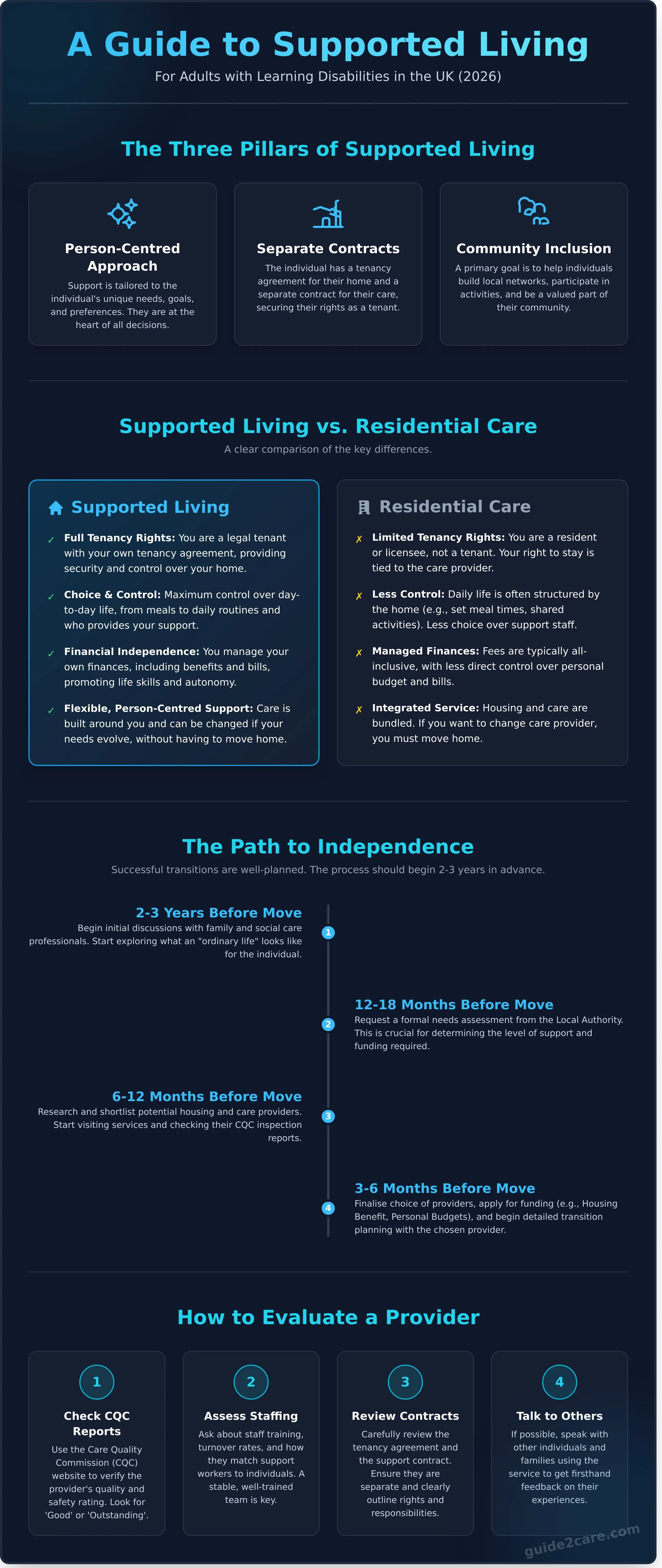
- Person-Centred Approach: All support is tailored to the unique needs, goals, and preferences of the individual. The person is at the centre of all planning and decision-making regarding their care.
- Separation of Housing and Support: The individual holds their own tenancy agreement with a landlord, which is separate from their agreement with a care provider. This gives them the rights and security of a tenant, not a patient or resident.
- Community Inclusion: A primary objective is to help individuals build local networks and participate in community life. This includes using local shops, joining clubs, or finding employment. For those looking to explore job opportunities, you can click here to see how a dedicated platform can help.
Who is it For? Eligibility and Suitability
Supported living is a flexible model suitable for adults across a wide spectrum of learning disabilities and autism. It can be successfully adapted to provide high levels of support for individuals with complex needs, including co-existing physical disabilities or behaviours that may be described as challenging. Eligibility is determined following a needs assessment conducted by your Local Authority's adult social care department. This assessment establishes the level of support required to live safely and independently.
The Mechanics of Supported Living: Housing, Care, and Law
Understanding what is supported living for adults with learning disabilities requires looking at its unique legal structure. The core principle is the separation of housing and care. An individual holds a tenancy agreement with a housing provider (like a housing association) and has a separate contract with a care provider for their support. This dual-contract model protects their rights as a citizen and tenant, ensuring their home is their own. This approach is central to the UK Government's National Statement of Expectations, which sets out standards for quality and security in supported housing.
The care and support element is regulated by the Care Quality Commission (CQC) in England. The CQC inspects care providers to ensure they are safe, effective, and responsive to people's needs. It does not regulate the housing itself. Furthermore, the sector is moving towards the "Building the Right Support" standards, which by 2026 will reinforce the focus on enabling people with learning disabilities to live fulfilling lives in their own communities, not in institutional settings. Staffing levels are determined by a detailed needs assessment, resulting in a tailored plan that may include dedicated 1:1 support or access to a pool of shared support hours with other tenants.
This tailored support can encompass a wide range of services, from daily living assistance to specialized therapeutic interventions. For example, in Australia's NDIS framework, a person's plan might include funding for an NDIS speech therapist Melbourne to help improve communication skills, demonstrating how support is built around specific individual goals.
The Tenancy Agreement: Rights and Responsibilities
In a supported living service, the individual is a tenant. They sign a formal tenancy or license agreement that outlines their rights and responsibilities, just like any other renter. If there are concerns about an individual's ability to understand and sign this legal document, a Mental Capacity Act assessment is completed. This ensures they are given all appropriate support to make the decision themselves. If they are found to lack capacity, decisions are made in their best interests, often with input from family or an appointed deputy. This legal status provides security of tenure, meaning a person cannot be moved from their home if their care provider changes.
Floating Support vs. 24/7 On-Site Presence
The type and intensity of support are matched to individual needs. This can range from a few hours a week to round-the-clock assistance. The main models include:
- Floating Support: Ideal for individuals who are mostly independent. A support worker visits for an agreed number of hours per week to assist with specific tasks like managing bills, attending appointments, or social activities.
- Shared Supported Living: Common in properties where several people with support needs live in their own flats or a shared house. Care staff are based on-site 24/7, providing a mix of planned 1:1 support and responding to ad-hoc requests from the tenants.
- Overnight Support: To ensure safety at night, services provide either a "sleep-in" shift, where staff sleep at the property but are available for emergencies, or a "waking night" shift, where a staff member is on duty and awake throughout the night for those with more complex needs.
Supported Living vs. Residential Care: A Comparison
A common misconception is that supported living is a "care home lite." This is incorrect. The two models are fundamentally different in their structure, funding, and philosophy. The primary distinction is that in supported living, accommodation and care are provided separately. This separation gives the individual more rights and control. Understanding this is essential when asking what is supported living for adults with learning disabilities.
The core difference lies in who holds the power. In supported living, the individual is a tenant with a legal tenancy agreement. In residential care, they are a resident in a home run by a provider.
Autonomy and Daily Life
The level of personal choice in daily life varies significantly between the two models. Supported living is designed to maximise independence through person-centred planning and "active support," where individuals are helped to do tasks for themselves.
- Choice and Control: In supported living, you choose where to live, who you live with (if anyone), and how to decorate your home. Daily schedules, mealtimes, and social activities are your decision. To make managing meals easier while maintaining a healthy diet, you can discover Eat Better Meals for fresh, ready-to-eat options. In residential care, the provider often makes these decisions, with more structured routines for all residents.
- Community Access: Supported living actively promotes integration. Support workers help tenants access local amenities, jobs, and social groups, making them part of their community. Residential care can sometimes be more insular, with activities centred within the home itself.
Financial Control and Benefits
How care is funded is a critical point of difference. The financial model for supported living empowers the individual, whereas the residential model is typically managed by the provider. As the official NHS guide to supported living services explains, this model is built on providing tailored support that the individual controls.
- Benefits and Tenancy: As a tenant, a person in supported living can claim benefits to cover costs. This often includes Universal Credit or Housing Benefit for rent and a Personal Budget from the local authority for care. They may also be entitled to the full rate of benefits like Personal Independence Payment (PIP).
- Funding Flow: In residential care, the local authority usually pays the provider a single fee for accommodation and care. The resident contributes from their benefits, but has no direct control over the total budget. In supported living, a Personal Budget allows the individual to purchase the specific care they need from their chosen provider.
To decide which model fits best, consider the individual’s skills and goals. If developing independence, managing a budget with help, and making personal choices are priorities, then exploring what is supported living for adults with learning disabilities is the correct next step. If an individual requires a higher level of all-inclusive, structured care in a communal setting, residential care may be more appropriate.
How to Evaluate and Choose a Supported Living Provider
Choosing the right provider is a critical step in finding the best care. A structured approach ensures you make an informed decision that aligns with the individual’s needs and preferences. To find the right answer to what is supported living for adults with learning disabilities, you must evaluate providers carefully. Start by identifying local services on a directory like Guide2Care, then follow a clear evaluation process.
Once you have a shortlist, visit the property. Observe the environment and the culture. Pay close attention to how staff and residents interact with one another. A positive, respectful atmosphere is a key indicator of quality care. Also, review the provider’s specific experience with different learning disability profiles, such as supporting non-verbal individuals or those with complex sensory needs.
Creating a safe, comfortable, and stimulating environment is also crucial. Many providers invest in sensory rooms or dedicated spaces with specialized equipment to help residents manage sensory input and relax. Specialist suppliers like SoftplayToys4kids offer a wide range of sensory-friendly equipment often used to create these supportive spaces.
Beyond permanent installations, leading providers also arrange unique group activities that are both educational and entertaining. For those looking for accessible, awe-inspiring events that can be brought on-site, you can discover Immersive Experiences and their mobile planetariums, which offer a fantastic sensory-friendly option.
Similarly, ensuring personal comfort in individual living spaces is key. For those who spend significant time seated for recreation or work, an ergonomic chair is a crucial piece of furniture. Online guides like TopGamingChair.com offer detailed reviews on supportive seating options that can greatly improve daily quality of life.
Key Questions to Ask During a Site Visit
Use your visit to gather specific information about the provider's operational practices. Direct questions help clarify their approach to staffing and resident well-being. Focus on stability, empowerment, and support strategies.
- Staffing: What are your staff turnover rates? How do you ensure continuity of care for residents?
- Involvement: How are residents involved in choosing new staff members who will be supporting them?
- Support: How is Positive Behaviour Support (PBS) implemented in daily practice, not just in theory?
Using CQC Ratings to Filter Your Search
The Care Quality Commission (CQC) provides impartial inspection reports for all regulated care services in England. The ratings are a vital tool for assessment. The four ratings are: Outstanding, Good, Requires Improvement, and Inadequate. Always check the latest CQC report for the provider’s "Support" registered activity. Pay special attention to the "Well-Led" and "Effective" categories, as these reflect management quality and the impact of the care provided. Note that from 2026, the CQC will have an increased focus on preventing "closed cultures," which restrict the lives of residents.
Finally, ask to see a sample "Transition Plan." This document shows how the provider manages the move from a family home or another care setting into their supported living service. It should detail a person-centred, phased approach to ensure the transition is as smooth and stress-free as possible.
While this guide focuses on the UK's supported living model, the core principles of finding person-centred, high-quality care are universal. It can be helpful to look at examples from different specialisms to understand what excellent support looks like. For instance, if you want to see how a dedicated mental health provider approaches individualized treatment, you can discover Safe Harbor Behavioral Health.
Transitioning to Independence: Next Steps with Guide2Care
Supported living represents the gold standard for promoting independence, choice, and control for adults with learning disabilities. It provides a clear framework for individuals to live in their own homes, make their own decisions, and be part of their community. Understanding what is supported living for adults with learning disabilities is the crucial first step. The next is planning the transition, a process that should ideally begin two to three years before the intended move to ensure a smooth and successful outcome.
This journey requires careful research and coordination. Guide2Care is designed to simplify the initial and most critical phase: finding and evaluating potential care providers across the UK.
Creating a Shortlist of Providers
Your first practical step is to identify suitable supported living providers in your desired area. Use the Guide2Care directory to filter your search specifically for "Learning Disabilities." This will generate a list of specialised providers. Aim to create a shortlist of three to five organisations. When comparing them, look at their Care Quality Commission (CQC) ratings, read reviews, and note their specific expertise. While our Finding a Care Home: The Complete UK Guide focuses on residential settings, its principles on how to research and vet providers are invaluable. Having a preliminary list gives you a strong starting point before engaging with official channels.
The Role of Social Workers and Advocates
Once you have an idea of available options, the formal process begins by contacting the adult social services department at your Local Authority to request a "Needs Assessment." This assessment is a legal requirement and will determine the individual's specific care needs and their eligibility for funding. It is essential that the person with the learning disability is at the centre of this process. You have a right to request an independent advocate to attend meetings and ensure their voice, preferences, and goals are clearly heard and respected. This formal assessment helps define exactly what supported living will look like for them.
The transition to supported living is a significant milestone that unlocks immense potential for a fulfilling and self-directed adult life. With careful planning and the right support network, individuals can thrive with greater independence and a stronger connection to their community. Start exploring your options today.
Find the Care You Need on Guide2Care Today.
Your Next Step: Finding The Right Supported Living Service
Ultimately, understanding what is supported living for adults with learning disabilities is about recognising a pathway to greater independence and personal choice. This model is fundamentally different from residential care because it separates housing from support, placing control firmly in the hands of the individual. By enabling people to choose where they live and who supports them, it fosters a true sense of home and autonomy, tailored to their specific needs and aspirations.
Navigating the options and finding a suitable provider is the crucial next phase. Guide2Care is designed to make this process clear and manageable. As a trusted UK-wide resource, we offer a comprehensive directory of CQC-registered providers and practical guides on funding and care types. We provide the tools you need to make an informed and confident decision. Begin your search today and find the care you need.
Explore Supported Living Providers Near You
Frequently Asked Questions
Is supported living safer than a residential care home?
Neither option is inherently safer; safety depends on the quality of the provider and the individual’s specific needs. Both supported living services and residential homes are regulated by the Care Quality Commission (CQC) in England, which inspects and rates them on safety. Supported living promotes greater independence, which involves different risk assessments compared to the constant supervision in a residential setting. Check the provider's latest CQC report to assess their performance on safety.
Who pays for supported living for an adult with a learning disability?
Funding for supported living is split into two parts: housing and care. The individual is responsible for their housing costs, such as rent and bills, which are typically covered by benefits like Universal Credit or Housing Benefit. The care and support element is usually funded by the local authority's adult social services, following a needs and financial assessment. This funding can be managed through a personal budget or a direct payment to the individual.
Can my child stay in supported living for their whole life?
Yes, supported living is designed to be a long-term housing solution. The individual holds their own tenancy agreement, which is separate from their care package. This provides them with the same rights and security as any other tenant. As their needs change over time, the level of support they receive can be increased or decreased. This flexibility allows them to remain in their own home for as long as it continues to be the right environment for them.
What happens if the care provider is not doing a good job?
If you have concerns, first use the care provider’s formal complaints procedure. If the issue is not resolved, contact the commissioning local authority social services department. You can also report significant concerns to the Care Quality Commission (CQC). A key benefit of supported living is that the housing and care are separate. This means it is possible to change the care provider without the individual having to move out of their home.
Can siblings or friends live together in a supported living house?
Yes, it is common for supported living arrangements to involve small groups of people living together in a shared house. This model allows siblings or friends with support needs to live together, fostering a sense of community and mutual support. The housing provider and local authority will work with the individuals to ensure the property and the group dynamic are suitable for everyone’s needs, and each person will have their own tailored support plan.
Does the individual need to have "Mental Capacity" to choose supported living?
An individual does not necessarily need to have mental capacity to live in this type of service. Under the Mental Capacity Act 2005, a person is assumed to have capacity unless it is proven otherwise. If an individual is assessed as lacking the capacity to make the decision, a 'best interests' decision is made on their behalf. This involves consulting with family, social workers, and advocates to determine the most appropriate living arrangement for them.
How many hours of support can someone get in supported living?
The amount of support is entirely flexible and based on the individual's assessed needs. Following a needs assessment by the local authority, a personalised support plan is created. This can range from just a few hours per week to assist with specific tasks like budgeting or attending appointments, right up to 24-hour support with sleep-in or waking-night staff for those with more complex needs. The goal is to provide enough support to enable independence.
What is the difference between supported living and social housing?
Social housing provides affordable rented accommodation but does not automatically include care services. The primary purpose of supported living is to combine accommodation with a separate, structured care and support package. Understanding what is supported living for adults with learning disabilities means recognising this crucial separation of tenancy and care. While the property might be rented from a social landlord, the key difference is the formal support plan designed to help the person live independently.