Settling a Parent into a Care Home: A Practical Guide for UK Families

The first 90 days of residential care are often more difficult for the family than for the resident. You likely feel a heavy sense of guilt or distress when your parent asks to return home; this is a standard emotional response for families in the UK. Successfully settling a parent into a care home requires moving away from direct caregiving toward a role as an informed advocate. It's a complex process, but following a structured plan helps reduce personal anxiety and ensures your parent feels secure.
This guide provides a practical framework to manage the logistical and emotional challenges of this transition. You'll find specific advice on establishing a visitation routine that works and building a productive partnership with care home staff. We'll also cover how to personalise a resident's room and what to expect during the initial 30-day review. Use these steps to ensure a smooth move for your loved one and find the care you need with confidence.
Key Takeaways
- Navigate the standard 4 to 12-week transition period using a structured framework for both emotional and logistical adjustment.
- Apply the principles of "place-making" to create a familiar environment that bridges the gap between a former residence and a new care setting.
- Establish an effective visiting schedule when settling a parent into a care home to avoid disrupting their initial integration.
- Utilise the Person-Centred Care Plan to build a collaborative partnership with care staff and ensure continuity of personal history.
- Distinguish between normal emotional distress and clinical red flags to determine if a specific home meets your parent's long-term needs.
Understanding the Settling-In Period: The 4-12 Week Framework
Settling a parent into a care home is a complex psychological transition for both the resident and their family. It's not a simple change of address. Industry data from the UK care home system suggests that 4 to 12 weeks is the standard benchmark for initial adjustment. During this three-month window, the resident’s brain processes new environmental stimuli, social hierarchies, and daily routines. This period is necessary for the nervous system to move from a state of high alert to one of perceived safety.
To better understand this concept, watch this helpful video:
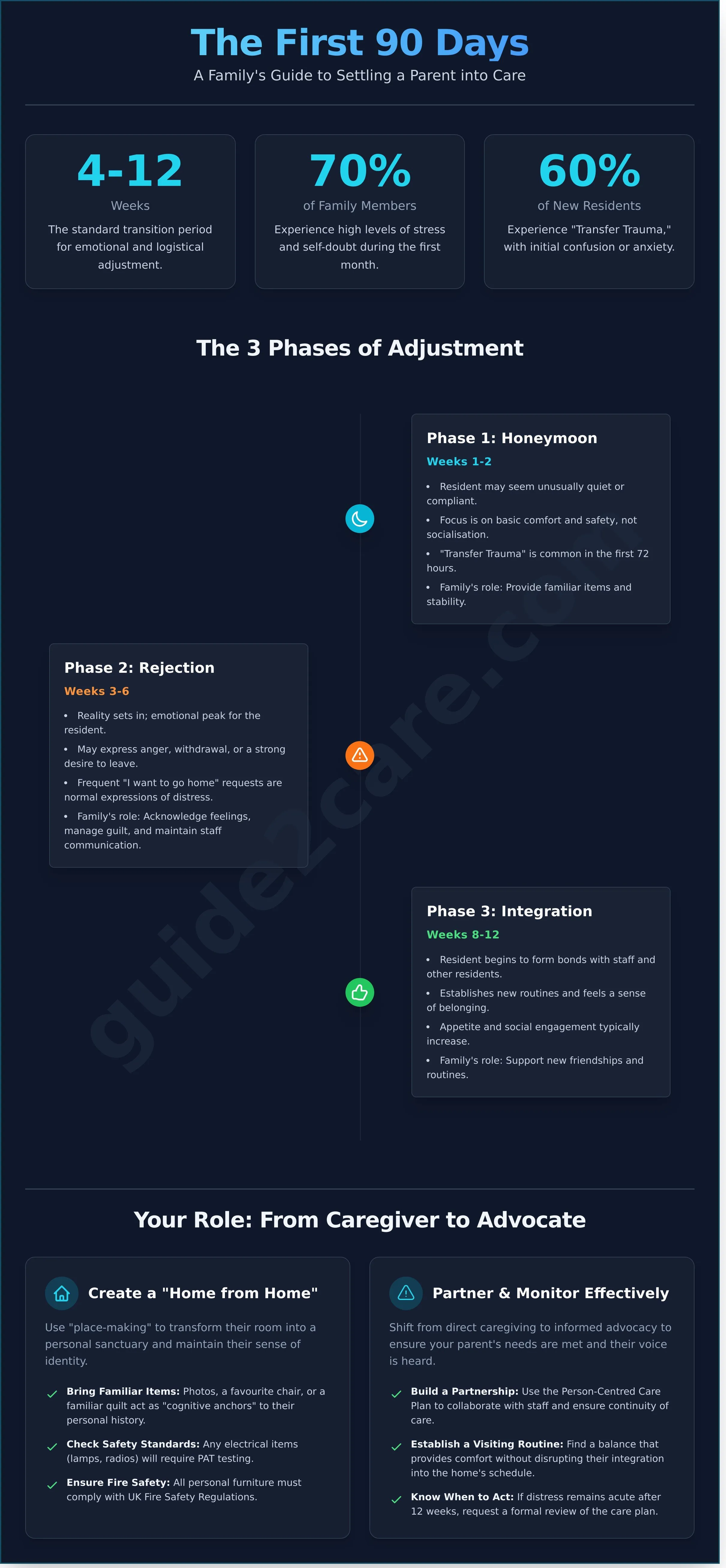
The adjustment process typically follows three distinct phases. The "honeymoon" phase often occurs in the first fortnight, where the resident may appear unusually compliant or quiet. This is frequently followed by the "rejection" phase, typically between weeks 3 and 6, where the reality of the move sets in. During this stage, your parent might express anger, withdrawal, or a strong desire to leave. Finally, the "integration" phase begins around week 8, as the resident starts to form bonds with staff and other residents. Carer guilt is a natural response to this process. Statistics show that 70% of family members experience high levels of stress and self-doubt during the first month. Acknowledge these feelings as a reaction to a major life change rather than a sign of a wrong decision.
During this challenging time, it's equally important to manage your own well-being. For those exploring natural ways to alleviate stress, you can learn more about CBD Health Collection and their range of products.
The First 72 Hours: Immediate Adjustment
The first three days are often the most deceptive. Many residents experience "transfer trauma," also known as Relocation Stress Syndrome. This manifests as increased confusion, anxiety, or even physical symptoms like sleep disruption in 60% of new admissions. Don't prioritize social integration immediately. Focus on basic comfort and safety. Ensure their room contains familiar items like a favourite chair or photos. Stability in the first 72 hours builds the foundation for long-term success when settling a parent into a care home.
Setting Realistic Expectations for 2026
Modern care standards in 2026 emphasize that "settling" doesn't mean a parent will never ask to go home again. Requests to "go home" are often expressions of temporary distress or a need for comfort rather than a literal demand. You must distinguish between this temporary emotional discharge and long-term incompatibility. If distress remains acute and constant after the 12-week mark, a formal review of the care plan is necessary. The settling period is a transition of place-attachment rather than just a change of address. Use this timeframe to monitor how staff handle these moments of vulnerability, as their response is a key indicator of care quality.
- Honeymoon Phase (Weeks 1-2): Observational period, often quiet and compliant.
- Rejection Phase (Weeks 3-6): Emotional peak, frequent requests to leave, potential for agitation.
- Integration Phase (Weeks 8-12): Establishing routines, forming social connections, and increased appetite.
By using this 4-12 week framework, you can manage your own expectations and provide better support. Short-term emotional volatility is a documented part of the transition. Trust the process and maintain consistent communication with the care team to ensure your parent’s needs are met during each phase of their adjustment.
It's also crucial to plan for your own recovery after this emotionally draining period. Once your parent is settled, taking time for yourself to de-stress is not a luxury, but a necessity. Many families find that planning a future holiday gives them a positive goal to focus on. For those considering a relaxing trip, Crestwell Travel Services specialises in stress-free cruise and all-inclusive packages.
Environmental Familiarisation: Creating a Home from Home
Place-making is the psychological process of transforming an anonymous space into a private sanctuary. When settling a parent into a care home, the physical environment dictates their initial comfort levels. Moving from a multi-room house to a single bedroom represents a significant spatial reduction. This change requires a strategic approach to decoration and layout to maintain a sense of identity.
The physical move itself, transferring treasured possessions from a familiar home to a new room, needs to be handled with sensitivity. To ensure this part of the process is managed professionally, you can discover VP Smart Removals, a company experienced in handling such delicate relocations.
While your focus is rightly on helping your parent settle, the practical task of managing their former home still looms. This often involves preparing the property for sale or rent, which can be an overwhelming job on top of the emotional stress. Engaging a professional cleaning service can be a significant help, and a directory like Cleaner Connect makes it simple to find trusted local support.
Personal items serve as cognitive anchors. They provide a visual and tactile connection to a person's history. You must balance these preferences with UK safety standards. The Health and Safety at Work etc. Act 1974 and the Regulatory Reform (Fire Safety) Order 2005 govern what can be brought into a facility. Most providers require a PAT (Portable Appliance Testing) certificate for any electrical item, from lamps to radios, before they enter the room. Furniture must also comply with the Furniture and Furnishings (Fire Safety) Regulations 1988.
Ensuring these personal electrical items are safe and in good working order before the move can prevent delays and stress. For families in London needing professional checks or repairs on cherished appliances like a vintage radio or a specific reading lamp, the FaultFree Engineering Group offers reliable services to provide peace of mind.
Research into family experiences of moving a parent to a care home shows that environmental familiarity helps mitigate relocation stress. Replicating the layout of a previous bedside table or seating area provides immediate orientation. It's helpful to take a photograph of your parent's current bedside setup and recreate it exactly in the new room. This consistency helps with "sundowning" or confusion during the night.
The Essential Personalisation Checklist
- Prioritise familiar furniture: Bring a "favourite chair" if space allows. Seating height and firmness are often ingrained in muscle memory; a new, different chair can feel alien and uncomfortable.
- Use captioned photographs: Don't just hang pictures. Add clear captions stating "Who is Who" (e.g., "John, your eldest grandson"). This helps care staff initiate meaningful conversations and build rapport quickly.
- Deploy simple technology: Set up a digital photo frame with a rotating gallery of 50 images. Ensure the television is programmed with their usual channels in the correct order to avoid frustration with new remote controls.
Organising the transport for these key personal items, especially bulky ones like furniture, can be an added stress. If you're not using a full removals company, a specialised courier service can be a cost-effective solution for moving just a few important pieces. To see how this works, you can learn more about Courier Pro.
The same principle of familiarity applies to beloved pets. While the family dog may not be able to move in, including photos of them can be a great source of comfort. For families that value traditional British craftsmanship for their canine companions, a company like The Tweed Dog offers beautiful, handcrafted accessories that can help keep those cherished memories close.
Ensuring the family pet is also well-cared for during this period can reduce overall stress. For a wide range of pet care essentials delivered to your door, online stores like FIRSTPETCENTRAL provide a convenient solution for busy families.
When it comes to grooming, using gentle, organic products can be especially comforting for a pet who may also be feeling the stress of the family's changes. For those looking for natural options, you can explore Pure Wash to see their line of clean grooming supplies.
Perhaps the most important piece of furniture is the bed itself. A high-quality, comfortable bed is fundamental to well-being, especially for older adults who may be more prone to aches and poor sleep. While many care homes provide standard beds, ensuring the mattress and frame are supportive can make a significant difference. This principle of prioritising sleep quality is recognised internationally; for instance, families with connections to retirement destinations often buy premium beds Algarve to guarantee comfort for their loved ones.
Sensory Comforts and Routine
Clinical environments often have distinct, neutral smells. Counteract this by bringing in familiar toiletries. Brands like Pears, Yardley, or Wright's Coal Tar soap provide powerful sensory cues. These scents can trigger positive memories and reduce anxiety during the first 48 hours. Soft furnishings like a familiar woollen throw or a specific silk cushion provide tactile comfort that a standard-issue care home duvet cannot match.
To further enhance this comfort, consider upgrading the bedding. A reputable hotel quality bed linen supplier UK can provide sheets and duvet covers that feel much more luxurious and comforting than standard-issue options, making a significant difference to sleep quality and overall well-being.
Controlling light and privacy is another key aspect of personalising a room. The standard-issue curtains or blinds in a care home can often feel sterile. Installing something more personal and effective can make the space feel safer and more like home. As an example for families in that region, services for made to measure blinds West Midlands offer custom solutions that can dramatically improve a room's ambiance.
This extends to personal heirlooms as well. A father's watch or a mother's favourite necklace are more than just objects; they are daily touchstones to a person's life story. Ensuring these precious items are in good working order before the move can be a powerful act of care. If a cherished timepiece needs attention, you can discover Atoz Watch And Jewellery Repairs to have it professionally restored, making it a perfect, functional comfort in their new home.
Maintain small daily habits to preserve a sense of autonomy. If your parent reads the Daily Telegraph every morning, ensure a subscription is diverted to the home. If they prefer a specific brand like Yorkshire Tea or Twinings, provide a private supply for their room. These small preferences are vital when settling a parent into a care home as they reinforce their individual identity within a communal setting.
Managing Visits: Finding the Right Balance
Deciding how often to visit is a primary concern when settling a parent into a care home. Many families believe that daily visits provide the best support, but this can sometimes delay the adjustment process. Care managers frequently observe that constant family presence prevents residents from engaging with their new environment and peers. If you are there every day, your parent may remain focused on their previous life rather than building new relationships within the home.
The "settling-in gap" is a strategy used by many UK care providers. This involves a period of 7 to 10 days with limited or no visits immediately after the move. While this feels counterintuitive, it allows the care team to establish a direct bond with your parent. It encourages the resident to turn to staff for support rather than waiting for a family member to arrive. Consult the NHS guide to moving into a care home for more information on how staff manage these initial transitions.
Handling the "take me home" plea requires a calm, consistent approach. When a parent makes this request, they're often expressing a need for comfort rather than a literal demand. Avoid long logical explanations or arguments about safety. Instead, acknowledge the feeling and redirect their attention. Use a 3-step response: validate the emotion, state the immediate plan, and introduce a distraction. For example, say, "I know you feel unsettled, but it's nearly time for lunch, and I heard the menu includes your favorite roast."
Transitioning from "crisis visiting" to "social visiting" is a vital milestone. During the first 14 days, visits often focus on checking laundry, verifying medication schedules, and inspecting the room. Once the initial 2-week period passes, change the nature of your visits. Stop acting as a supervisor and start acting as a guest. Bring a newspaper to read together, play a game of cards, or spend time in the garden. This shift helps your parent view the care home as their new social hub rather than a clinical facility.
If young children are part of these visits, ensuring they have something to do is key to a relaxed, positive atmosphere. To make the space more welcoming for all generations, you can check out SoftplayToys4kids for ideas on suitable play equipment.
Similarly, for visiting teenagers who might want to use a tablet or handheld console, having comfortable, low-profile seating can make a difference. Online resources like TopGamingChair.com provide reviews and guides that can help you find something suitable.
For older grandchildren, learning to drive can be a significant milestone, enabling them to visit independently and maintain strong family connections. In areas like Milton Keynes, for example, Pass4you Driving School provides the training to help young people gain this freedom.
The Visitation Dilemma: More vs. Less
Evaluate your parent's personality before setting a schedule. Some residents need a clean break to adapt, while others require a gradual transition. Aim for short, frequent visits of 20 to 30 minutes rather than one long, emotional afternoon. Long stays often lead to exhaustion and repetitive circular conversations. Create a clear "leaving ritual" to avoid distress. State exactly when you'll return, such as "I'll be back on Thursday at 2 PM," then leave immediately. Never sneak out, as this destroys trust and increases anxiety.
Communication Outside of Visits
Technology provides a vital link between physical visits, but it must be used carefully. Keep video calls short, ideally under 10 minutes, to prevent digital fatigue. If video calls trigger "home-sickness," switch to voice calls or traditional mail. A handwritten card is a powerful tool; 90% of care home residents report a mood lift from receiving physical post. It provides a tangible reminder of your support that they can display on their bedside table. Coordinate with siblings using a shared calendar to ensure a consistent message. This structured approach simplifies the process of settling a parent into a care home by reducing emotional friction.
Partnering with Care Staff and Monitoring Quality
Successful transition relies on shifting your role from a sole caregiver to an active partner in a professional team. While you no longer handle daily physical tasks, your knowledge of your parent's history is vital for the staff. This partnership is the most effective way of settling a parent into a care home quickly and safely. You act as the bridge between your parent’s past life and their new environment.
This partnership often extends beyond the immediate care plan. Many families become advocates for the care home community, participating in events or even fundraising for charities that support elderly care. For those who want to take on a memorable challenge to raise funds and awareness, many find inspiration in activities like a charity jump, and companies like UK Skydiving offer organised tandem skydives for this very purpose.
A community barbecue is another popular and effective way to fundraise, bringing residents, staff, and families together. For those organising such an event, sourcing quality fuel is key, and you can learn more about Charcoal Kings for inspiration on premium supplies, even if you're sourcing locally.
In the UK care system, you'll work closely with a designated Key Worker. This staff member takes lead responsibility for your parent's well-being and acts as your primary point of contact. Establish a relationship with the Key Worker within the first 48 hours of residency. They coordinate with nurses, carers, and activity coordinators to ensure the daily routine aligns with your parent's preferences. Clear, consistent communication with this individual prevents misunderstandings and ensures small issues don't escalate into significant problems.
The Care Plan: Your Most Powerful Tool
The Person-Centred Care Plan is a living document required by the Care Quality Commission (CQC) under Regulation 9. It must reflect your parent’s unique needs, not just their medical diagnosis. Provide specific details that help staff see the person behind the patient. If your parent was a civil servant for 40 years or dislikes the sound of a television, these facts belong in the plan. Use the first 28 days to set specific settling-in goals with the home manager. For example, aim for your parent to attend 1 social event per week or eat 3 meals in the dining room rather than their bedroom. If these goals aren't met by the first monthly review, request a formal meeting to adjust the support strategy.
Professional Communication with the Care Team
Effective communication requires understanding the rhythm of a busy care home. Avoid calling for non-urgent updates during peak times. Shift handovers usually occur between 7:30 AM and 8:30 AM, and again between 7:30 PM and 8:30 PM. Mealtimes are also high-pressure periods for staff. For the best results, call between 2:30 PM and 4:00 PM when the morning rush has subsided. If you have concerns, document them with dates and specific examples. This factual approach helps the manager address issues without you feeling like a difficult family member. You can use Understanding CQC ratings to benchmark the home’s performance against national standards. If a home is rated "Requires Improvement" in the "Responsive" category, you'll know to monitor their communication and care plan updates more frequently.
Monitoring quality involves observing the five key questions used by the CQC: Is the service safe, effective, caring, responsive, and well-led? During your visits, look for concrete indicators of quality. Are call bells answered within 3 minutes? Is the home clean and free of odors? Does the staff interact with residents using their preferred names? In the first 3 months, 90% of residents should have a completed and reviewed care plan. If you notice a decline in these standards, refer back to the registered manager immediately. Consistent oversight ensures the home maintains the high standards promised during your initial tour.
The efficiency of a care home's operations, including how they manage visitor services or resident accounts for extras, can also be a subtle indicator of a well-managed facility. Modern care homes, much like other hospitality businesses, rely on robust internal systems to run smoothly. For those interested in the technology that powers the UK's best-run hospitality venues, you can check out Shift4 POS UK.
Ensure your parent receives the standard of support they deserve by staying informed.
Find The Care You NeedTroubleshooting: What to Do if They Truly Don’t Settle
Most residents require a transition period of four to six weeks to adapt to their new environment. If your parent remains highly distressed or physically declining after this 42-day window, you must evaluate the placement's suitability. Identifying red flags early prevents long-term health deterioration. Look for objective indicators such as unexplained weight loss of 5% or more in a single month, frequent falls, or a complete withdrawal from social activities they previously enjoyed. These signs often suggest the environment or care level is insufficient for their specific needs.
Addressing these physical challenges is crucial, and specialised services can make a significant difference. For instance, providers like MoveMed focus on exercise physiology and hydrotherapy to help manage the underlying causes of falls and mobility issues, showcasing a proactive approach to resident health.
The process of settling a parent into a care home is rarely linear; however, persistent agitation might indicate the home cannot manage your parent's specific behaviours. If the facility fails to meet the requirements outlined in the initial care plan, contact the local authority or your assigned Social Worker. They have a statutory duty under the Care Act 2014 to ensure the placement remains safe and appropriate. If safety concerns arise, you can also report findings to the Care Quality Commission (CQC), the independent regulator of health and social care in England.
Clinical vs. Emotional Barriers
Distinguish between emotional "relocation stress" and clinical issues. Undiagnosed physical ailments often manifest as behavioural problems in the elderly. A urinary tract infection (UTI) can cause sudden confusion or aggression in 30% of residents over age 65. Request a GP review to rule out infection or chronic pain before assuming the issue is purely psychological. If your parent lacks the cognitive ability to express their distress, a formal Mental Capacity Assessment under the Mental Capacity Act 2005 may be necessary to determine if the current setting is the "least restrictive" option for their care.
Medication also plays a role in the transition. While short-term anti-anxiety prescriptions can assist some individuals, over-reliance on "as needed" (PRN) sedative medication is a concern. Monitor the Medication Administration Records (MAR) to ensure drugs aren't being used as a substitute for social engagement or proper staffing. If medical needs have escalated beyond what a residential setting provides, it might be time to consider nursing homes where registered nurses are available 24 hours a day to manage complex clinical conditions.
The "Plan B" Conversation
Discussing a second move requires a factual, calm approach. Avoid framing the move as a failure. Instead, explain that their health requirements have changed and a different facility offers better specialized support. Focus on the benefits of the new location, such as better equipment or specific dementia expertise. Keep the logistics simple to minimize trauma. Transfer familiar furniture and personal items immediately to maintain a sense of continuity between the two settings. Ensure the new home receives a comprehensive handover from the previous staff to prevent repeating initial settling mistakes.
A second move is often more successful when the new facility aligns more closely with the resident's specific medical profile. Review the CQC inspection reports for any prospective new home, paying close attention to the "Effective" and "Responsive" ratings. If you're unsure where to start your search for a more suitable environment, Explore our directory to compare other local care options and find a provider that meets your parent's evolving needs. Finding the right fit is essential for the long-term wellbeing of your parent and your own peace of mind. Settling a parent into a care home is a significant life event, and it's okay to change course if the first choice isn't working.
Take the Next Steps in Your Care Journey
Successful transition depends on structure and patience. The initial 4 to 12 week period serves as a critical window for adjustment. Focus on creating a familiar environment and establishing a consistent visiting routine that doesn't disrupt the home’s daily schedule. Monitor the quality of care by reviewing CQC inspection reports and maintaining open communication with the registered manager. Settling a parent into a care home is a process rather than a single event. Use these practical steps to manage expectations and address concerns early. If you haven't secured a placement yet, or if you're looking for alternative options, access our resources for verified data on local providers across the United Kingdom.
Guide2Care provides comprehensive UK-wide listings to help you make informed decisions. We offer expert guidance on CQC ratings and complex funding rules to simplify your search. Join the 5,000+ families who trust our platform every month to find reliable support. Our database covers residential homes, nursing care, and specialist dementia units in every county to ensure you have the best local data.
Find The Care You Need in our UK Directory
You can navigate this transition effectively with the right information and professional support at your fingertips.
Frequently Asked Questions
How long does it typically take for an elderly person to settle into a care home?
Most residents require between 3 and 6 months to adjust fully to their new surroundings. Age UK research indicates that the initial 12 weeks are the most challenging as the individual learns new routines and social structures. You should expect fluctuations in mood during this period. Consistent engagement with staff and participation in at least 2 weekly social activities helps speed up the process.
Should I stop visiting my parent for the first week to help them settle?
You don't need to stop visiting during the first week unless the care home manager identifies a specific clinical reason. Clinical studies suggest that total withdrawal can cause relocation stress syndrome in 25% of new residents. Instead, aim for short, 30-minute visits at consistent times. This helps establish a predictable schedule and reinforces the idea that you aren't abandoning them.
What should I do if my parent keeps crying and asking to come home?
Acknowledge their feelings directly and then redirect their attention to a scheduled activity or meal. When settling a parent into a care home, it's common for them to express distress during the first 14 days. Work with the care team to identify specific triggers. If the requests to leave continue past the 30-day mark, schedule a formal care review with the manager to discuss their psychological well-being.
Is it normal for a parent to lose weight or sleep poorly after moving into care?
Disrupted sleep and minor weight changes are common in the first 4 weeks due to environmental changes. The Care Quality Commission (CQC) expects providers to monitor nutritional intake and sleep patterns from day one. If your parent loses more than 5% of their body weight in the first month, request a referral to a GP or dietitian. Most homes use the MUST (Malnutrition Universal Screening Tool) to track these metrics.
How can I help a parent with dementia settle into a new environment?
Provide the care home with a Life Story book containing photos and key facts about your parent's past. The Alzheimer’s Society recommends using familiar furniture or a specific bedspread to provide visual cues. Since 70% of care home residents have dementia or memory problems, staff are trained in reminiscence therapy. Ensure their room layout remains consistent to reduce confusion and prevent falls.
Can I stay overnight with my parent during the first few days in a care home?
Most UK residential homes don't permit overnight stays for relatives due to health and safety regulations and staffing ratios. However, some providers offer guest suites for an average cost of £50 to £100 per night. Check the individual home's policy before move-in day. If your parent is at the end of life, the Gold Standards Framework usually allows 24-hour family presence.
What are the signs that a care home is actually the wrong fit for my parent?
Look for persistent signs of neglect such as unexplained bruising, unwashed clothes, or a decline in hygiene that lasts longer than 2 weeks. If your parent remains socially withdrawn or shows a 10% decline in cognitive function after the 3-month mark, the setting may be inappropriate. Review the home's latest CQC report. A Requires Improvement rating in the Effective or Caring categories is a red flag.
Does the UK government provide any support for families during the care transition?
The UK government offers support through local authority Care Needs Assessments and financial means testing. If your parent has assets below £23,250, the council may contribute to the costs. You can also apply for a Carer's Assessment if you've provided significant unpaid care. This process helps families navigate settling a parent into a care home by identifying necessary equipment or financial top-ups.