Specialist Dementia Nursing Care UK: The 2026 Comprehensive Guide
Choosing a care facility based on the quality of the carpets rather than the clinical staffing ratio is the most common mistake made by families in 2026. Finding specialist dementia nursing care in the UK often feels like learning a complex medical language during a period of high emotional stress. You likely feel confused by the difference between RGN and RMN qualifications or anxious about how the £1,200 plus weekly costs will be met. It's a difficult transition that often carries an unnecessary weight of guilt.
It's understandable to feel overwhelmed by these technicalities and the weight of this decision. This guide simplifies the search by providing clear definitions of clinical requirements and a practical framework for your site visits. You'll learn exactly what to look for in a secure unit and how to navigate the strict criteria for NHS Continuing Healthcare funding. We'll explore the specific staffing levels, 2026 cost benchmarks, and funding pathways you need to ensure the best possible clinical outcome for your family member.
Key Takeaways
- Understand the critical distinction between standard residential support and specialist dementia nursing care uk designed for complex clinical needs and advanced physical decline.
- Identify the essential roles of Registered Mental Health Nurses (RMNs) and why their expertise is the backbone of effective clinical dementia units.
- Apply a practical 5-point checklist to evaluate potential nursing homes based on clinical standards rather than aesthetic "hotel" features.
- Navigate the complexities of NHS Continuing Healthcare (CHC) funding and learn how to prepare for the "Primary Health Need" assessment.
- Use the Guide2Care directory to efficiently filter for specialist providers and find the care you need near your local support network.
What Defines Specialist Dementia Nursing Care in the UK?
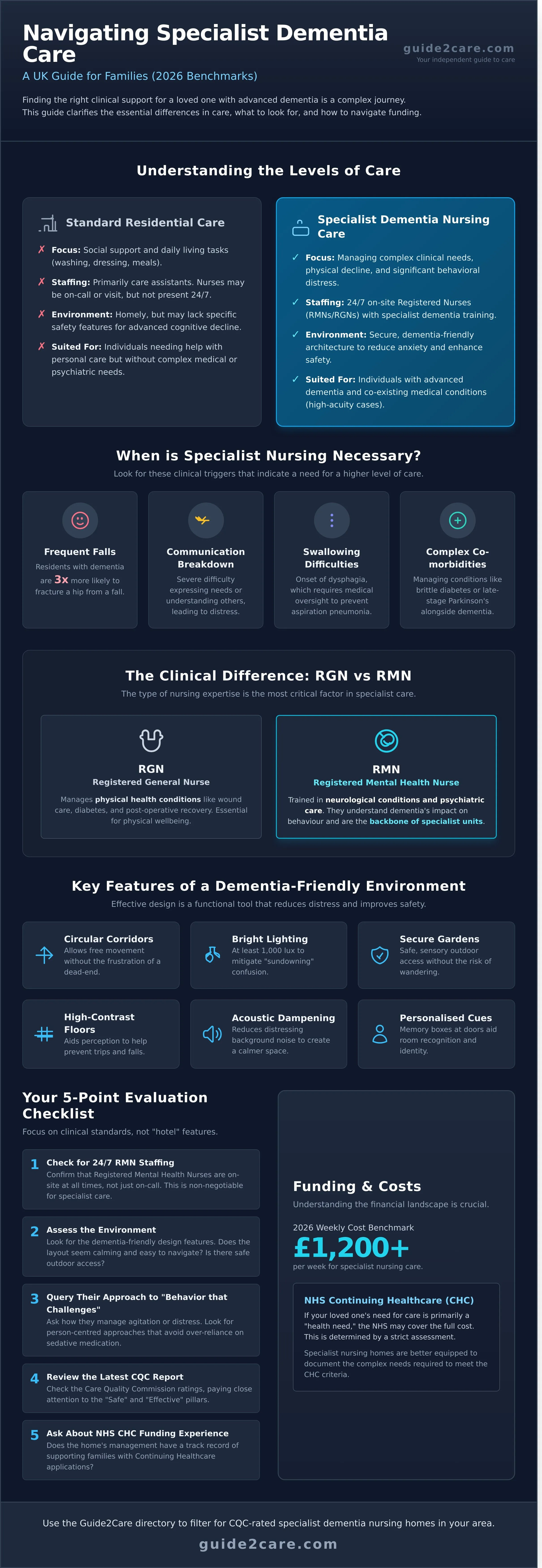
Specialist dementia nursing care uk refers to a specific tier of clinical support designed for individuals with advanced cognitive decline and complex medical needs. This isn't standard residential care. It involves 24-hour supervision by Registered Mental Health Nurses (RMNs) or Registered General Nurses (RGNs) who possess specific training in neurological conditions. These professionals manage "high-acuity" cases where symptoms include severe physical decline, complex medication regimes, or significant behavioral distress. While residential care focuses on social support and daily living tasks, specialist nursing care addresses the intersection of cognitive failure and physical illness.
The Care Quality Commission (CQC) regulates these services under the Health and Social Care Act 2008. Every provider must demonstrate compliance with five key pillars: safety, effectiveness, care, responsiveness, and leadership. In the UK, specialist nursing units must meet higher staffing ratios than standard homes. Data from the 2023 CQC State of Care report indicates that specialist providers are increasingly monitored for their ability to manage "behavior that challenges" without relying on sedative prescriptions. By 2026, the sector is moving toward a mandatory "person-centred" environment standard. This shift requires facilities to move away from traditional clinical layouts toward domestic-style settings that still maintain hospital-grade medical capabilities.
When is Specialist Nursing Necessary?
Determining the right time for specialist nursing involves looking at specific clinical triggers. You should consider this level of care if a loved one experiences frequent, unexplained falls; statistics show that residents with dementia are three times more likely to fracture a hip than those without. Severe communication breakdown or the onset of dysphagia (swallowing difficulties) also necessitates medical oversight to prevent aspiration pneumonia. Complex co-morbidities, such as brittle diabetes or late-stage Parkinson's disease, require the constant presence of clinical staff to manage fluctuating health markers. Specialist teams, which often include or work alongside Admiral Nurses, provide the high-level expertise needed to coordinate this multifaceted care. The transition from residential to nursing care occurs when the clinical risk to the individual's safety exceeds the capability of non-medical staff to manage.
While addressing the primary neurological condition is key, managing co-existing physical issues like poor balance is also crucial for safety and quality of life. Families exploring all avenues for support may find resources for specialized practitioners through directories like Upper Cervical Care, which focuses on a specific area of chiropractic care related to the nervous system and stability. To find a provider in their directory, you can click here.
The Role of Secure Environments
Specialist units utilize "dementia-friendly" architecture to reduce anxiety and improve safety. This includes high-contrast flooring to prevent trips and lighting levels of at least 1,000 lux in communal areas to mitigate the effects of "sundowning," a period of increased confusion that occurs as natural light fades. Design features like circular corridors are essential; they allow residents to walk freely without encountering the frustration of a dead-end door, which often triggers agitation. Safe outdoor access is a legal requirement for many high-tier providers, offering secure sensory gardens that allow for fresh air without the risk of "wandering" into dangerous areas.
The 2026 industry focus emphasizes sensory-integrated care environments. This means moving beyond simple safety and incorporating tactile walls, acoustic dampening to reduce distressing background noise, and personalized memory boxes at room entrances. These elements don't just look better; they're functional tools that reduce the need for physical or chemical restraint. By creating an environment that compensates for cognitive loss, specialist providers can manage complex behaviors through design rather than restriction. It's a method that prioritizes the dignity of the resident while maintaining the high level of security required for advanced dementia care.
The Clinical Difference: RMNs, Admiral Nurses, and Specialist Staffing
Specialist dementia nursing care uk facilities operate with a different clinical focus than standard nursing homes. The primary distinction lies in the type of nursing expertise available on-site. Registered General Nurses (RGNs) primarily manage physical health conditions, such as wound care, diabetes, or post-operative recovery. While RGNs are essential for physical health, they may lack the specific psychiatric training required to manage complex dementia. Registered Mental Health Nurses (RMNs) provide the clinical foundation for specialist units. They're trained to understand the neurological changes associated with different types of dementia, including Alzheimer’s and Lewy Body dementia. This expertise is why RMNs are considered the backbone of specialist dementia nursing care uk.
RMNs identify whether a resident’s distress is caused by physical pain, environmental triggers, or a progression of the condition. Because these needs are often complex, residents in these settings frequently qualify for NHS CHC funding, which covers the full cost of care for those with a primary health need. Specialist units also utilize Admiral Nurses, who are specialist dementia nurses supported by the charity Dementia UK. These professionals provide a vital link between the clinical team and the resident's family, offering psychological support and practical advice to relatives who may be struggling with the transition.
Registered Mental Health Nurses (RMNs) Explained
RMNs manage the neuropsychiatric symptoms of dementia, such as agitation, aggression, or hallucinations. They lead the care team in de-escalation techniques, using non-pharmacological interventions before considering medication. This approach reduces the reliance on sedative "as-required" (PRN) medications. When visiting a home, ask for their RMN-to-resident ratio. High-quality specialist units often maintain a ratio of one nurse to five residents during peak day hours. Night-time staffing should also include at least one RMN to manage nocturnal wandering or sundowning symptoms.
The expertise of mental health professionals is vital across many specialized fields. For families who may also be navigating the complexities of addiction, you can discover Detox Rehab Clinics UK for independent advice on treatment and support.
Support Staff and Specialist Training
The quality of daily care depends on the training of the care assistants. The 2018 Dementia Training Standards Framework sets out clear tiers for staff development. In a specialist setting, you should expect all care staff to have completed Tier 2 training, which covers 14 essential areas of dementia care. Senior staff often hold Tier 3 qualifications, enabling them to lead complex care planning. Consistent staffing is also vital. Staff turnover rates in the UK care sector averaged 28.3% in 2023. Specialist units that prioritize consistent staffing help residents with memory loss feel secure, as familiar faces reduce the anxiety that often triggers distressed behaviors.
- Occupational Therapists (OTs): These professionals adapt the environment to reduce confusion. They might introduce specific signage, lighting, or sensory equipment to help residents maintain independence.
- Contact Hours: Specialist units provide more "contact hours" per resident. This means staff spend more time on meaningful engagement rather than just task-based care like feeding or dressing.
- Specialist Ratios: Standard residential homes might have a 1:10 ratio, but specialist dementia units aim for 1:5 or 1:4 to ensure safety and individual attention.
Effective care requires a multidisciplinary team that understands both the clinical and emotional aspects of the condition. If you're unsure which level of support your loved one requires, compare specialist providers to see how their staffing models and clinical expertise differ.
How to Evaluate a Specialist Dementia Nursing Home
Choosing a facility for specialist dementia nursing care uk requires a move beyond surface-level aesthetics. High-end furnishings and modern lobbies don't guarantee clinical competence. You must focus on the ward's daily reality. Visit during peak hours, such as the 12:00 PM lunch service or the 4:00 PM shift change. These windows reveal how the team manages high-pressure moments and whether residents receive individual attention when the home is busiest. A home that looks like a boutique hotel but lacks specialized staff is not a safe choice for advanced dementia.
The Specialist Care Checklist
Use this five-point checklist to assess the clinical and social environment. Effective care follows the NICE guidelines for dementia care, which prioritize person-centered support and dignity. Use these points to guide your tour:
- Meaningful Activity: Look for schedules tailored to different cognitive stages. 2:00 PM shouldn't just be "TV time" for everyone. Check for evidence of sensory stimulation or one-to-one engagement for those in later stages.
- Nutrition and Hydration: Observe if hydration stations are accessible. Are snacks and drinks designed for independent access, such as finger foods for those who struggle with cutlery? Check if staff are actively assisting those who can't feed themselves.
- Life Story Integration: Check if "Life Story" books or memory boxes are visible near residents' rooms. Staff should use this personal history to de-escalate distress and spark conversation.
- Specialist Equipment: Look for floor-level beds to prevent fall injuries and motion sensors that alert nurses to movement at night without disturbing the resident. Ask about the ratio of pressure-relieving mattresses available.
- Staff Interaction: Watch the body language. Do staff kneel to make eye contact? Do they use the resident's preferred name? Consistency is key, so ask about the percentage of agency staff used in the last 30 days.
Sourcing and delivering this type of specialized equipment requires a robust logistics network, a challenge familiar to many industries. For businesses managing complex supply chains, freight forwarding specialists like gateway-cargo.com provide essential support.
Reviewing CQC Ratings for Dementia Care
The Care Quality Commission (CQC) provides a baseline, but you must look deeper than the overall rating. A home rated "Good" overall might have a specialist dementia wing that hasn't been inspected separately for 24 months. Ensure the report date is current for 2026. If the last full inspection was before 2024, the data may not reflect the current management team or staffing levels. You should ask the manager for their most recent internal quality audit if the CQC data is older than 12 months.
Focus on the "Effective" and "Well-led" categories. The "Effective" rating tells you if staff have the specific qualifications required for specialist dementia nursing care uk. A "Well-led" rating indicates a stable management structure, which is vital for consistency; achieving this often involves robust back-office systems and out-of-hours management from specialist support services like Contesto. Check the "Safe" category for markers regarding medication management. Look for mentions of "PRN" (as needed) medication. High usage of sedatives to manage behavior is a red flag. Inadequate markers in these sections often signal a lack of specialized training for complex needs. If a report mentions "delayed response times to call bells," it's a clear sign that the clinical reality doesn't match the marketing brochures.
While your search is focused on the UK, looking at international examples of high-quality care can provide a useful benchmark for what to expect. For instance, you can discover Im with you, an Australian NDIS provider, to see how different systems approach person-centred support and quality standards.
Funding Specialist Dementia Care: NHS CHC and Local Authority Support
NHS Continuing Healthcare (CHC) is the primary funding route for individuals with intense or complex health requirements. If you qualify, the NHS pays the full cost of specialist dementia nursing care uk. This includes care home fees and personal care costs. Eligibility depends on the "Primary Health Need" test. This test determines if your care needs are mainly health-based rather than social. Many families find this test difficult to pass for dementia. Assessors often categorize cognitive decline or wandering as social needs, even when they require constant supervision. To succeed, you must demonstrate that the care is complex, intense, or unpredictable.
If you don't qualify for CHC, you may face Local Authority means-testing. In England, the current upper capital limit is £23,250. If your assets exceed this, you must fund your own care. The lower limit is £14,250. If your assets fall between these two figures, the council contributes to your costs. The government plans to implement new thresholds in October 2026. Under these proposals, the upper limit will rise to £100,000 and the lower limit to £20,000. These changes aim to reduce the financial burden on homeowners and those with modest savings.
Individuals who require nursing care but fail the CHC assessment can often claim NHS Funded Nursing Care (FNC). This is a flat-rate contribution toward the cost of registered nursing staff. For the 2024/25 financial year, the standard FNC rate in England is £235.88 per week. The NHS pays this directly to the care home. It's not a personal benefit, but it reduces the overall bill you or the council pays.
Navigating the CHC Assessment Process
The assessment follows a strict two-step process. First, a health professional completes a "Checklist" to see if you require a full assessment. If you meet the threshold, a Multi-Disciplinary Team (MDT) evaluates your needs. This team includes at least two professionals, such as a social worker and a nurse. They use the Decision Support Tool to rate 12 different domains of health. One useful tip is to document every "unpredictable" health event. If a patient's condition changes rapidly or requires emergency intervention, record it. Frequent, unpredictable needs are more likely to satisfy the Primary Health Need criteria.
Self-Funding and Third-Party Contributions
When a Local Authority contributes to costs, they often pay a set "usual cost" for a room. If you choose a home that charges more than this rate, a "top-up fee" applies. A third party, such as a family member, must usually pay this difference. The resident cannot pay their own top-up fee from their own capital in most cases. If you own a home and move into permanent care, look into the 12-week property disregard. The council ignores the value of your property for the first 12 weeks of your stay. This gives you time to sell the house or arrange a deferred payment agreement. Find more about funding care on Guide2Care.
Understanding your financial options is the first step toward securing high-quality support. Find the care you need by exploring our directory of UK providers.
Finding the Right Specialist Provider with Guide2Care
Finding specialist dementia nursing care uk wide involves managing complex medical requirements and emotional transitions. Guide2Care simplifies this search by providing a centralized database of vetted providers. Most families spend over 15 hours searching for care independently; our platform reduces this time by organizing information logically. You can access clinical details and contact information without navigating multiple external websites or making dozens of speculative phone calls.
Using the Guide2Care Directory
Use the search bar to enter your specific location or postcode. Select "Nursing Home" under the primary care category and apply the "Dementia" filter to refine the results. This process ensures you only view providers equipped with the registered nursing staff necessary for advanced care. The directory works as a functional tool to narrow your options from hundreds to a manageable shortlist of relevant facilities.
This structured approach saves time and ensures clinical suitability. Once you have a list, examine the individual provider profiles. These profiles contain direct contact details and options to request brochures. Contacting homes directly through the site allows you to gather specific information about bed availability and fee structures without delay. Find the care you need today to begin evaluating your local options.
Prioritizing local search is vital for long-term resident wellbeing. Proximity to a family support network is crucial, as data from 2023 suggests that residents with frequent family contact maintain higher cognitive engagement levels. Use the directory to find homes within a specific radius of your home or workplace to make regular visits more sustainable for your family.
Empowering Your Decision
Knowledge of clinical standards serves as your most effective tool for advocacy. Understanding what constitutes high-quality specialist dementia nursing care uk standards allows you to ask the right questions during site visits. You should compare at least three different providers to understand the variation in facilities and staff expertise. Look for specific mentions of sensory environments or specialized nutrition plans in their profiles to see how they handle complex needs.
Reviewing the specific clinical offerings of different homes is a necessary step. Some may offer specialized end-of-life care while others focus on early-onset dementia support. Identifying these distinctions early prevents unnecessary moves for your loved one later. Most providers listed on Guide2Care offer downloadable materials that detail their specific staffing ratios and daily activity schedules. Reviewing these documents helps you build a realistic picture of the daily environment before you visit in person.
Legal standards in the UK care sector are currently adapting to updated 2026 legislation regarding staff training and resident safety. You'll find detailed breakdowns of these changes in our Information and Guidance section. This resource helps you understand the legal obligations providers have toward your family. It's vital to stay informed about funding changes and inspection ratings which are updated regularly on our platform. Using these resources ensures your choice is based on objective data rather than marketing materials.
Start your search today to find the clinical support your loved one deserves. Guide2Care organizes the UK care market so you can focus on making a stable, informed choice. You aren't alone in this search; Guide2Care simplifies the process through clarity and structure.
Secure the Right Support for 2026
Finding specialist dementia nursing care uk involves balancing clinical requirements with complex funding structures. You've identified how Registered Mental Health Nurses (RMNs) provide essential expertise and why NHS Continuing Healthcare (CHC) remains a critical path for securing 100% funding in eligible cases. The 2026 care landscape demands a methodical approach to selecting providers who meet updated staffing and safety benchmarks.
Guide2Care simplifies this search by providing a structured, neutral directory of UK providers. Our 2026 resources offer practical data to help you compare facilities and understand your rights within the current system. We focus on delivering clear facts so you can make an informed choice for your family's future. Our database is updated regularly to reflect the latest CQC ratings and service availability across all regions.
Find the care you need: Search our directory of specialist dementia providers
You can move forward with confidence knowing you have the right information to make a practical, long-term decision.
Frequently Asked Questions
What is the difference between a dementia care home and a specialist nursing home?
A dementia care home provides residential support and assistance with daily tasks, whereas a specialist nursing home offers 24-hour medical care from registered nurses. Specialist nursing facilities are equipped to manage complex clinical needs and severe behavioral symptoms that residential homes can't handle. You'll find that residential homes focus on personal care, while nursing homes provide clinical interventions and medication management.
How much does specialist dementia nursing care cost in the UK in 2026?
Projected costs for specialist dementia nursing care uk in 2026 range from £1,350 to £1,950 per week. These figures reflect an estimated 5% annual increase in provider fees and operational overheads since 2024. In high-demand areas like London or the South East, weekly rates often exceed £2,100. Annual costs for high-level support are expected to average approximately £85,000 across the country.
Will the NHS pay for specialist dementia nursing care?
The NHS pays the full cost of care if the individual qualifies for NHS Continuing Healthcare (CHC) following a formal assessment of their primary health needs. If a person isn't eligible for CHC, they might still receive NHS-funded Nursing Care (FNC) to help with clinical costs. The FNC rate for 2024 is £235.88 per week, which is paid directly to the nursing provider. You'll still be responsible for accommodation costs unless you meet local authority means-testing criteria.
What is an RMN and why do I need one for my loved one?
An RMN is a Registered Mental Health Nurse who has specific training in managing psychiatric conditions and cognitive impairments. You need an RMN if your loved one displays high levels of distress, agitation, or complex psychological symptoms that require specialist intervention. These nurses design behavioral support plans that focus on de-escalation and safety. They're essential for ensuring that residents receive appropriate mental health support without over-reliance on sedative medications.
Can a person with advanced dementia stay in a residential home?
A person with advanced dementia usually can't stay in a standard residential home once they require constant medical supervision or clinical equipment. Residential homes lack the registered nursing staff needed to manage end-stage symptoms or complex co-morbidities. When a resident's needs escalate to include regular nursing interventions, they must move to a specialist nursing unit. This transition ensures they have access to 24-hour clinical monitoring and palliative expertise.
What should I look for during a visit to a specialist dementia unit?
Look for a staff-to-resident ratio of at least 1 to 4 during daytime hours and clear, dementia-friendly signage throughout the building. Observe whether the environment is calm and if residents are participating in tailored activities rather than sitting unoccupied. Check the latest Care Quality Commission (CQC) report for a "Good" or "Outstanding" rating in the "Effective" and "Well-led" categories. Ask the manager specifically about their protocols for managing night-time wandering and "sundowning" behavior.
What happens if a dementia patient becomes too difficult for a standard nursing home?
If a patient's behavior poses a risk to themselves or others, they're transferred to a specialist EMI (Elderly Mentally Infirm) nursing unit. These units feature higher staffing levels and enhanced security measures designed for residents with high-intensity needs. Local Integrated Care Boards (ICBs) coordinate these moves when a standard setting can no longer maintain safety. This change in circumstances often necessitates a reassessment for specialist dementia nursing care uk funding levels.
How do I appeal a rejected NHS Continuing Healthcare (CHC) decision?
You must submit a written request for a local resolution meeting to your Integrated Care Board within 6 months of the original decision date. If this meeting doesn't resolve the issue, you can escalate the case to an Independent Review Panel (IRP) managed by NHS England. Data shows that approximately 20% of cases are successfully overturned during the local appeal stage. It's vital to provide dated evidence and daily care logs to demonstrate the complexity and unpredictability of the person's health needs.