End of Life Care Homes UK: A Complete Guide to Finding & Funding Care in 2026
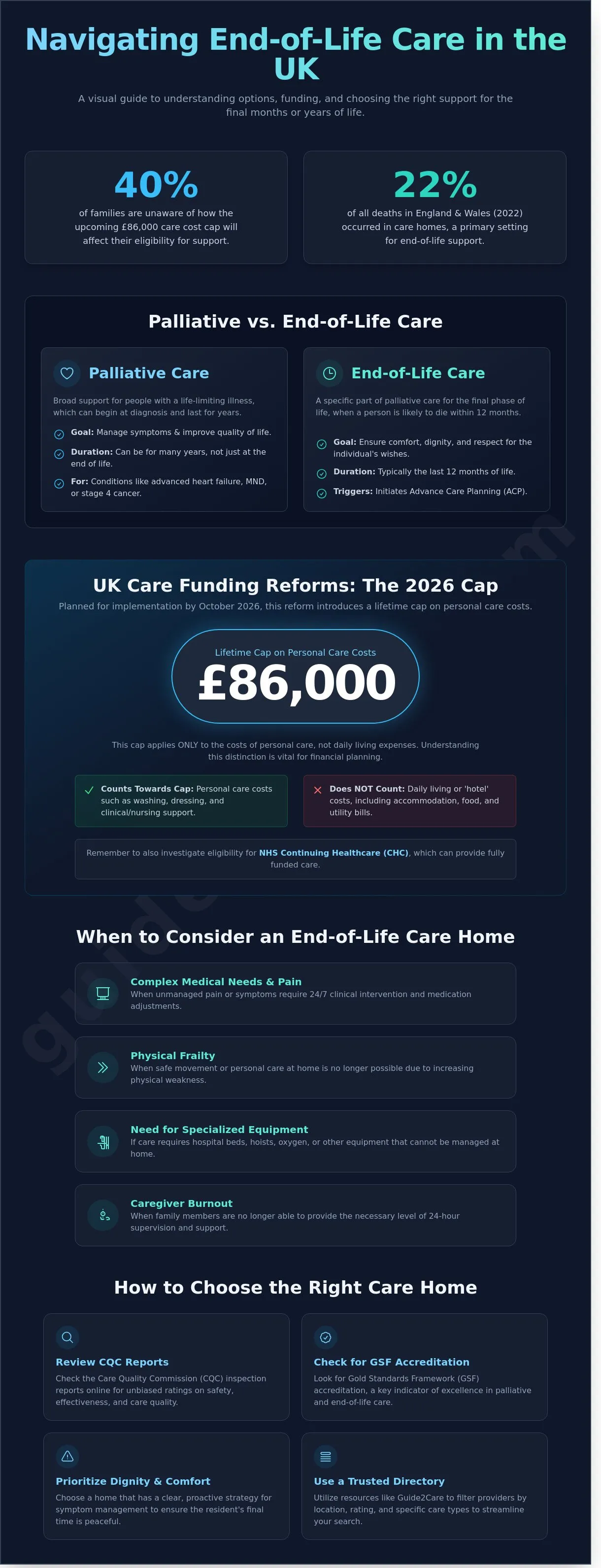
By October 2026, the UK government plans to implement a £86,000 cap on lifetime care costs, yet 40% of families still don't know how this affects their immediate eligibility for support. Selecting end of life care homes uk involves more than just finding a bed. It requires understanding complex legal and financial frameworks that change frequently. You're likely feeling the pressure of choosing a provider that offers high clinical standards while managing the rising costs of residential care.
This guide provides the clarity you need to make an informed choice. We'll explain the specific 2026 funding thresholds, define the practical difference between palliative and end-of-life services, and provide a 10-point checklist to evaluate any facility. You'll learn how to access NHS Continuing Healthcare and what to look for in Care Quality Commission (CQC) inspection reports. Use this information to simplify your search, understand your options, and find the care you need.
Key Takeaways
- Understand the distinction between palliative care and end-of-life support to ensure the correct level of medical and emotional assistance.
- Navigate the 2026 funding landscape, including updated Local Authority thresholds and eligibility for fully funded NHS Continuing Healthcare (CHC).
- Evaluate end of life care homes uk by reviewing the latest CQC inspection reports and checking for Gold Standards Framework (GSF) accreditation.
- Use the Guide2Care directory to filter providers by location, rating, and specific care types to streamline your search process.
- Identify how to prioritize symptom management and dignity when choosing a setting for the final months or years of life.
What is End of Life Care in UK Care Homes?
End-of-life care is the support provided to people who are in the final months or years of their life. This specialized care aims to help individuals live as well as possible until they die. It focuses on managing physical symptoms like pain or breathlessness while addressing emotional and social needs. Understanding What is End of Life Care involves recognizing it as a holistic approach that prioritizes comfort and dignity for the resident and their family.
In the UK, many people choose end of life care homes uk because they provide a stable environment with consistent staff. While hospices offer intensive terminal care, they often focus on short-term symptom management or the very final days of life. Residential and nursing homes provide a long-term solution where residents stay in a familiar setting. Data from the Office for National Statistics (ONS) shows that approximately 22% of deaths in England and Wales occurred in care homes during 2022. This makes care homes a primary setting for end-of-life support in the national healthcare system.
Most residential and nursing homes in the UK offer end-of-life care as a standard service. It's not a separate "type" of home but rather a level of care integrated into the facility's operations. Nursing homes are particularly well-equipped for this as they have registered nurses on-site 24 hours a day to administer medication and monitor clinical changes. Residential homes also provide high-quality support by partnering with external medical professionals to ensure all needs are met.
When Should You Consider an End of Life Care Home?
Choosing a care home becomes necessary when a person's needs exceed what family members or visiting carers can provide at home. Complex medical requirements often drive this decision. If a resident needs 24/7 professional monitoring for pain management or assistance with breathing, a clinical setting is safer. Clinical guidelines suggest that end-of-life planning should begin when a healthcare professional identifies that a patient is likely in their last 12 months of life.
- Physical frailty that prevents safe movement or personal care at home.
- The need for specialized equipment like hospital beds, hoists, or oxygen.
- Unmanaged pain that requires frequent clinical intervention and medication adjustments.
- Family caregiver burnout or the inability to provide 24-hour supervision.
The Role of the Palliative Care Team
Care home staff work as part of a multidisciplinary palliative care team to provide seamless support. This team includes the care home's own nurses, the resident's GP, and district nurses. In complex cases, specialist palliative care consultants from local hospices provide expert advice on symptom control. This collaborative approach ensures that medical care remains consistent even as the resident's condition changes over time.
Coordination is a vital part of the process. The team uses tools like the Gold Standards Framework (GSF) to track the resident's needs and preferences. They document "Advance Care Plans" to ensure the individual's wishes regarding medical intervention and place of death are respected. This system reduces unnecessary hospital admissions, which helps maintain a calm environment for the resident. Staff also facilitate communication between different services, arranging equipment deliveries and coordinating medication reviews with pharmacists. Find the support you need by checking the specific palliative capabilities of local end of life care homes uk before making a final choice.
Palliative Care vs. End of Life Care: Understanding the Difference
Palliative care is a broad approach to treatment. It supports people living with a life-limiting illness that cannot be cured. This care doesn't only apply to the final days of life. It can start at the point of diagnosis and continue for several years. The primary goal is to manage symptoms, reduce pain, and provide emotional support for both the patient and their family. Conditions like advanced heart failure, motor neurone disease, or stage 4 cancer often require this level of intervention to maintain a high quality of life.
End-of-life care is a specific subset of palliative support. It focuses on the final phase of a person's life. In the UK, healthcare professionals generally define this as the period when a person is likely to die within the next 12 months. This timeframe is used to trigger specific care planning, such as Advance Care Planning (ACP), which ensures a person's wishes are respected regarding their treatment and place of death. When searching for end of life care homes uk, it's essential to know which stage of support your loved one currently requires.
The distinction between these two terms is critical for financial planning. Understanding how these stages overlap is vital for Navigating Funding for End of Life Care. If a person's primary need is health-based, they may qualify for NHS Continuing Healthcare (CHC). For those in the very final stages of life, the CHC Fast Track Pathway can provide funding within 48 hours. If the needs are classified as social care, the local authority will conduct a means test to determine if the individual must pay for their own care.
Misconceptions about "terminal" status often cause unnecessary distress. Being terminal doesn't mean death is imminent. It simply means the condition is life-limiting. Some people live for years with a terminal diagnosis while receiving palliative support. This period allows families to make informed decisions about long-term care settings before a crisis occurs.
Residential Care Homes for End of Life
Residential homes are suitable for individuals who need help with personal care but don't require constant medical monitoring. Staff provide assistance with washing, dressing, and mobility. These settings focus on comfort and social interaction. However, residential homes have limitations. They don't have registered nurses on-site at all times. If a resident needs complex medication management or clinical procedures, the home must rely on visiting district nurses. You can compare these options further in our Nursing Home vs Residential Care guide.
Nursing Homes for Complex End of Life Needs
Nursing homes are necessary when a person's medical needs become complex. These facilities employ registered nurses 24 hours a day to provide clinical intervention. This is essential for managing advanced conditions like vascular dementia, where patients may struggle with swallowing or experience high levels of agitation. Nursing settings provide specialised equipment, including profiling beds and pressure-relieving mattresses, to prevent complications. Choosing the right end of life care homes uk ensures that clinical needs are met without the person having to move to a hospital. Explore our directory to find the care you need and compare providers in your area.
Navigating Funding for End of Life Care in 2026
By April 2026, the financial landscape for end of life care homes uk remains defined by the current capital threshold system following the cancellation of proposed social care reforms. You must understand these limits to plan effectively. In England and Northern Ireland, if your total assets exceed £23,250, you're responsible for the full cost of your care. This calculation includes savings, stocks, and the value of your property, unless a spouse or qualifying relative still lives there. If your assets fall between £14,250 and £23,250, the local authority provides partial funding, but you'll contribute a "tariff income" from your own funds.
NHS Continuing Healthcare (CHC) provides an alternative to these means-tested assessments. This is a package of ongoing care that the NHS funds entirely, covering 100% of the cost of care home fees, including board and accommodation. The eligibility isn't based on your bank balance or property value. Instead, it focuses on whether your "primary health need" is intense, complex, or unpredictable. NHS Continuing Healthcare is a non-means-tested funding package provided to individuals whose primary need for care is health-related, meaning the NHS pays for 100% of care costs regardless of a person's savings or property value.
The Fast Track Pathway Tool is the most vital resource for urgent situations. If a clinician determines that a patient has a rapidly deteriorating condition that may be entering its final weeks of life, they use this tool to bypass the standard assessment wait times. This ensures that funding for end of life care homes uk is approved within 48 hours. It removes the stress of financial paperwork during a critical time for the family and ensures immediate placement in a suitable facility.
Applying for NHS Continuing Healthcare (CHC)
The standard application follows a two-stage process. First, a healthcare professional completes a Checklist tool to see if you require a full assessment. If you pass this initial screening, a multi-disciplinary team carries out a Full Assessment using the Decision Support Tool. They evaluate 12 "domains" of need, including:
- Breathing and nutrition
- Continence and skin integrity
- Communication and cognition
- Psychological and emotional needs
You can Find the Care You Need by accessing expert guidance on these criteria through specialized palliative care charities. This ensures you're prepared for the rigorous questioning during the assessment meeting and understand how to present evidence of health needs.
Understanding Local Authority Financial Assessments
If you don't qualify for CHC funding, the local authority will conduct a financial assessment to determine your contribution. In 2026, the upper capital limit remains at £23,250 for England. If the care home you choose costs more than the council's standard budget, a third party, such as a family member, must pay a "top-up" fee. You cannot usually pay this top-up from your own restricted funds. Always seek independent financial advice from organizations like the Society of Later Life Advisers (SOLLA) to understand how these payments affect your long-term estate and to ensure you aren't overpaying for services.
Alongside planning for care costs, ensuring loved ones are financially secure is another key consideration. Exploring options like getting instant term life insurance quotes can provide peace of mind and help cover final expenses or protect your estate.
How to Choose the Right End of Life Care Home
Selecting a facility requires a methodical approach. Start by examining the Care Quality Commission (CQC) ratings. The CQC is the independent regulator of health and social care in England. Its reports categorize performance into five areas: safe, effective, caring, responsive, and well-led. According to the CQC State of Care 2023 report, 83% of adult social care services were rated as 'Good' or 'Outstanding'. When researching end of life care homes uk, prioritize providers with an 'Outstanding' rating in the 'Responsive' and 'Caring' categories. These ratings indicate the home adapts quickly to changing medical needs and treats residents with dignity.
The 'well-led' criterion is crucial because it reflects the business's overall health and stability, which directly impacts long-term care quality. The buying and selling of these essential healthcare facilities is a specialized market, often handled by expert brokerage firms like the Assisted Living Real Estate Group to ensure continuity of care during ownership transitions.Evaluate the staff-to-resident ratio. In a nursing home setting, at least one Registered Nurse (RN) must be on-site 24 hours a day. Ask the manager for the specific ratio during the night shift. A ratio of 1:10 or better is often necessary for high-dependency palliative care. Beyond numbers, verify specialist training. Staff should have completed the Six Steps to Success programme or have specific certifications in syringe driver management and symptom control. This expertise ensures that clinical needs are met without delay.
Physical facilities must accommodate both the resident and their loved ones. Terminal care is not just about the patient; it's about the family experience. Check for dedicated 'family rooms' or suites that allow for overnight stays. 24-hour visiting access is a standard requirement for terminal care. Confirm if the home provides quiet spaces for private discussions or spiritual reflection. These features distinguish a high-quality environment from a standard residential setting.
A forward-thinking facility also considers the practical needs of visitors, such as providing on-site electric vehicle charging stations. This kind of modern amenity reflects a commitment to convenience and care for the entire family. For those interested in the technical aspects of such installations, visit Great Park Electrical.
The Gold Standards Framework (GSF) Explained
The GSF Quality Hallmark Award is the primary accreditation for end-of-life care in Britain. It uses a three-tier system: Bronze (Pass), Silver (Commend), and Gold (Beacon). Homes with 'Beacon' status demonstrate the highest level of proactive planning. Statistics from the GSF Centre show that accredited homes reduce crisis hospital admissions by up to 20%. This ensures residents remain in a familiar environment rather than being moved to a clinical ward during their final days. Always ask to see the home's current GSF certificate during a tour.
Confirm the home’s policy on Advance Care Planning (ACP). An ACP is a legal document recording preferences for medical interventions and spiritual needs. Many UK providers now use the ReSPECT (Recommended Summary Plan for Emergency Care and Treatment) process. Ensure the home reviews these plans at least every 28 days or whenever a health change occurs. A robust ACP prevents unwanted hospital transfers and ensures the care team respects the resident's autonomy at all times.
Essential Questions to Ask During a Visit
Direct questions reveal the operational reality of end of life care homes uk. Ask the manager: "How do you handle breakthrough pain management at 3 AM?" This tests their access to 'just in case' medications. Ask: "Can family members stay with the resident during the final 48 hours?" Reliable homes will facilitate a constant presence. Finally, ask: "How is the Advance Care Plan integrated into daily shift handovers?" This ensures all staff, including temporary or agency workers, understand the resident's specific end-of-life wishes.
Find the care you need and explore local care providers to compare inspection reports and facility details today.
Find the Care You Need with Guide2Care
Finding the right facility requires access to accurate, up-to-date data. Guide2Care provides a structured platform to identify and compare end of life care homes uk. The directory is designed to reduce the complexity of the search process by centralizing all necessary provider information in one place. It acts as a practical tool for families who need to make informed decisions without the stress of searching multiple disconnected websites.
Using Our UK Care Directory
Find The Care You Need by using the main search bar on our homepage. This tool allows you to filter results based on specific criteria to ensure the facility meets your family's requirements. Enter your postcode or town to see providers in your immediate area. You should use the filter tools to select "End of Life Care" or "Palliative Care" as the primary service type to narrow your results effectively. This ensures you only see homes equipped with the medical expertise required for late-stage support.
The directory includes Care Quality Commission (CQC) ratings for every registered provider in England. These ratings range from "Outstanding" to "Inadequate." National data from 2023 shows that approximately 75% of care homes maintain a "Good" or "Outstanding" rating. Checking these scores helps you prioritize high-performing facilities. Some providers choose premium listings. These provide more detailed facility information, such as high-resolution photographs, full staff credentials, and current room availability. We also encourage users to explore the "Funding Care" resource section. This area clarifies the differences between local authority funding, NHS Continuing Healthcare (CHC), and private self-funding options.
Planning for the Future
Start your search early. Research indicates that families who begin looking at end of life care homes uk at least 4 months before a transition is necessary experience significantly less emotional strain. Avoid making decisions during a medical crisis when options might be limited by immediate bed availability. Guide2Care simplifies the comparison of multiple providers through a standardized layout, making it easier to weigh costs against the specific facilities offered.
Verified reviews are a critical part of the selection process. These testimonials from other families offer practical insights into the daily atmosphere and staff responsiveness. Once you have a shortlist of three potential options, the next step is to arrange a visit. Use the contact details in our directory to book a tour or request a fee schedule. During your visit, you should focus on several key areas:
- Review the latest CQC inspection report for specific mentions of end-of-life care quality.
- Confirm the weekly fees and identify any additional costs for specialized medical equipment.
- Ask about the staff-to-resident ratio during night shifts to ensure continuous support.
- Observe how staff interact with residents in communal areas to gauge the home's culture.
Take the first step today by exploring our directory. Comparing providers systematically ensures you choose a home that offers dignity, comfort, and professional medical oversight. Use our resources to move from a place of uncertainty to a clear, actionable plan for your loved one's care.
Secure The Right Care For 2026
Finding the right end of life care homes uk depends on a clear understanding of both clinical requirements and the updated 2026 funding landscape. You've learned that distinguishing between palliative support and final-stage care is the first step in selecting an appropriate setting. Navigating the 2026 regulations for NHS Continuing Healthcare and local authority assessments ensures you access the financial support available to you. Prioritizing providers with a "Good" or "Outstanding" CQC rating remains the most effective way to guarantee high standards of safety and dignity.
Guide2Care simplifies this process by providing a comprehensive directory of CQC-registered providers across the country. Our detailed guides explain the complexities of UK care funding and the specific 2026 legislative changes. We serve as a trusted resource for families who need to make informed decisions quickly and confidently. Use our tools to compare options and verify provider credentials today.
Find The Care You Need: Search UK End of Life Care Homes
Take the next step with confidence knowing you have the right information to support your family.
Frequently Asked Questions
Is end of life care free in a care home in the UK?
End of life care is free if the individual qualifies for NHS Continuing Healthcare (CHC) funding. This clinical funding package covers 100% of the fees for end of life care homes uk, including both care costs and accommodation. If the person doesn't meet the CHC criteria, they'll need to self-fund or apply for local authority assistance. Average weekly costs for private residents currently range from £800 to £1,500 depending on the facility's location.
What is the difference between a hospice and an end of life care home?
Hospices provide short-term intensive medical care for complex symptoms, while care homes offer a long-term residential setting. Statistics show that 80% of hospice patients stay for less than 14 days to stabilize symptoms or for final terminal care. In contrast, end of life care homes uk provide a permanent place to live with 24-hour support for those with stable but life-limiting conditions. Use our directory to find a setting that matches your clinical needs.
How long does end of life care usually last?
End of life care typically lasts for the final 12 months of life according to standard NHS definitions. The most intensive phase of support often occurs during the final 2 or 3 months as symptoms progress. Some patients receive this specialized care for only a few days if their health declines rapidly. Clinical teams use the Gold Standards Framework to identify the exact point when a resident requires this transition in support.
Can I move my loved one from a hospital to a care home for end of life care?
You can move a loved one from a hospital to a care home using the "Discharge to Assess" pathway. Hospital discharge teams aim to complete these transfers within 48 hours for patients nearing the end of their life. This process ensures the individual spends their remaining time in a more comfortable, non-clinical environment. Data indicates that 40% of hospital deaths are avoidable if appropriate social care placements are secured in time.
What happens if a care home cannot manage my loved ones pain?
Care homes coordinate with external specialists like District Nurses or GP palliative leads if a resident's pain becomes unmanageable. They use a "Just in Case" box containing 5 essential medications to treat sudden symptoms like breathlessness or pain. If symptoms remain unstable, the person might be transferred to a hospice for 3 to 5 days of intensive medical intervention. Staff follow the NICE Quality Standard [QS13] to ensure comfort is maintained at all times.
How do I apply for the NHS Continuing Healthcare Fast Track?
A clinician or senior nurse must complete the NHS Fast Track Pathway Tool to start your application. This tool is designed for individuals with a rapidly deteriorating condition who may be entering their final weeks of life. The local Integrated Care Board (ICB) must process these applications and make a funding decision within 48 hours. Once approved, the NHS pays for the full cost of care immediately without a financial means test.
Are all care homes in the UK required to provide end of life care?
Not all facilities provide this service; only homes registered with the Care Quality Commission (CQC) for palliative care are officially recognized. There are approximately 15,500 care homes in England, but their staff training and equipment levels vary significantly. Always check the home's latest CQC report for a "Good" or "Outstanding" rating in the "Caring" category. This ensures they have the specific expertise required to manage terminal care effectively.
What is an Advance Care Plan and why is it important?
An Advance Care Plan (ACP) is a formal document that records a person's preferences for their future medical treatment and care. It's important because it ensures your wishes are followed even if you lose the capacity to communicate. Research shows that having an ACP reduces emergency hospital admissions by 25% during the final months of life. It often includes specific instructions like a Do Not Attempt Cardiopulmonary Resuscitation (DNACPR) order to prevent unwanted interventions.