Care Options for Elderly with No Money UK: A Comprehensive Guide to State-Funded Support

Having less than £23,250 in total assets doesn't mean you're locked out of high-quality support. You likely worry that lacking private savings leads to poor-quality care or the forced sale of your family home. These concerns are common when exploring care options for elderly with no money uk, especially as the system often feels designed to be complex. It's frustrating to face means-testing rules that seem to penalise those without significant savings.
This guide shows you exactly how to access local authority funding and secure a place in a reputable care home without personal wealth. You'll find a clear breakdown of the financial assessment process, the specific benefits you can claim, and how to identify providers that accept state-funded rates. We provide the facts you need to secure the right support quickly and efficiently.
Key Takeaways
- Understand your statutory rights under the Care Act 2014 and the distinction between means-tested social care and NHS-funded healthcare.
- Identify the 2026 capital limits for savings and property to determine your eligibility for local authority financial support.
- Explore various care options for elderly with no money uk, including council-funded domiciliary care and sheltered housing schemes.
- Navigate the application process by requesting a Care Needs Assessment to define your eligible needs and required support levels.
- Use the Guide2Care directory to find and filter local care providers in your postcode, including residential, nursing, and home care agencies.
Understanding the UK Care Safety Net: Your Statutory Rights
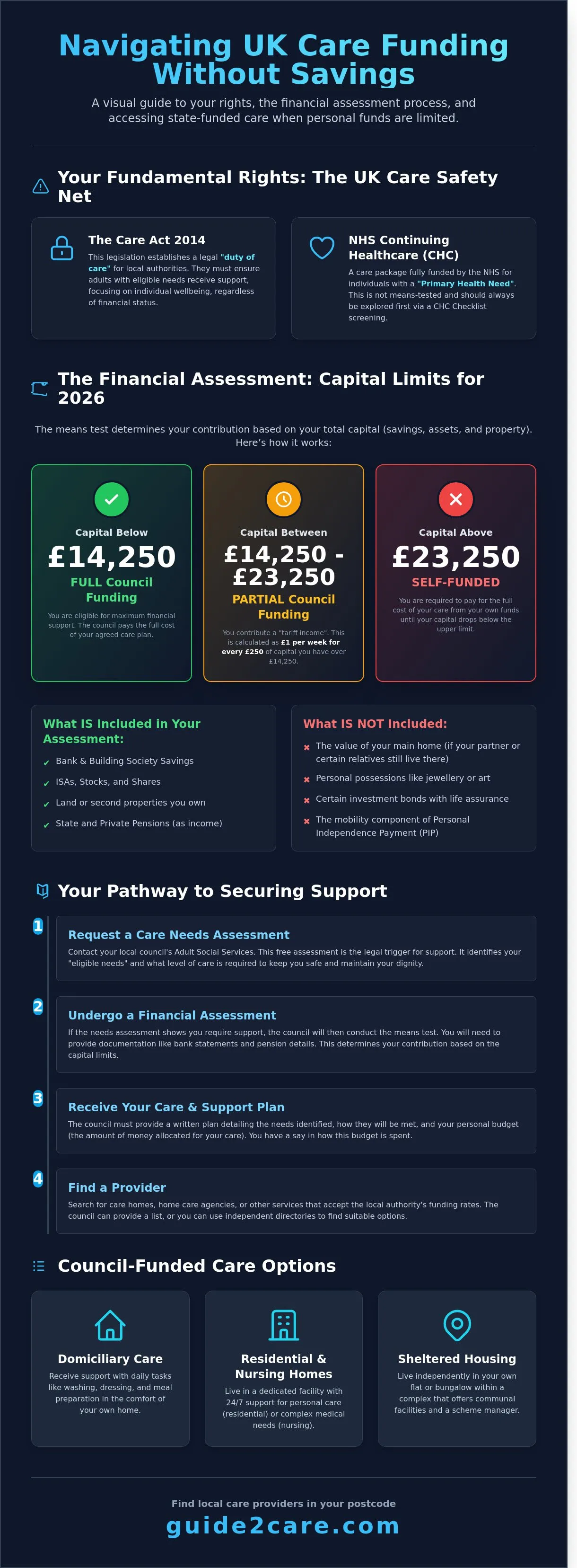
The British social care system operates on the principle that financial status should not prevent an individual from receiving essential support. Under the Care Act 2014, local authorities have a legal "duty of care" to ensure that adults with eligible needs are supported. This legislation shifted the focus from providing services to promoting individual wellbeing. If you have no savings and a low income, the state must step in to provide or fund your care. Having no money doesn't mean you'll be left without help; it simply means the local council becomes the primary source of funding for your requirements.
Accessing care options for elderly with no money uk begins with a single point of entry: your local council's Adult Social Services department. You don't need a medical referral to contact them. Anyone can request a statutory assessment of their needs. This process determines what level of support is required to maintain safety and dignity. The structure of Social care in England ensures that the council must act if an individual's physical or mental health is at risk, regardless of their bank balance.
It's vital to distinguish between "social care" and "healthcare" early in the process. Social care covers assistance with daily living, such as dressing, eating, and personal hygiene. This is means-tested and managed by the local authority. Healthcare involves medical treatment and nursing, which is the responsibility of the NHS. While social care often requires a financial contribution from those who can afford it, NHS healthcare remains free at the point of use for everyone. Understanding this divide helps you identify which budget will cover your specific needs.
The Local Authority Duty
The Care Act 2014 requires councils to meet "eligible needs" based on a national set of criteria. These criteria focus on whether a person can achieve basic outcomes, such as maintaining nutrition or using their home safely. If a person's assets fall below the lower capital limit of £14,250, the council typically pays the full cost of their care. For those with assets between £14,250 and £23,250, the council provides partial funding. A Care Needs Assessment is the legal tool used to trigger this obligation. It's a free service that identifies exactly what support is needed to keep you safe.
NHS Continuing Healthcare (CHC)
NHS Continuing Healthcare is a package of care arranged and funded solely by the NHS. You don't pay a penny for this, and it isn't means-tested. To qualify, you must have a "Primary Health Need," meaning your primary requirement for care is related to your health rather than social needs. This often applies to individuals with complex, intense, or unpredictable medical conditions. You should always request a CHC screening before undergoing a financial assessment for social care. Ask your GP or social worker for a "CHC Checklist" to start this process. It's a critical step for finding care options for elderly with no money uk because it bypasses council budget constraints entirely.
The system is designed to catch those who cannot support themselves. Start by requesting your assessment. Don't wait for a crisis to occur. Early engagement with Adult Social Services ensures that the safety net is ready when you need it. The council's duty is clear; they must provide a care plan that maintains your dignity and keeps you safe in your own home or a residential setting.
The Financial Assessment: How "No Money" is Defined in 2026
The local authority uses a financial assessment to determine your eligibility for state-funded support. This means-test examines your total capital and weekly income to decide how much you must contribute toward your fees. In 2026, the UK capital limits remain the primary benchmark for these calculations. If your total assets are below £14,250, you are generally eligible for maximum council funding. This is what the system defines as having "no money" for care purposes. If your capital falls between £14,250 and £23,250, you must pay a "tariff income" of £1 per week for every £250 of savings you own.
Capital includes more than just the balance in your current account. The assessor looks at savings, ISAs, stocks, shares, and any land or second properties you own. For individuals researching care options for elderly with no money uk, it's vital to know that certain assets are excluded. Personal possessions, such as jewellery or furniture, are not counted. Similarly, some specific investment bonds with a life assurance element are disregarded during the calculation. Your income is also scrutinized. The council includes your State Pension and any private pensions in the assessment. While most benefits count as income, the mobility component of Personal Independence Payment (PIP) is strictly ignored.
The Means-Test Process
You must provide specific documentation to the financial assessor to verify your status. Gather at least 12 weeks of bank statements, building society books, and your latest pension award letters. The council calculates your contribution by deducting a Personal Expenses Allowance (PEA) from your total weekly income. In 2026, the PEA remains at £30.15 per week. This ensures you keep a small amount of money for personal items like clothing or snacks. This financial review usually occurs after getting a needs assessment, which identifies the specific level of care required.
Property and the 12-Week Property Disregard
Your family home is excluded from the financial assessment in specific circumstances. If a spouse, a partner, or a relative who is aged over 60 lives in the property, the council cannot count its value as capital. If you live alone and move into permanent residential care, the 12-week property disregard applies. For the first 84 days of your stay, the local authority ignores your home's value, providing a window of state-funded support while you decide on a long-term plan.
If you prefer not to sell your home during your lifetime, you can request a Deferred Payment Agreement. This arrangement functions as a secured loan from the council. They pay your care costs and reclaim the total amount plus interest later, typically when the house is sold or after your death. This option prevents the forced sale of a home while the resident is still living in care. It provides a practical solution for those with high-value property but very little liquid cash.
Planning for costs reclaimed after death is a key part of the process. Similarly, many families also look into covering funeral and other final expenses to prevent future financial strain. For those researching how insurance can address these specific costs, resources like thepaulgroup.biz provide useful examples of final expense policies.
- Lower Capital Limit: £14,250 (Full funding eligibility)
- Upper Capital Limit: £23,250 (Self-funding threshold)
- Personal Expenses Allowance: £30.15 per week
- Property Disregard Period: 12 weeks
Navigating these figures is essential for securing personal care, just as understanding cost structures is key in the business world. For organizations planning brand campaigns, for instance, it's equally important to get expert financial guidance, and many discover The Celebrity Group for insights on talent procurement.
Similarly, planning any major life event, from securing long-term care to organizing a memorable celebration, requires attention to detail and reliable resources. For those planning a hen party, for example, it's helpful to have a central hub for ideas and bookings; to see what's possible, visit this popular platform.
Planning for significant life stages, whether it's elderly care or education, often involves navigating complex financial and administrative hurdles. Just as this guide helps with care funding, specialist consultancies like SBUB Group Ltd assist students with the intricate process of international university admissions.
Core Care Options for Those with Limited Financial Means
Local authorities in the UK must provide support if your assets fall below the lower capital limit of £14,250. You can access several care options for elderly with no money uk through your local council social services department after a care needs assessment. These services range from minimal support in your own house to full-time medical supervision in a specialist facility.
Home care, often called domiciliary care, is the first option for many. The council pays for carers to visit at scheduled times. They help with "activities of daily living" such as washing, dressing, and preparing meals. You might also qualify for free care and support from the NHS if your needs are primarily health-based. This is known as NHS Continuing Healthcare (CHC) and it isn't means-tested.
Sheltered housing and extra care schemes offer a middle ground. These developments provide self-contained flats with 24-hour emergency pull-cords or on-site staff. Extra care housing is more intensive, often featuring communal dining rooms and on-site care teams. For those with high-level needs, residential care homes provide a room and 24-hour supervision. If you require medical monitoring, nursing homes provide the same service but include registered nurses. The NHS pays a contribution towards nursing costs called NHS Funded Nursing Care (FNC). For the 2024/25 financial year, this rate is £235.88 per week in England.
Council-Funded Home Care
Direct payments offer the most control over your daily routine. Instead of the council arranging a care agency, they pay the money directly into a dedicated bank account. You use this money to hire your own personal assistants or choose a specific agency. This allows you to pick carers who understand your routine or speak your language. Staying in a familiar environment often leads to better mental health outcomes for seniors. If your home requires physical changes, apply for a Disabled Facilities Grant (DFG). These grants provide up to £30,000 in England to fund ramps, stairlifts, or walk-in showers. This ensures your home remains safe without depleting your limited resources.
To understand what a comprehensive home care agency can offer, it's helpful to look at established providers. For instance, while it operates in Canada, Cocoon Senior Services serves as a great example of the breadth of non-medical support available—from simple companionship to specialized care—which can help you identify high-quality options in your own area.
Residential Placements and Top-Ups
Every local authority sets a "standard rate" for care home placements. This is the maximum amount the council is willing to pay for a room. In 2024, these rates often fall between £600 and £850 per week depending on your location. Under "Choice of Accommodation" rules, you can choose any care home that meets your needs. The home must agree to the council's standard rate and have a place available. It's a common misconception that you're forced into the cheapest home. You have a say. If you prefer a home that costs more than the standard rate, a third party can pay the difference. This is a "third-party top-up." Usually, a family member or a charity pays this. You cannot pay your own top-up if the council is funding your care because your assets are already below the threshold. Find the care you need by comparing homes that accept local authority rates without requiring large additional payments.
Accessing Support: The Step-by-Step Application Process
Securing state-funded support requires following a specific legal path managed by your local authority. Finding care options for elderly with no money uk starts with a formal application to your local council's adult social services department. This process ensures that resources are allocated to those with the highest physical and financial needs. Follow these five steps to secure the necessary funding.
- Step 1: Request a Care Needs Assessment. Contact your local council to ask for an evaluation. Under the Care Act 2014, anyone who appears to need care is entitled to this assessment regardless of their finances.
- Step 2: Define Eligible Needs. A social worker or occupational therapist will visit to determine if your requirements meet the national eligibility threshold. They look at whether you can perform basic tasks like eating, washing, or moving safely.
- Step 3: Undergoing the Financial Assessment. Once a need is established, the council conducts a "means test." For the 2024/25 tax year in England, if your assets are below £23,250, you qualify for partial funding. If assets are below £14,250, the council usually pays the maximum amount possible.
- Step 4: Creating a Care Plan. The council produces a written document detailing the required support. It specifies whether you need domiciliary care at home or a move into a residential facility.
- Step 5: Selecting a Provider. You can choose a care provider that fits within the council’s personal budget allocation. If the chosen home costs more than the council's limit, a third-party top-up fee might be required from a relative.
Preparing for the Assessment
A Care Needs Assessment is a holistic review of physical, mental, and emotional requirements. When the assessor visits, don't downplay your struggles. It's vital to describe your "bad days" rather than your best ones to ensure the level of support granted is sufficient for your hardest moments. Involve a family member or a professional advocate during the meeting. They can provide specific examples of where you've struggled, such as forgetting to turn off the cooker or falling, which you might overlook or feel embarrassed to mention.
Claiming Relevant Benefits
Maximising your income through the benefits system is a crucial part of managing care options for elderly with no money uk. These payments can help cover the costs of equipment or daily living expenses.
- Attendance Allowance: This is a non-means-tested benefit for people over State Pension age who have a disability or long-term health condition. The lower rate is £72.65 per week, while the higher rate is £108.55 if you need help day and night.
- Pension Credit: This benefit tops up your weekly income to a minimum level of £218.15 for single people or £332.95 for couples. It's a "gateway" benefit that often triggers eligibility for other support like Housing Benefit or Council Tax Support.
- Carer’s Allowance: If a family member provides at least 35 hours of unpaid care per week, they may be eligible for £81.90 weekly. This helps sustain the care arrangement and reduces the immediate need for professional intervention.
Start your search for local support today and Find The Care You Need through our comprehensive directory.
How to Find and Choose Care Providers with Guide2Care
The Guide2Care directory provides a direct route to identifying local providers. Start by entering your postcode into the search bar. This tool filters thousands of registered providers across the UK to show only those in your immediate area. For individuals exploring care options for elderly with no money uk, location is a primary factor. Local authorities often prefer to place residents in homes within their own borough to manage costs and social work logistics. The directory organises these choices into a manageable list, saving you time and reducing the complexity of the search.
The search results allow you to distinguish between residential homes, nursing homes, and home care agencies. Residential homes provide accommodation and personal care. Nursing homes offer 24 hour medical support from registered nurses. Home care agencies provide staff to visit your house. Use these categories to align your search with the Care Needs Assessment provided by your council. If the assessment specifies nursing care, don't waste time viewing residential-only facilities. The directory clearly labels the service types for every listed provider.
Identifying providers that accept local authority funding is a critical step. While some homes only accept "private payers," many maintain a specific number of beds for council-funded residents. Guide2Care profiles often indicate the types of funding accepted. Once you have a list of potential homes, verify their current status with the Care Quality Commission (CQC). The CQC regulates over 15,000 care homes in England. Look for ratings of "Good" or "Outstanding." These ratings are based on five key questions: is the service safe, effective, caring, responsive, and well-led?
Using the Directory Effectively
Search by "Care Type" to ensure the results match your specific assessment. If your social worker has identified a need for specialist dementia support, use the specialised services filter. This narrows your search to providers with the correct staff training and facilities. View individual provider profiles to check for specific amenities and recent CQC inspection dates. Shortlist three to five favourites. Present this list to your council social worker to see which providers have current vacancies at the local authority's set rate.
Questions to Ask Providers
Contacting providers directly is the final stage of the selection process. Prepare a list of practical questions to ensure the home is a viable option for those without private savings. Focus on financial transparency and the specifics of the care environment. Ask these questions during your initial phone call or visit:
- "Do you have any rooms available at the local authority rate?"
- "What is included in the standard fee, and are there hidden costs for services like hairdressing or chiropody?"
- "Do you require a third-party top-up fee for this room?"
- "How do you support residents who rely solely on the Personal Expenses Allowance of £30.15 per week?"
- "Can I see your most recent CQC inspection report and your internal quality audit?"
A transparent provider will give clear answers regarding their fee structures. Under the Care Act 2014, councils must ensure that at least one suitable option is available that doesn't require a top-up fee. Use the directory to find these options quickly and efficiently.
Secure Your State-Funded Care Today
The UK care safety net ensures that financial limitations don't prevent you from receiving essential support. By understanding the 2026 financial assessment thresholds, you can determine exactly how the state defines "no money" and what assistance you're entitled to receive. Local authorities have a legal duty to provide a needs assessment to identify suitable care options for elderly with no money uk, ensuring safety and dignity for all residents. Whether you require domiciliary care or a residential placement, following the statutory application path is the most effective way to access funding.
Guide2Care acts as your practical resource during this transition. Our platform offers an independent and neutral directory featuring a comprehensive database of CQC-registered providers. We also provide free educational resources focused on the complexities of UK care funding to help you make informed decisions. Use these tools to filter providers by location and service type efficiently.
Find The Care You Need: Search Our UK Directory
You've now got the facts needed to move forward. Take the first step toward securing the right support for your circumstances.
Frequently Asked Questions
What happens if I have no money and need a care home in the UK?
The local council pays for your care if your total assets fall below £14,250. They perform a care needs assessment followed by a financial check to determine your eligibility. This process identifies the best care options for elderly with no money uk residents. If you qualify, the council manages the funding and helps you find a suitable placement that meets your specific health requirements.
Will the council take my house to pay for care if my spouse still lives there?
Your house is not counted in the financial assessment if your spouse or partner still lives there. This mandatory disregard also applies if a relative aged 60 or over, or a child under 18, resides in the property. The council cannot force a sale or include the home's value in your capital total while these qualifying residents stay in the home. This protection ensures your partner's housing remains secure.
Can I choose my own care home if the council is paying for it?
You can choose your own care home if the facility costs no more than the council's set personal budget. The home must also agree to the council's standard contract and meet your specific care needs. If you select a more expensive home, a third party must pay the price difference. Always check the council's local rate before making a final selection to avoid unexpected costs.
How much money can you have before you have to pay for care in the UK?
In England and Northern Ireland, you must pay for your own care if your capital exceeds £23,250. The council provides maximum support if your assets are below £14,250. Between these two figures, you contribute a portion of your income and a tariff income from your savings. In Scotland, the upper threshold is £35,000; Wales sets a higher limit of £50,000 for residential care fees.
What is the "12-week property disregard" and how does it help?
The 12-week property disregard allows the council to ignore your home's value for the first 84 days of permanent care. This applies if your other assets are worth less than £23,250. It provides a vital breathing space to sell your property or set up a deferred payment agreement. During this period, the council covers your fees based on your remaining income and savings to prevent immediate debt.
Can my children be forced to pay for my care home fees?
Children cannot be legally forced to pay for their parents' standard care home fees in the UK. The local authority holds the legal responsibility to fund care for those who meet the financial and physical criteria. While children can volunteer to pay a top-up fee for a more expensive room, they aren't obligated to contribute to the basic cost of care. Your care remains a personal financial responsibility.
Is NHS Continuing Healthcare means-tested?
NHS Continuing Healthcare (CHC) is not means-tested and stays free regardless of your wealth. The NHS pays 100% of care costs for individuals with a primary health need, covering both social care and accommodation. Eligibility depends on a strict assessment of your medical condition's nature, intensity, complexity, and unpredictability. It's based entirely on your health requirements rather than your ability to pay or your savings.
What is a third-party top-up fee for a care home?
A third-party top-up fee is a payment made by a friend, relative, or charity to cover the gap between council funding and a home's price. This happens if you choose a home that exceeds the local authority's standard weekly rate. You cannot pay this fee yourself using your own capital. The third party must prove they can sustain these payments for the duration of your stay in the home.