How to Apply for Council Funded Care: A Step-by-Step UK Guide (2026)

What if the difference between losing your family home and securing your future care was simply a single 45-minute assessment? Understanding how to apply for council funded care is often the most stressful part of the ageing process. You likely feel overwhelmed. Complex UK legislation and the fear of depleting your family inheritance create unnecessary anxiety. This is a common concern for the 1.3 million people currently accessing adult social care services across the country. It's frustrating when the boundary between NHS and council responsibility remains unclear.
We'll provide a clear roadmap for securing local authority funding. You'll learn about the 2026 financial thresholds, including the £100,000 upper capital limit, and how to prepare for your mandatory needs assessment. This article covers every step from the initial contact to receiving your personal budget and selecting a registered care provider. Follow these practical steps to simplify your search and find the care you need today.
Key Takeaways
- Learn how to request a needs assessment from your local Adult Social Care department to determine your eligibility for support.
- Understand the 2026 financial assessment rules, including the "Upper Capital Limit" and how the council evaluates your assets.
- Discover the step-by-step process of how to apply for council funded care and the legal timeframes local authorities must follow.
- Explore how personal budgets and direct payments give you control over your care and support plan.
- Identify care homes and home care agencies that accept local authority funding and learn how to secure beds at the council's rate.
Understanding Local Authority Care Funding in the UK
The Care Act 2014 serves as the primary legal framework for adult social care. It dictates that local authorities have a statutory duty to assess any resident who appears to need support. This duty applies regardless of the person's financial situation. You don't need to be low-income to request help. The system separates social care from healthcare. While the NHS covers medical treatments, Social care in England focuses on daily activities like washing, dressing, and eating. This distinction is vital because social care is means-tested, whereas NHS care is generally free at the point of use.
Local councils use a specific set of "eligible needs" to decide who receives financial assistance. This process ensures that resources go to those with the highest level of risk to their independence. Knowing how to apply for council funded care begins with requesting a care needs assessment from your local adult social services department. This assessment is free for everyone. It identifies what you can do for yourself and where you require intervention. The council cannot refuse this assessment based on your savings or property value.
Who is Eligible for Council Support?
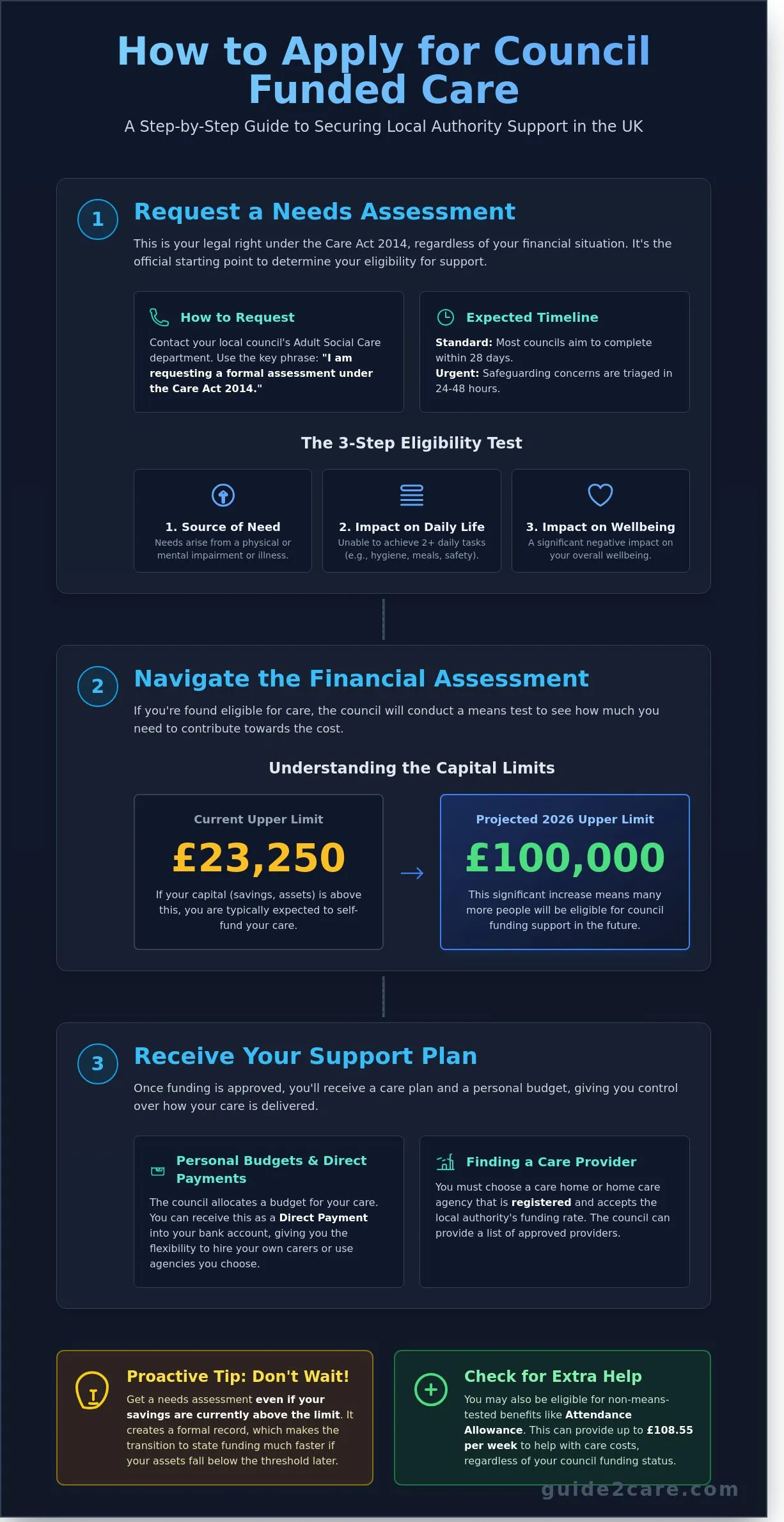
Social workers apply a three-step eligibility test to determine if your needs meet the national threshold. First, your needs must arise from a physical or mental impairment or illness. This includes conditions like dementia, mobility issues, or learning disabilities. Second, this condition must result in you being unable to achieve two or more daily outcomes. These outcomes include maintaining personal hygiene, preparing meals, or staying safe at home. Third, there must be a significant impact on your overall wellbeing. If you fail to meet any of these three criteria, the council isn't legally required to fund your care, even if you have limited funds.
The 2026 Funding Landscape
The UK social care system is currently in a state of transition. The government previously announced a lifetime cap on personal care costs of £86,000. While this reform was delayed from its original 2023 start date, current projections point toward an October 2025 or 2026 implementation. Local authorities currently prioritise urgent care for those at immediate risk. They also provide preventative support to stop needs from escalating. This includes small home adaptations or equipment that costs less than £1,000.
Even if you have savings above the current £23,250 threshold, you should still seek an assessment. This creates a formal record of your care journey. If your assets eventually fall below the limit, having an existing assessment makes the transition to state funding much faster. It's a practical way to future-proof your care plan. Understanding how to apply for council funded care early prevents delays when your situation becomes more critical. You may also be eligible for non-means-tested benefits like Attendance Allowance, which can provide up to £108.55 per week regardless of your council funding status.
Step 1: Requesting and Preparing for a Needs Assessment
To understand how to apply for council funded care, you must first request a needs assessment. This is a legal right established under the Care Act 2014. Every adult who appears to have a need for care and support is entitled to this evaluation, regardless of their financial situation or savings. You should contact the Adult Social Care department at your local council to start the process. While the law doesn't specify a rigid number of days for a response, most councils aim to complete the process within 28 days of your initial request. If your situation is urgent or involves a safeguarding concern, state this clearly to ensure your case is triaged within 24 to 48 hours.
Assessments typically take three forms: face-to-face, telephone, or online self-assessments. A face-to-face interview is the most thorough method. It allows the social worker to observe your living environment and physical mobility directly. Telephone or online assessments are often used for less complex cases, but you can insist on an in-person meeting if you feel your needs are being misunderstood. You should also have a family member, friend, or professional advocate present during the interview. While based in the Netherlands, advisory services such as Het Zorgkabinet exemplify the type of support available. Having a second person ensures that all your struggles are mentioned and that you don't miss any critical details during the conversation.
How to Request an Assessment
Use the GOV.UK search tool to find the contact details for your local authority. When you call or email, use specific phrasing to ensure your request is recorded correctly. State that you are "requesting a formal assessment under the Care Act 2014." This language triggers the council's legal obligations. If the council refuses to assess you, they must provide the reasons in writing. You can challenge this decision through their formal complaints procedure or by citing the NHS guide to council funding rules regarding eligibility. If the refusal persists, you may contact the Local Government and Social Care Ombudsman for a formal review.
Preparing Your Care Evidence
Preparation is vital for a successful outcome. Don't rely on memory during the interview. Keep a 7-day care diary before the assessment. Document every instance where you struggle with daily living tasks. This includes washing, dressing, preparing meals, and managing medication. Be specific about the time taken and the level of help required. Gather supporting evidence from your GP or occupational therapist. These medical professionals can provide letters that confirm your diagnosis and the impact it has on your independence. Having this paperwork ready prevents delays in the decision-making process.
Learning how to apply for council funded care effectively requires you to be honest about your limitations. During the interview, you must describe your "worst day" rather than your "best day." Many people naturally try to appear more capable than they are, but this can lead to an underestimation of your needs. If you can only wash yourself with significant pain, or if it takes you 45 minutes to get dressed, you must explain this clearly. The social worker needs to see the full extent of your challenges to allocate the correct funding. Once you have documented your needs, you can compare local care providers to see which options fit your specific requirements.
Step 2: Navigating the Financial Assessment and Means Test
Understanding how to apply for council funded care requires a clear grasp of the means test. Once the council completes your needs assessment, they'll perform a financial assessment. This process calculates your ability to pay for services. They'll examine your weekly income, such as State Pension and private pensions. They also review capital assets, including bank accounts, ISAs, and property. For detailed criteria, consult this NHS guide to council-funded care to understand the full scope of the process.
The council splits your capital into three categories based on specific thresholds. If your assets exceed the Upper Capital Limit, you must pay the full cost of your care. If assets fall between the upper and lower limits, the council provides partial funding. You'll contribute a "tariff income" of £1 for every £250 of savings between these two figures. If your capital is below the Lower Capital Limit, the council pays for your care, though you still contribute from your weekly income.
You aren't expected to spend every penny on care. The council leaves you with a Personal Expenses Allowance (PEA). In England, this is £30.15 per week for those in residential care as of the 2024/25 financial year. For those receiving care at home, the council applies a Minimum Income Guarantee (MIG). This ensures you have enough money for food, utilities, and clothing after paying care charges. These figures are reviewed annually by the Department of Health and Social Care.
2026 Capital Thresholds in the UK
In England, the Upper Capital Limit remains £23,250 for 2026. The Lower Capital Limit is £14,250. Scotland and Wales offer different structures. Wales sets a higher capital limit of £50,000 for residential care. Scotland provides free personal care for adults regardless of income. If your savings dwindle while you're in care, contact the council immediately. They'll reassess your finances as you approach the £23,250 threshold to prevent a gap in funding.
The Property 12-Week Disregard
Your home's value is ignored if your spouse, a relative over 60, or a disabled dependent still lives there. If you move into a care home and the property is empty, the council applies a 12-week property disregard. During these 84 days, the council ignores the property's value when calculating your assets. This gives you time to sell the home or arrange a Deferred Payment Agreement (DPA).
A DPA acts like a loan from the local authority. The council pays your care costs and secures the debt against your property. You repay the total amount once the house is sold or from your estate. This is a vital option when learning how to apply for council funded care without being forced into a quick sale. Use this mechanism to retain control over your assets while securing necessary support.
Managing Your Care: Personal Budgets and Direct Payments
Once your local authority completes your needs assessment, they produce a Care and Support Plan. This document identifies your eligible needs and sets out the specific outcomes you want to achieve. It also determines your Personal Budget. This is the total amount of money the council calculates is necessary to pay for your care. Under the Care Act 2014, this figure must be sufficient to meet all your assessed needs. The council arrives at this sum by looking at the cost of local services. Learning how to apply for council funded care involves understanding that this budget isn't a fixed grant. It fluctuates based on the complexity of your requirements and the prevailing market rates for care in your area.
The Care and Support and After-care (Choice of Accommodation) Regulations 2014 provide you with a legal right to select your preferred care provider. You aren't restricted to the council's list of preferred homes. However, if your chosen home costs more than the amount allocated in your Personal Budget, a top-up fee applies. The person receiving care cannot pay this themselves if their capital is below the £23,250 limit. A third party, such as a family member or a friend, must sign a contract to pay the difference every week. If the third party stops paying, the council may move you to a cheaper setting that fits within the original budget.
- Personal Budget: The total sum allocated to meet your needs.
- Sufficiency: The council must prove the budget can actually buy the required care locally.
- Top-up Fees: Costs that exceed the council's standard rate, paid by a third party.
- Outcome-focused: Budgets are designed to meet specific goals, like maintaining social contact or personal hygiene.
What are Direct Payments?
Direct payments are cash sums paid into a dedicated bank account for you to manage. This option offers the highest level of control. You can use this money to buy services from agencies or hire a personal assistant. If you become an employer, you're responsible for tax, National Insurance, and liability insurance. Many people find this flexibility worth the extra admin. You can Find The Care You Need by searching for local agencies that specifically accept direct payments.
Council-Managed vs. Third-Party Managed Budgets
You don't have to manage the money yourself. In a council-managed budget, the local authority handles all contracts and payments. They choose the providers and deal with the paperwork. If you want more flexibility without the admin of direct payments, an Individual Service Fund (ISF) is an alternative. Here, a third-party provider or care agency manages the budget on your behalf. You still decide how the care is delivered. You can switch management styles at any time by requesting a review from your social worker. This helps you adapt as you become more confident in managing your support.
When you're researching how to apply for council funded care, it's vital to decide which management style suits your lifestyle. If you prefer a hands-off approach, the council-managed route is simplest. If you want to choose your own staff and set your own schedules, direct payments are the standard choice. According to NHS Digital data, approximately 26% of adults receiving long-term support in the community now use direct payments to maintain their independence.
Finding Care Providers That Accept Council Funding
Securing approval for financial support is a significant milestone, but you must then find a provider that accepts the council's fee structure. Most local authorities have a "usual cost" or "standard rate" they are willing to pay for residential or domiciliary care. Not every private provider agrees to these rates. Some homes may require a "top-up" payment from a third party if their fees exceed the council's budget. Understanding how to apply for council funded care includes knowing how to negotiate these placements effectively.
Start your search by requesting a list of approved providers from your local social services department. You can also use the Guide2Care directory to identify local options independently. When contacting providers, ask direct questions to clarify their financial policies. Use these specific queries to gather necessary data:
- Do you currently have vacancies for residents funded at the local authority rate?
- Is a third-party top-up fee required for the specific room or care package available?
- How do you handle transitions if a resident's funding status changes from private to council-funded?
- What specific services are excluded from the standard council-funded rate?
Quality remains a priority regardless of who pays the bill. Every care provider in England is regulated by the Care Quality Commission (CQC). Before visiting a home, check their most recent inspection report. Focus on the five key questions the CQC asks: Is the service safe, effective, caring, responsive, and well-led? A provider with a "Good" or "Outstanding" rating ensures high standards of dignity and safety for your loved one.
The Search Process
Use the filtering tools on the Guide2Care directory to distinguish between "Residential" and "Nursing" care. Residential homes provide personal care and 24-hour supervision, while nursing homes have registered nurses on-site to manage complex medical needs. Once you identify 3 to 5 suitable providers, organise site visits. Take a copy of the Care Plan developed during your assessment. Verify that the provider can meet every specific need identified in that document, such as specialist dementia support or mobility assistance.
Next Steps and Moving Forward
Once you select a provider, the council will finalise a contract with them. This document outlines the services provided and the payment schedule. Your care isn't static; the Care Act 2014 mandates that local authorities conduct a review of your care and support plan at least once every 12 months. These annual reviews ensure the setting remains appropriate as your health needs evolve. If your financial situation or care requirements change significantly before the annual date, you can request an earlier review. Find the care you need today in our comprehensive directory to begin your search with confidence.
The process of finding the right provider requires patience and diligence. By using structured tools and asking the right financial questions, you ensure that the funding you've secured translates into high-quality, sustainable care. Focus on providers that demonstrate transparency in their pricing and a commitment to the standards set by the CQC. This practical approach simplifies the transition and provides peace of mind for the entire family.
Secure Your Care Funding and Support
Navigating the UK care system requires a methodical approach. Start by requesting a needs assessment from your local authority. This assessment determines your eligibility under the Care Act 2014 standards. You'll then undergo a financial means test. In 2026, the upper capital threshold remains a critical figure; if your savings are below £23,250, you'll qualify for at least partial support. Understanding how to apply for council funded care ensures you don't miss out on essential financial aid. Once your personal budget is confirmed, you can choose providers that align with your specific care plan.
Guide2Care simplifies this search by providing a comprehensive directory of CQC-registered providers. We offer expert guides on UK care legislation and funding at no cost to families. Use our database to compare options and find local services that accept council funding. Our tools bring order to your search and help you make practical decisions for the future. It's time to take the next step and secure the support you deserve.
Find the care you need in our UK-wide directory
Frequently Asked Questions
How long does it take for the council to process a care funding application?
Local authorities typically take 28 to 56 days to complete a care needs assessment. The financial assessment follows and usually adds another 28 days to the timeline. These timeframes are set by the Care Act 2014 guidelines. If your situation is urgent, request an interim care package to ensure safety while the council processes the paperwork. This ensures you aren't left without support during the eight week wait.
Do I have to sell my home to pay for residential care in 2026?
You don't have to sell your home immediately to pay for care in 2026. Local councils offer Deferred Payment Agreements that allow you to use your property as security for a loan. This means the council pays your fees and recovers the debt after your home is eventually sold. The UK government's planned £86,000 lifetime care cap is currently scheduled for implementation in October 2025.
What is the deprivation of assets and how can I avoid it?
Deprivation of assets occurs when you intentionally reduce your wealth to qualify for council funding. This includes gifting £20,000 to a relative or transferring a house title shortly before needing care. To avoid this, keep clear records of all spending and only make gifts that follow your historical patterns. Councils use the Care and Support Statutory Guidance to investigate transactions without a specific time limit.
Can I get council funding if I already live in a care home as a self-funder?
You can apply for council funding if your capital falls below the £23,250 threshold while living in a care home. Contact your local authority at least 12 weeks before your savings reach this limit. This gives them enough time to complete the assessment process. Understanding how to apply for council funded care ensures the transition from self-funding to state support happens without a gap in payments.
What happens if the council says I am not eligible for funding?
You can appeal the decision through the council's formal complaints procedure if they find you ineligible. Statistics show that 15% of initial social care decisions are successfully challenged. Request a written copy of the assessment to check for factual errors. If your needs change, you have the right to request a new assessment at any time after the initial decision is made.
Will the council pay for a family member to be my carer?
The council can pay for a family member to be your carer through a Direct Payment scheme. This typically applies if the family member doesn't live in the same household. In exceptional circumstances, the council may approve a resident family member if they determine it's the only way to meet your needs. The hourly rate is set by the local authority, often ranging between £10.42 and £15.00.
Is NHS Continuing Healthcare different from council funding?
NHS Continuing Healthcare (CHC) is a fully funded package for people with primary health needs, whereas council funding is means-tested. If you qualify for CHC, the NHS pays for 100% of your care costs regardless of your savings or property value. Council funding requires you to have assets below £23,250. Always ensure an NHS CHC screening takes place before the council conducts a financial assessment.
Can I choose a care home that costs more than the council is willing to pay?
You can choose a more expensive home if a third party, such as a relative or charity, pays the difference. This is known as a top-up fee. You generally can't pay this top-up yourself using your own remaining capital. Knowing how to apply for council funded care helps you understand the personal budget the council sets, which dictates the maximum they will pay for your placement.