Deferred Payment Agreements for Care Explained: A 2026 UK Funding Guide

What if you could secure residential care without putting a "For Sale" sign on your family home today? Many people assume that moving into a care home requires an immediate property sale to cover fees. It's a stressful assumption that often causes unnecessary panic during a difficult transition. This guide provides deferred payment agreements for care explained for the 2026 funding landscape. It shows you how to use your property's equity as a legal loan from your local authority to pay for care home costs.
You likely want to protect your inheritance while ensuring your loved one receives high-quality support. We will show you how to achieve that balance. Find clear details on the 2026 eligibility rules, current interest rates, and the specific application steps required to secure a DPA. This information helps you make a logical financial decision without the pressure of a forced sale. Explore the facts and manage your care costs effectively.
Key Takeaways
- Discover how a local authority loan works to cover fees while keeping your property in this guide to deferred payment agreements for care explained.
- Check if you meet the 2026 eligibility criteria, including the £23,250 capital threshold for England, Scotland, and Wales.
- Evaluate the total cost of a DPA by breaking down administrative set-up fees and daily compound interest rates.
- Weigh the impact on your family’s inheritance against the emotional and financial benefits of delaying a property sale.
- Follow a practical checklist for the application process, from contacting your local council to arranging an independent property valuation.
What is a Deferred Payment Agreement (DPA) for Care?
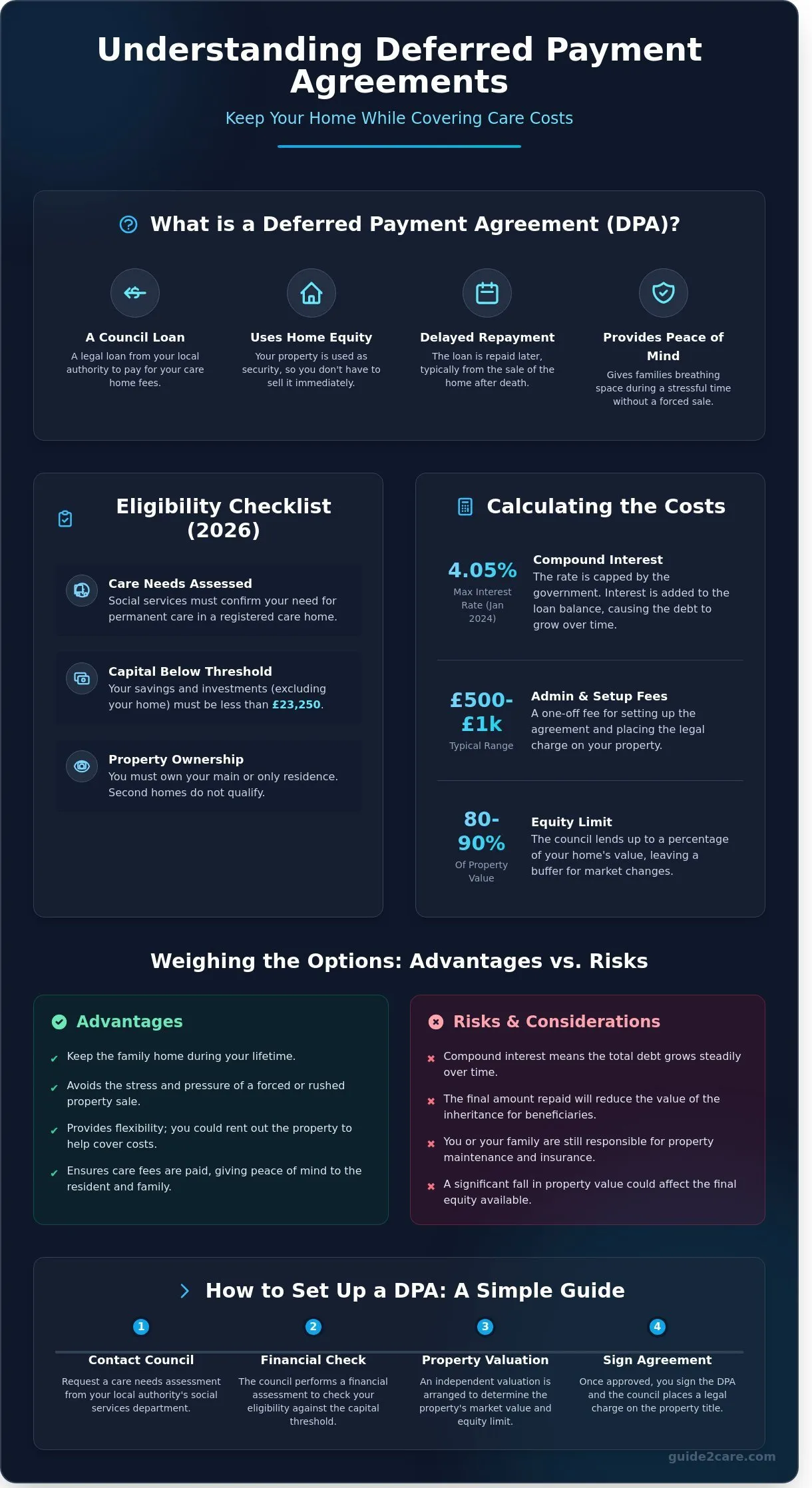
A Deferred Payment Agreement is a formal, voluntary loan arrangement between you and your local authority. It's designed for homeowners who must move into residential care but don't have enough liquid savings to pay the fees. Under this scheme, the council pays your care home costs on your behalf. You don't have to sell your home immediately. Instead, the debt stays against your property and you repay it later, usually when the house is sold or after your death. The Care Act 2014 made it a legal requirement for all councils in England to offer this scheme from April 2015.
This financial tool is essential because of how Social care in England is funded. Currently, if you have assets worth more than £23,250, you're responsible for the full cost of your care. For many, this entire value is tied up in their family home. This guide provides deferred payment agreements for care explained to help you decide if this path suits your financial situation. It allows you to use the value of your property without being forced into a quick sale.
To better understand this concept, watch this helpful video:
The Legal Nature of the Agreement
The local authority acts as a secured lender during this process. They place a "legal charge" on your property title at the Land Registry. This is the same mechanism used by mortgage providers to protect their investment. It ensures the council's debt is paid before any other proceeds from a house sale reach beneficiaries. Unlike a commercial mortgage, you don't make monthly repayments of the principal or interest. The debt simply grows over time. The council also adds administrative costs to the balance. These setup fees often range between £500 and £1,000. Interest rates are capped by the government. For example, on 1 January 2024, the maximum interest rate for DPAs was set at 4.05%.
Why the Universal Deferred Payment Scheme Exists
The government created this scheme to prevent the forced sale of homes during a person's lifetime. It provides vital breathing space for families. When a relative moves into care unexpectedly, the stress is high. You shouldn't have to manage a property sale and a health crisis simultaneously. This scheme gives you time to organise long-term finances. You might choose to rent out the property to contribute to care costs, which reduces the final debt. The scheme also includes a "12-week property disregard" period. During these first three months of care, the council ignores your property's value in their financial assessment, giving you a head start before the DPA even begins. It's a structured way to manage deferred payment agreements for care explained through clear legal frameworks.
Using a DPA offers significant peace of mind. Residents can move into their chosen care home knowing their fees are covered. The council conducts a valuation of the property to determine the "equity limit." They typically lend up to 80% or 90% of the home's value, leaving a small buffer for market fluctuations. This calculation ensures the debt doesn't exceed the eventual sale price. It's a functional, reliable method for managing the high costs of residential care while keeping your primary asset intact for as long as possible.
Eligibility Criteria: Who Can Apply for a DPA in 2026?
Local authorities in England, Scotland, and Wales follow strict national guidelines to determine who qualifies for financial support. These rules ensure that homeowners aren't forced to sell their property in a hurry to fund residential care. To be eligible for a DPA in 2026, you must meet three primary criteria. First, your care needs must be professionally assessed by the local social services department. They must confirm that your needs are best met in a registered care home on a permanent basis. Having deferred payment agreements for care explained by a social worker is often the first step in this journey.
The second criterion involves your liquid assets. Your total savings, investments, and capital must be below the upper threshold of £23,250. This figure excludes the value of your primary property but includes everything else from ISA accounts to premium bonds. If your non-property wealth exceeds this amount, you're expected to pay your own fees until your capital drops below the limit. Finally, the property in question must be your main or only residence. You cannot typically use a DPA for a second home or a buy-to-let investment property.
According to the Official UK Government DPA Statistics, thousands of people use these agreements to manage their transition into care. The council will perform a valuation of your home to ensure there's enough equity to act as security for the loan. They usually leave a "buffer" of around 10% to 20% of the property value to account for potential market fluctuations and interest accrual over time.
The 12-Week Property Disregard Period
The 12-week property disregard is a crucial financial breathing space. It starts the moment you move into permanent residential care. For these first 84 days, the local authority ignores the value of your home during your financial assessment. This period allows you to settle into your new environment without the immediate pressure of a house sale. On day 85, the disregard ends and the property value is included in your means test. You should aim to have your DPA application processed and active before this 85-day mark to ensure a seamless transition in payments.
When a DPA Might Be Refused
Councils don't approve every application. They can refuse a DPA if the property is uninsurable or in such poor repair that it cannot be used as security. If there are already significant debts or legal charges secured against the title, such as a large outstanding mortgage or a secured bank loan, the council may decide there isn't enough equity left. They need to be the primary lender in most cases to protect the public funds they're advancing.
Effectively managing these existing financial commitments is a key part of long-term property ownership and estate planning. For professionals in demanding fields, seeking specialist advice can be crucial; for example, a dedicated mortgage broker for doctors UK can provide tailored support for those in the medical community.
The "sustainability test" is also a common reason for refusal. The local authority calculates whether the equity in your home will last for the duration of your expected care. If your care home fees are £1,500 per week but your property is only worth £100,000, the DPA might not be sustainable for more than a year or two. In these instances, the council might suggest finding a more affordable care setting. You can find the care you need by using our directory to filter providers by cost and location.
Calculating the Costs: Interest Rates, Fees, and Equity Limits
Local authorities don't provide these loans for free. You'll face setup charges and ongoing interest. Having deferred payment agreements for care explained clearly means looking at the specific numbers involved in the 2026 financial landscape. These costs ensure the council covers its administrative and borrowing expenses while providing you with a funding bridge.
Setting up the legal agreement requires professional time. Councils charge an administrative fee to cover land registry searches, legal documentation, and valuation reports. Expect to pay between £400 and £600 for this initial setup. Some councils charge a single flat fee. Others break it down into an application fee and a separate legal fee. You can usually choose to pay this upfront or add it to the total loan amount.
Interest starts accruing the moment the council begins paying your care fees. It's calculated on a daily compound basis. This means the council adds interest to the total debt every day; the next day's interest is then calculated on that new, higher balance. Over several years, this compounding effect can significantly increase the final amount you owe.
The council won't lend the full market value of your property. They apply an 'Equity Limit' to protect themselves against falling house prices. This limit is typically set at 80% or 90% of the home's value. The remaining 10% to 20% serves as a safety buffer. It also ensures there's money left to pay for the eventual sale of the property. Owning the home during the agreement brings other financial responsibilities. You must continue to pay for:
- Building insurance to cover the full reinstatement value.
- General maintenance to prevent the property's value from dropping.
- Utility standing charges and any applicable council tax.
These maintenance tasks are crucial for preserving the home's value. Some families also use this opportunity to make small, cost-effective improvements to enhance the property for a future sale or rental. For instance, installing new, made-to-measure window coverings is a simple way to modernise a home, with specialists like Universal Blinds UK offering a range of suitable options.
Current 2026 Interest Rates and Admin Charges
The maximum interest rate for the first half of 2026 is 4.75%. This rate isn't fixed for the duration of the loan. The Office for Budget Responsibility reviews and updates the national maximum interest rate every six months. These changes happen every January and July. Councils cannot charge more than this government-set cap, though some may choose to charge a lower rate to remain competitive or supportive. Most administrative fees fall within the £400 to £600 range, though complex legal cases involving multiple owners might see higher costs.
The Upper Accrual Limit and Disposable Income
Residents must contribute their income toward care costs before the loan covers the remainder. You'll use your State Pension and any private pensions for this. You don't have to spend every penny. You're entitled to a 'Disposable Income Allowance' (DIA). This is a set amount of money you can keep each week for personal items or property costs. It's vital to have deferred payment agreements for care explained in the context of your total income to see how much the loan will actually grow.
Renting out the property is a practical way to manage the debt. You can use the rental income to pay off part of the care costs directly. This reduces the amount added to the loan each month and preserves more of your estate's value. Most councils allow you to keep a percentage of the rental income to cover landlord expenses and tax obligations. This strategy is often the most efficient way to prevent the debt from reaching the equity limit too quickly.
To make this process smoother, many families opt to use a professional property management service. An experienced agency like Regal Gateway Property can handle everything from finding tenants to ongoing maintenance, easing the administrative burden during a difficult time.
Weighing the Options: Advantages, Risks, and Alternatives
Choosing a Deferred Payment Agreement (DPA) is a significant financial decision that impacts your family's future wealth. The primary concern for most homeowners is the erosion of inheritance. When you use a DPA, the local authority pays your care home fees and secures the debt against your property. If residential care costs £1,200 per week, a two-year stay creates a debt of £124,800. This amount, plus compound interest and administrative fees, is deducted from your estate when the property is eventually sold. For many, this is a necessary trade-off to avoid the stress of an immediate house sale.
Comparing a DPA to an immediate sale reveals distinct emotional and financial differences. Selling a home quickly often results in a lower sale price, sometimes 10% to 15% below market value. A DPA provides the flexibility to wait for a better market or to allow family members time to clear the house. It's a practical way to have deferred payment agreements for care explained to family members who may not be ready to let go of a family home during a crisis. However, you must maintain the property while it is empty. This includes paying for insurance, heating, and general repairs, which can cost thousands of pounds annually.
Interest rates present a long-term risk. Local authorities set these rates based on the government's gilt rate plus 0.15%. As of 1 January 2024, the maximum interest rate for DPAs is 4.65%. While this is often lower than commercial loans, the interest compounds daily. Over a long-term stay, this significantly increases the total debt. If interest rates rise during your care period, the cost of the loan grows faster than expected. You should review the total debt statement provided by the council every six months to monitor these costs.
DPA vs. Private Equity Release
Local authority DPAs are generally cheaper than commercial equity release products. Commercial rates currently fluctuate between 6% and 9%, significantly higher than the 4.65% council rate. Equity release is regulated by the Financial Conduct Authority (FCA), offering specific consumer protections that DPAs do not. However, DPAs are governed by the Care Act 2014, which mandates that councils offer this option to eligible residents. Always seek independent financial advice to compare the total cost of borrowing over a five-year period before committing to either path.
Impact on State Benefits and Pension Credits
A DPA can protect your eligibility for means-tested benefits. In England, the capital limit for council support is £23,250. Because the property value is "deferred" under a DPA, it is often excluded from the immediate means test for Pension Credit. This allows you to continue receiving state support for daily living expenses while the council covers the care fees. You must be careful with property transfers. Deprivation of Assets is the deliberate disposal of wealth to avoid care fees. If a council decides you gave your home away to avoid paying, they can still charge you as if you owned it.
How to Set Up a DPA and Choose Your Care Provider
Setting up a DPA requires coordination between the resident, the local authority, and legal professionals. The Care Act 2014 mandates that local councils offer these agreements to eligible individuals. You don't need to manage the process alone, but you must follow a specific sequence of actions. Use this application checklist to stay organised:
- Request a formal financial assessment from your local council's social services department.
- Complete and submit the DPA application form provided by the authority.
- Provide proof of property ownership via Land Registry title deeds.
- Submit a current buildings insurance policy to show the asset is protected.
- Provide 3 to 6 months of bank statements for all personal accounts.
- Authorise an independent valuer to assess the property's current market value.
The council uses the independent valuation to calculate the "equity limit." This is the maximum amount you can borrow. In England, this limit is usually 90% of the property value minus the lower capital limit of £14,250. This 10% buffer protects the local authority against house price fluctuations. Expect to pay an administrative setup fee for the agreement. These costs vary by council but typically range between £200 and £1,000. You can often add these fees to the total loan amount rather than paying them upfront.
Both the resident and their family should seek independent legal representation. A solicitor ensures the terms of the legal charge registered at the Land Registry are fair. This charge works like a mortgage; it secures the debt against the property. Selecting a care home is the final, critical step in this journey. Your choice must align with the funding limits established during your application. Having deferred payment agreements for care explained clearly helps you understand exactly how much equity you can access for your chosen provider.
The Application Process and Mental Capacity
Mental capacity is a vital legal requirement for signing a DPA. If the resident has the capacity, they sign the agreement themselves. If they lack capacity, a person with a registered Lasting Power of Attorney (LPA) for Property and Financial Affairs must sign. Without an LPA, you must apply to the Court of Protection for a Deputyship order. This process takes 6 to 9 months and costs significantly more in legal fees. Ensure you have the title deeds and current insurance policy ready to avoid delays.
Using Guide2Care to Find Eligible Care Homes
Once the local authority approves the funding, use the Guide2Care directory to find suitable providers. Many homes accept local authority rates, but some require a "top-up" fee if their costs exceed the council's standard budget. Use our filters to narrow down options by location and care type. Always check the latest CQC Ratings: Understanding Care Quality in the UK before visiting a home. This ensures the provider meets national standards for safety and leadership. Finding the right environment is easier when the financial foundation is secure. Search our directory today to find the care you need. Finding a Care Home: The Complete UK Guide.
Securing Your Care Funding for 2026
Navigating the 2026 social care landscape requires a clear understanding of your property's role in funding. Having deferred payment agreements for care explained ensures you recognise how to use your home as security without being forced to sell it during your lifetime. You must meet specific eligibility criteria, such as having non-property assets below the £23,250 threshold and a formal care needs assessment from your local authority. It's vital to account for interest rates, which the government reviews every six months, and local council setup fees that often range from £500 to over £1,000.
Once you've established your financial strategy, you can focus on selecting a facility that aligns with your clinical requirements. Guide2Care provides an independent directory of thousands of UK care providers alongside expert resources updated for 2026 regulatory standards. This structured approach simplifies your search and helps you compare options with confidence. Our platform brings order to the complex process of finding the right environment for yourself or a loved one.
Find the care you need by searching our comprehensive directory of UK care homes. Taking these practical steps today ensures a stable and well-funded future for your long-term care needs.
Frequently Asked Questions
Can the local authority force me to sell my home if I have a DPA?
No, the local authority cannot force you to sell your home during your lifetime if you have a valid deferred payment agreement. The Care Act 2014 protects homeowners by allowing them to defer care costs until a later date, usually after death. The council places a legal charge on the property, similar to a mortgage, which ensures they recover the costs when the house is eventually sold. You keep ownership of the home throughout the duration of the care period.
What happens to the deferred payment agreement after the resident passes away?
The agreement ends automatically when the resident dies, and the full balance becomes due for repayment. Executors typically have 90 days to settle the debt, which includes the deferred care fees, administrative charges, and accrued interest. If the family cannot pay the balance from other assets, the property must be sold to clear the debt; agents managing such sales can explore Agent Pro Account options on global platforms to reach more buyers. Interest continues to accumulate at the government-set rate until the council receives the final payment.
Is it possible to rent out the house while a deferred payment agreement is in place?
Yes, you can rent out your home, and councils often encourage this to help pay for care costs. Rental income reduces the amount you need to borrow from the local authority, which keeps the final debt smaller. Under most deferred payment agreements for care explained by local authorities, you can keep 20% of the rental income to cover maintenance, insurance, and letting agent fees. The remaining 80% goes directly towards your weekly care home bills.
Does a deferred payment agreement cover the full cost of any care home?
A deferred payment agreement doesn't necessarily cover the full cost of every care facility. Councils calculate a "sustainable" limit based on the equity in your home, usually leaving a buffer of 10% to 20% of the property value to protect against market drops. If you choose a premium care home that costs more than the council's standard rate, you might need a third-party top-up. The council must ensure you retain at least £14,250 in equity at all times.
How long does it take to set up a deferred payment agreement with the council?
The setup process usually takes 12 weeks to complete, which matches the standard "12-week property disregard" period. During these first 84 days of permanent care, the council ignores your property value, giving you time to complete the legal paperwork. You must apply early to ensure the legal charge is registered with the Land Registry before the disregard period ends. Delays in providing property valuations or proof of ownership can extend this timeline by several weeks.
Can I cancel a deferred payment agreement if I decide to sell the house earlier?
You can cancel the agreement at any point by paying the total outstanding balance to the council. This total includes all care fees paid on your behalf plus interest and the initial setup fees, which often range from £500 to £1,000 depending on the local authority. Once the debt is cleared, the council instructs the Land Registry to remove the legal charge. This flexibility allows families to sell the property if market conditions improve or if they find a cash buyer.
Are there any alternatives to a deferred payment agreement if I don't qualify?
If you don't meet the criteria, you could consider an Immediate Needs Annuity or a standard equity release product. An Immediate Needs Annuity requires a lump sum payment to an insurance company, which then pays your care fees for the rest of your life. You could also downsize to a smaller property to free up cash if your assets exceed the £23,250 threshold. Each option has different risks, so it's vital to speak with a financial adviser regulated by the Financial Conduct Authority.
For medical professionals considering how their property finances fit into long-term planning, specialist advice can be particularly beneficial. To explore tailored mortgage options, you can visit Mortgages for Doctors.
Will a deferred payment agreement affect my inheritance tax (IHT) liabilities?
A deferred payment agreement reduces the taxable value of your estate because the debt is a liability secured against your home. When your executors calculate inheritance tax, they deduct the full council debt from the property's value before applying the 40% tax rate. For estates valued over the £325,000 nil-rate band, this can result in a smaller tax bill for your beneficiaries. You should check current HMRC rules to see how the residence nil-rate band applies to your specific situation.