Care Home Fees Financial Assessment Checklist: A Complete 2026 Guide

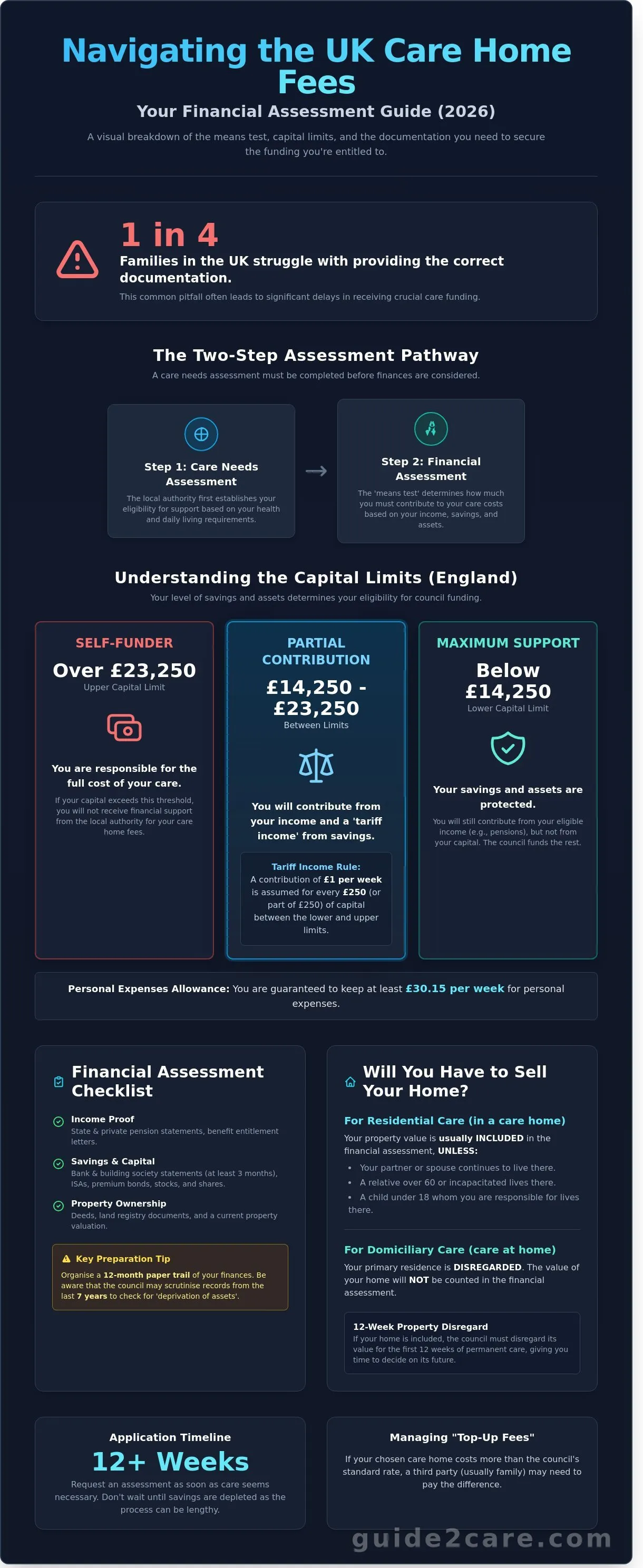
Did you know that 1 in 4 families in the UK struggle to provide the correct documentation during a local authority means test, often leading to delayed funding? Using a comprehensive care home fees financial assessment checklist is the most effective way to avoid these common pitfalls. It's natural to feel anxious about the "deprivation of assets" rules or the fear of losing a property that's been in the family for 30 years. Local authorities often request detailed proof of income, savings, and assets to determine your contribution level. Gathering financial records from the last seven years is a significant administrative task that requires precision.
Master the 2026 regulations and ensure you receive every penny of funding you're entitled to. This guide simplifies the UK means test by providing a clear understanding of the £14,250 lower and £23,250 upper capital limits. Organise your financial history effectively to avoid unnecessary stress during this transition. We provide a structured breakdown of required documents, property valuation rules, and essential steps for a successful funding application.
Key Takeaways
- Understand the sequence of the local authority means test and why a care needs assessment must always be completed first.
- Use our care home fees financial assessment checklist to navigate the 2026 capital limits, including the £23,250 and £14,250 thresholds.
- Identify the specific rules regarding your property, including the 12-week disregard and mandatory exemptions for partners or relatives.
- Learn how to organise a 12-month paper trail of income and assets to ensure you receive every penny of funding you are entitled to.
- Explore how to select the right care provider and manage potential "top-up fees" if your preferred home exceeds local authority budgets.
What is the Care Home Fees Financial Assessment?
The care home fees financial assessment is a formal "means test" conducted by your local authority. It determines the specific amount you must contribute towards your care costs. This process only begins after you've completed a care needs assessment. The council must first establish that you require support before they analyse your finances. Local authorities operate under a legal obligation to provide a fair, clear, and transparent evaluation of your assets. This Overview of social care in England explains the statutory framework that councils must follow when managing these duties.
To better understand how this means test functions in practice, watch this helpful video:
The assessment varies based on where you receive support. For residential care, the council typically includes the value of your home in their calculations unless a spouse or qualifying relative still lives there. If you receive domiciliary care in your own home, your primary residence is usually disregarded. This distinction is vital for long-term financial planning and affects your total contribution significantly.
The Purpose of the Means Test
The main objective is to categorise you as either a "self-funder" or someone eligible for council support. In England, the upper capital limit is £23,250. If your assets exceed this, you'll pay the full cost of your care. The Financial Assessment Officer will review your state pension, private pensions, and all savings. They aim to calculate your "ability to pay" without leaving you with nothing. For instance, they must ensure you keep a Personal Expenses Allowance of at least £30.15 per week. If your capital is between £14,250 and £23,250, you'll pay a "tariff income" of £1 for every £250 of savings. Find The Care You Need by understanding these thresholds early.
When Should You Request an Assessment?
Timing is critical. Request an assessment as soon as a change in health suggests care is necessary. Don't wait until your savings are gone. If your capital is approaching the £23,250 limit, contact your council immediately. Application processing can take 12 weeks or longer. In some cases, the council performs a "light-touch" assessment. This occurs when your financial situation is straightforward or your assets are clearly below the limits. Using a care home fees financial assessment checklist ensures you have your 3 months of bank statements and pension statements ready. This preparation prevents delays in securing funding.
A Financial Assessment Officer acts as your point of contact throughout this process. They verify your income and identify any benefits you might be missing. Their role is to ensure the council's contribution is accurate based on your specific wealth profile. Always double-check their calculations against your own records to ensure no errors were made during the audit.
Capital Limits and Income Rules for 2026
In 2026, the financial thresholds for residential care funding in England remain a critical part of your planning. The Upper Capital Limit is £23,250. If your total assets exceed this amount, you're responsible for the full cost of your care. The Lower Capital Limit is £14,250. Assets below this level are protected and won't be used to pay for care. You'll still contribute from your weekly income, but your savings stay intact. These figures are central to any care home fees financial assessment checklist when calculating long-term affordability.
If your capital falls between these two figures, the local authority applies a "tariff income" calculation. This isn't actual money you earn. It's a "notional" income of £1 per week for every £250 of capital you hold between the limits. For example, if you have £5,000 of capital above the lower limit, the council assumes you have an extra £20 of weekly income to contribute. You can find the official financial assessment guidelines to see how these rules apply to your specific situation.
What Counts as Capital?
Local authorities include various liquid and fixed assets in their calculation. This includes all bank accounts, building society balances, and ISAs. They also count the value of stocks, shares, and premium bonds. If you own a second home, a holiday let, or land, these are valued at current market rates minus 10% for selling costs. Your main home is usually excluded if a spouse, partner, or qualifying relative still lives there. If the home is empty, its value is typically included after a 12-week disregard period.
For business owners, valuing company shares as part of this assessment can be particularly complex. Those looking to raise capital as part of their long-term financial strategy might want to feature my company for pre-IPO investment through specialist introducers.
Certain items are excluded from the assessment. Your personal possessions, such as jewellery, clothes, or furniture, don't count towards the total. Most life insurance policies and specific investment bonds with a life assurance element are also ignored. Understanding these distinctions is a vital part of your care home fees financial assessment checklist. It's important to list every asset clearly to avoid delays in the assessment process.
Income Treatment and Personal Expenses Allowance
The assessment treats capital and income as separate categories. Your State Pension and any private occupational pensions are counted as income. Most of this money goes toward your care costs. However, you're legally entitled to keep a Personal Expenses Allowance (PEA). In the 2024/25 period, this is £30.15 per week. This figure is reviewed annually and is expected to rise by 2026. This money is for your own use. You use it for things like stationery, snacks, or small gifts for family.
Benefits like Attendance Allowance or the care component of Personal Independence Payment (PIP) are treated differently. If the council pays for your care, these benefits usually stop after 28 days. If you're a self-funder, you continue to receive them. Always check if you're eligible for the Savings Credit element of Pension Credit, as a portion of this may be disregarded. You can compare different care options to see how these income rules impact your monthly budget and long-term savings.
Local authorities have a legal duty to leave you with your PEA. They cannot ask you to use this money to subsidise the cost of the care home. If you have a spouse at home, you can often choose to pass 50% of your private pension to them. This reduces the amount of income the council can take for your care. Ensure you have all pension statements ready for the assessor to review.
The Property Question: Will You Have to Sell Your Home?
The prospect of selling a family home to fund residential care is a primary concern for many. However, your property isn't always included in the calculation. During the initial stage of your care home fees financial assessment checklist, the local authority determines if your home's value is "disregarded." If your non-housing assets are below £23,250, the council must ignore your property's value for the first 12 weeks of your permanent stay in a care home. This 12-week property disregard provides a breathing space to decide whether to sell or seek alternative funding.
When the Home is Excluded
The council cannot include your home in the assessment if specific people still live there. This is known as a mandatory disregard. It applies if the property is the main residence of your partner or civil partner. It also applies if a relative aged 60 or over, or a relative who is incapacitated, lives in the house. A child under 18 also triggers this rule. Some councils offer discretionary disregards. They might ignore the property if a long-term carer lives there who gave up their own home to look after you. If you own a property jointly with a person who doesn't live there, the council only assesses the value of your specific "beneficial interest." This is often significantly less than 50% of the market value because a share in a house is difficult to sell on the open market.
Deferred Payments Explained
A Deferred Payment Agreement (DPA) functions like a loan from the local authority. The council pays your care fees and secures the debt as a legal charge against your property. You don't have to sell your home during your lifetime. The debt is settled when the house is sold or within 90 days of your death. This option is common for those who want to keep the house for sentimental reasons or to wait for a better housing market.
Entering a DPA isn't free. Local authorities charge administrative fees to set up the agreement, often ranging between £500 and £1,000. They also charge interest. Between 1 January 2024 and 30 June 2024, the maximum interest rate for DPAs was 4.65%. You can choose to rent out your property while it's under a DPA. This income can pay off some of the care costs, but you must factor in tax and maintenance. Understanding the financial assessment for care explained by experts helps you weigh these costs against the benefits of retaining the asset.
If you're considering renting out the property, factoring in potential maintenance or renovation costs is crucial for your budget. To get a professional estimate for such work anywhere in the UK, you can discover Page Building Consultants.
Be cautious about "Deprivation of Assets." This occurs if you intentionally reduce your wealth to qualify for council funding. Gifting your home to your children shortly before moving into care is a common trigger. There's no fixed time limit like the "seven-year rule" used for inheritance tax. The council examines your health and your motivation at the time of the transfer. If they decide you gave the house away to avoid fees, they can assess you as if you still own the property. This can leave you with high care bills and no liquid assets to pay them. Ensure you include all recent property transfers on your care home fees financial assessment checklist to avoid legal complications later.
Your Step-by-Step Financial Assessment Checklist
Preparing for a financial assessment requires meticulous organisation. Local authorities typically request 12 months of financial records to verify your average income and identify any significant capital transfers. This window is standard because it helps the council determine if "deprivation of assets" has occurred; this is when someone intentionally reduces their wealth to qualify for state-funded care. If you cannot provide these records, the assessment process often stalls, delaying your funding decision. Use this care home fees financial assessment checklist to gather your paperwork before the visiting officer arrives.
Organisation is the most effective way to ensure you receive the correct funding. Start by creating a dedicated folder for physical documents. If you manage your finances online, download and print the last 12 months of statements for every account. The council will look for patterns, such as regular dividend payments or large one-off withdrawals. Clear records prevent the local authority from making assumptions about your wealth that could lead to an overestimation of your contribution.
Document Checklist: Income and Benefits
You must provide proof of all recurring funds. Locate your National Insurance number and your most recent Department for Work and Pensions (DWP) award letters. These should confirm amounts for State Pension, Pension Credit, or Attendance Allowance. If you receive an occupational pension, find your latest P60 or three months of consecutive payslips. You also need documentation for any annuities or trust fund dividends. The council counts this income toward your weekly care contribution, so accuracy is vital to avoid overpaying.
Document Checklist: Savings and Assets
List every account you hold, including building society passbooks and Post Office accounts. You need the last 12 months of statements for each to show current balances. Include certificates for Premium Bonds, National Savings & Investments (NS&I) products, and stocks. If you own property in the UK or abroad, provide a current valuation or the latest mortgage statement. In England, if your capital exceeds £23,250, you usually pay the full cost of your care. If it falls between £14,250 and £23,250, the council provides partial funding.
Claiming Disability Related Expenses (DRE)
DRE is a vital category for those receiving care at home. These are costs you incur specifically because of your disability or medical condition. Common examples include £10 per week for a gardener because you can't manage the outdoor space; £5 extra per week for specialist laundry; or £15 per week for a specific diet. You must provide receipts or invoices for these costs to have them accepted. Identifying these expenses is essential because the council deducts them from your "assessable income."
By accurately recording DRE, you lower the amount of income the council considers "available" for care costs. For instance, if you have £100 in weekly income but prove £30 in DRE, the council only assesses you on £70. This can significantly reduce your weekly care contribution, saving you upwards of £1,500 per year in some cases. Always ask the financial assessment officer for a copy of their DRE policy to see which specific items your local authority allows.
Find the support you need to manage your care journey effectively.
Explore Guide2Care for more funding adviceFinding the Right Care Provider After Your Assessment
Once the local authority completes your financial assessment, they'll provide a personal budget. This is the total amount they calculate as sufficient to meet your eligible care needs. You must now find a provider that accepts this rate. If your preferred home charges £1,100 per week but the council only pays £850, a gap exists. Use your care home fees financial assessment checklist to verify which specific services are included in the local authority's offer and which might require additional funding.
Take your assessment results with you when visiting potential providers. This document proves your care needs have been officially recognised. It allows managers to give you an accurate quote immediately. Don't settle for the first available bed. Compare at least three different providers to ensure the environment suits your personal preferences as well as your medical requirements.
Navigating the "Top-Up" Trap
A top-up fee is the difference between council funding and a care home's standard price. Under the Care Act 2014, the resident usually cannot pay this fee from their own remaining capital. A third party, such as a family member or a friend, must sign a legal agreement to cover the cost. This ensures the resident's protected capital, which is £14,250 in England, stays intact. If the third party's financial situation changes and they can't pay, the resident might have to move to a cheaper room or a different facility altogether.
You can negotiate with care homes. Ask if they have "standard" rooms that fall within the local authority's price bracket. Some providers offer discounts for local authority placements if they have high vacancy rates. Always clarify if "extras" like hairdressing, social trips, or specific toiletries are included in the base rate or billed separately. Keep your care home fees financial assessment checklist handy to track these hidden costs during tours.
Using Guide2Care to Simplify the Search
Finding a provider that aligns with your financial and clinical needs requires precise data. Our directory simplifies this by allowing you to filter results by location and specific care specialisms, such as complex dementia or palliative care. You can view provider profiles to see which homes currently accept council-funded residents, which helps you avoid the stress of top-up negotiations. Every listing includes the most recent Care Quality Commission (CQC) rating, from 'Outstanding' to 'Inadequate', so you can verify safety and leadership standards before booking a visit.
The search tool helps you identify providers that offer specific amenities that matter to you, such as garden access or pet-friendly policies. By narrowing your list to homes that already work with your local council, you reduce the risk of administrative delays. Efficient searching means you can focus on the quality of life the home provides rather than just the paperwork.
Selecting a care provider is the final step in a long process. Ensure you read the residency contract thoroughly before signing. Check for clauses regarding annual fee increases, which typically rise by 5% to 8% each April. Confirm the notice period required if you decide the home isn't the right fit. Clear communication now prevents financial surprises later.
Take Control of Your Care Funding Strategy
Navigating the 2026 capital limits requires precise planning and an understanding of current thresholds. If your total assets exceed the £23,250 limit, you'll likely be responsible for your own costs until your capital reduces. Using a structured care home fees financial assessment checklist helps you organise property valuations, savings records, and pension statements before the local authority review begins. This preparation ensures you don't miss out on vital property disregards or state benefits that directly impact your weekly budget.
Once you've clarified your financial position, the next step is selecting a high-quality provider. Guide2Care offers a comprehensive UK-wide directory designed to simplify this search. Our platform provides neutral, expert-led guidance that's regularly updated for 2026 regulations, ensuring you have access to the most current data. You can filter results by care type and location to find a home that fits your specific financial and medical requirements. Find the care you need today in our UK directory. You've now the tools to make an informed decision for your future care needs.
Frequently Asked Questions
How long does a financial assessment for care home fees take?
A financial assessment typically takes between 4 and 6 weeks to complete. The process begins after your care needs assessment confirms that you require professional support. Provide all documents from your care home fees financial assessment checklist promptly to avoid delays beyond this 42-day window. Local authority workloads can affect these timescales.
Can I refuse a financial assessment from the council?
You can refuse a financial assessment, but the council will automatically treat you as a "self-funder." This means you're responsible for paying the full cost of your care fees without state assistance. If your assets clearly exceed the £23,250 upper capital limit, you might choose to skip the assessment. However, you'll miss out on potential council-funded support or deferred payment agreements.
What happens if my savings fall below the £23,250 limit while in care?
You should contact your local council when your total assets fall towards the £23,250 threshold. Most authorities recommend starting the re-assessment process once you reach approximately £27,000. Once your capital is below £23,250, the council begins contributing to your care costs. You'll still contribute a portion of your weekly income toward the fees.
Is the value of my car included in the financial assessment?
The value of your car is generally excluded from the financial assessment. Local authorities focus on capital assets such as savings, stocks, shares, and property interests. They don't typically include personal belongings, furniture, or vehicles in the calculation. This ensures your primary mode of transport remains your own asset rather than being used to fund residential care.
While the car's value is excluded from the financial calculation, protecting the physical asset is still important, particularly if it will be used less often or left at an unoccupied property. To safeguard a vehicle against theft and potentially lower insurance premiums, you can explore Insurance Approved Vehicle Trackers.
Do I have to pay for care if I have a Power of Attorney?
Having a Power of Attorney doesn't exempt you from paying care fees. An attorney manages your finances on your behalf but doesn't become personally liable for the costs. The financial assessment still uses your own income and capital to determine your contribution. Your attorney simply ensures payments are made from your accounts according to UK law.
What is considered "deliberate deprivation of assets" in 2026?
Deliberate deprivation occurs if you intentionally reduce your assets to avoid care costs. This includes gifting large sums of money, transferring property titles, or making unusual luxury purchases. If the council determines you did this to increase your eligibility for funding, they'll assess you as if you still own those assets. There's no set time limit for how far back a council can investigate.
Can the council force me to sell my home if my partner lives there?
The council cannot force you to sell your home if your partner still lives there. This is a mandatory disregard. The property value is excluded from the financial assessment as long as a spouse, partner, or a relative who is aged over 60 or incapacitated resides in the house. Your care home fees financial assessment checklist should note this living arrangement to ensure the disregard is applied.
How often is the financial assessment reviewed?
Local authorities review financial assessments at least once every 12 months. This annual check ensures your contribution levels reflect current benefit rates and any changes in your savings. You must notify the council immediately if your financial circumstances change significantly between these scheduled reviews. This includes receiving an inheritance or a change in your private pension income.