Avoiding Selling Your House to Pay for Care: A 2026 UK Guide

The prospect of selling your home to cover care costs is a significant worry for many homeowners in England. It's a valid concern, especially when the average cost of a UK care home now exceeds £800 per week. You want to ensure your children receive their intended inheritance while you access high-quality support. Understanding the legal methods for avoiding selling house to pay for care uk is essential for your long-term financial security within the English social care system.
This Guide2Care guide provides clear information on legal exemptions and strategic planning for the English social care system, particularly anticipating changes for the 2026 system. You'll learn how proposed social care reforms and the new £86,000 lifetime care cap are intended to change the landscape for property owners in England. We detail the specific rules regarding disregarded assets, the benefits of domiciliary care, and how to protect your home's value under England's Care Act 2014 and Department of Health and Social Care guidelines. While social care is a devolved matter with different rules in Scotland, Wales, and Northern Ireland, use these insights to make informed decisions about your future and find the care you need within England without losing your family home.
Key Takeaways
- Understand the 2026 financial assessment rules and how the Upper Capital Limit (UCL) determines your eligibility for local authority funding.
- Identify the specific "property disregard" conditions where the council is legally prohibited from including your home's value in their assessment.
- Explore legal mechanisms like Property Protection Trusts and Deferred Payment Agreements as viable routes for avoiding selling house to pay for care uk.
- Learn the risks of "deliberate deprivation of assets" and why social care rules regarding asset transfers differ from standard Inheritance Tax regulations.
- Evaluate how domiciliary and live-in care options provide a practical alternative to residential placements while keeping your property within the family.
Understanding the UK Care Funding Rules in 2026
The 2026 financial assessment marks a significant shift in how local authorities evaluate your ability to pay for residential or home-based support. Under these regulations, the council conducts a detailed review of your financial standing to decide if you qualify for state assistance. This process determines whether you must fund your own support or if the government will contribute. Understanding these UK care funding rules is the first step in protecting your family home from being sold to cover fees.
A central component of this system is the distinction between health care and social care. The NHS funds health care entirely through Continuing Healthcare (CHC) if your primary need is medical. Social care is different because it is means-tested and covers assistance with daily living activities like washing or dressing. For many homeowners, the challenge of avoiding selling house to pay for care uk starts when the local authority identifies a social care need that exceeds their financial thresholds.
To better understand this concept, watch this helpful video:
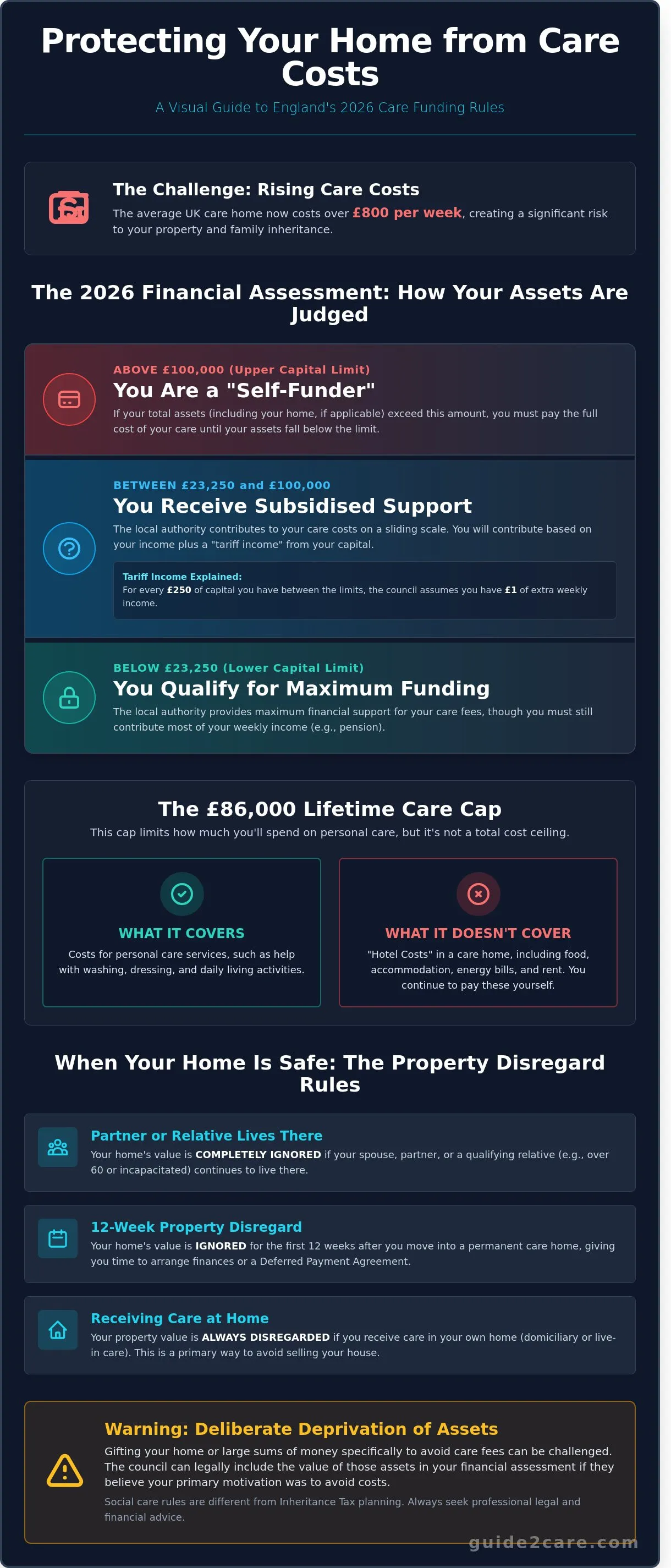
The 2026 reforms introduce an £86,000 cap on personal care costs. This cap limits the total amount you spend on actual care services during your lifetime. It does not cover daily living costs like food or rent in a care home. This distinction is vital for your long-term property protection strategy. Even after you reach the cap, you remain responsible for "hotel costs" in a residential setting, which can still drain your equity if you don't plan ahead.
The Means Test: Income vs Assets
The means test is a statutory gatekeeper for state funding. Local authorities first examine your income, including your State Pension and any private pensions. They also calculate "tariff income" on your savings. For every £250 of capital you own between the lower and upper limits, the council assumes you have £1 of weekly income. If your total assets fall below the lower capital threshold of £23,250, the council provides maximum support, though you must still contribute most of your weekly income toward the fees.
2026 Capital Thresholds Explained
The 2026 rules increase the Upper Capital Limit (UCL) to £100,000. If your total assets, including your property, exceed this £100,000 limit, you are a "self-funder" and must pay the full cost of your care. For joint accounts, the council usually assumes each person owns an equal 50 percent share. Shared property ownership can complicate this calculation. If a spouse or a dependent relative aged over 60 still lives in the house, the council must disregard the property value entirely. This is a primary legal route for avoiding selling house to pay for care uk while a partner remains at home. If your assets sit between £23,250 and £100,000, you receive subsidised support based on a sliding scale of your wealth.
When Your Home is Safe: The Property Disregard Rules
Local authorities in England follow strict rules when assessing your ability to pay for residential care. Under the Care Act 2014, the council cannot always include your home's value in their financial calculations. These rules are called property disregards. Understanding these exceptions is a vital step in avoiding selling house to pay for care uk. If your property is disregarded, the council only assesses your income and other capital, such as savings or stocks, against the current £23,250 upper capital limit.
The 12-week property disregard is a primary protection for those moving into permanent residential care. When you first enter a care home, the local authority must ignore the value of your main residence for the first 12 weeks of your stay. This period provides a financial buffer. It allows you time to explore options like a Deferred Payment Agreement or to sell the property at a fair market price rather than in a rush. During these 84 days, the council will help with your care costs if your other assets are below the £23,250 threshold.
Choosing home care over a residential home is another effective method for protecting your property. When you receive domiciliary care, the value of your home is always excluded from the financial assessment. The council only considers your property value if you move into a care home or nursing home. You can find local home care providers who offer support ranging from basic housekeeping to complex medical assistance. This choice keeps your asset entirely out of the means test while you remain in your own surroundings.
To complement professional care and maintain a safe, comfortable living environment, many families also arrange for regular domestic help. Using a directory like Cleaner Connect can help you find trusted local cleaners, ensuring the home is well-kept while you focus on health and wellbeing.
Who Can Stay in the House?
Mandatory disregards apply if specific people continue to live in your home after you move into care. The council must ignore the property value if your spouse, civil partner, or an estranged partner who is a lone parent lives there. Protection also extends to relatives aged 60 or over and those who are "incapacitated." A child under 18 living in the property also triggers this rule. The official government guidance ensures these residents aren't made homeless by your care needs. It's a legal requirement that councils must honour without exception.
Discretionary Disregards
Councils have the power to ignore your home's value even if you don't meet the mandatory criteria. This is known as a discretionary disregard. It often applies when a long-term carer lives in the house but isn't over 60 or incapacitated. To succeed with a discretionary claim, you must present a strong case to your local authority. Explain why the resident needs to stay in the home and how their presence benefits the community or your long-term care plan. You should document exactly who has lived in the property and for how long. Use utility bills, council tax records, or GP registration data from the last 5 years to prove residency. Clear evidence makes it harder for a council to refuse your request.
The financial assessment process is rigorous. You must provide accurate details about your property's ownership and the residents living there. If the council determines a disregard applies, they'll focus on your other assets. This often means you can keep your home within the family while still accessing the support you need. Always ask for a written explanation of the council's decision regarding your property status. If they refuse a disregard, you have the right to appeal through their formal complaints procedure.
Legal Mechanisms to Protect Your Property: Trusts and DPAs
Homeowners often worry about losing their family home to residential costs. Understanding the legal frameworks available is the first step toward avoiding selling house to pay for care uk. You have several options to delay or ringfence property value, provided you plan before the need for care becomes an emergency. These mechanisms range from local authority loans to complex trust arrangements within your Will.
Deferred Payment Agreements Explained
A Deferred Payment Agreement (DPA) acts as a specialized loan from your local council. The council pays your care home fees directly and secures the debt as a legal charge against your property, similar to a mortgage. You don't have to sell your home during your lifetime. The debt is usually settled from the estate after death or when the house is eventually sold. For the period between January and June 2026, the national maximum interest rate for DPAs is projected at 5.1%, though local authorities also charge administrative setup fees. These fees typically range from £600 to £1,200 depending on your location.
DPAs offer a vital breathing space for families. They allow the property to remain in the family, potentially benefiting from house price growth that outpaces the interest charged. However, the debt accumulates quickly. If a resident remains in care for several years, the total owed can consume a significant portion of the equity. You can find detailed eligibility criteria in Age UK's guide on property and care fees to see if your local council must offer this option.
Will Trusts and Life Interests
Property Protection Trusts (PPTs) are effective tools for couples. Most UK couples own their home as "Joint Tenants," meaning the survivor automatically inherits the whole property. If the survivor then enters care, the entire house value is assessed for fees. By changing ownership to "Tenants in Common," each partner owns a distinct 50% share. You can then write a Will that places your share into a trust rather than leaving it directly to your spouse.
This trust usually grants the surviving spouse a "Right of Occupation" or a "Life Interest." They can live in the house for the rest of their life, but they don't own your half. If they eventually need residential care, the local authority can only assess the 50% they actually own. The half held in trust is protected for your children or other beneficiaries. You must set these trusts up while both partners have full mental capacity under the Mental Capacity Act 2005. Attempting to do this after a diagnosis of dementia may be challenged as a deliberate deprivation of assets.
Equity release is another route, though it's frequently considered a last resort. This involves taking a commercial loan against the home to pay for domiciliary care or home adaptations. While it helps in avoiding selling house to pay for care uk in the short term, the interest rates are often higher than DPAs, ranging between 6% and 8%. Because the interest compounds, the amount owed can double every 10 to 12 years. Always seek independent financial advice before committing to an equity release scheme, as it significantly reduces the inheritance you leave behind.
- Joint Tenants: Property passes to the survivor; 100% is vulnerable to care costs.
- Tenants in Common: Each owns a share; 50% can be protected via a Will trust.
- DPA: A council loan that prevents an immediate sale but accrues interest.
- PPT: A trust that ringfences half the property value for heirs.
The Risks of 'Deprivation of Assets': What to Avoid
Deliberate deprivation of assets happens when you intentionally reduce your wealth to decrease the amount you pay for social care. Local authorities in England follow the Care and Support Statutory Guidance under the Care Act 2014 to identify these instances. When a council carries out a financial assessment, they look for any assets you no longer own. If they decide you gave away property or money to avoid care costs, they treat you as if you still own those assets. This is known as 'notional capital'.
A common misconception is the '7-year rule'. This rule applies to Inheritance Tax (IHT) and allows gifts to leave your estate for tax purposes after seven years. It does not apply to social care. There is no time limit on how far back a council can look for deprivation. If you gave away a house ten years ago but were already diagnosed with a progressive condition like Parkinson's, the council can still challenge the transfer.
Many people research methods for avoiding selling house to pay for care uk, but transferring a deed to your children while you remain in the property is high-risk. This is often viewed as a 'gift with reservation of benefit'. Beyond the council's investigation, you lose legal control. If your child faces a divorce, their ex-spouse could claim a share of your home. If the child becomes bankrupt, the Insolvency Act 1986 allows creditors to seize the property to settle debts. You could be evicted from a home you thought was protected.
The consequences of being found in breach are severe. The council can assess you as a 'self-funder' even if you have no cash left. This creates personal debt. Under the Care Act 2014, councils also have the power to recover the cost of care from the person who received the gift. This means your children could be legally forced to pay your care fees or sell the house to settle the debt.
How Councils Investigate Transfers
Councils use a 'foreseeability' test to determine your intent. They ask if you could have reasonably expected to need care at the time of the transfer. If you were 80 years old and in poor health, the council will likely argue that the need for care was foreseeable. They also apply a 'motive' test. If the primary reason for the gift was to qualify for local authority funding, it is classed as deprivation. Social workers and financial assessors use Land Registry records to track when ownership changed. They compare these dates against your medical records and GP history to build a timeline of your health and financial decisions.
Legal Alternatives to Giving Assets Away
You can manage your estate without triggering deprivation rules by using HMRC-recognised exemptions. Making small, regular gifts from your surplus income is generally acceptable if it doesn't reduce your standard of living. You might also choose to invest in your current home. Spending £12,000 on an accessible wet room or £5,000 on a high-quality stairlift is a legitimate use of capital. These improvements facilitate 'care at home' and are not viewed as avoiding fees because they directly support your wellbeing. Using your savings to pay off a mortgage or legitimate debts is also a safe way to reduce your capital total before an assessment.
To understand your options for funding and support, Find The Care You Need through our comprehensive directory.
Finding Alternative Care Options to Preserve Your Assets
Choosing domiciliary care is the most direct strategy for avoiding selling house to pay for care uk. When you receive care in your own home, the value of your property is excluded from the local authority financial assessment. Under current 2024 regulations in England, the upper capital limit is £23,250. If your assets exceed this figure, you're generally required to self-fund your care. However, because your primary residence isn't counted as an asset while you still live in it, you can protect the home's value while accessing necessary support.
Agencies like Bloomfield Care specialise in providing this person-centered support, allowing individuals to remain in their familiar surroundings while safeguarding their property assets.
Live-in care serves as a practical alternative to residential settings. This model involves a professional carer living in your spare room to provide one-to-one support. It's often more affordable than premium nursing homes. In regions like the South East, residential nursing fees can frequently exceed £1,600 per week. In contrast, live-in care packages typically start between £1,000 and £1,300 per week. For couples who both require support, a single live-in carer is almost always more cost-effective than paying for two separate beds in a residential facility.
While based in Belgium, the model used by services like Zuster in Huis provides a clear example of how professional, full-time live-in assistance can be structured, offering an alternative to residential care that many UK families also seek.
The Benefits of Home Care
Home care allows you to maintain your established routines and community links. It offers a level of flexibility that residential homes can't match. You can scale your support from a few hours of domiciliary care per week to full-time assistance as your health needs evolve. This graduated approach ensures you only pay for the specific care you require at any given time. Most importantly, it keeps your property classified as an excluded asset, ensuring it remains within the family estate rather than being sold to fund a care home placement. While you'll want to find a local provider, looking at international examples like cocoonss.com can give you a clear idea of the wide range of non-medical support that is possible.
Planning for the Future
Effective asset protection requires early planning. You should set up a Lasting Power of Attorney (LPA) for both health and finance as soon as possible. These legal documents ensure that trusted individuals make decisions on your behalf if you lose mental capacity. Without an LPA, your family might face expensive and lengthy Court of Protection proceedings to manage your affairs. Current data from the Office of the Public Guardian suggests it can take up to 20 weeks to register an LPA, so don't delay this process.
This long-term financial planning often extends to ensuring the next generation is well-supported. For many families, this includes planning for significant educational expenses. If you're considering how best to support a child or grandchild's ambition for higher education abroad, you can learn more about SBUB Group Ltd, a consultancy that specialises in this area.
While many focus on navigating the UK system, some take a broader view of retirement planning by considering options abroad where care and living costs may be lower. For those exploring such alternatives, the Expat Retirement Chronicles provides personal stories and planning support for retiring in destinations like Thailand.
This broader perspective also includes planning for memorable life experiences before the need for care arises. For those looking to create lasting memories with their savings, you can discover Palace on Wheels Train for a luxury journey through the heart of India.
Use the Guide2Care directory to find CQC-rated home care agencies in your specific postcode. The directory allows you to filter for providers who specialise in 'ageing in place' and complex needs. This transparency helps you compare services and quality ratings before you commit to a provider. Always ensure you request a care needs assessment from your local authority before any financial assessment takes place. This assessment identifies the specific level of help you need, which is a vital first step in securing the right support while avoiding selling house to pay for care uk.
Take control of your future care arrangements. Find the care you need today with our comprehensive directory and explore the professional providers available in your area.
Take Control of Your Care Funding Strategy
Navigating the 2026 social care landscape requires a clear understanding of the 12-week property disregard rules and the risks associated with the deprivation of assets. You can protect your home by correctly applying for a Deferred Payment Agreement or utilising legal trusts before care needs arise. It's essential to act early to ensure you're avoiding selling house to pay for care uk while remaining compliant with Care Act 2014 assessments. By exploring alternative care options like domiciliary care or supported living, you can maintain your independence without immediate property liquidation.
Guide2Care provides the tools you need to make these decisions with confidence. Our comprehensive UK-wide directory focuses on CQC-rated providers, offering neutral and practical guidance to simplify your search. Use our resource hub to compare services and understand your funding options today. We help you find providers that meet your specific requirements across the country.
Find the care you need and explore UK providers to secure your future. You've got the facts; now take the next step toward a stable care plan.
Frequently Asked Questions
Can I give my house to my children to avoid care home fees?
You can transfer your home to your children, but the local council may view this as "deprivation of assets" if they believe your primary motive is avoiding selling house to pay for care uk. Under the Care Act 2014, local authorities investigate the timing and intent of such gifts. If the council decides you gave the property away to reduce your care costs, they'll assess your finances as if you still own the house. There's no fixed time limit for how far back a council can look.
What is the 7-year rule for care home fees in the UK?
The 7-year rule applies to Inheritance Tax rather than social care funding. If you survive a gift by 7 years, it's usually exempt from the £325,000 Inheritance Tax threshold. However, for care fees, local councils can look back much further than 7 years to investigate asset transfers. They check if you could've reasonably foreseen the need for care when you made the gift. Don't confuse tax rules with care funding regulations.
Is my spouse's half of the house safe if I go into care?
Your home is protected if your spouse or partner continues to live there while you're in residential care. This is known as a mandatory property disregard under the Care Act 2014. The council can't include the value of your home in your financial assessment while a qualifying relative lives in it. This rule also applies if a relative aged over 60 or a disabled relative resides in the property. It ensures your partner isn't left without a home.
How much can I keep in savings before I have to pay for care in 2026?
You must currently pay the full cost of your care if your assets exceed £23,250 in England. While the previous government proposed raising this upper limit to £100,000, the new administration has cancelled these specific social care reforms. If your capital falls between £14,250 and £23,250, the council provides partial funding. You'll contribute £1 for every £250 of savings between these two figures. These thresholds are subject to change in future budget statements.
Does the council take your house immediately if you move into a care home?
The council won't take your house immediately because of the 12-week property disregard rule. For the first 84 days of your permanent stay in a care home, the value of your main residence is ignored during the financial assessment. This period gives you time to decide how to fund your care or arrange a house sale. After 12 weeks, the property value is included in your total assets, which often means you'll start paying the full fee.
What happens if I refuse to sell my house to pay for care?
You aren't forced to sell your home immediately if you enter into a Deferred Payment Agreement with your local council. This arrangement acts like a loan secured against your property. The council pays your care fees and recovers the money, plus interest, when the house is eventually sold. In 2024, the maximum interest rate councils can charge for these agreements is 4.05%. It's a useful option for avoiding selling house to pay for care uk during your lifetime.
Can a Deferred Payment Agreement be refused by the council?
A council can refuse a Deferred Payment Agreement if your property doesn't have enough equity to cover the care costs. They must be able to secure a first legal charge on the property at the Land Registry. If you have an existing mortgage or a lifetime mortgage that leaves little remaining value, the council may decline the application. They also require the home to be maintained and insured throughout the agreement. Each council has its own specific DPA policy.
What is the difference between a care needs assessment and a financial assessment?
A care needs assessment identifies the specific support you require, such as help with washing, dressing, or medication. The financial assessment follows this to determine how much you'll contribute toward those costs. The council conducts the needs assessment first to see if you meet the national eligibility criteria. Only after confirming you need care will they review your bank statements and property values to calculate your funding. You're entitled to a needs assessment regardless of your financial situation.