Residential Homes for Couples UK: A 2026 Guide to Staying Together
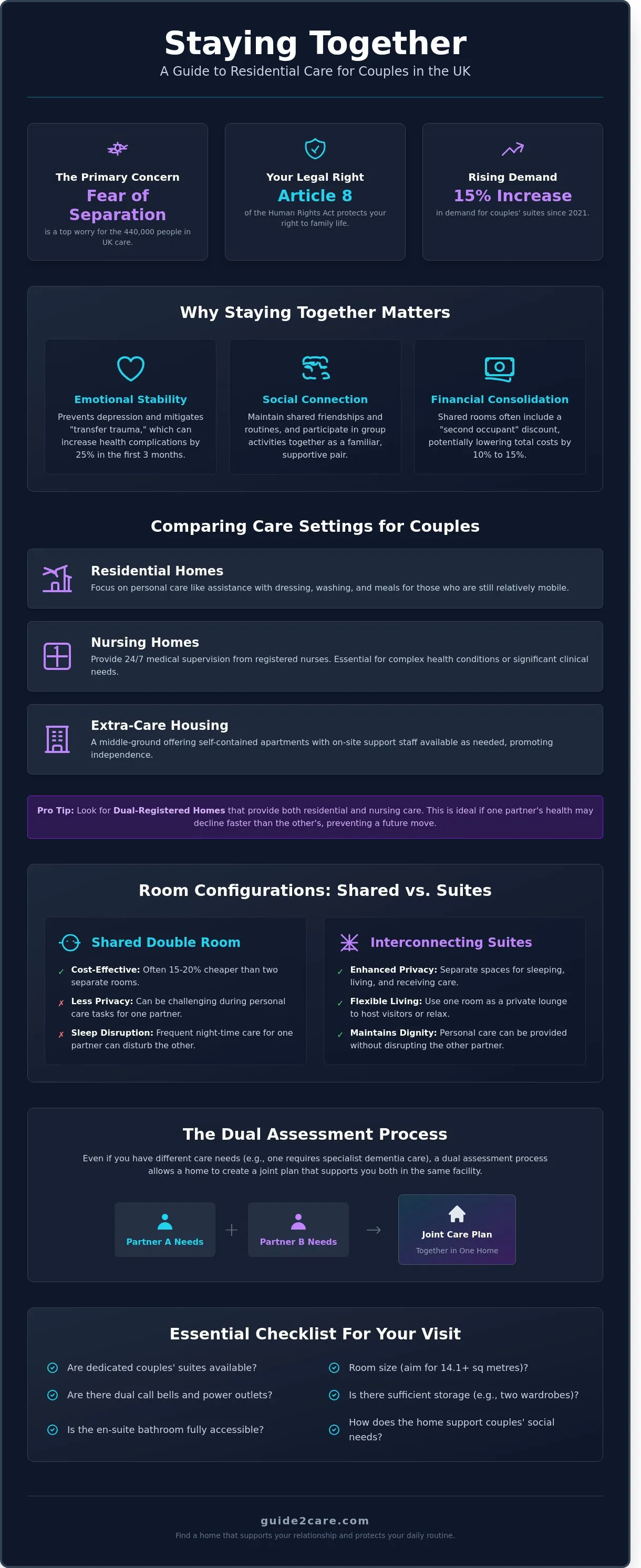
Why should decades of shared history end at the door of a care facility because one partner requires more physical support? You likely feel that staying together is the only way to maintain your quality of life. Research from the Relatives & Residents Association suggests that the fear of separation is a primary concern for the 440,000 people currently living in UK care settings. It's a valid worry, but the care system offers specific pathways to keep you under the same roof.
Finding residential homes for couples uk allows you to stay together while accessing professional help. This guide explains how to navigate the assessment process and manage complex situations, such as when one person needs specialist dementia care and the other does not. You will learn about different room layouts, including interconnecting suites and shared double rooms. We also clarify how joint funding and financial assessments work for couples. Use this information to find a home that supports your relationship and protects your daily routine.
Key Takeaways
- Understand your legal rights under the Human Rights Act and differentiate between residential care, nursing homes, and extra-care housing options.
- Identify suitable room configurations in residential homes for couples uk, including the choice between shared bedrooms and private lounge spaces.
- Learn how dual-track assessments allow partners with diverging care needs to remain together in the same facility.
- Use our viewing checklist to ask registered managers essential questions regarding social dynamics and couples' facilities.
- Filter the Guide2Care directory to compare local providers based on CQC ratings and the availability of dedicated suites for couples.
Understanding Your Options: Residential Care for Couples in the UK
The Human Rights Act 1998 protects your right to a private and family life under Article 8. This legal framework means local authorities and care providers must make reasonable efforts to keep partners together when they move into long-term care. Finding suitable residential homes for couples uk ensures that your relationship remains the priority while your physical needs are met. It's a vital protection that prevents the forced separation of spouses who may have different levels of dependency.
By 2026, UK care providers have significantly increased their "couples suites" inventory to meet a 15% rise in demand for shared occupancy recorded since 2021. You need to understand the differences between the three primary settings. Residential homes focus on personal care, such as dressing and washing. Nursing homes provide 24-hour medical supervision from registered nurses. Extra-care housing offers a middle ground, providing self-contained apartments with on-site support staff available as needed. Selecting the correct setting depends on your specific clinical requirements.
- Emotional stability: Staying together prevents the depression often associated with late-life separation.
- Social circles: Couples can maintain shared friendships and participate in group activities as a pair.
- Financial consolidation: Shared rooms often come with a "second occupant" discount, potentially lowering total costs by 10% to 15%.
Types of Residential Settings for Couples
Standard residential homes provide personal care for couples who are still relatively mobile but struggle with daily domestic tasks. Dual-registered homes are more versatile; they provide both residential and nursing care in one location. This is essential if one partner’s health declines faster than the other's. Specialist dementia units now offer companion suites designed for safety, allowing a healthy partner to live alongside a spouse with cognitive impairment while professional staff manage the complex care needs.
The Emotional and Physical Impact of Staying Together
Moving as a single unit helps mitigate "transfer trauma," which industry data from 2024 suggests can increase health complications by 25% during the first three months of a move. For those with early-stage dementia, the presence of a partner provides a constant, familiar anchor that supports cognitive health and reduces agitation. Staying in residential homes for couples uk allows you to maintain established routines. Whether it's a specific breakfast time or a shared evening walk, these habits are easier to preserve in a dedicated couples' environment.
Room Configurations and Living Arrangements
Residential homes for couples UK must comply with Care Quality Commission (CQC) standards to ensure dignity and safety. Regulation 15 requires that premises are suitable for the service provided and are kept in good repair. When a home offers double occupancy, the physical space must accommodate two sets of needs, including mobility aids and medical equipment. Most modern providers design rooms to be at least 14.1 square metres for two people, though many premium facilities offer significantly more space to prevent a cramped environment.
Evaluating a room requires looking beyond the floor space. You should check for dual call bell points, multiple power outlets, and sufficient lighting for both residents. Storage is a frequent challenge in shared settings. Ensure the room has at least two wardrobes and separate chest-of-drawers to manage life-long possessions. Bathroom accessibility is also vital. A shared en-suite must have a level-access shower and enough turning space for a wheelchair or a carer assisting a resident.
Shared Rooms vs. Interconnecting Suites
Shared rooms are the traditional "double room" option. They're often 15% to 20% cheaper than paying for two separate single placements. While cost-effective, they offer less privacy when staff perform personal care tasks. If one partner requires frequent night-time intervention, the other's sleep may be disrupted.
Interconnecting suites provide a more flexible alternative. These consist of two single rooms joined by an internal door. One room usually becomes the bedroom, while the other serves as a private sitting room. This arrangement offers a clear boundary between living and sleeping areas. It allows one partner to host visitors or watch television while the other rests. It also provides a private space for care visits, maintaining the dignity of both individuals. You can find the care you need by filtering for homes that offer these specific suite configurations.
Bringing Your Own Furniture and Belongings
Personalising a room helps it feel like home. Most providers encourage residents to bring smaller items like photos, clocks, and lamps. Bringing larger items like beds or armchairs is often permitted but subject to strict rules. All upholstered furniture must comply with the Furniture and Furnishings (Fire Safety) Regulations 1988. Items should carry a permanent label proving they're fire-resistant.
Of course, you might decide to purchase new items that fit the space perfectly. You can find a wide selection of stylish and compliant options from online homeware stores such as Living Chic.
These items serve as powerful reminders of a shared life. Photos from past adventures, whether it was exploring the local countryside or a diving trip with a group like Cozumeldivehub, help to maintain a sense of identity and continuity.
Space management is critical when two people move into a single environment. A standard room measuring 16 square metres won't accommodate two full sets of household furniture. Prioritise items with sentimental value or those that improve comfort, such as a specific orthopaedic chair. Always request a floor plan with dimensions before the move-in date to ensure your belongings fit safely without creating trip hazards for staff or residents.
Managing Different Care Needs Under One Roof
Couples often enter residential homes for couples uk with "diverging needs." This occurs when one partner requires significantly more physical or cognitive support than the other. Data from 2023 sector reports indicates that nearly 30% of couples in care settings have mismatched dependency levels. Managing this requires a flexible approach to care delivery that prioritises both safety and companionship.
The Joint Assessment Process
Each partner must have an individual care plan. This is a legal requirement under the Care Act 2014. Care managers conduct dual-track assessments to identify specific health requirements for both people. They specifically look for "carer strain." If a spouse tries to provide 35 or more hours of unpaid care per week within the home, the staff will intervene. This protects the health of both residents. It also helps both partners maintain their social independence and unique identities. You don't lose your autonomy just because your partner needs more help.
What Happens if Needs Become Incompatible?
Health needs can change quickly. If one partner develops specialist dementia requirements, providers often use "floating support." This brings specialist staff into the shared suite to provide focused 1-to-1 care. If safety becomes a primary concern, a move to a different wing within the same building might occur. Most modern residential homes for couples uk are designed to facilitate this transition without total separation. You can still share meals, attend events, and spend daylight hours together. Use these strategies to stay connected:
- Shared Social Calendars: Staff coordinate activities so couples with different abilities can participate in the same room.
- Zoned Care: One partner receives nursing care in a shared suite while the other maintains a standard residential status.
- Article 8 Rights: Use the Human Rights Act to advocate for your right to a private and family life during care reviews.
If a partner requires hospitalisation, the transition is often difficult. Most UK care contracts include a "bed-hold" clause. This typically lasts between 14 and 21 days. During this period, the home keeps the room available. They usually charge the full fee or a slightly reduced rate of around 80%. Check these terms in your residency agreement to avoid unexpected financial pressure during a health crisis.
Evaluating a Care Home: The Couples Viewing Checklist
Visiting potential residential homes for couples uk requires a focus on shared living logistics. You must ensure the facility supports two distinct sets of care needs within one environment. Take a notepad and request a copy of the standard residency agreement during your tour. This allows you to review terms away from the pressure of a viewing.
Questions for the Care Home Manager
Start by asking about future-proofing. What's the policy if one partner develops nursing needs later? Some homes require a move to a different wing, while others bring nursing staff to the existing suite. You should also ask how staff handle personal care. If one partner wakes at 06:00 for medication, staff must ensure the other isn't disturbed.
Discuss the financial breakdown clearly. Is there a discount on the second person’s weekly fee? It's common for the second resident to pay a reduced rate. This discount typically ranges from 10% to 20% of the standard weekly fee because they share the physical room space and certain overheads.
Observing the Environment
Check the communal layout for practical use. Look for quiet corners in lounges where a couple can sit privately away from the main television area. Accessibility is vital for independence. Ensure both partners can move around the grounds together. Check for wide doorways and level access to gardens or patio areas.
Review the activity schedule for variety. Look for evidence of meaningful activity tailored for pairs. This might include dedicated couples' dining nights or shared hobby groups. According to 2023 CQC inspection frameworks, homes must demonstrate how they support residents to maintain significant personal relationships.
- Social Dynamics: Ask if other couples currently live there. Speaking with them provides direct insight into how the home manages dual occupancy.
- Dining Preferences: Analyse the food and beverage programme. Check if you can have a private table for two. Verify if there are extra charges for tray service if you choose to eat in your suite.
- Fee Structures: Examine the small print for "community fees" or "administration charges" that might be doubled for two people.
Careful observation helps you identify if a home truly values the bond between partners. Don't settle for a facility that treats you as two individual residents who happen to share a room. Find the care you need by comparing providers that specialise in dual occupancy.
Finding the Right Provider with Guide2Care
Guide2Care provides a centralised database to simplify your search for residential homes for couples uk. The platform organises care providers into searchable categories, allowing you to filter by specific needs and geographical location. This structure removes the complexity of contacting multiple agencies individually and presents all necessary data in a neutral, accessible format.
Navigating the Directory
Start your search by entering a specific postcode or town. Use the location filters to pinpoint homes within a 5 or 10-mile radius of your family and support networks. This proximity is vital for maintaining social connections after a move. While browsing, read the provider descriptions carefully for mentions of "interconnecting rooms" or "companion suites." These specific room types are often limited, so identifying them early is essential.
Use the "favourite" feature to shortlist providers that meet your criteria. This tool allows you to compare CQC ratings across your choices. In 2024, the Care Quality Commission continues to monitor providers based on safety, effectiveness, and leadership. Prioritise homes with "Good" or "Outstanding" ratings to ensure high standards of care. Look for specific facility data such as wheelchair access, private garden areas, and on-site medical support.
Taking the Next Step
Contact providers directly through the Guide2Care platform to ask about current availability for couples. You should arrange an initial visit to see the shared living spaces first-hand. Many providers offer a trial stay, usually lasting between 7 and 14 days. This respite care period is a practical way to test the shared living arrangement and see how the staff manages the different care needs of both partners without a long-term commitment.
Prepare for the transition by accessing our supplementary resources. Guide2Care hosts detailed guides on funding thresholds and the legalities of Power of Attorney. If your situation involves international elements, such as one partner's visa status, getting advice from a specialist consultancy like 1 Absolute Advisor can be crucial. In England, the upper capital limit for care funding remains £23,250 for 2024, and understanding how this applies to couples is a critical step in your planning. Use these resources to organise your finances and legal protections before signing a residency agreement.
Secure Your Shared Future with the Right Care
Finding suitable residential homes for couples uk doesn't have to be a complex process. You've seen that companion suites and interlinked rooms provide the space needed for independence while ensuring 24-hour support is accessible. It's vital to confirm that a provider can manage dual care plans, particularly if one partner requires specialised dementia support while the other needs standard residential assistance. Always verify the latest Care Quality Commission (CQC) inspection reports to ensure the facility meets one of the four essential quality ratings. If your individual assets are above the £23,250 capital threshold in England, you'll likely be self-funding your care. Use a structured checklist during visits to compare facilities objectively and review their specific couples' policies. Guide2Care simplifies this search by providing a central hub for all your requirements. Our platform offers a comprehensive UK-wide directory, up-to-date CQC rating information, and detailed guides on funding and legal requirements. Explore our directory to find the care you need. Start your search today to ensure you stay together in comfort.
Frequently Asked Questions
Do care homes for couples cost twice as much as a single room?
Costs for residential homes for couples UK don't usually double the price of a single room. Most providers offer a companion discount of 10% to 15% compared to the price of two separate residents. You pay for the care level of each individual plus a shared room rate. Average weekly costs for a couple range from £1,500 to £3,000 depending on location and specific care requirements.
Can we share a bed in a residential care home?
You can share a bed in a residential care home if the room size and health requirements allow it safely. Care homes must follow the Health and Social Care Act 2008 (Regulated Activities) Regulations 2014 regarding privacy and dignity. Many homes provide double beds or permit you to bring your own furniture from home. Confirm the room dimensions with the manager to ensure a double bed fits safely according to fire regulations.
What happens if one of us dies while living in the care home?
The surviving partner can usually remain in the home, though they may need to move to a single occupancy room. Fees reduce to a single rate after a set notice period, which is typically 7 to 14 days in most UK contracts. Age UK data shows that many residents stay in the same facility to maintain their social circle. Review your residency agreement for specific clauses regarding room changes after a bereavement.
Can we move into a care home if only one of us needs care?
You can move into a care home together even if only one person requires professional support. This is often called a companion suite or independent living within a care setting. The independent partner pays for accommodation and meals but avoids the costs of nursing or personal care they don't use. This arrangement prevents the separation of couples when one person's health declines and the other remains physically independent.
Are there specific care homes for LGBTQ+ couples in the UK?
Specific care homes for LGBTQ+ couples exist, including Tonic@Bankside in London which opened in 2021 as the UK's first LGBTQ+ affirmative retirement community. Many other providers hold the Pride in Care quality standard from Opening Doors. This accreditation ensures staff have received specific training to support LGBTQ+ residents. Check the home's statement of purpose to see how they promote an inclusive environment for all couples and their families.
How do we handle the sale of our home if we move into care together?
Use the 12-week property disregard or a Deferred Payment Agreement through your local council to manage the sale. The local authority pays care costs for the first 12 weeks after you move into residential homes for couples UK if your other assets are below £23,250. This provides time to sell the property. A Deferred Payment Agreement allows the council to reclaim costs from the eventual sale of your home at a later date.
What if my partner has dementia but I am physically independent?
Look for a dual-registered home that provides both residential and specialist dementia care on the same site. This allows you to live in the same suite or building while your partner receives the memory support they need. Data from the Alzheimer's Society suggests that 80% of care home residents have some form of cognitive impairment. Choosing a home with varied care levels ensures you aren't separated if health needs diverge.
Is there a specific CQC rating I should look for when choosing a home for a couple?
Aim for a Care Quality Commission (CQC) rating of Good or Outstanding when selecting a home. The CQC 2023 State of Care report shows that 83% of adult social care services meet these standards. Focus on the Caring and Responsive categories within the inspection report. These sections highlight how a provider supports personal relationships and respects the choices of couples living in the facility, ensuring they receive high-quality support.