How to Get a Care Needs Assessment from the Council: A Step-by-Step Guide (2026)

In 2023, local authorities in England received 1.9 million requests for adult social care support, yet many families remain unsure of where to begin. You might be wondering how to get a care needs assessment from the council without getting lost in a maze of bureaucracy. It's a common concern. Most people feel anxious about potential costs or worry that asking for help means a loss of personal independence.
The UK social care system is complex, and the application process is often rigorous. This guide provides a practical, step-by-step walkthrough to help you navigate the council assessment process and secure the support you deserve. We'll outline the three core stages of the assessment, define the national eligibility threshold, and explain how to prepare for a social worker's visit. You'll find a clear roadmap to obtain a fair assessment of your needs and understand the specific domiciliary care or residential options available to you in 2026.
Key Takeaways
- Understand the care needs assessment as the essential gateway to council-funded support, home care, and equipment.
- Learn how to get a care needs assessment from the council by using official GOV.UK tools to contact your local adult social services department.
- Prepare for your evaluation by keeping a care diary to document daily challenges and ensure your support requirements are accurately recorded.
- Navigate the assessment visit and understand how local authorities apply national eligibility thresholds to determine your care provision.
- Review your post-assessment options, including the use of direct payments to gain control over your personal care budget and providers.
Understanding the Care Needs Assessment: Your First Step to Support
A care needs assessment is a free evaluation carried out by your local authority. It identifies the specific support you require to live safely and maintain your independence. This process serves as the essential gateway to council-funded equipment, home care, or residential placement within the broader framework of Social care in England. Understanding how to get a care needs assessment from the council is the first step for anyone struggling with daily living tasks.
To better understand this process, watch this helpful video:
The Care Act 2014 provides the legal basis for this service. It protects your right to an assessment regardless of your financial situation. This means the council cannot refuse to assess you simply because they think you have enough savings to pay for care yourself. The assessment offers significant benefits beyond funding. It helps identify hidden needs you might have overlooked and provides access to professional advice from social workers who understand the local support network.
Care Needs Assessment Eligibility: Who Can Apply?
Anyone who appears to have a need for support can request an assessment. You don't need a formal medical diagnosis from a GP to start the process. Eligibility is based on your ability to manage daily life rather than your bank balance. Your income or savings won't affect your right to be evaluated. You should apply if you experience any of the following:
- Mobility issues that make moving around your home difficult or unsafe.
- Cognitive decline or memory loss that impacts your safety.
- Difficulty with personal care tasks like washing, dressing, or using the toilet.
- Challenges with essential activities such as preparing meals or managing medication.
If these struggles impact your wellbeing, you meet the criteria for learning how to get a care needs assessment from the council.
The Difference Between Needs and Financial Assessments
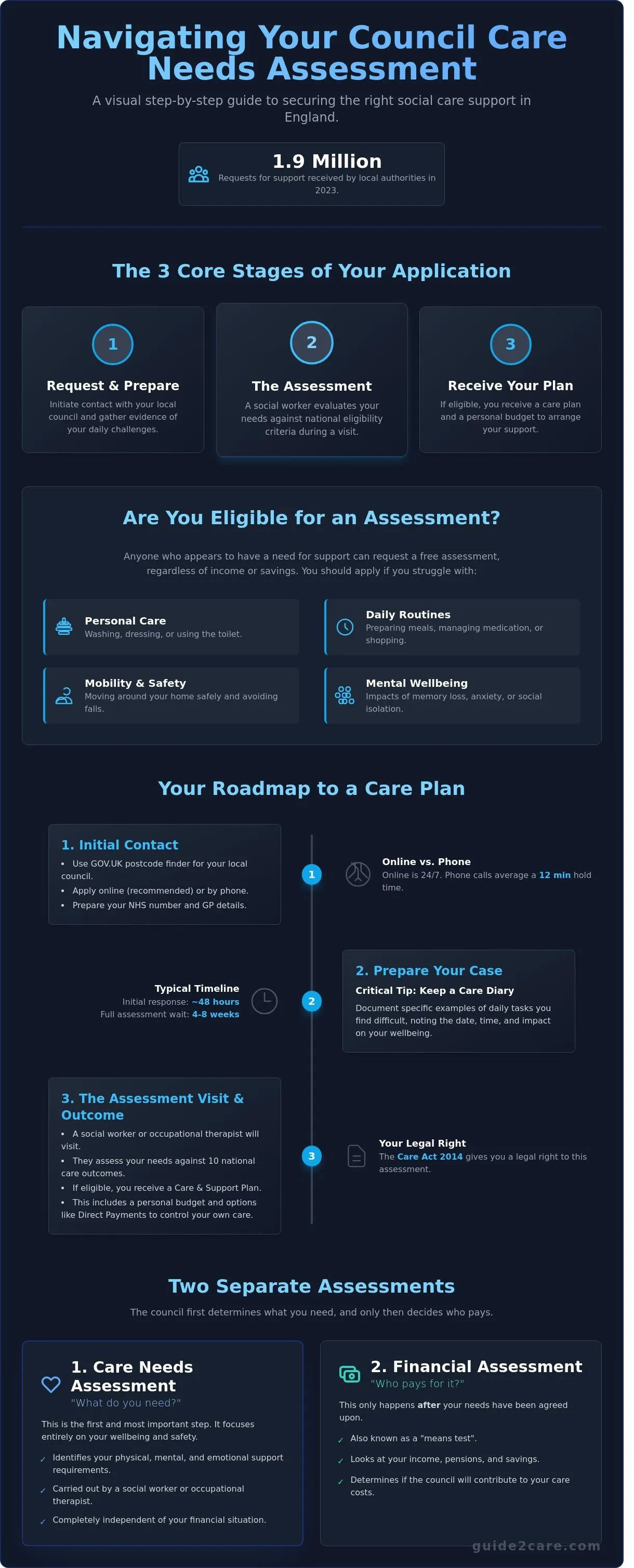
It's vital to distinguish between the two types of evaluations the council performs. The care needs assessment is the "what you need" stage. It focuses entirely on your physical, mental, and emotional requirements. A social worker or occupational therapist will document the specific help required to keep you safe and healthy.
The financial assessment, often called a means test, is the "who pays" stage. This occurs after your needs have been established. It looks at your income, pensions, and savings to decide if the council will contribute toward your care costs. In 2026, the upper capital limit remains a key factor in these calculations. You must complete the needs assessment before the council discusses costs. This ensures your care plan is built around your health requirements rather than your budget.
How to Apply for Your Council Care Assessment
Start your application by visiting the GOV.UK website. Use their postcode finder to locate your local Adult Social Services department. This tool ensures you contact the correct authority responsible for your borough or county. Understanding how to get a care needs assessment from the council starts with this initial identification of your local provider.
Prepare specific information before making contact. You'll need your 10-digit NHS number and full contact details for your GP surgery. Create a summary of daily tasks that cause difficulty. Focus on the outcomes defined in the Care Act 2014, such as maintaining personal hygiene, preparing meals, or staying safe at home. Provide concrete examples of when these tasks couldn't be completed safely.
In 2026, most local authorities operate a triage system. Expect an initial response or acknowledgement within 48 hours of your request. However, the waiting list for a full face-to-face assessment currently averages between 4 and 8 weeks. If your situation is stable, you'll be prioritised behind those in immediate danger or those being discharged from hospital. You can find the care you need by exploring our directory of local providers while you wait for your council appointment.
Telephone vs. Online Applications
Most councils prefer online self-referral forms. These digital tools allow you to take your time and keep a written record of exactly what you've disclosed. They're accessible 24 hours a day. Alternatively, calling the council provides immediate clarification if your needs are complex. Be prepared for hold times, which averaged 12 minutes in 2025. Use the phrase "I am struggling to maintain my safety at home" to ensure the call handler logs your request with the correct priority level.
Third-Party Referrals
You don't have to apply yourself. GPs and hospital discharge teams can trigger an assessment if they believe you're at risk. If you're applying for a loved one, ensure you have their verbal or written consent documented. Without consent, the council can only intervene if the person lacks mental capacity under the Mental Capacity Act 2005. In urgent situations, ask to speak with the "duty social worker." They're responsible for crisis intervention and can bypass standard waiting lists if there's a risk of immediate harm or breakdown of a care arrangement.
Preparing for the Assessment: Avoiding the 'Good Day' Trap
Preparation is the most critical stage when learning how to get a care needs assessment from the council. Many people instinctively downplay their struggles during the interview. This "brave face" often leads to a lower level of support than is actually required. The assessor can only base their decision on the information you provide, so transparency is vital for an accurate outcome.
Keep a detailed care diary for seven days before the visit. Document every instance where you struggle with activities of daily living. This includes difficulties with buttoning a shirt, standing up from a chair, or preparing a hot meal. Precise records prevent you from forgetting small but significant challenges that occur throughout the week.
Organise your thoughts by listing specific risks. Focus on safety and health. Mention if you have forgotten to take medication in the last month or if you have experienced a fall. According to NHS data, around 30% of adults over 65 fall at least once a year. Highlighting these risks helps the council understand the urgency of your situation.
- Invite an advocate: You have a legal right to an independent advocate under the Care Act 2014 if you have substantial difficulty engaging with the process.
- List your medications: Have a printed list of all prescriptions and dosages ready for the assessor to review.
- Identify your goals: Think about what you want to achieve, such as staying in your own home or regaining independence.
The 'Worst Day' Strategy
Assessors look for "fluctuating needs." If you can perform a task on Monday but are too exhausted to do it on Tuesday, you cannot do it reliably. Always describe your abilities based on your most difficult days. Be ready for specific questions about your routine. Can you get out of bed without help every single morning? How do you manage your weekly shopping? If a task causes pain or takes an unreasonable amount of time, tell the assessor. If you can't do it safely every time, you can't do it.
Environmental Checklist
Walk through your home to identify physical barriers. Look for steep stairs, low toilet seats, or rugs that pose trip hazards. Show the assessor exactly where you struggle rather than just describing it. Don't overlook your social needs. Loneliness has a significant impact on physical health. Mention if you're unable to access the community or attend local groups without assistance. This information is essential for a holistic view of your care requirements.
What to Expect in a Care Assessment and Understanding Results
Once you've learned how to get a care needs assessment from the council, the next stage is the physical or remote evaluation. A social worker or occupational therapist (OT) will lead this process. They focus on what you can do for yourself and where you require assistance to remain safe and healthy. This visit is practical rather than medical.
During the Assessment Visit
The assessor will observe your mobility and cognitive function. They don't just listen to what you say; they watch how you navigate your environment. An OT focuses on home adaptations. They might recommend installing £150 grab rails in the bathroom or a £3,000 stairlift to manage the stairs safely. State your needs clearly. You should be honest about your limitations. Don't try to appear more capable than you are on a difficult day. Tell the assessor exactly what happens when you try to wash, cook, or use the toilet. Make sure they record every concern in their official notes before they leave.
What Happens After the Assessment?
You'll typically receive a written decision and care plan within 28 days of the visit. The council uses the Care Act 2014 national eligibility threshold to make their decision. They look for three specific markers. Your needs must relate to a physical or mental impairment. You must be unable to achieve two or more outcomes, such as maintaining personal hygiene, preparing meals, or staying safe at home. There must also be a significant impact on your overall wellbeing.
If you meet these criteria, you're "Eligible." The council then creates a care plan. This document lists services like domiciliary care or access to day centres. A financial assessment follows this stage to determine if the council will pay for these services or if you must contribute. If you're "Non-Eligible," the council must still provide advice on local support. You can challenge a decision through the local authority's formal complaints procedure. Most councils aim to resolve these disputes within 20 working days. If your needs change later, you can request a new assessment at any time.
Next Steps: Choosing the Right Care Provider for Your Needs
Once you understand how to get a care needs assessment from the council and receive your results, your care plan becomes your primary tool. This document acts as a legal blueprint for your support. It specifies exactly what the local authority will fund based on your eligibility. Use this plan as a checklist when interviewing potential providers to ensure they can meet every identified requirement, from personal care to social engagement.
You can choose to have the council arrange services for you, or you can opt for Direct Payments. This second option gives you the allocated budget as a cash payment into a dedicated bank account. It's a practical choice if you want to hire a specific personal assistant or an agency that isn't on the council's preferred provider list. You'll be responsible for managing the money and keeping receipts, but it offers maximum control over who enters your home.
When considering your options, it can be helpful to see how different organizations approach disability support, even if they operate under different national systems. For example, looking at providers like Accessible Care in Australia can offer a useful model of specialized, person-centered support that you can then look for in your local UK-based agencies.
A holistic care plan also considers social and recreational needs, which often involve group transportation. While the context is different, it can be useful to see how specialist transport is arranged for other types of events. For those planning group celebrations in the North West, for example, you can explore Party Bus Hire Manchester to see an example of coordinated group travel.
For those with a passion for travel, seeing how luxury and accessibility are combined in different settings can be inspiring. If you're exploring unique holiday ideas that prioritize comfort, you might want to check out Palace on Wheels Train for an example of a premium, all-inclusive journey.
Finding Local Care Providers
Use the Guide2Care directory to filter results by your specific postcode and the required support level. It's essential to distinguish between domiciliary support for those staying at home and residential care for those needing 24-hour supervision. If the care plan identifies complex medical needs, look for nursing homes which employ registered nurses on-site. For specific conditions like vascular dementia, verify that the provider has staff with specialised training or RMN (Registered Mental Health Nurse) qualifications to ensure high-quality cognitive support.
Finalising Your Care Choice
Ask potential providers about their current Care Quality Commission (CQC) ratings before making a commitment. A rating of "Good" or "Outstanding" is the benchmark for safety and effectiveness. Request a trial period of 14 days to test the compatibility between the carer and your family. You should also inquire about staff turnover rates; lower turnover usually indicates better continuity of care. Once you're satisfied, set a start date and provide the agency with a copy of the care plan you received after learning how to get a care needs assessment from the council.
Find the care you need today with our comprehensive directory.
Take Control of Your Care Journey
Securing support starts with a clear plan. You now understand the essential steps for how to get a care needs assessment from the council, from the initial application to avoiding the "good day" trap during your meeting. Under the Care Act 2014, your local authority has a legal duty to assess anyone who appears to have a need for care and support, regardless of their financial situation. Once your assessment identifies your specific requirements, the focus shifts to selecting a provider that meets those standards.
Finding the right help doesn't have to be a complex task. Use our comprehensive UK-wide directory to compare options based on your specific requirements. You can filter results by Care Quality Commission (CQC) ratings and specific care types to ensure high standards of service. We provide practical resources to help you navigate funding rules and choose between residential homes or domiciliary care. Take the next step in your care journey with confidence.
Frequently Asked Questions
Is a care needs assessment free?
Yes, every adult in the UK is entitled to a free care needs assessment regardless of their income or savings. Local councils have a legal duty under the Care Act 2014 to provide this evaluation to anyone who appears to need support. While the assessment itself costs nothing, the council will perform a separate financial assessment later to determine if you must contribute toward the cost of your actual care services.
How long does it take to get a care assessment from the council?
Most local authorities aim to complete an assessment within 4 to 6 weeks of your initial request. This timeline varies depending on the current demand in your specific borough and the complexity of your needs. If your situation is urgent, such as a sudden hospital discharge or a breakdown in existing care, the council should conduct an emergency assessment within 24 to 48 hours to ensure your safety.
What happens if the council says I am not eligible for care?
If you don't meet the national eligibility criteria, the council must provide a written decision explaining why. They're also required to give you free information and advice on how to prevent or delay your needs from increasing. This usually includes signposting to local voluntary organisations or charities. You can challenge the decision through the council's formal complaints procedure if you believe they've overlooked key facts about your health.
Can I get a care assessment if I have savings over £23,250?
Yes, you can and should request one even if your assets exceed the current £23,250 capital limit. Understanding how to get a care needs assessment from the council is vital for self-funders because it provides a professional roadmap for the types of support you require. Even if you pay for services yourself, the council's assessment ensures you don't miss out on specialist equipment or specific care recommendations that improve your quality of life.
Does the care needs assessment include home adaptations?
Yes, the assessor will look at how your home environment affects your independence and safety. They can recommend minor adaptations costing under £1,000, such as grab rails or easy-turn taps, which the council provides for free. For larger projects like stairlifts or level-access showers, the assessor may refer you for a Disabled Facilities Grant. These grants can provide up to £30,000 in England to fund major structural changes to your property.
Can my family be present during the assessment?
You have the right to have a family member, friend, or advocate with you during the meeting. Their presence helps ensure all your daily challenges are accurately reported, especially if you find it difficult to talk about personal tasks. If you have significant difficulty communicating and don't have a suitable person to support you, the council must appoint an independent advocate to represent your interests throughout the process.
What is the difference between a care assessment and a carer's assessment?
A care needs assessment focuses on the person who requires daily support with tasks like washing, dressing, or eating. A carer's assessment is specifically for the person providing unpaid care, such as a spouse or adult child. It examines how the caring role impacts their own health, work, and social life. Both are separate legal entitlements, and a carer can receive support like respite care or sitting services even if the person they care for isn't eligible for council funding.
How often is a care needs assessment reviewed?
The council should review your care plan at least once every 12 months to ensure the support still meets your needs. They'll typically perform an initial check-in within the first 3 months of a new care package starting to confirm everything is working correctly. You don't have to wait for the annual date; you can request an earlier review if your health changes significantly or if your primary carer is no longer able to help you.