Care for Young Adults with Physical Disabilities: A UK Guide

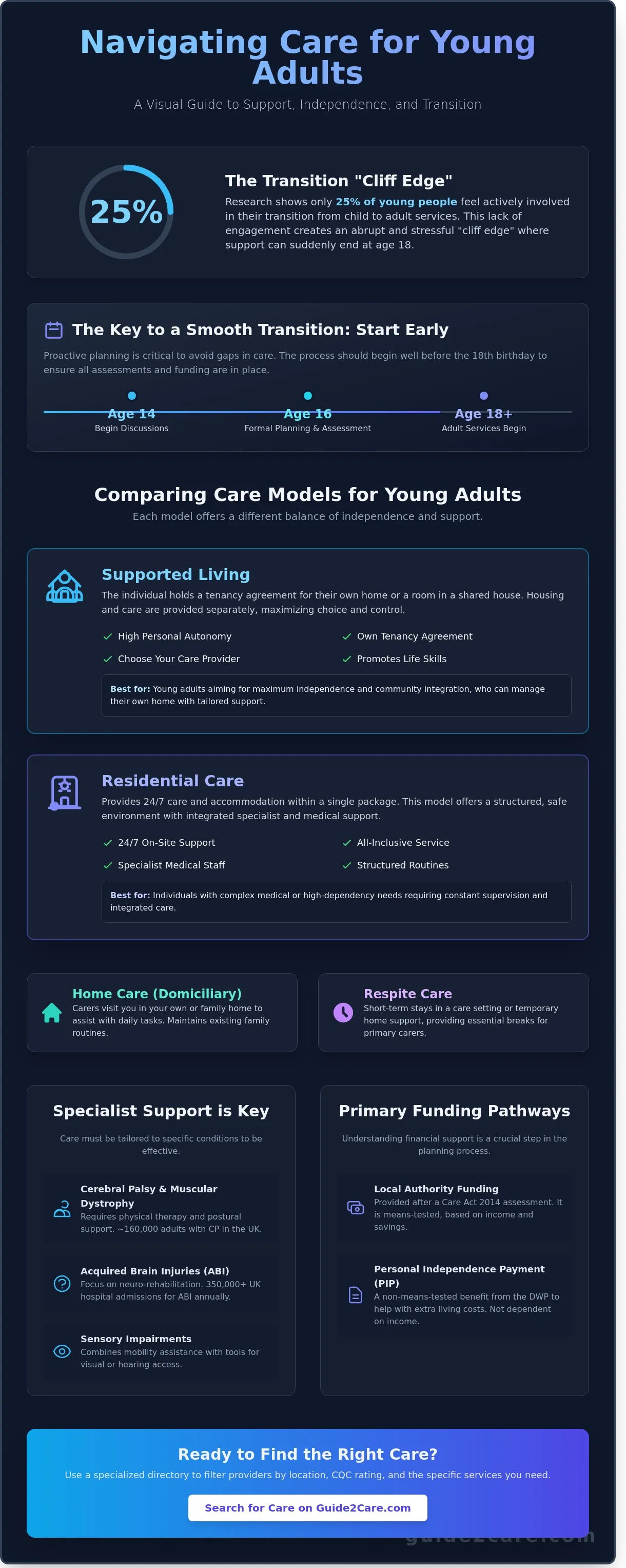
Research from the Council for Disabled Children indicates that only 25% of young people feel they were actively involved in their transition to adult services. This lack of clarity often creates a "cliff edge" where paediatric support ends abruptly at age 18. If you're struggling with the complexity of the UK benefit system or fear losing independence, you aren't alone. Finding appropriate care for young adults with physical disabilities requires a structured approach to avoid these common pitfalls.
This guide provides a practical overview of essential care options and funding pathways. You'll gain a clear understanding of the differences between supported living and residential care. It also explains how to access financial support and outlines a roadmap for the transition process. Follow these steps to secure the right support. Explore the information below to find the care you need and ensure a stable, independent future.
Key Takeaways
- Identify the differences between supported living and domiciliary care to determine the most suitable living arrangement for long-term independence.
- Learn how to manage the transition from child to adult services using the legal framework and assessments provided by the Care Act 2014.
- Explore the primary funding pathways available through Local Authority means-testing and Personal Independence Payments (PIP).
- Use the Guide2Care directory to search for and filter specialized care for young adults with physical disabilities based on location and CQC ratings.
- Discover why starting the transition planning process between ages 14 and 16 is critical for maintaining continuity of support into adulthood.
What is Care for Young Adults with Physical Disabilities?
Care for young adults with physical disabilities refers to specialized support provided to individuals aged 18 to 64. Within the framework of Social care in England, this demographic requires a distinct approach compared to pediatric or geriatric services. The focus shifts from childhood development or elderly maintenance to fostering independence and long-term autonomy. It's a system designed to help individuals manage their daily needs while pursuing personal goals.
Providers distinguish between congenital conditions, present from birth, and acquired injuries. A person might live with a condition like cerebral palsy since childhood or sustain a spinal cord injury at age 25. Each scenario demands unique rehabilitation paths. While safety remains vital, the primary goal is balancing protection with personal growth and social inclusion. This ensures that the individual doesn't just receive care but also experiences a fulfilling lifestyle.
To better understand this concept, watch this helpful video:
Common Conditions Requiring Specialist Support
- Cerebral Palsy and Muscular Dystrophy: Management involves physical therapy and postural support to maintain mobility. According to Scope, there are approximately 160,000 adults with cerebral palsy in the UK.
- Acquired Brain Injuries (ABI): Neuro-rehabilitation helps individuals regain cognitive and physical functions after trauma or stroke. Headway reports that there are over 350,000 hospital admissions for ABI annually in the UK.
- Sensory Impairments: Support often combines mobility assistance with tools for visual or hearing impairments to ensure full environmental access.
The Importance of Age-Appropriate Environments
Comparing Care Models: Supported Living vs Residential Care
Choosing the right care for young adults with physical disabilities involves balancing independence with safety. The UK care system offers four primary models. Each provides different levels of autonomy and clinical support. Understanding these options helps families make informed decisions about long-term housing and support.
- Home Care (Domiciliary): Support workers visit the young adult in their family home. This model maintains existing social circles and family routines.
- Supported Living: The individual lives in their own home or a shared house under a formal tenancy agreement. Care is provided separately from the housing.
- Residential Care: This provides 24-hour support within a registered care home. It's often the best fit for those with complex medical needs.
- Respite Care: These are short-term stays or temporary home-based support packages. They provide essential breaks for both the young adult and their primary carers.
To begin your search, you can find local care providers that offer these specific services in your area.
Supported Living: The Path to Independence
Supported living focuses on giving young adults their own front door. Unlike residential care, the individual has a legal tenancy agreement. This means they've more control over their environment and who enters their home. Some people choose individual flats within a block that has 24-hour on-site support. Others prefer shared housing where 2 to 4 adults live together with communal living spaces.
In this model, support is often delivered by Personal Assistants (PAs). PAs assist with specific tasks like personal care, meal preparation, or attending university. This setup empowers the individual to manage their own life. Families often need to help with financial planning during this transition. This includes accessing trust funds for disabled young adults to ensure they've the resources needed for independent living.
When is Residential Care the Best Option?
Residential care is usually necessary when a young adult has complex medical needs that require 24-hour nursing supervision. These settings are registered with the Care Quality Commission (CQC) and provide a high staff-to-resident ratio. They're equipped with specialized technology that's difficult to install in standard domestic homes.
Most residential centers for young adults include:
- Ceiling track hoists in bedrooms and bathrooms.
- On-site hydrotherapy pools for physiotherapy.
- Specialist beds and pressure-relieving equipment.
- Environmental controls for lighting and doors.
Transitioning to residential care often happens when a student reaches age 19 or 25 and leaves a residential school. These adult centers provide a continuation of the structured support they're used to while focusing on adult social goals. It ensures that care for young adults with physical disabilities remains consistent and safe as they move out of the education system.
Navigating the Transition from Child to Adult Services
The transition from children's services to adult care is a significant milestone that requires early preparation. In the UK, the legal framework for this change is primarily governed by the Care Act 2014. This legislation mandates that local authorities carry out "Transition Assessments" for any young person likely to have care needs after they turn 18. These assessments identify the specific support required to help the individual live as independently as possible.
Planning typically starts in Year 9, when the young person is aged 13 or 14. This early start provides a four-year window to organize the shift in services. It's a period where the Education, Health and Care Plan (EHCP) begins to focus on adulthood, including employment and independent living. While an EHCP can stay in place until age 25 if the person remains in education, the funding and management of care for young adults with physical disabilities often move to adult social care departments at age 18.
The emotional impact of leaving paediatric care shouldn't be underestimated. For many families, this means moving away from consultants and therapists who have known the child since birth. Adult services are often less centralized, requiring the young person or their representative to manage multiple specialist appointments. Preparing for this change helps reduce the stress of losing familiar support networks.
The Transition Assessment Process
The transition assessment involves a multidisciplinary team, including social workers, Special Educational Needs Coordinators (SENCOs), and healthcare professionals. The local authority has a statutory duty to place the young person's voice at the center of the plan. Under the Mental Capacity Act 2005, professionals must assume the young person can make their own decisions unless it's proven otherwise. If a transition assessment is delayed or refused, you can challenge the decision using the Care Act's "significant benefit" clause, which requires authorities to act if an assessment would help the transition go smoothly.
Moving to Adult Social Care
Funding Care for Young Adults in the UK
Securing funding for care for young adults with physical disabilities requires navigating several government systems. Local authorities provide social care funding based on a financial means test. In England, if your capital exceeds £23,250, you must pay the full cost of your care. Those with assets below £14,250 receive maximum support, though they may still contribute from their income. The council assesses your needs first to determine the level of support required before looking at your finances.
Personal Independence Payment (PIP) helps with the extra costs of living with a long-term health condition. It consists of two parts: daily living and mobility. This mobility support is often used for adapted vehicles, which require specialized security from experts like Safe & Sound Mobile to protect these vital assets. PIP isn't means-tested, so your income or savings don't affect your eligibility. For home changes, apply for a Disabled Facilities Grant (DFG). This grant provides up to £30,000 in England to install ramps, stairlifts, or accessible bathrooms. You must apply through your local council, and the work must be necessary to meet your needs.
NHS Continuing Healthcare (CHC) covers the full cost of care for individuals with a primary health need. This is not means-tested. Eligibility depends on the complexity and intensity of your health requirements rather than a specific diagnosis. A team of health professionals uses a Decision Support Tool to evaluate your eligibility during a formal assessment.
Direct Payments: Taking Control of Your Budget
Direct payments allow you to receive your social care budget as cash. You use this money to buy services directly. This option offers flexibility when arranging care for young adults with physical disabilities. You can hire your own personal assistants instead of using council-contracted agencies. This gives you control over who provides your care and when they visit. Being an employer involves specific duties. You must manage payroll, pay National Insurance, and arrange liability insurance. Many people use a third-party payroll service to handle these administrative tasks.
Understanding Personal Health Budgets
A Personal Health Budget (PHB) is for healthcare and support, whereas social care budgets cover daily living. You can use a PHB for specialized equipment or nursing care. By April 2026, the NHS aims to expand the "Right to Have" a PHB to all individuals eligible for Section 117 aftercare and those with ongoing complex needs. This gives you more choice over your clinical support and how it's delivered. You can manage the budget yourself or ask a third party to handle it for you.
Find the care you need by exploring our directory of local providers and funding resources.
How to Find and Choose the Right Care Provider
Using CQC Reports to Evaluate Quality
The Care Quality Commission (CQC) regulates all health and social care services in England. Before booking a visit, download the most recent inspection report for any potential provider. Pay close attention to the "Effective" and "Caring" ratings. These scores reflect how well a service supports individual needs and treats people with dignity. Check the report date; a "Good" rating from 2021 might not reflect current standards if there's been a recent change in management. Look for mentions of staffing levels. High turnover often leads to a lack of continuity, which is vital for complex physical needs. For more details on these metrics, see our guide on Understanding CQC Ratings.
Questions for Potential Providers
A site visit or interview is the best way to judge the culture of a service. You're looking for an empowering environment, not a restrictive one. Ask the manager or lead carer these questions:
- How do you support residents to access the local community? Look for specific examples of transport support or local partnerships.
- What experience do you have with [specific condition]? Ask about specialist training staff have received in the last 12 months.
- Can I bring my own specialised equipment or furniture? Personalisation is a key indicator of a person-centred approach.
- How is the care plan reviewed? The process should involve the young adult directly, ensuring their voice is heard in every decision.
Finding Local Support via Guide2Care
The Guide2Care platform is designed to make the search process logical and efficient. You can search by postcode to find local domiciliary care, supported living, or residential homes. Use the advanced filters to select "Physical Disabilities" to narrow your options. This prevents you from wasting time on services that don't have the necessary hoisting equipment or wet room facilities. The side-by-side comparison tool allows you to evaluate multiple providers at once, looking at their CQC status and service specialisms. Start your search now to Find the care you need today on Guide2Care.
Take Control of the Care Transition
The transition to adult services is a legal requirement under the Children and Families Act 2014, which mandates that local authorities begin planning when a child reaches Year 9. Success depends on choosing the right model, whether that's supported living for greater independence or residential care for 24-hour support. Finding appropriate care for young adults with physical disabilities requires a methodical approach to checking CQC ratings and understanding local authority funding brackets. You've the information needed to distinguish between different care types and identify which financial supports apply to your situation.
Guide2Care provides a comprehensive UK-wide database of CQC-registered providers to streamline your search. You'll find independent resources on funding and care types that simplify complex regulations. Use our easy-to-use filters to find specialists equipped for specific physical disability needs. This platform acts as an impartial tool to bring order to your search process.
Find the care you need: Search our UK directory for young adult specialists
Finding the right support is a manageable task when you've the correct data. You're ready to secure a provider that meets every requirement.
Frequently Asked Questions
Can a 19-year-old go into a residential care home?
Yes, adults aged 18 to 64 can access residential care if a needs assessment confirms it's the most suitable environment. Under the Care Act 2014, local authorities must provide accommodation that meets the specific eligibility criteria of the individual. These settings for younger adults focus on promoting independence and rehabilitation, distinguishing them from traditional elderly care homes.
What is the difference between DLA and PIP for young adults?
Personal Independence Payment (PIP) replaces Disability Living Allowance (DLA) for individuals once they reach age 16. While DLA is designed for children, PIP uses a different points-based system to assess how a condition affects daily living and mobility for adults. According to Department for Work and Pensions 2024 guidelines, claimants must undergo this new assessment to determine their award level.
How do I get a Disabled Facilities Grant for a young adult?
Apply through your local council's housing department to access a Disabled Facilities Grant (DFG). This mandatory grant provides up to £30,000 in England for essential home adaptations like wet rooms or ceiling track hoists. An Occupational Therapist must first visit the home to confirm the modifications are necessary for effective care for young adults with physical disabilities.
What happens to my EHCP when I turn 19?
An Education, Health and Care Plan (EHCP) can remain active until age 25 if the young adult stays in non-higher education or training. The Children and Families Act 2014 specifies that the plan stops if the individual starts university, begins a full-time job, or leaves education entirely. For those exploring higher education, you can learn more about UK Home Students for flexible degree programmes. Local authorities must review the plan annually to ensure it still supports the person's transition goals.
Can I use Direct Payments to pay a family member for care?
You can't typically use Direct Payments to pay a close relative who lives in the same house for routine support. Exceptions exist under the Care and Support (Direct Payments) Regulations 2014 if the local authority decides this arrangement is necessary for the user's wellbeing. This usually requires evidence that a family member is the only person capable of providing the specific care required.
Is supported living cheaper than a residential care home?
Supported living is often more cost-effective for local authorities because housing costs are usually covered by Housing Benefit instead of social care budgets. Data from the 2023 LaingBuisson report shows residential care fees are higher because they include 24-hour onsite staffing and all meals. In supported living, you only pay for the specific hours of care and support you use each week.
What should I do if my local authority refuses to fund care?
Request a formal written decision and follow the local authority's statutory complaints procedure immediately. If the internal complaint doesn't resolve the matter, escalate the case to the Local Government and Social Care Ombudsman. Statistics from the Ombudsman's 2023 report show they uphold 77% of complaints regarding adult social care assessments, providing a vital path for challenging funding refusals.
How do I find care homes that specialise in younger adults?
Use the Care Quality Commission (CQC) online directory and filter your search by the "service user band" for younger adults. This ensures you find facilities specifically registered to provide care for young adults with physical disabilities rather than older residents. You can also use the Guide2Care directory to compare providers that meet the age-appropriate standards required for the 18 to 65 age group.