Step Down Care Facilities in the UK: A Guide to Post-Hospital Discharge

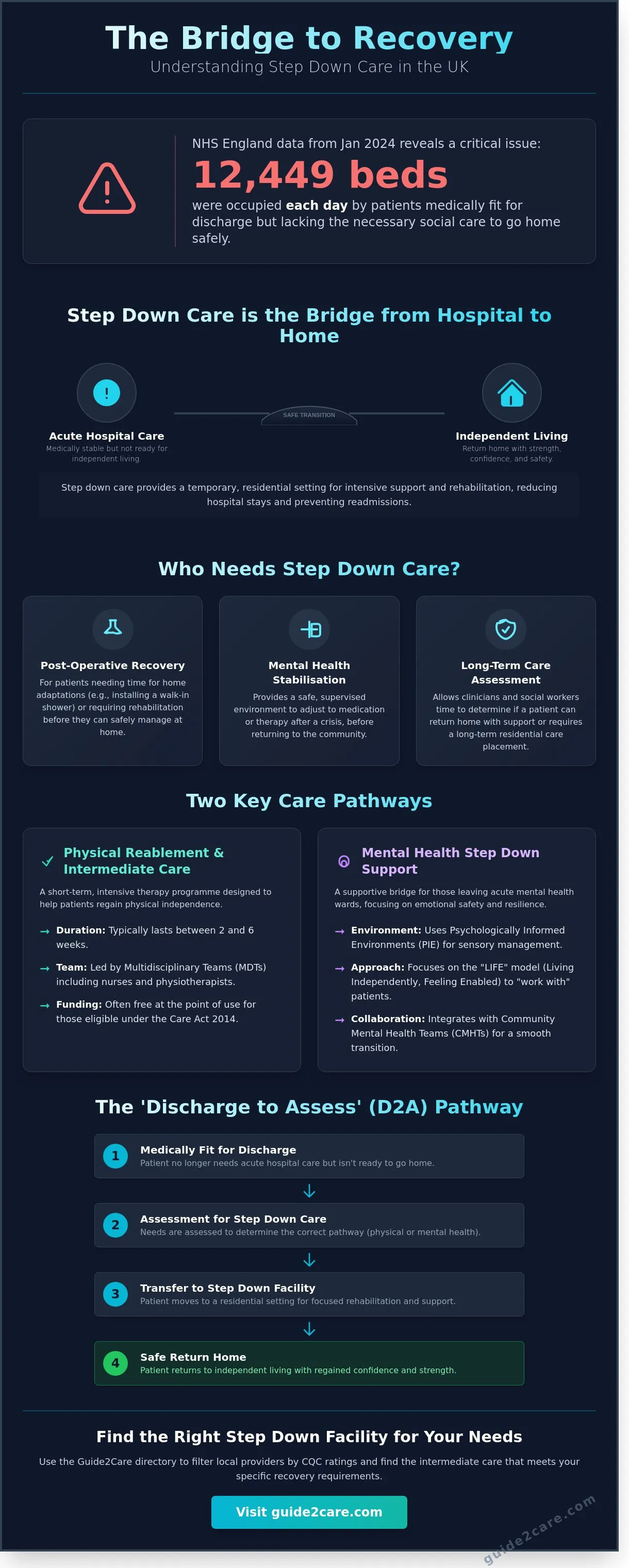
Being told you're "medically fit for discharge" often feels like a premature exit when you still struggle with mobility or managing your own medication. You aren't alone in this feeling. NHS England figures from January 2024 showed that an average of 12,449 beds each day were occupied by patients who no longer met the clinical criteria to stay in hospital but lacked the necessary social care to leave. It's common to fear a "revolving door" scenario where you end up back in a ward because your home isn't yet a safe environment. Utilizing step down care facilities uk provides a vital bridge, offering professional rehabilitation in a residential setting before you return home permanently.
This guide simplifies the transition from ward to recovery. You'll learn how the "Discharge to Assess" pathway works and who is responsible for funding your transitional stay. We provide a clear framework to help you find a local provider that offers the specific physiotherapy or nursing support you require. By the end of this article, you'll have a practical list of steps to secure the right care and ensure your recovery stays on track.
Key Takeaways
- Understand how step down care acts as a temporary bridge to help you transition from hospital to independent living safely.
- Learn the differences between physical rehabilitation and mental health support pathways to identify the right level of specialist care.
- Compare step down care facilities uk against traditional residential homes to understand why higher staffing levels are essential for recovery.
- Navigate the UK discharge process by identifying your specific assessment pathway and understanding the 'Discharge to Assess' (D2A) model.
- Use the Guide2Care directory to filter providers by CQC ratings and find local intermediate care that meets your specific recovery needs.
Understanding Step Down Care: The Bridge from Hospital to Home
Step down care facilities uk provide a temporary residential setting for patients who no longer need acute hospital care. These individuals are medically stable but aren't yet ready for independent living. The primary goal is to reduce the length of hospital stays while preventing premature readmissions through intensive support. This transition period ensures patients regain their strength and confidence before returning to their own homes.
In 2026, these facilities are vital for addressing the UK's 'bed-blocking' crisis. Recent NHS data indicates that thousands of beds are occupied by patients who are fit for discharge but lack appropriate social care placements. By moving these individuals into What is Intermediate Care?, hospitals can free up clinical space for emergency admissions. This process improves overall hospital flow and ensures that acute resources are used for those in need of surgery or intensive medical intervention.
Understanding the difference between 'stepping down' and 'stepping up' is crucial for effective care management. Stepping down involves moving from a high-intensity hospital environment to a community-based facility. Stepping up occurs when a person's health dips while they're living at home. They move into a facility temporarily to receive extra support, which often prevents a full hospital admission. Both methods focus on maintaining independence and avoiding long-term clinical stays; for insights into arranging medical support directly at your residence, read more.
When is Step Down Care Necessary?
Key Benefits for Patients and Families
Types of Step Down Facilities: Mental Health vs. Physical Rehab
Step down care facilities uk categorise support into two distinct streams. One focuses on neuro-physical rehabilitation. The other addresses psychiatric needs. Deciding between them depends on whether the patient requires physical therapy or mental health stabilisation. Both pathways aim to reduce the length of hospital stays and prepare the individual for a return to independent living.
Mental Health Step Down Accommodation
Residents in these units learn to manage their own symptoms and adhere to medication schedules. They build resilience through structured daily routines and peer support groups. Success in these facilities relies on close integration with Community Mental Health Teams (CMHTs). This ensures that the 24-hour support of a residential setting transitions smoothly into outpatient care. This collaborative approach reduces the risk of relapse once the resident moves back to their own home or supported living.
Physical Reablement and Intermediate Care
Physical reablement is a short-term, intensive therapy programme. It typically lasts between 2 and 6 weeks. The service is often free at the point of use for those who meet the Care Act 2014 eligibility criteria. Multidisciplinary teams (MDTs) lead the recovery process. Nurses manage wound care or complex medication. Occupational therapists (OTs) adapt the living environment and teach new ways to perform tasks like cooking or dressing. Physiotherapists focus on improving gait, balance, and muscle strength.
A report on the Challenges of Intermediate Care notes that effective reablement can prevent 1 in 10 hospital readmissions. Specialist centres also exist for specific conditions. Stroke recovery units prioritise intensive neuro-physiotherapy to help rewire neural pathways. Brain injury units focus on cognitive rehab and speech therapy. These facilities use measurable goals, such as the Barthel Index, to track a patient's ability to perform daily activities safely. You can explore Guide2Care to find providers that offer these specific rehabilitation services in your local area.
Choosing the right step down care facilities uk involves assessing the level of clinical supervision required. Physical rehab units are often equipped with hoists and gym facilities. Mental health units prioritises therapeutic spaces and 24-hour emotional support. Both models share the same goal: providing a safe environment to recover before a full discharge home.
Comparing Step Down Care vs. Traditional Care Homes
Step down care facilities uk operate as a bridge between hospital and home. This service is inherently transitional. It differs from traditional residential care, which provides a permanent or long-term living solution. While a care home focuses on long-term support and daily living assistance, step down care focuses on recovery and discharge planning. You should view step down care as a temporary intervention designed to restore independence.
Staffing levels in step down units are typically higher than in standard care homes. These facilities employ multidisciplinary teams including physiotherapists, occupational therapists, and specialist nurses. This high staff-to-patient ratio supports intensive rehabilitation sessions. In a standard residential setting, the focus shifts toward social care and general assistance. The clinical intensity is lower because the goal is maintenance rather than rapid improvement. For the dedicated medical professionals working in these environments who are managing their own property goals, they can discover Mortgages for Doctors for expert remortgaging advice.
Funding models create another significant divide. NHS 'Intermediate Care' is usually free for a limited period, often up to six weeks. This is funded by the NHS or local authorities to prevent hospital readmissions. Standard residential care is often means-tested. In England, individuals with assets over £23,250 generally must self-fund their stay. Traditional care home costs can exceed £800 to £1,200 per week, depending on the level of need and location.
The 'exit strategy' is a core component of step down care from day one. Clinical teams monitor progress daily to ensure the patient moves to the next stage of independence as soon as they are safe. Residential care homes do not usually operate with a planned exit date in mind.
Duration and Intensity of Support
Step down care is a short-term, high-intensity option. Most stays last between 2 and 6 weeks. During this time, patients receive daily therapy and monitoring. Residential care offers permanent support with lower clinical oversight. Choosing the wrong type of facility can lead to a loss of independence. If a patient enters a long-term care home when they have the potential to recover, they may become reliant on staff for tasks they could eventually perform themselves. This "institutionalisation" can make returning home much harder.
Goal-Setting and Outcomes
Step down care focuses on 'recovery' and returning to a previous baseline of health. Teams set specific, measurable targets for mobility and self-care. Residential care often focuses on 'maintenance' and quality of life during a period of physical or cognitive decline. The Care Quality Commission (CQC) regulates both types of services in England. They inspect step down facilities to ensure they meet specific standards for rehabilitation and safety. Regular reviews occur every 7 to 14 days to determine if the patient is ready for the next stage of their journey.
How to Organise Step Down Care in the UK: Funding and Assessment
Organising a transition from hospital involves a structured four-step process. The first step is the Hospital Discharge Assessment. Hospital staff use this to assign you to a specific 'Pathway'. Pathway 0 is a simple discharge home. Pathway 1 involves support in your own home. Pathway 2 is the most common route for those entering step down care facilities uk, as it provides rehabilitation in a residential setting. Pathway 3 is reserved for patients with complex, 24-hour nursing needs.
The second step follows the 'Discharge to Assess' (D2A) model. This national policy ensures you don't stay in a hospital bed longer than necessary. Instead of waiting for a long-term care assessment on a ward, you move to a community setting first. This allows therapists to assess your functional abilities in a more natural environment. It provides a clearer picture of your long-term requirements.
Step three involves determining your funding eligibility. The multidisciplinary team (MDT) decides if your needs are primarily health-based or social-care based. Finally, step four is the selection of a facility. You must choose a provider that matches the clinical outcomes identified during your initial assessment, such as specific stroke rehabilitation or post-operative wound care.
The Role of the Discharge Coordinator
The discharge coordinator acts as the central point of contact between the ward and community providers. You should communicate with them early to express preferences for specific step down care facilities uk. Ask the coordinator for the 'Estimated Date of Discharge' (EDD) to help you plan. You need to ask specific questions regarding medication management and the frequency of physiotherapy sessions. The coordinator ensures the transition meets the local Integrated Care Board (ICB) requirements. These boards manage the regional budgets and determine which facilities have active contracts with the NHS. If you want a facility outside the standard ICB list, you must discuss this immediately to understand the financial implications.
Funding: Who Pays for Step Down Care?
Financial responsibility for step down care depends on the duration and nature of the support. Intermediate care is often free at the point of use for a limited time.
- The 6-Week Rule: NHS-funded intermediate care is usually provided free of charge for up to six weeks. This aims to prevent permanent admission to long-term care.
- NHS Continuing Healthcare (CHC): If your needs are complex and primarily health-related, the NHS may cover the full cost of the facility indefinitely. This is not means-tested.
- Local Authority Support: If you don't qualify for CHC, the local council conducts a financial assessment. In England, if your assets are above £23,250, you typically pay the full cost.
- Self-Funding and Top-Ups: You may choose to self-fund to access a wider range of facilities or premium rooms. If the council's preferred facility doesn't meet your choice, a family member can sometimes pay a 'third-party top-up' to cover the price difference.
Finding the Right Step Down Facility with Guide2Care
Identifying the most suitable step down care facilities uk requires a structured and objective approach. Use the Guide2Care directory to find providers that specialise in post-hospital recovery. You can filter search results specifically for 'Intermediate Care' or 'Rehabilitation' to ensure the facility aligns with the clinical discharge plan provided by the hospital. Every provider profile on our platform includes direct access to the latest Care Quality Commission (CQC) inspection reports. These documents evaluate services based on five key areas: safety, effectiveness, care, responsiveness, and leadership. Checking these ratings helps you avoid facilities that don't meet national standards.
Location is a vital component of a successful recovery journey. Selecting a facility close to family members facilitates regular visits, which provides the emotional stability needed for physical rehabilitation. After identifying potential centres, create a shortlist of three to five options. Contact these providers directly to ask about current bed availability and their specific admission criteria. This proactive step prevents delays in the discharge process and ensures the transition happens as soon as the patient is medically fit.
Using Our Directory Filters Efficiently
Refine your search by selecting specific care categories such as dementia support, physical disabilities, or complex mental health needs. Our platform allows you to compare multiple providers side-by-side to evaluate their facilities and staffing ratios. You can also access practical guides on care funding, including local authority assessments and NHS Continuing Healthcare. These resources provide the clarity needed to manage the financial aspects of care without confusion. Find the care you need by using our data-driven search tools to narrow down your options quickly and accurately.
Making the Transition Successful
Preparation is key to a smooth move into a temporary care setting. Ensure the patient has enough comfortable clothing, all current medications, and any personal mobility aids used in the hospital. It's vital to speak with the facility manager immediately to establish a target date for returning home. This keeps the focus on rehabilitation goals and ensures the stay remains temporary. Clear communication with the care team helps manage expectations for everyone involved and ensures all support services are ready for the final move home. Find the care you need today with the Guide2Care directory.
Secure Your Recovery with the Right Step Down Care
Effective recovery starts with a clear plan for leaving the hospital. Choosing the right step down care facilities uk ensures you or your loved one receives specialist support before returning home. This transition period is vital; NHS England figures from 2023 show that structured discharge pathways can reduce hospital readmission rates by up to 20%. Whether you require physical rehabilitation or mental health support, selecting a provider with a high Care Quality Commission (CQC) rating is the best way to guarantee safety and professional standards.
Finding a suitable facility shouldn't be a stressful process. Use our comprehensive UK-wide database of over 15,000 providers to narrow down your options quickly. We provide direct links to the latest CQC ratings and offer expert guides on navigating local authority funding and selection criteria. It's important to have all the facts before making a decision. You'll find the information needed to bridge the gap between hospital treatment and independent living with confidence.
Find the care you need: Search our directory of UK care providers
Take the next step toward a successful recovery today.
Frequently Asked Questions
What is the difference between step down care and reablement?
Step down care provides a temporary residential setting for recovery, while reablement focuses on intensive therapy to regain independence. Step down care facilities uk often host reablement services, but the terms aren't identical. Reablement usually lasts up to 6 weeks and aims to reduce the need for long-term care packages. This service helps you relearn daily tasks like cooking or dressing after a hospital stay.
How long can someone stay in a step down care facility in the UK?
Stays in step down care typically last between 2 and 6 weeks. Discharge planning starts on day one to ensure the transition home is efficient. If you require more than 42 days of support, the local authority conducts a formal assessment to determine your ongoing needs and funding eligibility. Most patients return home within 21 days once they achieve their specific rehabilitation goals.
Is step down care free on the NHS?
Step down care is free at the point of use for up to 6 weeks if it's part of an NHS intermediate care package. This period is funded by the NHS or local council to prevent hospital readmission. After this initial 6-week window, you might need to contribute to costs based on a financial assessment under the Care Act 2014. Eligibility depends on your clinical needs at the time of discharge.
Can I choose which step down facility my relative goes to?
You have limited choice regarding specific step down care facilities uk because placements depend on immediate bed availability. Hospital discharge teams prioritise safety and speed to free up acute beds. While you can express a preference, the priority is finding a suitable location that can meet your clinical needs within 24 to 48 hours. Use the Guide2Care directory to find the care you need and explore local providers.
What happens if a patient isn't ready to go home after 6 weeks of step down care?
If you aren't ready to return home after 6 weeks, the social work team performs a Care Act assessment. This review determines if you need long-term residential care or a permanent domiciliary care package. Depending on your savings and assets, you may transition from state-funded intermediate care to self-funded or means-tested support. The assessment ensures your future care plan matches your physical and cognitive abilities.
Do step down facilities provide 24-hour nursing care?
Not all step down facilities provide 24-hour registered nursing care; many operate as residential units with visiting clinical staff. Some locations are nursing-led for complex recoveries, while others focus on social-led rehabilitation. You should check the specific CQC registration of the facility to confirm if they have nurses on-site 24 hours a day. This distinction is vital for patients with complex wound care or medication requirements.
What is 'Discharge to Assess' and how does it work?
Discharge to Assess is a national policy where your long-term care needs are assessed in a community setting rather than a hospital ward. This model aims to discharge patients within 2 hours once they're medically fit. It ensures assessments of your functional abilities happen in a realistic environment, leading to more accurate care plans. D2A reduces the time spent in hospital beds and speeds up recovery.
Are step down facilities the same as 'halfway houses'?
Step down facilities are often called halfway houses in informal conversation, but the terms differ in a professional context. In the UK, "halfway house" often refers to mental health or offender rehabilitation settings. Step down care specifically describes clinical and rehabilitative support for patients transitioning from acute hospital wards to their own homes. These facilities bridge the gap between intensive hospital treatment and independent living.