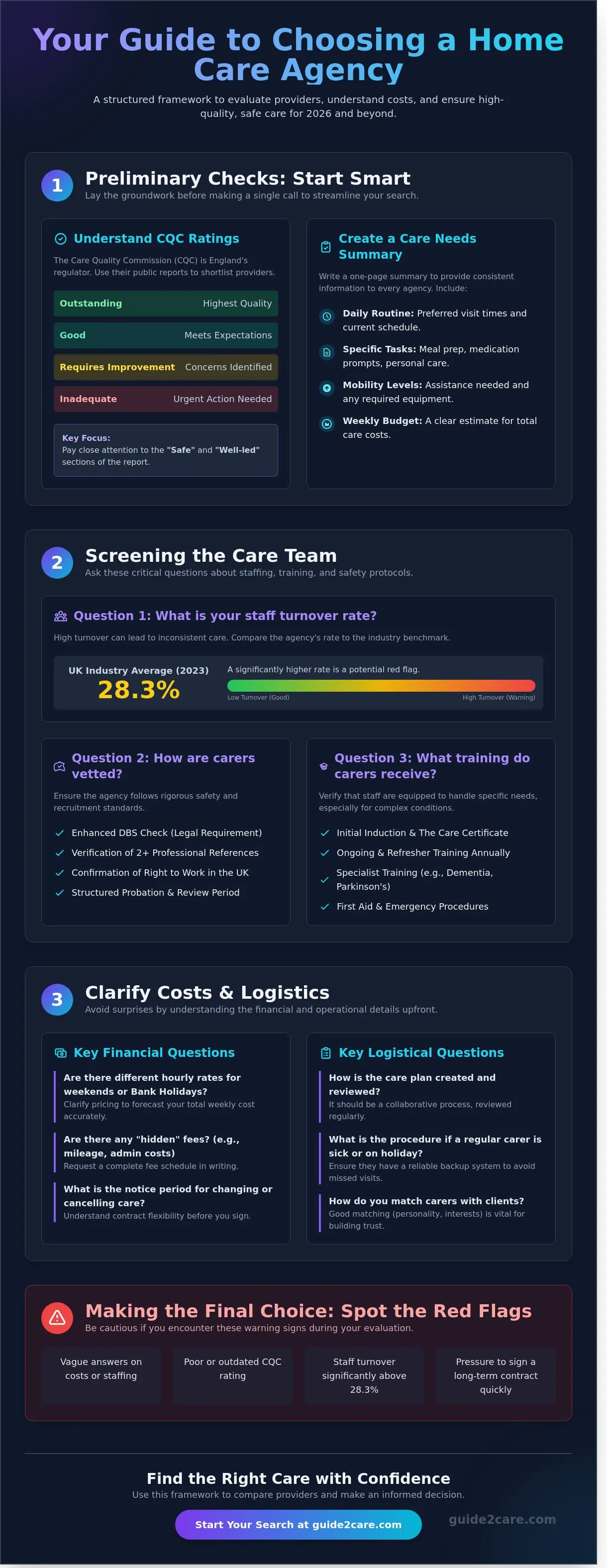
35 Essential Questions to Ask a Home Care Agency: A UK Guide for 2026

Selecting a domiciliary care provider based on marketing brochures alone is the quickest way to encounter hidden fees and inconsistent staffing. You likely feel the weight of this decision while struggling with complex UK care terminology and the fear of choosing an unreliable provider. It's a high stakes process that requires a structured approach to ensure safety and quality.
This guide provides a functional framework of 35 essential questions to ask a home care agency to help you evaluate providers effectively. By using these specific queries, you'll gain clarity on total weekly costs and ensure every agency meets Care Quality Commission (CQC) standards. We've organized these questions into categorical sections so you can interview providers with confidence. You will learn how to verify staff training, scrutinize contract terms, and establish a transparent care plan for 2026. Find the care you need by following this methodical evaluation process.
Key Takeaways
- Use Care Quality Commission (CQC) ratings to shortlist providers and simplify the initial research phase.
- Master the essential questions to ask a home care agency to verify recruitment standards and staff vetting.
- Assess care plan flexibility and staffing consistency to ensure care remains reliable and personalized.
- Review financial structures to avoid hidden extras and clarify hourly rates for weekends or bank holidays.
- Utilize a systematic framework to compare providers and identify management red flags before making a final decision.
Preparing for Your Search: Preliminary Checks Before You Call
Finding the right support requires a structured approach. Shortlisting agencies is essential to avoid decision fatigue. The UK home care system includes thousands of providers, so you must narrow your focus early. Selecting three to five agencies based on local availability and specific expertise will make your search more efficient. This preparation provides a solid foundation for the questions to ask a home care agency during your initial consultations.
To better understand the inquiry process, watch this helpful video:
Understanding CQC Ratings and Inspection Reports
The Care Quality Commission (CQC) is the independent regulator of health and social care in England. Every registered agency has a public inspection report. These reports provide one of four ratings: Outstanding, Good, Requires Improvement, or Inadequate. Pay close attention to the "Safe" and "Well-led" sections. These scores indicate how well the agency manages risk and supports its workforce. If an agency received a "Requires Improvement" rating in 2024 or 2025, check if they've published an updated action plan to address previous regulatory breaches.
Defining Your Specific Care Requirements
Define your needs clearly before making contact. Differentiate between companionship, personal care, and specialist nursing. Determine the frequency of visits. Some families require 30-minute check-ins, while others need 1-hour calls or live-in care. Use the Guide2Care directory to filter providers by location and specialism. Note down specific medical conditions such as dementia or Parkinson’s. This ensures you only contact agencies with the appropriate staff training and experience. For those seeking additional clinical oversight, you can discover Ready Health to see how automated health check pods can support overall wellbeing. Having these details ready helps you refine the questions to ask a home care agency when you speak with a care manager.
Actionable Task: Create a Care Needs Summary
Write a one-page summary before calling any provider. This ensures you provide consistent information to every agency. Include these details:
- Current daily routine and preferred visit times.
- Specific tasks required, such as meal preparation or medication prompting.
- Mobility levels and any necessary lifting equipment.
- A clear weekly budget for care costs.
- Provisions for any pets in the household, ensuring they have access to reliable health services from London Veterinary Surgeries.
This document saves time. It helps you identify which agency is the best fit for your specific circumstances without repeating your story multiple times. It also acts as a checklist to ensure no vital information is missed during the screening process.
Screening the Care Team: Questions About Staffing and Training
Staff retention is a primary indicator of care quality. High turnover often results in missed visits or unfamiliar faces providing personal care. Ask providers for their annual staff turnover rate. A rate significantly higher than the 2023 industry average of 28.3% suggests potential instability. Consistent care requires a stable team that understands your specific routine and preferences.
Care matching is another vital factor. Ask how the agency pairs carers with clients. Effective agencies consider personality, shared interests, and cultural needs rather than just geographical proximity. This compatibility reduces friction and builds trust quickly. You can find the care you need by comparing providers who prioritise these matching processes during the initial assessment.
Recruitment, Vetting, and DBS Checks
Recruitment standards dictate the safety of your home environment. Use these specific questions to ask a home care agency to reveal their vetting rigour:
- "What percentage of your staff are permanent versus agency workers?"
- "Can you explain your enhanced DBS check and reference verification process?"
- "How do you handle staff who don't meet your internal standards during their probation?"
Enhanced Disclosure and Barring Service (DBS) checks are a legal requirement for all UK care workers. These checks reveal spent and unspent convictions, cautions, and reprimands. Agencies must also verify at least two professional references and check the right to work in the UK. Consult this checklist of questions to ask a home care agency to ensure no vetting steps are overlooked. If a carer fails to meet performance benchmarks, the agency should have a clear policy for retraining or termination.
Training and Specialist Competencies
Basic induction is not enough for complex needs. All UK care workers should complete the Care Certificate within 12 weeks of starting. This covers 15 essential standards including safeguarding, equality, and duty of care. Beyond this, ask about ongoing Continuing Professional Development (CPD). This ensures staff stay updated on the latest health regulations and techniques, often facilitated by expert consultancy and training firms like Guardian Safety.
Specific conditions require targeted expertise. If the care recipient has dementia or Parkinson's, ask: "What specific training do carers receive for this condition?" Verify how the agency assesses a carer’s competency before they work solo. This should involve "shadowing" experienced staff and a formal sign-off by a supervisor for tasks like manual handling or medication administration. To understand how a dedicated agency handles specialized support as an example, you can discover Providential Fijian Home Care and their focus on individualized care plans. Never assume a carer is qualified for specialist tasks without seeing evidence of their specific training modules.
Managing Daily Operations: Questions on Care Plans and Logistics
Effective care depends on rigorous logistics and clear communication. You must understand how an agency handles the practicalities of daily visits before committing to their service. These specific questions to ask a home care agency help you determine if their operational structure is reliable and transparent.
The Care Plan Development Process
A care plan should never be a static document kept in a folder. It must be a living record that evolves as the client's health or preferences change. Use these questions to assess their approach:
- "How do you involve the family and the client in writing the care plan?" Direct involvement ensures the care is person-centered and respects individual routines.
- "How often is the care plan formally reviewed and updated?" In the UK, high-quality agencies typically perform a formal review every six months or immediately following a hospital discharge.
- "What is the process for making urgent changes to the care routine?" If a client’s condition worsens overnight, the agency needs a protocol to increase support levels without delay.
When setting up these arrangements, consult the UK Government Guidance on Home Care to understand your rights and the standards you should expect from local providers. This guidance helps clarify how social care assessments integrate with private agency plans.
Continuity and Communication
Consistency is the most frequent concern for families. A "revolving door" of different carers prevents the building of trust and can lead to missed red flags in a client's health. Ask the following to ensure stability:
- "What is your policy on ensuring the same small team of carers visits?" Aim for a "pod" system where a group of three or four regular carers rotates. This ensures someone familiar is always available during staff holidays.
- "How can I see daily care notes? Do you use a digital portal?" By 2026, most reputable UK agencies have moved away from paper logs. Digital portals allow families to see real-time updates on medication, nutrition, and wellbeing via a smartphone app.
- "Who answers the phone for out-of-hours support?" Emergency issues don't only happen during office hours. Confirm that the agency provides a 24/7 on-call service—often facilitated by specialists like Contesto—staffed by people who have access to the client's records.
Reliable agencies also have clear contingency plans for staff sickness or extreme weather. Don't hesitate to ask for their specific backup strategy. You need to know that a qualified replacement will arrive if the primary carer is unavailable. To see how a professional provider like Providential Fijian Home Care structures these support systems, you can find out more about their approach to senior care and recovery support. These questions to ask a home care agency will reveal whether the provider prioritizes administrative efficiency or just basic scheduling.
Navigating the Financials: Questions on Costs and Contracts
Financial clarity is essential when arranging domiciliary care. You must understand the full cost of service before signing any contract. Many families overlook hidden extras that inflate monthly invoices. Use these specific questions to ask a home care agency to ensure pricing transparency. In 2024, the Homecare Association calculated that a minimum hourly rate of £28.53 is necessary for providers to meet legal obligations and maintain quality standards. If a quote is significantly lower, ask how they maintain staff pay and safety.
Fee Structures and Payment Terms
Compare providers by looking beyond the base hourly rate. Some agencies use complex billing structures that add costs for travel or administration. Ask these direct questions about their billing practices:
- "Is there an initial assessment fee or a sign-up charge?" Some agencies charge between £50 and £150 to create the initial care plan and conduct home safety checks.
- "Do you charge extra for mileage or travel time for the carers?" Confirm if the carer's travel costs are included or billed separately at a rate, such as 45p per mile, when they take your loved one to appointments.
- "What is the minimum call time and its cost?" Providers often set a 30-minute or 1-hour minimum. Shorter visits may carry a higher pro-rata cost to cover the carer's travel.
Verify the rates for weekends and bank holidays. These typically carry a premium of 25% to 100% over standard weekday charges. Ask for a full price list that covers every day of the year. This prevents surprises during holiday periods like Christmas or Easter.
Contractual Flexibility and Termination
A service agreement is a legally binding document. It defines how you can end or pause care without financial penalty. Check these clauses carefully before signing:
- "What is the notice period if we wish to cancel the service?" Standard contracts usually require 14 days' notice, though some allow 7 days for private clients.
- "What are the charges if my loved one is hospitalised for a week?" Ask if you pay a reduced "holding fee" to keep your preferred carer's slot available. This is often 50% of the normal rate.
- "How are fee increases handled and how much notice is given?" Agencies usually adjust prices every April to align with National Living Wage increases. Demand at least 30 days of written notice for any rate changes.
Check the policy for "missed calls." You might still be charged the full rate if you cancel a scheduled visit with less than 24 or 48 hours' notice. Clear contracts protect both the provider and the service user by setting firm expectations from the start.
Find the right provider for your budget and needs. Find The Care You Need by searching our directory today.
Making the Final Choice: Spotting Red Flags and Comparing Providers
After you've finished posing your specific questions to ask a home care agency, you must organize the data to make an objective choice. Create a decision matrix. List your three most important factors, such as "specialist dementia training," "consistency of carers," and "hourly cost." Assign a score from 1 to 5 for each agency based on their responses. This structured approach helps you look past sales pitches and focus on service delivery facts.
Don't ignore your initial impressions of the agency management. A manager's responsiveness is a reliable indicator of future service quality. If they took more than 24 hours to return your initial inquiry or seemed rushed during the consultation, they'll likely be difficult to reach during a care crisis. A professional provider is direct, transparent, and willing to admit when they can't meet a specific niche requirement.
Identifying Red Flags in an Agency
Watch for these specific warning signs during your final evaluations:
- High staff turnover: Skills for Care data shows the average turnover rate in UK social care was 28.3% in 2023/24. If an agency's rate exceeds this or they can't provide a specific figure, it indicates poor staff retention and lack of care continuity.
- Vague CQC responses: If an agency has a "Requires Improvement" rating from the Care Quality Commission, they should provide a written action plan immediately. Evasive answers about past inspections are a major concern.
- Contractual pressure: Avoid any provider that insists on a signed contract or deposit before a full home environment and needs assessment is completed. Legitimate agencies prioritize the assessment process over the sale.
Final Comparison and Selection
Compare your top three agencies by looking at the balance between cost and staff investment. A lower hourly rate often means lower pay for carers, which leads to higher turnover. Prioritize agencies that demonstrate "Value for Money" through high-quality training programs and robust supervisor support. Ask the manager for access to verified testimonials or a redacted copy of their most recent internal quality audit.
Finalize your choice by reviewing the terms of notice. Most UK agencies require 14 to 28 days' notice to cancel services. Ensure these terms are fair and clearly stated in the service agreement. Once you've verified these details, you're ready to begin the care journey.
Find the care you need today. Use our comprehensive tools to compare providers and view local ratings. Find the care you need on the Guide2Care directory and start your shortlisting process now.
Secure Your Home Care Selection
Choosing a provider requires a methodical approach. Focus on verifying staff training and understanding the breakdown of hourly rates. The Homecare Association's 2024/25 calculations suggest a minimum rate of £28.53 per hour to cover essential operating costs. You now have the essential questions to ask a home care agency to identify reliable providers. Use these benchmarks to compare agencies and spot potential red flags—such as inadequate out-of-hours management—before signing a contract. Agencies that work with Contesto often demonstrate a higher level of operational reliability. A structured search ensures that daily operations and financial commitments remain transparent from the start.
Finding support is simpler when you use the right tools. Guide2Care acts as an independent resource for families throughout the UK. Our platform offers a comprehensive UK-wide database that includes verified CQC rating integration. This ensures you access official performance data and inspection results for every listed provider. You can filter options by location and care type to find the best fit for your specific requirements.
Start your search today.
Find The Care You Need: Search Our Directory
You're ready to secure the high-quality support your family deserves.
Once you have professional support in place, it becomes easier to plan family holidays or respite trips. For those considering a getaway to the Turkish coast, you can visit ClickYourGuide to find memorable activities such as an Alanya pirate boat tour.
Frequently Asked Questions
How do I know if a home care agency is regulated in the UK?
You can verify an agency's status by checking the official register of the relevant national regulator. In England, search the Care Quality Commission (CQC) website; in Wales, check Care Inspectorate Wales (CIW); in Scotland, use the Care Inspectorate; and in Northern Ireland, refer to the RQIA. These bodies provide inspection ratings and reports that confirm if a provider meets legal safety and quality standards. Always ask for the agency's provider ID number to ensure you're viewing the correct registration details.
What is the average cost of home care per hour in 2026?
Average costs for domiciliary care in 2026 typically range between £32 and £36 per hour. This follows data from the Homecare Association which set the minimum sustainable rate at £28.53 in 2024 to cover rising wages and inflation. Prices vary significantly by region, with London and the South East often charging 15% to 20% more than the national average. These fees cover the carer's salary, travel time, professional insurance, and 24/7 office support.
Can I choose my own carer if I use an agency?
You can't usually select a specific individual from a staff roster, but you can specify your preferences and requirements. Managed agencies match carers to clients based on skills, personality, and schedule availability. Most providers offer a "meet and greet" session before care begins to ensure compatibility. If the match isn't successful, the agency's manager will find an alternative staff member to maintain your care plan without interruption.
What is the difference between a managed agency and an introductory service?
A managed agency employs the carers directly and handles all training, insurance, and supervision. They're responsible for the quality of care and provide cover if a carer is sick or on holiday. An introductory service acts as a matchmaker to find self-employed carers for you. If you use an introductory service, you often become the legal employer, meaning you're responsible for paying tax, National Insurance, and managing the carer's performance yourself.
Should I ask for a trial period before signing a long-term contract?
Yes, you should request a trial period of 14 to 28 days to assess the service quality. This timeframe is standard in the UK care sector and allows you to see how the carers interact with your family. It's one of the vital questions to ask a home care agency during your initial consultation. Check the contract for a "cooling-off" clause that lets you cancel the service without heavy financial penalties if the care doesn't meet your expectations.
How do I complain about a home care agency if I am unhappy?
Start by following the agency's internal complaints procedure, which they're legally required to provide to you. If the agency's management doesn't resolve the issue, escalate your concern to the Local Government and Social Care Ombudsman for an independent review. For serious safety concerns or abuse allegations, contact the local authority's safeguarding team immediately. You should also notify the CQC or your national regulator, although they don't investigate individual contract disputes.
What happens if a carer doesn’t show up for a scheduled visit?
The agency must have a robust contingency plan to provide a replacement carer if the original staff member is delayed or absent. Most modern agencies use electronic call monitoring systems that alert the office within 15 minutes if a carer hasn't logged into a visit. Ask the provider for their specific "no-show" policy and ensure you have an emergency 24-hour phone number to reach an on-call manager—a service often supported by Contesto to ensure professional out-of-hours oversight. They're responsible for finding cover to ensure your safety and continuity of care.
Can a home care agency help with medication administration?
Yes, home care agencies can assist with medication, provided their staff have received accredited Level 2 or Level 3 training. Carers can help with simple prompts, opening bottles, or physically administering pills from a pre-filled blister pack (Dosette box). They must record every dose on a Medication Administration Record (MAR) chart to ensure safety and transparency. If you have complex needs, like injections or PEG feeding, you'll need an agency that provides specialist clinical care or district nursing support.