Cost of Live-In Care UK 2026: The Complete Financial Guide

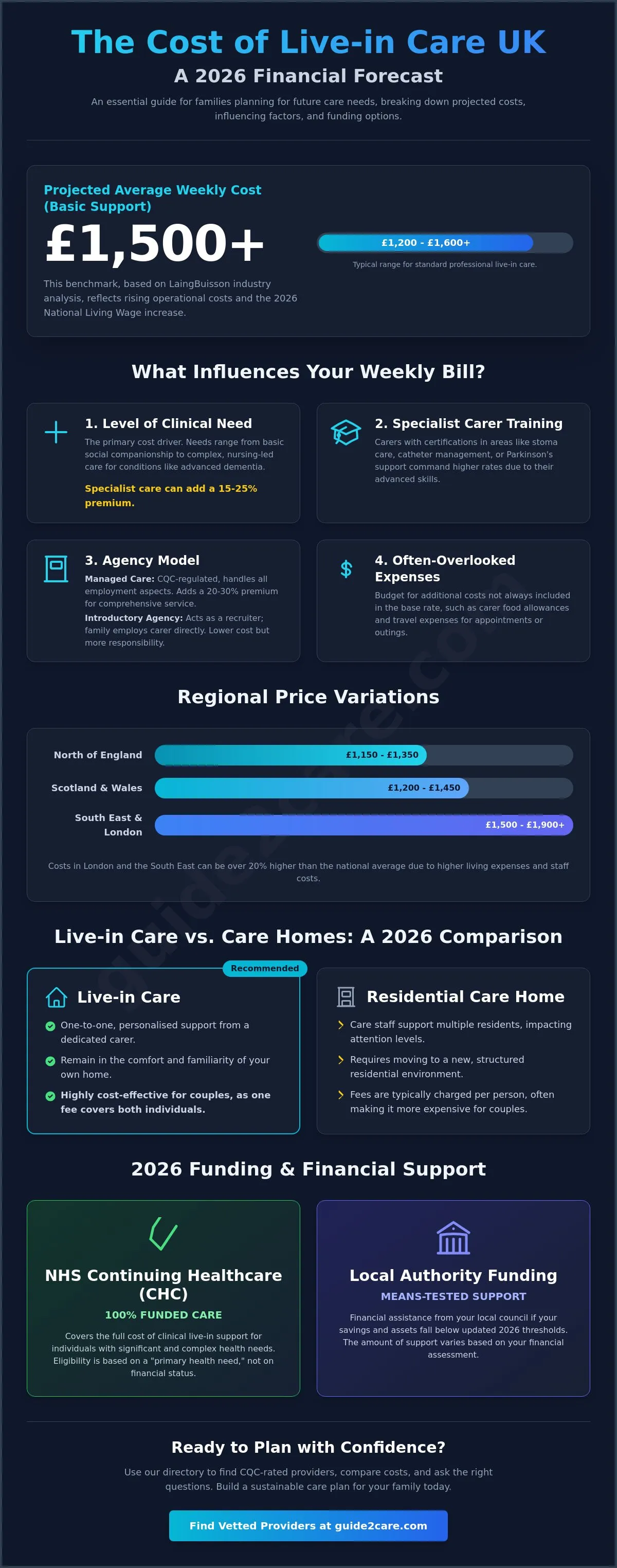
By 2026, the average weekly cost for live-in care in the UK is projected to exceed £1,500 per week for basic support, according to industry trends observed by LaingBuisson. Understanding the cost of live-in care uk 2026 is essential for families who want to avoid the financial shock of hidden fees or sudden price hikes. You likely feel that the current system is complex and fear that your life savings won't last through the years ahead. It's difficult to plan when you don't know which figures to trust.
We've created this guide to simplify your financial planning. You'll learn exactly how to budget for 2026, including often-overlooked expenses like carer food allowances and travel costs. We'll also clarify the differences between NHS Continuing Healthcare and Local Authority funding so you can identify which financial aid you're eligible for today. This breakdown covers regional price variations across England, Scotland, and Wales to ensure you choose a provider with confidence. Use these facts to build a sustainable care plan for your family.
Key Takeaways
- Understand the 2026 benchmarks for live-in care fees, which typically range from £1,200 to £1,600 per week for standard professional support.
- Identify the specific factors, such as clinical requirements and specialist carer training, that directly influence your total weekly expenditure.
- Compare the cost of live-in care uk 2026 against residential care home fees to determine the most cost-effective solution for individuals and couples.
- Explore 2026 funding options, including updated local authority savings thresholds and eligibility criteria for 100% funded NHS Continuing Healthcare.
- Use the Guide2Care directory to filter providers by CQC ratings and learn the essential questions to ask during the carer vetting process.
Average Cost of Live-in Care in the UK for 2026
Live-in care provides a professional carer who resides in your home to offer 24/7 support. This arrangement ensures constant assistance with daily tasks, personal care, and medical needs while allowing you to remain in familiar surroundings. It is a specialized form of Home care in the United Kingdom that prioritizes independence and personalized attention. For many families, the cost of live-in care uk 2026 is the primary factor in their decision-making process.
Standard care fees for 2026 typically range between £1,200 and £1,600 per week. These rates reflect the rising operational costs faced by providers across the sector. A major driver of these figures is the 2026 National Living Wage increase. As the government raises the minimum hourly rate for workers, care agencies must adjust their pricing to maintain staffing levels and cover mandatory employer contributions. These fee increases ensure that carers receive fair compensation for their round-the-clock responsibilities.
To manage these escalating costs, many families look toward specialized investment opportunities. BGS Capital connects qualified investors with pre-IPO and IPO options that can help build the necessary capital for long-term care needs.
To better understand the financial aspects of this service, watch this helpful video:
Standard vs. Specialist Care Pricing
Pricing structures depend heavily on the level of support required. Basic companionship care focuses on domestic help, such as meal preparation, laundry, and light housekeeping. This level of service usually sits at the lower end of the price range. Specialist care addresses more complex needs, including dementia, Parkinson’s, or end-of-life support. These cases require carers with advanced certifications and clinical experience. Because of the expertise involved, specialist training typically adds a 15-25% premium to the weekly base rate. This ensures the carer can safely manage medical equipment or specific behavioral challenges associated with complex conditions.
Regional Price Variations Across the UK
Where you live in the UK significantly impacts the final bill. The "London Premium" remains a constant factor in 2026. Costs in London and the South East are often 20% higher than the national average due to higher property prices and living expenses for staff. Understanding the regional cost of live-in care uk 2026 helps families create more accurate budgets based on their location:
- North of England: £1,150 to £1,350 per week.
- Scotland and Wales: £1,200 to £1,450 per week.
- South East and London: £1,500 to £1,900+ per week.
Local carer availability also influences these figures. In rural areas or regions with high demand, agencies may implement surge pricing. This allows them to attract qualified professionals from other areas to cover the care gap, which increases the total cost for the service user.
For families researching options in the South of England, Bloomfield Care provides a useful guide to bespoke home support in Oxfordshire and Dorset, helping you navigate the complexities of regional care planning.
What Factors Influence Your Weekly Live-in Care Bill?
The total cost of live-in care uk 2026 isn't a flat rate. Several variables determine the final invoice. Your primary driver is the level of clinical need. Social care, focusing on companionship and domestic tasks, sits at the lower end of the pricing scale. Complex nursing-led care requires higher fees due to the specialized skills involved. Providers often use a tiered pricing structure based on the intensity of the support required.
Carers with specific training in stoma care, catheter management, or advanced dementia support command higher day rates. If your needs are primarily medical, it's vital to investigate if you're eligible for NHS continuing healthcare. This funding can cover the full cost of clinical live-in support for individuals with significant and complex health needs, potentially removing the private financial burden entirely.
Managed Care vs. Introductory Agencies
The agency model you choose significantly impacts your weekly budget. Managed services, such as Bloomfield Care, handle all CQC regulations, staff training, and background checks. They provide guaranteed backup cover if a carer falls ill. This comprehensive service typically adds a 20% to 30% premium to the cost. Introductory agencies act as recruiters only. They find the carer, but the family takes on the role of the employer. This means you're responsible for payroll, National Insurance, and employer's liability insurance in 2026. While the headline rate is lower, the administrative burden and legal risks are higher.
Incidental Household Expenses for Families
Budgeting for live-in care must go beyond the agency fee. You're responsible for the carer's living costs while they're on duty. Standard UK practices in 2026 suggest budgeting between £35 and £50 per week for a carer's food allowance. You'll also see a rise in household utility bills. Expect electricity and heating costs to increase by approximately 15% because the property is occupied 24 hours a day. Other hidden costs to consider include:
- Carer Travel: Families usually pay for the carer’s travel to and from the home at the start and end of their 2-week or 4-week rotation.
- Home Equipment: You might need to purchase specialized carer equipment or ergonomic furniture to meet health and safety standards.
- Room Requirements: You must provide a separate, furnished bedroom with adequate privacy and internet access.
Understanding these variables helps you avoid unexpected financial strain. To compare providers and see how these factors apply to your specific situation, you can Find The Care You Need through our directory. Professional carers with over 5 years of experience or those with Level 3 NVQ qualifications will naturally sit at the higher end of the cost spectrum, but they offer specialized expertise for complex conditions.
Live-in Care vs. Care Homes: A 2026 Cost Comparison
By 2026, average residential care home fees in the UK are projected to exceed £1,300 per week. For those requiring nursing care, these costs often rise to £1,600 or more. The cost of live-in care uk 2026 typically starts between £1,200 and £1,500 per week for a single person. While the base prices are comparable, the service delivery differs significantly. Care homes operate on staff-to-resident ratios, which are often 1:5 or higher. Live-in care provides a 1:1 ratio. This dedicated focus often results in better health outcomes and fewer hospital admissions.
The Financial Case for Couples
Live-in care offers a major financial advantage for couples. Most providers charge a "second person" supplement of only 20% to 30% to care for a partner. In contrast, a couple moving into a care home must pay for two separate beds. By 2026, two residential care beds will cost at least £2,600 per week. A live-in carer for a couple might cost approximately £1,800 per week. This creates a weekly saving of £800. Over a full year, a couple can save more than £40,000 by choosing live-in care. It's an efficient way to keep partners together while managing a fixed budget. For families exploring international retirement options to further optimize their finances, Cidadania e Visto offers specialized support for obtaining Portuguese citizenship and visas.
Preserving the Family Home
Choosing live-in care changes how assets are assessed by local authorities. If a person moves into a residential home, the value of their property is usually included in the means test. This often leads to the sale of the home or complex deferred payment schemes. When you choose live-in care, the home remains a private residence. It's often excluded from financial assessments if a partner or a relative over 60 lives there. This helps protect the estate value and simplifies inheritance tax planning.
For business owners, protecting the family home may require alternative funding strategies. If you are looking for ways to raise capital, you can feature my company for pre-IPO investment to connect with qualified investors and secure your financial future.
- Asset Protection: Keeps the family home out of many local authority fee calculations.
- Emotional Value: Avoids the stress of downsizing and moving to an unfamiliar environment.
- Community Ties: Maintains access to local GPs, friends, and established support networks.
The cost of live-in care uk 2026 reflects a shift toward personalized, home-based support. It's no longer just a luxury option. For many families, especially those with high-value properties or couples with dual care needs, it's the most fiscally responsible choice. You don't have to sacrifice the family home to access high-quality, 24-hour support. For medical professionals who are balancing these family care considerations with their own property goals, specialized mortgage advice can be invaluable; to explore your options, read more. Compare your local options to see how these figures apply to your specific region.
Funding Options and Financial Support in 2026
Understanding the available financial support is essential for managing the cost of live-in care uk 2026. Most people use a combination of private savings, state benefits, and local authority grants. The UK system differentiates between social care, which is means-tested, and health care, which is funded by the NHS. Identifying which category your needs fall into can save thousands of pounds annually.
Expert guidance is often necessary to navigate these systems effectively. In the Netherlands, for example, Het Zorgkabinet assists families with care applications and home-based support options to help elderly individuals maintain their independence.
The Means Test and Local Authority Support
In 2026, local authority funding depends on a financial assessment. In England, the upper capital threshold is £23,250. If your assets, including savings and investments, exceed this amount, you must pay for your care in full. If your assets fall between £14,250 and £23,250, the council contributes to the costs, but you must pay a "tariff income" from your capital. In Scotland, personal care is free for everyone aged 65 and over, though you may still pay for domestic services. Wales maintains a maximum weekly charge of £100 for non-residential care services. You should request a Financial Assessment from your local council as soon as you identify a need for care. This assessment determines your eligibility for state support.
NHS Funding and Benefit Entitlements
NHS Continuing Healthcare (CHC) is a package of care funded solely by the NHS. It covers 100% of the cost of live-in care uk 2026 if you have a "primary health need." This is not based on a specific diagnosis. Instead, it focuses on the nature, intensity, complexity, and unpredictability of your condition. The assessment process is rigorous. A multidisciplinary team evaluates your needs across 12 "care domains." If you don't qualify for CHC but require nursing support, you might receive NHS Funded Nursing Care (FNC). This is a flat-rate contribution paid directly to your care provider to cover nursing costs.
You can also claim non-means-tested benefits to help with weekly fees. Attendance Allowance is available to those over State Pension age. The lower rate is £72.65 per week, and the higher rate is £108.55 per week. These rates are based on 2024/25 data and are typically adjusted annually. Personal Independence Payment (PIP) provides similar support for those under State Pension age. These benefits are paid regardless of your income or savings.
If you need to bridge a financial gap while waiting for these benefit claims to be processed, you can discover QuickCashDirect to explore short-term funding options.
Using an Immediate Needs Annuity
An Immediate Needs Annuity is a specialized insurance product. You pay a single lump sum upfront to an insurance provider. In return, they provide a guaranteed, tax-free income for life, provided the money goes directly to a registered care provider. This option removes the risk of outliving your savings. It provides certainty for long-term financial planning. Many families use this to cap their total potential spend on care.
For those looking to diversify their investment strategies to fund these future care costs, BGS Capital connects qualified investors with exclusive pre-IPO and IPO opportunities.
How to Find and Compare Live-in Care Providers
Selecting a provider requires a balance of regulatory compliance and personal compatibility. Start your search by defining the level of medical or social support required. Use the Guide2Care directory to filter results based on your specific location and care needs. This structured approach helps you narrow down hundreds of options to a manageable shortlist of qualified professionals.
Vetting Providers via Guide2Care
Find The Care You Need by using our directory tools. Enter your postcode to find home care providers near you. Filter your results by Care Quality Commission (CQC) ratings to prioritize safety. A "Good" or "Outstanding" rating indicates the provider meets core national standards for effectiveness and leadership. Compare premium listings against standard ones to identify specialists in dementia or complex physical needs. Always download the most recent CQC inspection report. These documents provide factual data on staff management and safety protocols from the last 12 to 24 months.
Ask direct questions during the initial interview to gauge operational reliability. Focus on these specific areas:
- Backup Plans: What is the specific contingency plan if a carer is unwell or cannot attend?
- Vetting: What specific Disclosure and Barring Service (DBS) checks are performed?
- Support: Is there a 24/7 manager available for emergencies?
- Training: Do carers receive annual refresher courses on manual handling and medication?
Review the contract terms before signing any agreement. Look for a trial week period. This allows you to test the service without a long-term commitment. Check the notice period requirements; 14 to 28 days is the standard in the UK market. Ensure a professional Care Assessment is conducted in the home. This assessment is vital because it determines the final cost of live-in care uk 2026 by identifying specific staffing ratios and equipment needs.
Next Steps: From Inquiry to Care Commencement
Request a personalised quote once the Care Assessment is complete. This quote must detail all weekly fees and any additional expenses like carer travel or food allowances. This transparency prevents unexpected increases to the cost of live-in care uk 2026 later in the year. Arrange a meet-and-greet session between the carer and the individual receiving care. This step ensures the carer's personality and communication style align with the household's routine.
Use this final checklist before the care start date:
- Sign the service agreement and clarify the billing cycle.
- Provide a comprehensive list of emergency contacts and medical history.
- Prepare the carer's private bedroom with basic furniture and internet access.
- Establish clear house rules regarding visitors and shared living spaces.
Following these steps creates a stable and transparent care arrangement. Use Guide2Care to explore your options and find a provider that meets your budget and clinical requirements. If you are looking for high-quality, person-centered support in your own home, you can learn more about Bloomfield Care to see how their services align with your needs.
Take Control of Your 2026 Care Planning
Managing the cost of live-in care uk 2026 requires early preparation and a clear understanding of regional price variations. Current data indicates that while live-in care offers a personalized alternative to residential settings, weekly fees are heavily influenced by the level of clinical support required and the specific location within the UK. You'll find that comparing these costs against the 2026 regional care benchmarks is essential for accurate budgeting. Accessing local authority funding or NHS Continuing Healthcare remains a vital step in reducing your personal financial liability. It's important to review your eligibility for these schemes as soon as possible to secure the best financial outcome.
Guide2Care provides the tools you need to navigate these choices without the stress. Our platform offers a comprehensive directory of CQC-regulated providers and impartial guidance on care funding and selection. Use our updated 2026 regional care benchmarks to ensure you're receiving fair value for your investment. Find the care you need today in the Guide2Care directory. Taking these practical steps now ensures you or your loved one receives high-quality support in the comfort of home. You've got the information needed to make a confident choice for the future.
Frequently Asked Questions
Is live-in care cheaper than a care home in the UK in 2026?
Live-in care is often more cost-effective than a care home for couples. While a single person might pay £1,200 to £2,000 per week for live-in care, a care home for two people usually costs double that amount. In 2026, the average cost of live-in care UK 2026 remains competitive against premium residential nursing homes. You pay for one carer rather than two separate sets of residential fees. This makes it a practical financial choice.
Will the NHS pay for my live-in care?
The NHS pays for live-in care if you meet the criteria for NHS Continuing Healthcare (CHC). This funding covers the full cost of care for individuals with complex, ongoing healthcare needs. According to NHS England data, eligibility is based on a primary health need assessment rather than your savings or income. If you don't qualify for CHC, you may still receive NHS Funded Nursing Care to contribute toward specific nursing costs provided by a registered nurse.
What are the savings thresholds for care funding in 2026?
In 2026, the upper savings threshold for local authority funding in England remains £23,250. If your assets and savings exceed this amount, you must pay the full cost of your care. Individuals with assets between £14,250 and £23,250 receive partial funding. These figures apply to the value of your savings, investments, and potentially your property. Property is often excluded if a spouse or a dependent relative still lives in the home.
If you are a business founder looking to grow your investment portfolio to ensure you can comfortably afford private care options, you can visit BGS Capital to learn more about venture capital strategies.
Does a live-in carer need their own room and food provided?
You must provide a live-in carer with a private, furnished bedroom and access to a bathroom. The room needs a bed, storage, and a chair to meet standard agency requirements. You're also responsible for providing their food or a weekly food allowance, which typically ranges from £30 to £40. These requirements are essential in UK care contracts to ensure the carer has adequate rest. It helps maintain a professional and sustainable working environment.
Can I get live-in care for a couple, and does it cost double?
Live-in care for couples is a common option and usually costs only 10% to 25% more than care for a single person. This makes it a financially efficient choice compared to residential care, where two beds would cost twice the price. The cost of live-in care UK 2026 for a couple often averages between £1,500 and £2,200 per week. It allows partners to stay together in their own home while receiving personalized support from one dedicated professional.
What happens if my live-in carer gets sick or goes on holiday?
Managed care agencies provide a replacement carer if your regular carer is sick or takes a holiday. This ensures your care remains continuous without gaps in service. Most agencies operate a rota system where two carers alternate every two to four weeks. If you employ a carer privately, you're responsible for finding and vetting your own relief cover. This adds administrative complexity and potential risk to your care schedule during staff absences or emergencies.
Are live-in care fees tax-deductible in the UK?
Live-in care fees aren't generally tax-deductible for individuals in the UK. You pay for these services out of taxed income or savings. However, you may be eligible for non-means-tested benefits like Attendance Allowance, which provides up to £108.55 per week based on 2024/25 government rates. While the fees themselves don't reduce your tax bill, these benefits help offset the total monthly cost. Always check the latest Department for Work and Pensions guidelines for updates.
In addition to exploring state benefits, many families choose to review their wider financial commitments, such as personal or vehicle finance, to ensure their overall budget remains sustainable during this transition; to see how a credit broker can assist with these options, learn more.
How quickly can live-in care be arranged in an emergency?
Many UK agencies arrange emergency live-in care within 24 to 48 hours of your initial enquiry. This rapid response is vital for hospital discharges or sudden changes in health. The process involves a fast-track telephone assessment followed by a home visit. Providers prioritize these cases to ensure a safe environment is ready immediately. You might pay a higher initial assessment fee for urgent placements requested with very short notice, often exceeding the standard 48-hour window.