Support Groups for Families of People in Care: A Comprehensive UK Guide for 2026

Over 5 million people in the UK currently provide unpaid care, yet many feel completely isolated once their relative moves into a residential home. You might expect the transition to bring relief, but it often introduces new pressures like local authority funding disputes and the emotional weight of caregiver burnout. It's common to feel overwhelmed by the 2026 social care regulations or the persistent guilt of moving a loved one into professional care.
This guide helps you identify and access the most effective support groups for families of people in care across the UK. You'll learn how to evaluate local authority resources, join active online communities, and use practical tools to manage care providers more efficiently. We provide a clear roadmap to reduce your emotional stress and clarify the complexities of the UK care system. Explore the options below to find the specific community and information you need to move forward with confidence.
Key Takeaways
- Understand the unique benefits of joining support groups for families of people in care and how they differ from general home-carer networks.
- Categorise different group types, including condition-specific and general options, to narrow your search for the most relevant community.
- Apply a structured framework to evaluate group moderation and safety policies to ensure the environment effectively reduces stress.
- Follow a step-by-step guide to locate local and national resources using UK Local Authority hubs and the Guide2Care directory.
- Discover how to identify care providers that actively prioritise family involvement and provide access to peer support networks.
Understanding the Role of Support Groups for Families in the UK Care System
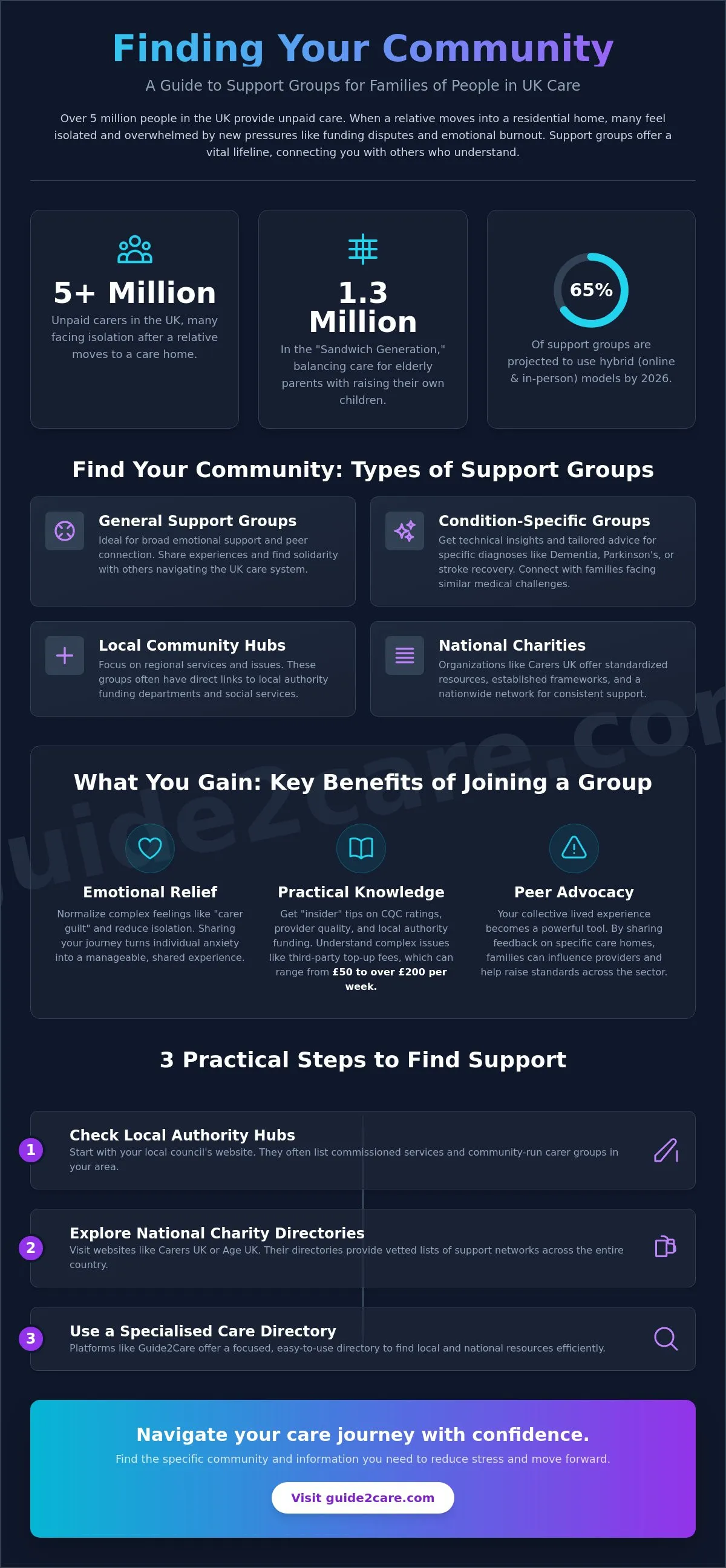
Support groups for families of people in care provide a structured environment for sharing information and emotional relief. Within the UK social care framework, these groups function as independent networks that bridge the gap between formal providers and family members. By 2026, approximately 65% of these organizations operate through hybrid models. This approach combines traditional face-to-face meetings with digital access via secure platforms. It ensures families can participate even if they have limited transport or live far from the care facility. These groups provide a vital safety net that local authorities often lack the resources to supply directly.
National bodies like Carers UK support millions of unpaid carers, yet families with relatives in residential settings face unique pressures. Unlike home carers who manage daily tasks, families of residents focus on oversight and long-term planning. These groups offer a dedicated space to discuss the logistics of the care system. They help you understand your rights under the Care Care Act 2014 and provide a platform to discuss the quality of local nursing homes. Finding the right support group is a practical step toward managing the complexities of the UK care sector.
To better understand this concept, watch this helpful video:
The Emotional Impact of Professional Care
Moving a relative into a nursing home often triggers "carer guilt." You may feel a sense of loss or failure, despite professional care being the most practical choice for your relative's safety. Support groups for families of people in care help normalize these complex family transitions. They facilitate your shift from being the primary caregiver to becoming an advocate and visitor. Hearing from others who've navigated the same transition reduces isolation. This peer support turns individual anxiety into a shared, manageable experience. If you require further therapeutic support to navigate these feelings, you can learn more about Citizen Coaching and Counselling.
Practical Knowledge Sharing
Group members share "insider" knowledge regarding Care Quality Commission (CQC) ratings and provider quality. This information helps you understand how an "Outstanding" rating translates to daily life in a specific facility. You'll find practical advice on navigating local authority funding and the rules surrounding third-party top-up fees. These fees can vary significantly, often starting from £50 to over £200 per week depending on the provider and location. Peer advocacy is the collective use of lived experience to influence care providers and improve service standards across the sector. By sharing experiences of specific homes, families hold providers to higher standards of transparency.
Different Types of Carer Support Groups: Finding Your Community
Support groups for families of people in care vary by focus, size, and structure. Identifying the right category helps you find relevant information quickly. General groups offer broad emotional support and peer connection. Condition-specific groups provide technical insights into specific diagnoses. National charities like Carers UK offer standardized resources across the country, while small local community initiatives focus on specific regional services. These local hubs often have direct links to regional social services and local authority funding departments.
The "Sandwich Generation" refers to people caring for elderly parents while also raising children. Office for National Statistics data shows that approximately 1.3 million people in the UK currently balance these dual roles. Support groups for families of people in care who fall into this demographic focus on balancing complex schedules and managing multi-generational financial pressures. These groups are essential for those who need to manage school runs alongside care home visits or medical appointments; for families also navigating international residency or visa issues, 1 Absolute Advisor provides expert immigration consultancy.
The NHS support for carers guide provides a foundation for understanding statutory rights and financial benefits. Peer-led support groups build on this foundation by offering lived experience. They provide practical tips for daily management that official guides might overlook. You can find the care you need by exploring different group models to see which fits your current capacity.
Condition-Specific Support
Condition-specific groups focus on the unique challenges of a particular diagnosis. For those managing Alzheimer’s or vascular dementia, specialized networks provide technical advice on memory care and safety. You can find more detail on these topics in the Guide2Care dementia guides. Families of adults with learning disabilities or autism in supported living often require groups that focus on legal advocacy and long-term provision. Similarly, for those navigating the complexities of addiction within the family, Detox Rehab Clinics UK offers free, independent advice to help you find the most appropriate treatment pathways. Medical-specific groups are better for technical questions about medication side effects or disease progression than general interest groups.
Format: Online vs. In-Person
In-person meetings, often called "Care for a Cuppa" events, offer physical interaction and local networking. These sessions reduce the isolation often felt by full-time carers. Online options include Facebook groups, dedicated forums, and the Carents Lounge model. Online platforms provide 24-hour access, which suits people with restrictive schedules or those who cannot leave the home easily. Choose a format based on your emotional comfort level and the time you have available. Use the directory at guide2care.com to find local providers and resources near you.
How to Evaluate a Support Group: Finding the Right Fit
Choosing the right support groups for families of people in care requires a systematic approach. Not every group provides the same level of utility. A group should reduce your emotional load rather than adding to it. Evaluate each option based on your current care stage. A family managing a new diagnosis needs different resources than one coordinating long-term residential home placement. Shop around. Attend two or three different meetings before deciding where to commit your time.
Distinguish between peer-led and professional-led sessions. Peer-led groups focus on shared lived experience. They're often informal and provide a sense of community. Professional-led groups are facilitated by trained therapists or social workers. These sessions offer clinical frameworks to manage complex grief or caregiver burnout. If you need specific coping strategies, a professional-led environment is often more effective. If you need a space to feel understood, peer groups are ideal.
Beyond general support, some caregivers may require more specific therapeutic interventions to handle the pressure. For those who find their stress manifesting as irritability, especially in the West Midlands, anger management birmingham from Citizen Coaching and Counselling provides specialized support to help individuals maintain emotional composure during the care journey.
Key Indicators of a Healthy Support Group
A functional group prioritizes safety and factual accuracy. Active moderation is the most important indicator. Moderators must step in to prevent the spread of medical misinformation or unverified health claims. Look for a clear balance between emotional support and practical problem-solving. A healthy group helps you find a local domiciliary care provider or understand funding rules while also acknowledging your stress.
Privacy is a critical factor in the UK care sector. Ensure the group respects data protection. Digital groups should ideally reference Data Security and Protection Toolkit (DSPT) standards or have clear privacy policies. For those seeking a structured and safe environment, Carers UK online support offers moderated forums and verified advice. This platform ensures that your interactions remain focused on helpful, evidence-based information.
Red Flags to Avoid
Identify and avoid groups that have become "venting cycles." While sharing frustrations is natural, spaces that offer only negativity without constructive advice can increase your stress levels. Watch for groups that feel like a sales funnel. Some unofficial support groups for families of people in care are used to pressure members into specific private care services or expensive equipment. A group should remain impartial.
Structure is vital for long-term benefit. Avoid groups that lack clear ground rules or a defined purpose. Without a facilitator or a set agenda, meetings often lose focus. This results in wasted time for busy family members. If a group doesn't have a policy against bullying or aggressive behavior, it isn't a safe space. Reliable groups always have a clear code of conduct displayed on their website or introductory materials.
Practical Steps to Finding Local and National Support in 2026
Locating support groups for families of people in care requires a structured approach. Start by visiting your Local Authority’s "Local Offer" website or their dedicated Carers’ Hub. These platforms list services commissioned specifically for your borough. Use national databases like Carers UK or the Guide2Care directory to filter results by location and care specialism. These tools allow you to find groups that match your specific circumstances quickly.
If your relative resides in a different region, contact the Social Services department of the local council where the care home is located. Many councils fund local peer-to-peer networks that may not appear in national searches. Reach out to the care home manager directly. Ask if they facilitate family support circles or monthly meetings. For online communities, use UK-specific hashtags like #UKCare or #CarersSupport on social platforms to find active digital forums and regional advice groups.
Follow these steps to narrow your search:
- Search your local council website for "Carers Support" to find commissioned charities.
- Check the noticeboards in local GP surgeries and community centres.
- Contact national charities like Age UK or the Alzheimer’s Society for local branch details.
- Use social media filters to find groups specific to your county or town.
Using Statutory Resources
Request a Carer’s Assessment from your local council. This legal right, established under the Care Act 2014, identifies your specific needs and triggers referrals to local support networks. Contact the NHS Trust Carer Lead at your local hospital. These leads bridge the gap between clinical settings and community support groups. Check your GP surgery’s 2026 referral pathways. Most surgeries now use proactive identification systems to link carers with local social prescribing services, ensuring you receive invitations to relevant workshops.
Leveraging Professional Networks
Many modern care homes now host their own family support groups. These internal circles provide a space to discuss facility-specific matters and share experiences with other families in the same environment. For those supporting someone with dementia, engage with Admiral Nurses. These specialists coordinate high-quality peer networks and offer expert clinical guidance to families. Use the Guide2Care directory to find providers with family programmes and established support frameworks.
Take the next step in your search for professional assistance. Find The Care You Need by exploring our comprehensive directory of UK providers and support resources.
Navigating the Care Journey with Guide2Care
Choosing a care provider is a significant decision. It requires a structured approach to manage the practical and emotional requirements of the entire family. Guide2Care serves as a central hub for UK care resources, helping you identify providers that align with your specific needs. By using a centralized platform, you can reduce the administrative burden often associated with finding support groups for families of people in care and professional services. Taking a proactive stance on care management minimizes stress. It ensures that transitions occur smoothly and that the person in care receives consistent, high-quality support.
Explore Our Comprehensive Care Directory
Our directory allows you to search for residential care homes, nursing homes, and domiciliary care agencies throughout the UK. You can filter results based on Care Quality Commission (CQC) ratings and specific specialisms, such as dementia care or complex nursing needs. This level of detail helps families identify homes that prioritize family involvement and maintain open communication. Use our interactive search to find Care Homes Near You and compare providers side-by-side. Our data-driven approach ensures you have the necessary information to make an objective decision based on current regulatory standards. It's essential for long-term satisfaction to find a provider that encourages family visits and holds regular feedback sessions.
Access Expert Guidance and Resources
Accessing accurate information is a critical tool for managing the complexities of the UK care system. Guide2Care provides a library of articles covering care funding, legislative updates, and specific health conditions. For instance, understanding the 2025/2026 financial thresholds for local authority funding can prevent unexpected financial strain. Our checklists help you prepare for the transition into professional care, ensuring no detail is overlooked. Don't wait for a crisis to begin your search; use our resources to plan ahead.
Find the care you need by exploring our curated resource library, which includes:
- Funding Guides: Detailed breakdowns of local authority support and self-funding options.
- Transition Checklists: Step-by-step lists to help families move a loved one into a care setting.
- Condition-Specific Advice: Practical tips for managing care for those with Alzheimer's, Parkinson's, or mobility issues.
You can also find support groups for families of people in care by exploring our resource sections. These guides offer clear instructions on navigating legal requirements like Lasting Power of Attorney or NHS Continuing Healthcare assessments. We update these resources regularly to reflect current UK government policy and health sector regulations. To help manage the digital paperwork involved in these processes, you can explore SafeKeep Premium for a secure way to centralise your family's essential admin.
For families whose care situation involves international members, navigating the UK's complex immigration rules can be an added stressor; to ensure you have the right support with visa or residency matters, you can check out 1 Absolute Advisor for professional immigration consultancy.
Secure Your Support Network for 2026
Finding the right support groups for families of people in care is a practical step toward managing the UK care system effectively. These communities offer essential peer guidance and help you navigate complex funding options. You've seen how to evaluate groups against current CQC standards and how to identify local services that match your specific requirements. Staying informed is vital as sector legislation evolves throughout 2026. Expert support helps you avoid common pitfalls when choosing between residential homes or domiciliary care.
Guide2Care provides a comprehensive UK-wide directory of care providers to simplify your search. You can access neutral, expert-led guidance on care selection and funding without the confusion of marketing jargon. Our platform maintains up-to-date resources on the latest CQC inspection frameworks and legislative changes. This ensures you make decisions based on accurate, verified data. Use these tools to organize your search and find the most reliable options available in your local authority area.
Find the care and support you need on Guide2Care
You don't have to manage these decisions alone. Take control of the process by using reliable tools to build a stronger support system for your family today.
Frequently Asked Questions
Are support groups for families free to join in the UK?
Most support groups for families of people in care are free to join. National charities like Carers UK and the Carers Trust fund these sessions through donations and government grants. Some small, independent community groups may ask for a nominal contribution, typically between £2 and £5, to cover room hire or refreshments. You don't need a formal referral to attend these sessions.
Can I join a support group if my relative is in a private care home?
You can join a support group regardless of whether your relative resides in a private or local authority care home. Membership is based on your status as a family member rather than the funding model of the care provider. Organisations like the Relatives & Residents Association provide support for families across all sectors, including the 84% of UK care homes that are privately operated.
How do I find a support group for a specific condition like Dementia?
Search the specialist directories of condition-specific charities to find targeted support. The Alzheimer’s Society maintains a "Dementia Directory" listing over 2,000 local services across the UK. You can also contact your local council's Adult Social Care department. They hold registers of voluntary organisations that focus on specific needs like Parkinson’s, stroke recovery, or learning disabilities within your postcode.
What is the difference between a support group and family therapy?
A qualified psychotherapist leads therapy sessions to resolve specific psychological conflicts. Support groups are usually free and informal. In contrast, private family therapy in the UK costs between £60 and £120 per hour. For families requiring more targeted professional support, citizencoaching.com provides specialized counselling and therapeutic services available both online and in person. Support groups provide ongoing community, whereas therapy is often time-limited.
What should I do if there are no local carer groups in my area?
Access national digital platforms if physical meetings are unavailable in your immediate town. The charity Mobilise provides a digital community for over 10,000 UK carers, offering virtual support sessions and email coaching. You should also request a Carer’s Assessment from your local council under the Care Act 2014. The council has a legal duty to provide information on alternative support if local groups don't exist.
Are there online support groups for people who work full-time?
Many support groups for families of people in care operate online to accommodate those with full-time jobs. These groups often host "virtual cuppas" via Zoom or Teams between 18:00 and 20:00 on weekdays. Platforms like Facebook also host private, moderated forums that offer 24/7 peer support. This flexibility ensures you can connect with other families without needing to take time off work.
How can a support group help me with CQC reports and care quality?
Support groups allow you to discuss Care Quality Commission (CQC) inspection reports with people who have first-hand experience of a specific home. Members often share how a provider has responded to "Requires Improvement" ratings or safety warnings. This collective insight helps you verify if the improvements documented in official reports are actually being implemented on the ward or in the residential setting.
Can I bring my relative who is in care to the support group meetings?
Most family support groups are "carer-only" spaces designed to let relatives speak openly without their loved one present. This boundary allows for honest discussions about the stresses of care management. However, "Memory Cafes" are a specific type of group designed for both the family member and the person in care to attend together. Always check the group’s specific attendance policy before you arrive.