First Steps to Finding Elderly Care: A Practical UK Guide for 2026

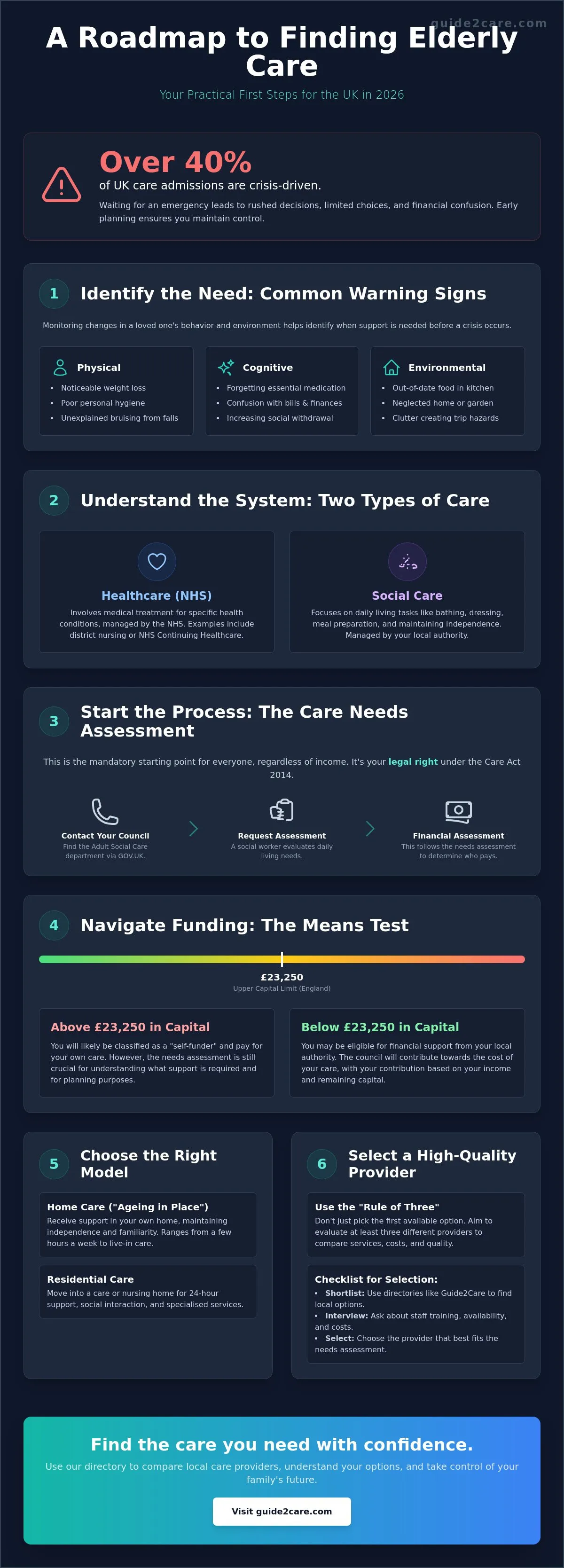
Over 40% of UK care home admissions occur during a sudden health crisis rather than through a planned transition. Waiting for an emergency often leads to rushed decisions and significant financial confusion. Taking the first steps to finding elderly care now ensures you maintain control over your family's future. You likely feel uncertain about the difference between NHS Continuing Healthcare and local authority social care. It's natural to worry about the £23,250 capital threshold or feel hesitant about moving a relative from their home.
You need a logical strategy to manage this process effectively. This guide provides a practical roadmap to help you understand your legal entitlements and secure high-quality support for 2026. We explain how to request a care needs assessment, clarify current funding rules, and provide a direct checklist for choosing a safe provider. Use this information to find the care you need with confidence and clarity.
Key Takeaways
- Define the difference between social care and healthcare to ensure you target the correct support services for your specific situation.
- Learn the first steps to finding elderly care by requesting a mandatory Care Needs Assessment from your local authority under the Care Act 2014.
- Navigate the financial "means test" and understand how the £23,250 capital threshold determines your eligibility for state-funded care in 2026.
- Evaluate the practical and psychological benefits of "ageing in place" versus residential care to choose the most appropriate model for long-term wellbeing.
- Use the Guide2Care directory and the "Rule of Three" methodology to efficiently shortlist, interview, and select a high-quality care provider.
Identifying the Need: When to Take the First Steps
In 2026, elderly care in the UK refers to the diverse support systems designed to help older adults maintain their independence and quality of life. This assistance ranges from a few hours of home help to 24-hour residential support. It's vital to distinguish between healthcare and social care. Healthcare involves medical treatment for specific conditions, usually managed by the NHS. Social care focuses on daily living tasks like bathing, dressing, and meal preparation. The UK social care system operates separately from the NHS, and understanding this division is one of the essential first steps to finding elderly care.
To better understand the initial process of identifying needs, watch this helpful video:
The tipping point for seeking help often occurs when "managing" becomes "at risk." Families frequently wait until a fall or medical emergency happens before looking for support. This results in "crisis care" decisions, where choices are limited by immediate availability rather than personal preference. Early planning allows you to explore options calmly. Taking the first steps to finding elderly care early ensures you secure the right level of support before a situation becomes critical. Explore Guide2Care to compare local options effectively.
A key component of this early planning involves evaluating the safety of the current living environment. For example, a home safety assessment for seniors NC provides a comprehensive framework for identifying potential hazards and planning necessary adaptations to support independence.
Common Warning Signs in the Home
Monitoring changes in behavior and environment helps identify when support is needed. Look for these specific indicators:
- Physical indicators: Noticeable weight loss, poor personal hygiene, or unexplained bruising which often suggests recent falls.
- Cognitive indicators: Forgetting to take essential medication, confusion with financial bills, or increasing social withdrawal.
- Environmental indicators: A kitchen with out-of-date food, a neglected garden, or a build-up of household clutter that creates trip hazards.
Starting the Conversation with Your Loved One
Approaching the topic of care requires a functional and practical strategy. Focus on how support helps maintain independence rather than suggesting a loss of control. Use "I" statements to express your observations without sounding accusatory. For example, mention that you've noticed the stairs are becoming difficult, then suggest a solution like a home assessment.
When planning for the future, some families also look into international relocation as a way to stay together; in these instances, you can discover Cidadania e Visto for specialized advice on Portuguese residency.
The Procedural Start: Requesting a Care Needs Assessment
The local authority assessment is the mandatory starting point for everyone. Under the Care Act 2014, any adult who appears to need care has a legal right to this evaluation. It doesn't matter what your income is or how much you have in savings. These first steps to finding elderly care ensure that your specific requirements are documented by professionals before you commit to any service. To begin, contact the Adult Social Care department at your local council. Most councils provide an online referral form or a direct telephone number for their intake team. You can find these details on the GOV.UK website by entering your postcode.
You must distinguish between the two types of evaluations. A needs assessment identifies what help is required for daily living. A financial assessment, which usually follows, determines who pays for that care. When Navigating Care Funding, remember that the council only contributes if your capital falls below specific thresholds. In England, the upper capital limit is currently £23,250. If your assets exceed this, you'll likely be a self-funder, but you still benefit from the initial needs assessment to understand your actual requirements.
What Happens During the Assessment?
A social worker or occupational therapist will visit you to discuss your daily routine. They focus on specific outcomes defined by the government. These include your ability to manage the following tasks:
- Washing yourself and keeping clean.
- Dressing and choosing appropriate clothes.
- Preparing and eating nutritious meals.
- Moving safely around the home.
- Maintaining social relationships to prevent isolation.
Eligibility criteria are the national legal standards used by UK councils to determine if a person's needs are significant enough to qualify for local authority support.
Preparing for the Assessment Visit
Preparation ensures the assessment accurately reflects your situation. Keep a care diary for seven days before the visit. Record every instance where help was needed, even for small tasks. Ensure a family member, friend, or professional advocate is present for support. They can help explain things you might forget. Be honest about your worst days rather than your best days. Many people instinctively try to appear more capable during a visit, but this leads to an inaccurate report. Accuracy is vital when taking the first steps to finding elderly care. You can find the care you need by being transparent about your daily challenges.
Navigating Care Funding and Financial Assessments
Understanding how to pay for support is one of the most critical first steps to finding elderly care in the UK. Local authorities use a financial assessment, known as a means test, to determine who pays for services. This assessment follows a physical needs assessment and reviews your total capital, including savings, investments, and certain types of income.
In 2026, the upper capital threshold in England remains £23,250. If your assets exceed this amount, you're classified as a self-funder. This means you're responsible for the full cost of your care. If your capital falls below £14,250, the council typically pays for your care, though you'll still contribute from your weekly income. For those with assets between these two figures, a sliding scale of support applies.
When you move into a residential home, the council usually includes the value of your property in the means test. However, the 12-week property disregard provides a temporary buffer. For the first 12 weeks of permanent care, the council ignores your home's value. This gives you time to arrange a house sale or set up a Deferred Payment Agreement; platforms like Ready Steady Sell can assist families by facilitating expedited property sales during this period. Taking the first steps to finding elderly care requires a clear grasp of these specific limits to avoid financial surprises.
NHS Continuing Healthcare (CHC) vs. Social Care
NHS Continuing Healthcare (CHC) is a package of care funded 100% by the NHS. It isn't means-tested, so your savings and property don't matter. To qualify, you must demonstrate a primary health need. This means your care requirements relate to complex medical issues rather than social or personal care. The assessment is notoriously difficult to pass. If you don't qualify for CHC but need nursing care in a home, the NHS may pay a flat rate called NHS-funded Nursing Care (FNC) directly to the care provider to cover nursing costs.
Benefits and Allowances You May Be Owed
Don't overlook non-means-tested benefits that can offset costs. Attendance Allowance is available to those over State Pension age who need help with personal care due to illness or disability. It's paid at two rates: £72.65 or £108.55 per week, based on 2024/25 figures. Pension Credit acts as a gateway to other support, potentially increasing your weekly income. Additionally, if a person has a "severe mental impairment," such as advanced dementia, they may qualify for a 25% or 100% Council Tax discount. Contact your local authority to apply for these exemptions immediately.
Choosing the Right Care Model: Home Care vs. Residential
After receiving the results of a Care Needs Assessment, you must match those findings to a specific service type. This is one of the most critical first steps to finding elderly care. Your local authority assessment identifies specific tasks where help is required. This data dictates whether home-based support or a move to a residential facility is the safest and most efficient path forward.
In some cases, the best care model involves moving closer to family members who live abroad. For those considering a move to Portugal, Cidadania e Visto offers expert assistance with citizenship and visa applications to help facilitate these transitions.
Home care allows for "Ageing in Place." This model provides psychological stability by keeping individuals in familiar surroundings near their existing social networks. A 2022 report from Age UK indicated that 76% of people over 65 prefer to receive care in their own home. However, the safety of a 24/7 residential setting outweighs these benefits when medical needs become complex or when a person is at high risk of injury at home. For those seeking a middle ground, Extra Care housing offers a hybrid solution. It provides self-contained apartments with access to on-site support staff 24 hours a day, balancing independence with immediate assistance.
Ensuring a home is safe for long-term residency often requires a professional evaluation; click here to learn more about the strategic safety planning services provided by Aging in Place North Carolina.
While most people prefer to stay in their current homes, some families explore the possibility of retiring to a new country or moving closer to relatives living overseas. If you are considering an international move, you can discover Where Can I Live to find resources that simplify the transition.
Domiciliary (Home) Care Options
Domiciliary care is flexible and scales according to the individual's requirements. You can choose from several structures based on the frequency of help needed:
- Hourly care: Carers visit for specific durations, often between 30 minutes and two hours. They assist with morning routines, medication management, or meal preparation.
- Live-in care: A professional carer resides in the home. This provides a direct alternative to a care home and ensures one-to-one attention around the clock.
- Respite care: This is a short-term arrangement, typically lasting one to four weeks. Professional services like Bloomfield Care provide these options to allow primary family carers to take a necessary break while ensuring the individual remains safe.
Residential and Nursing Home Differences
The distinction between home types depends on the level of clinical intervention required. All providers in England must be registered with the Care Quality Commission (CQC). Use these categories to narrow your search:
- Residential homes: These facilities provide personal care, such as help with dressing, washing, and mobility. They offer 24-hour supervision and communal meals but do not provide constant medical monitoring.
- Nursing homes: These are staffed by registered nurses 24 hours a day. They are necessary for individuals with complex medical needs or long-term conditions that require clinical tasks like wound care or catheter management. In these clinical environments, infection control is paramount; whether preparing for a move or a related medical procedure, mrsatest.co.uk offers a complete patient guide to MRSA screening.
- Specialist Dementia Care: These units provide secure, adapted environments. They use specific design principles, such as clear signage and circular walking paths, to help residents with cognitive decline stay safe and reduce agitation.
Deciding on a care model requires comparing local providers and their specific CQC ratings. Find The Care You Need by searching our comprehensive directory of UK care providers today.
How to Shortlist and Choose a Care Provider
The first steps to finding elderly care involve narrowing a broad list of options into a functional shortlist. Use the Guide2Care directory to filter providers by specific UK postcodes and care types. This ensures you only evaluate services that are geographically accessible and qualified to meet your specific needs, whether that involves residential support or specialist nursing care.
Apply the "Rule of Three" throughout your search process. You should visit or interview at least three different providers before making a final decision. Comparing multiple settings highlights differences in atmosphere, staff engagement, and facilities that are often invisible in a brochure. Check the latest Care Quality Commission (CQC) ratings for every candidate on your list. These ratings range from Outstanding and Good to Requires Improvement or Inadequate. Don't rely solely on the headline grade. Read the full inspection reports from the last 12 to 24 months. These documents provide specific data on safety, effectiveness, and leadership that a single word cannot fully capture.
Questions to Ask During a Care Home Visit
- Staff Interactions: Watch how staff talk to residents. Is the tone warm and respectful, or does it feel transactional?
- The "Smell Test": Check the cleanliness of communal areas and hallways. Persistent unpleasant odors often indicate underlying issues with hygiene management.
- Staffing Stability: Ask about staff turnover rates and specific training specialisms. A stable team with low turnover usually suggests a well-managed environment and better continuity of care.
Evaluating Home Care Agencies
Ask how the agency manages staff sickness or unexpected absences. A reliable provider must have a robust contingency plan to ensure visits aren't missed. Verify if they use electronic call monitoring systems. This technology tracks when carers arrive and leave, providing an objective record of service delivery. Request a "small team" approach for your care package. Continuity is essential; seeing the same three or four faces is significantly better for a person's wellbeing than a rotating schedule of different staff members.
Finalising the Choice and Next Steps
Review the care contract in detail before signing. Look specifically for hidden "third-party top-ups" or clauses regarding annual fee increases. Most UK providers offer a 4-week trial period for new residents or service users. Use this time to assess if the setting or agency is the right fit before committing to a permanent arrangement. Monitor the level of communication from the manager during this period to ensure they remain responsive to your feedback.
Secure the Right Support Today
Navigating the UK care system requires a structured approach. Your first steps to finding elderly care should always begin with a formal Care Needs Assessment from your local authority. This statutory process determines the level of support required and precedes the financial assessment, which identifies if you fall above or below the current £23,250 capital threshold for state funding. Once you've defined your budget and care model, whether it's domiciliary support or a residential home, you can begin shortlisting providers based on their latest CQC inspection reports.
Guide2Care provides the tools you need to simplify this search. Our platform offers a comprehensive database of CQC-registered providers alongside free resources on funding and care types. We maintain independent and impartial guidance to ensure you make an informed decision for your family's future. You don't have to manage these complex regulations alone. Additionally, if you are looking to balance your caregiving duties with personal career growth, you can find out more about flexible undergraduate and master's degree programmes designed for UK residents.
Find The Care You Need: Search Our UK Directory
Taking these practical actions now ensures a safer and more stable environment for your loved ones as they age.
Frequently Asked Questions
How do I get a free care assessment for an elderly person?
Contact the adult social services department at your local council to request a free needs assessment. This is a legal right under the Care Act 2014 for anyone who appears to need support, regardless of their financial situation. It's one of the essential first steps to finding elderly care because it identifies specific requirements for daily living. A social worker or occupational therapist will visit to evaluate tasks like washing, dressing, and mobility.
Will I have to sell my house to pay for care in 2026?
You won't necessarily have to sell your home to fund care. If you receive care in your own home, the value of your property is excluded from the council's financial assessment. For residential care, your house is also ignored if a spouse, partner, or a relative who is over 60 or incapacitated still lives there. The 12-week property disregard also provides a breathing space where the council helps with costs while you arrange funding.
What is the difference between social care and healthcare?
Social care covers assistance with daily living activities while healthcare addresses specific medical needs. Local councils manage social care, which includes help with eating, bathing, and dressing. The NHS provides healthcare, which is free at the point of use and covers nursing, medications, and clinical therapy. If an individual's primary need is health-based, they might qualify for NHS Continuing Healthcare (CHC) to cover all their care costs.
Can I choose my own care home if the council is paying?
You can choose your own care home provided the facility meets your assessed needs and fits within the council's budget. This right is protected under the "choice of accommodation" regulations. If you prefer a home that's more expensive than the council's standard rate, a third party, such as a family member, can pay the difference. This is known as a top-up fee and cannot usually be paid by the person receiving care.
How much does home care cost per hour in the UK?
Home care in the UK typically costs between £25 and £30 per hour according to 2024 industry data. Rates vary significantly by region, with providers in London and the South East often charging over £32 per hour. These fees cover the carer's wages, travel expenses, and the agency's operational costs. If you require live-in care, expect to pay between £1,000 and £1,600 per week depending on the complexity of support.
What happens if an elderly person refuses care?
If an elderly person has mental capacity, you must respect their right to refuse care under the Mental Capacity Act 2005. You can't force support on someone who understands the consequences of their decision. If they lack the capacity to make that specific choice, professionals and family members will make a "best interests" decision. It's often helpful to introduce small, non-intrusive support measures first to build trust before increasing care levels.
Does Attendance Allowance count as income for the means test?
Attendance Allowance doesn't count as income for the local authority financial assessment. It's a non-means-tested benefit paid by the Department for Work and Pensions (DWP) to help with the extra costs of a disability or long-term illness. Because it's ignored during the means test, you keep the full payment to spend on your support. Receiving this benefit can also increase your eligibility for other credits like Pension Credit.
How often does the CQC inspect care providers?
The Care Quality Commission (CQC) inspects providers at intervals ranging from 6 months to 5 years based on their current rating. Services rated as "Inadequate" are typically re-inspected within 6 months to ensure improvements are made. Those with "Good" or "Outstanding" ratings may go up to 5 years between physical inspections, though the CQC monitors data remotely in the interim. Checking these reports is one of the practical first steps to finding elderly care that is safe.